Gravity is one of the most familiar forces in everyday life. It keeps our feet on the ground, governs planetary motion, and shapes the structure of the universe. But behind this familiar force lies a powerful concept in physics: gravitational fields and gravitational potential energy.
Understanding how gravitational fields work — and how they store energy — is essential for studying mechanics, astronomy, engineering, and space science.
What Is a Gravitational Field?
A gravitational field is the region of space around a mass where another mass experiences a gravitational force.
In simple terms:
- Every object with mass creates a gravitational field.
- The more massive the object, the stronger the field.
- The field extends outward in all directions.
For example:
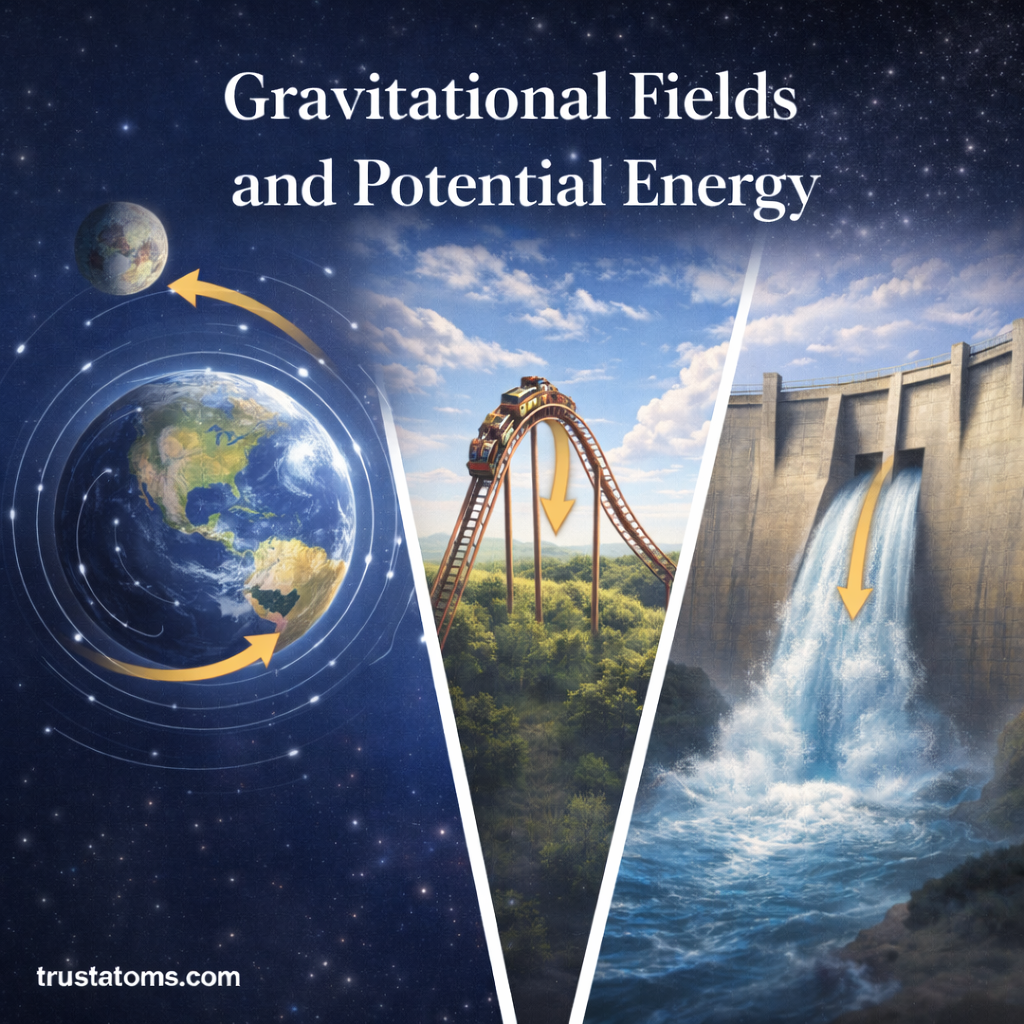
- Earth creates a gravitational field that pulls objects toward its center.
- The Sun creates a gravitational field that keeps planets in orbit.
Gravitational fields explain how objects interact without physically touching each other.
Gravitational Field Strength
Gravitational field strength describes how strong the gravitational force is at a specific location.
Key ideas:
- It depends on the mass creating the field.
- It decreases with increasing distance.
- It is strongest near massive objects.
Near Earth’s surface:
- The gravitational field is nearly uniform.
- Objects accelerate downward at a consistent rate.
- This is why falling objects behave predictably.
As you move farther away from Earth, the gravitational field becomes weaker.
What Is Gravitational Potential Energy?
Gravitational potential energy (GPE) is energy stored due to an object’s position within a gravitational field.
When you lift an object:
- You do work against gravity.
- That work becomes stored energy.
- The higher the object, the greater its potential energy.
Examples include:
- A book on a shelf
- A roller coaster at the top of a hill
- Water stored behind a dam
This stored energy can later convert into motion.
Gravitational Potential Energy Near Earth’s Surface
Close to Earth, gravitational potential energy depends mainly on height.
Important factors:
- The object’s mass
- The height above the reference point
- The strength of the gravitational field
If height increases:
- Gravitational potential energy increases.
If mass increases:
- Gravitational potential energy increases proportionally.
This relationship explains why heavier objects require more effort to lift.
Energy Conversion: Potential to Kinetic

When an object falls:
- Gravitational potential energy decreases.
- Kinetic energy increases.
- Total mechanical energy remains constant (if air resistance is ignored).
For example:
- A ball dropped from a height speeds up as it falls.
- At the top, it has maximum potential energy.
- Just before impact, it has maximum kinetic energy.
This illustrates conservation of mechanical energy.
Gravitational Fields in Space
In space, gravitational fields behave differently than near Earth’s surface.
Key differences:
- The field strength decreases with distance.
- Orbits result from gravitational attraction.
- Objects continuously fall toward massive bodies but move sideways fast enough to stay in orbit.
Planets orbit the Sun because:
- The Sun’s gravitational field pulls inward.
- The planet’s motion carries it forward.
- The balance creates orbital motion.
This dynamic interaction governs solar systems and galaxies.
Gravitational Potential Energy in Orbital Systems
In space, gravitational potential energy depends on:
- The masses involved
- The distance between them
As distance increases:
- Gravitational potential energy changes.
- The gravitational force weakens.
For satellites:
- Moving to higher orbit requires added energy.
- Lower orbits correspond to stronger gravitational interaction.
Understanding this is essential in aerospace engineering.
Field Lines and Visualization
Gravitational fields can be visualized using field lines.
Field lines:
- Point toward the mass.
- Show the direction of gravitational force.
- Become closer together where the field is stronger.
Near Earth:
- Field lines are nearly parallel.
- This indicates a nearly uniform field.
Near massive objects like stars:
- Field lines curve inward more sharply.
- This indicates stronger gravitational influence.
Work Done by Gravity
Gravity does work whenever an object moves within its field.
If an object moves downward:
- Gravity does positive work.
- Kinetic energy increases.
If an object moves upward:
- Work is done against gravity.
- Potential energy increases.
This connection links gravitational fields directly to the work–energy principle.
Real-World Applications
Gravitational fields and potential energy are critical in:
- Hydroelectric power systems
- Roller coaster design
- Spacecraft launch and orbit
- Structural engineering
- Planetary motion modeling
Engineers and scientists use gravitational principles to:
- Predict object motion
- Calculate launch requirements
- Design stable structures
- Model celestial systems
Common Misconceptions
Students often assume:
- Gravity only exists near Earth.
- Heavier objects fall faster.
- Potential energy depends only on height.
Important clarifications:
- Gravity exists everywhere mass exists.
- In a vacuum, all objects fall at the same rate.
- Gravitational potential energy depends on both mass and position.
Understanding these distinctions prevents confusion.
Why Gravitational Fields Matter
The concept of gravitational fields allows physicists to:
- Describe interactions at a distance.
- Predict planetary motion.
- Understand energy transfer in mechanical systems.
- Model cosmic structures.
Without gravitational field theory, modern astronomy and space exploration would not be possible.
Key Takeaways
- Every mass creates a gravitational field.
- Gravitational field strength decreases with distance.
- Gravitational potential energy depends on position in the field.
- Energy converts between potential and kinetic during motion.
- Orbital motion is governed by gravitational interaction.
- Gravitational fields shape the structure of the universe.
Final Thoughts
Gravitational fields and potential energy reveal how mass, motion, and energy interact on both everyday and cosmic scales. From lifting a book to launching a satellite, gravitational principles guide motion and energy transfer throughout the universe.
By understanding gravitational fields, we gain insight into how objects move, how energy is stored, and how the cosmos itself is structured.