Waves are everywhere — in ocean tides, sound vibrations, light from the Sun, and even electrical signals. But one of the most important concepts in understanding waves is phase.
Phase relationships in wave motion determine how waves combine, interfere, amplify, or cancel each other. Whether you’re studying sound engineering, optics, or quantum physics, understanding phase is essential.
In this guide, we’ll explore what phase means, how phase differences arise, and why they matter in real-world systems.
What Is Phase in Wave Motion?
Phase describes the position of a point within a wave cycle at a given time.
Imagine a repeating wave:
- It rises to a crest.
- Falls to a trough.
- Returns to equilibrium.
- Repeats the pattern.
Each point in that cycle corresponds to a specific phase.
Two waves are said to be:
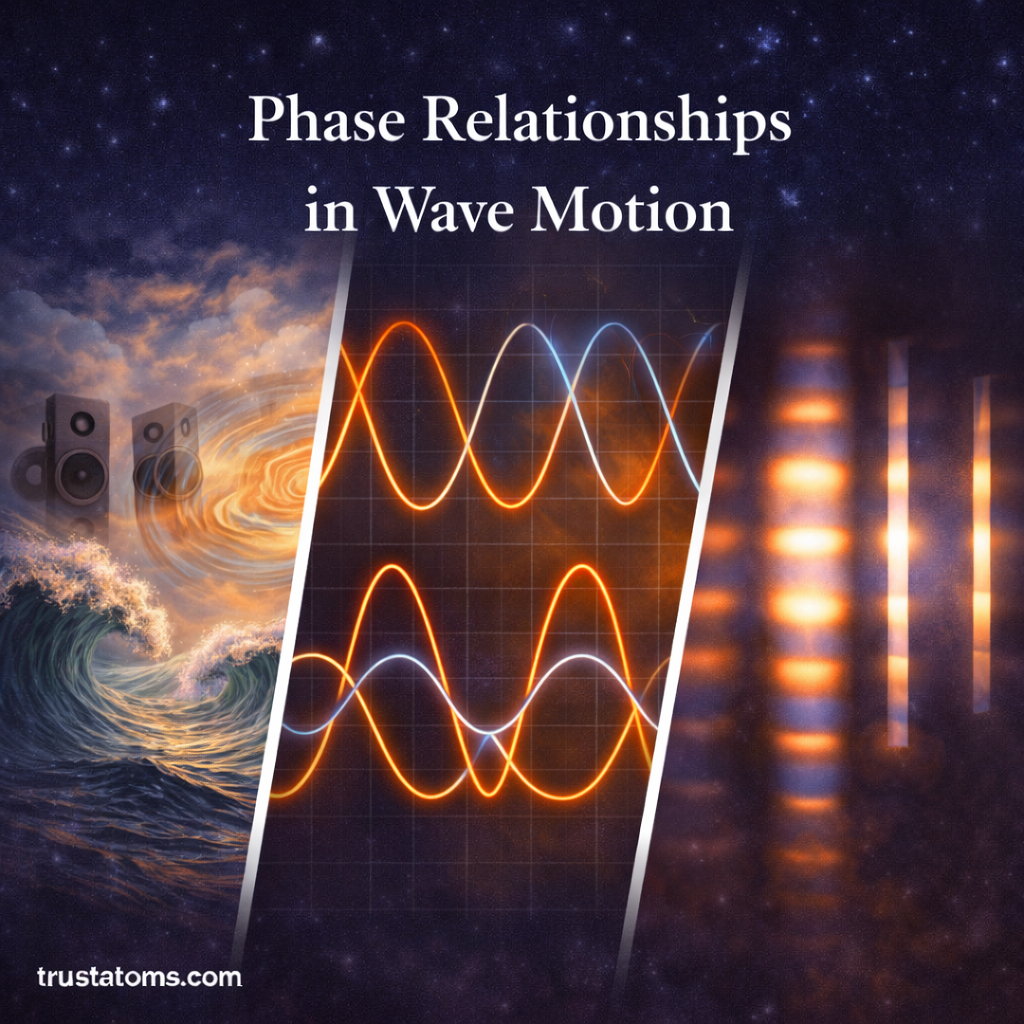
- In phase if their crests and troughs align.
- Out of phase if their peaks and valleys do not match.
Phase tells us how synchronized waves are.
Phase Difference
Phase difference measures how much one wave is shifted relative to another.
It can be described in:
- Degrees (0° to 360°)
- Radians (0 to 2π)
Common phase relationships:
- 0° → Completely in phase
- 180° → Completely out of phase
- 90° → Quarter-cycle difference
Phase difference determines how waves interact when they meet.
Constructive and Destructive Interference
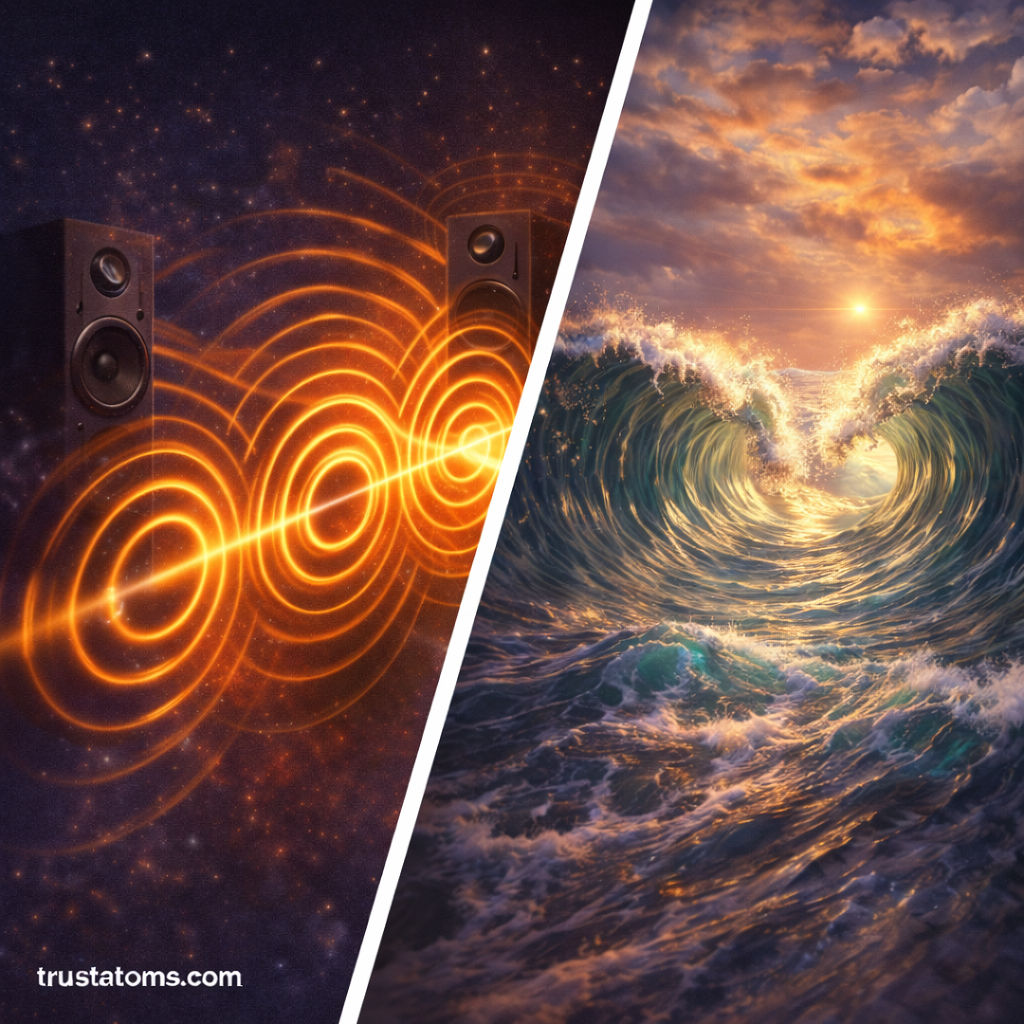
When two waves overlap, they combine through superposition.
Constructive Interference
Occurs when waves are in phase:
- Crests align with crests.
- Troughs align with troughs.
- Amplitude increases.
This results in a stronger combined wave.
Destructive Interference
Occurs when waves are out of phase:
- Crest aligns with trough.
- Amplitudes cancel partially or completely.
- Resulting wave is weaker or zero.
This principle explains noise-canceling headphones and wave cancellation patterns.
Phase and Periodic Motion
Phase is closely related to periodic motion.
For any repeating system:
- Phase increases steadily over time.
- One full cycle corresponds to a complete phase rotation.
- Frequency determines how quickly phase changes.
If frequency increases:
- Phase changes more rapidly.
- The system oscillates faster.
This connection is crucial in oscillatory systems.
Phase in Mechanical Waves
Mechanical waves, such as sound or water waves, rely heavily on phase relationships.
Examples:
- Two speakers emitting sound can create loud and quiet regions due to interference.
- Ocean waves can combine to form larger waves or flatten out.
In standing waves:
- Nodes occur where destructive interference happens.
- Antinodes occur where constructive interference occurs.
Phase determines the structure of these patterns.
Phase in Light Waves
Light also behaves as a wave, and phase plays a major role in optics.
When light waves combine:
- They can produce bright and dark fringes.
- Thin films show colorful interference patterns.
- Laser beams rely on phase coherence.
Phase relationships in light waves are fundamental to:
- Holography
- Fiber optics
- Diffraction experiments
Phase Velocity vs Group Velocity
In advanced wave analysis, two important velocities are considered.
Phase Velocity
- Speed at which individual wave crests move.
- Describes how phase propagates through space.
Group Velocity
- Speed at which energy or information travels.
- Associated with wave packets.
Understanding the difference helps explain signal transmission and wave behavior in various media.
Phase Shifts
Phase shifts occur when waves undergo changes due to:
- Reflection
- Refraction
- Medium transitions
- Damping
For example:
- A wave reflecting from a fixed boundary may invert.
- Light entering a different medium can shift phase.
Phase shifts are critical in analyzing wave interactions.
Real-World Applications
Phase relationships are essential in:
- Noise-canceling technology
- Musical acoustics
- Antenna array design
- Seismic wave analysis
- Medical imaging
- Wireless communication
Engineers carefully control phase to:
- Enhance signal strength.
- Reduce interference.
- Improve clarity and efficiency.
Without phase analysis, modern communication systems would not function.
Common Misconceptions
Many learners believe:
- Phase only matters in sound waves.
- All waves combine to make larger waves.
- Phase difference changes amplitude permanently.
Important clarifications:
- Phase affects all wave types, including light and water.
- Waves can cancel each other completely.
- Interference does not destroy energy — it redistributes it.
Understanding phase prevents confusion in wave behavior.
Why Phase Relationships Matter
Phase relationships reveal how waves interact and shape the physical world.
They explain:
- Interference patterns
- Beats in music
- Standing waves
- Signal transmission
- Optical phenomena
Mastering phase concepts provides a foundation for studying:
- Wave mechanics
- Electromagnetism
- Quantum physics
- Signal processing
Key Takeaways
- Phase describes position within a wave cycle.
- Phase difference determines wave interaction.
- In-phase waves produce constructive interference.
- Out-of-phase waves produce destructive interference.
- Phase relationships apply to mechanical and electromagnetic waves.
- Interference redistributes energy rather than destroying it.
Final Thoughts
Phase relationships in wave motion are central to understanding how waves combine, propagate, and influence one another. From ocean swells to radio signals, phase determines whether waves amplify or cancel.
By grasping phase concepts, we gain deeper insight into acoustics, optics, communications, and the broader behavior of oscillatory systems in physics.