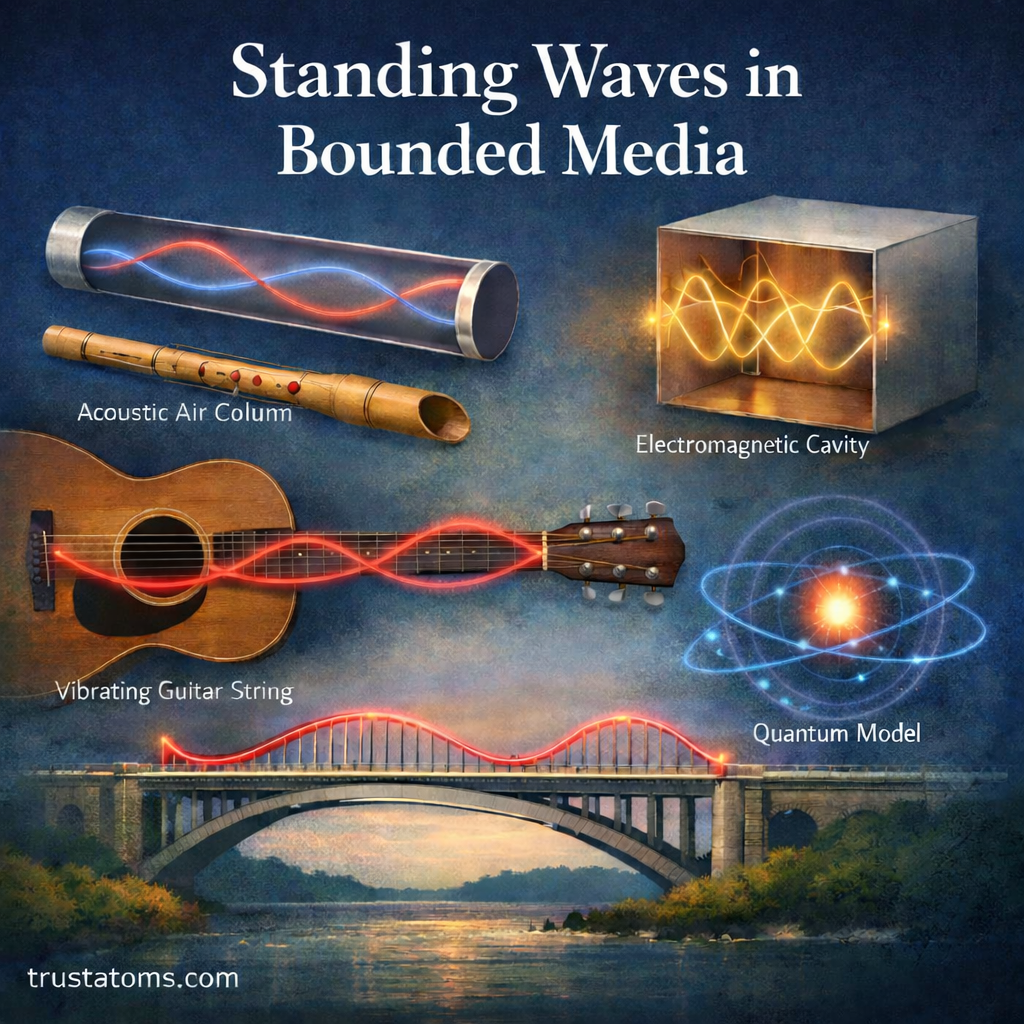
Standing waves are one of the most important and visually striking phenomena in physics. They appear when waves are confined within boundaries — such as a string fixed at both ends, air trapped in a pipe, or electromagnetic fields inside a cavity.
Understanding standing waves in bounded media helps explain musical instruments, microwave ovens, laser cavities, bridge vibrations, and even quantum mechanics.
This guide breaks down the physics clearly, step by step.
What Are Standing Waves?
A standing wave is a wave pattern that remains fixed in space. Unlike traveling waves that move energy from one point to another, standing waves oscillate in place.
They form when:
- Two waves of the same frequency and amplitude
- Travel in opposite directions
- Interfere with each other in a bounded region
This typically happens when a wave reflects off a boundary and overlaps with the incoming wave.
The result is a stable pattern of:
- Nodes (points that never move)
- Antinodes (points of maximum motion)
What Is a Bounded Medium?
A bounded medium is a system with physical constraints that limit wave motion.
Examples include:
- A guitar string fixed at both ends
- Air inside an organ pipe
- A rope tied to a wall
- Electromagnetic waves inside a metal cavity
Boundaries force waves to reflect, and only certain wave patterns “fit” within the space. These allowed patterns are called normal modes.
How Standing Waves Form
Consider a string fixed at both ends.
When plucked:
- A wave travels to one end
- Reflects back
- Interferes with the incoming wave
For a stable standing wave to form, the length of the string must support an integer number of half wavelengths.
Mathematically:
L = n(λ / 2)
Where:
- L = length of the medium
- λ = wavelength
- n = 1, 2, 3, … (mode number)
Only specific wavelengths satisfy this condition.
This is why standing waves occur only at discrete frequencies.
Nodes and Antinodes
Standing waves have two key features:
Nodes
- Points with zero displacement
- Result from destructive interference
- Always remain stationary
Antinodes
- Points of maximum displacement
- Result from constructive interference
- Oscillate with maximum amplitude
The number of nodes increases with higher modes.
Harmonics and Normal Modes
Each allowed standing wave pattern corresponds to a harmonic.
First Harmonic (Fundamental Frequency)
- Lowest possible frequency
- One half-wavelength fits in the medium
- Simplest standing wave pattern
Second Harmonic
- One full wavelength fits
- Two antinodes appear
Third Harmonic and Beyond
- Increasing numbers of nodes and antinodes
- Higher frequencies
The frequency of each harmonic is given by:
fₙ = n(v / 2L)
Where:
- fₙ = frequency of nth harmonic
- v = wave speed
- L = length of medium
- n = harmonic number
Standing Waves on Strings
For a string fixed at both ends:
- Nodes occur at both endpoints
- Only half-wavelength multiples are allowed
Wave speed on a string is:
v = √(T / μ)
Where:
- T = tension
- μ = linear mass density
This explains how tightening a guitar string raises its pitch.
Standing Waves in Air Columns
Air columns behave slightly differently depending on boundary conditions.
Open-Open Pipe
- Antinodes at both ends
- Supports all harmonics
Frequency formula:
fₙ = n(v / 2L)
Open-Closed Pipe
- Node at closed end
- Antinode at open end
- Supports only odd harmonics
Frequency formula:
fₙ = n(v / 4L), where n = 1, 3, 5…
This is why clarinets (approximately closed pipes) sound different from flutes (open pipes).
Energy in Standing Waves
Unlike traveling waves:
- Energy does not propagate along the medium
- Energy oscillates between kinetic and potential forms
- Nodes store minimal energy
- Antinodes have maximum energy oscillation
Even though the wave appears stationary, particles in the medium are still vibrating.
Resonance in Bounded Media
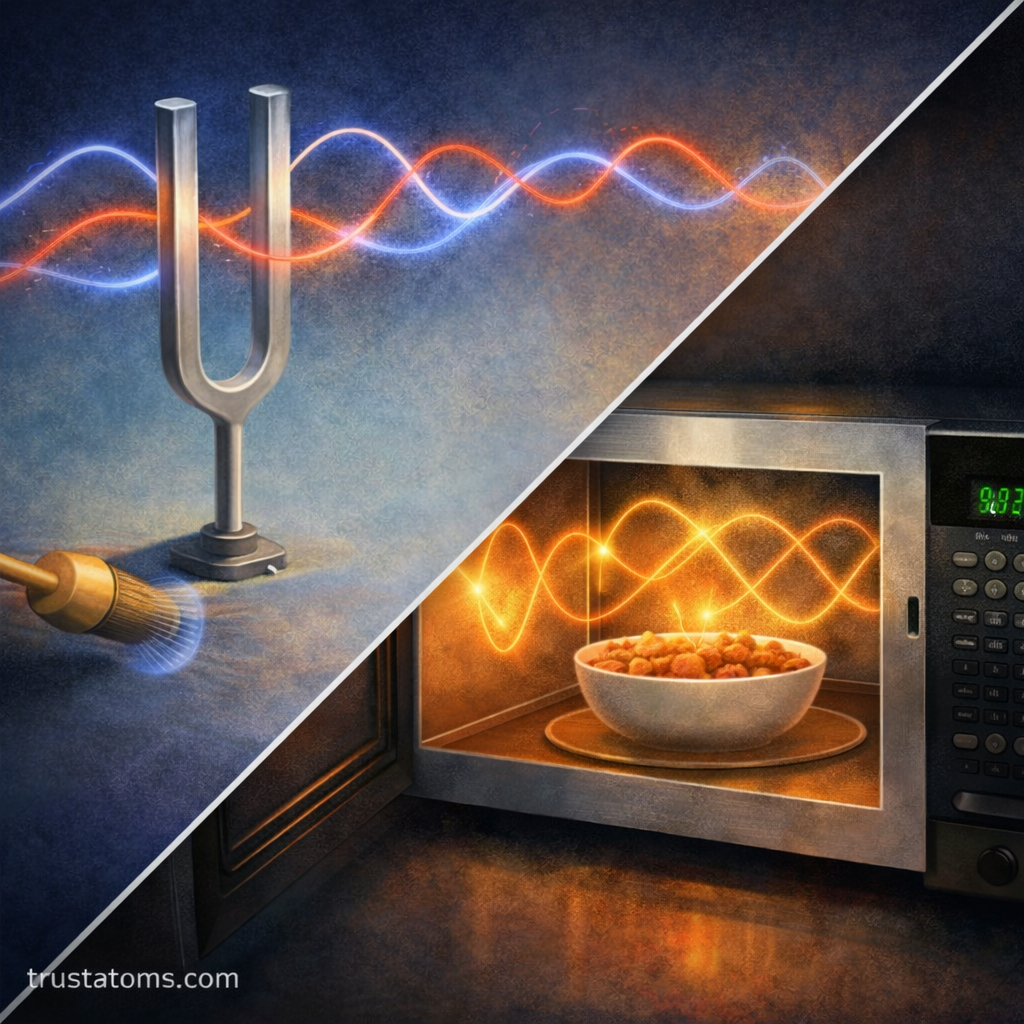
Resonance occurs when a system is driven at one of its natural frequencies.
At resonance:
- Amplitude increases dramatically
- Energy builds efficiently
- Standing waves become clearly defined
Examples include:
- Musical instruments
- Bridges under periodic forces
- Microwave ovens
- Laser cavities
Resonance can be beneficial (music) or destructive (structural failure).
Electromagnetic Standing Waves
Standing waves are not limited to mechanical systems.
Electromagnetic waves can form standing patterns inside:
- Microwave ovens
- Optical cavities
- Radio transmitters
In these systems:
- Electric and magnetic fields oscillate
- Boundaries reflect waves
- Only certain wavelengths are allowed
This principle is fundamental in laser design.
Standing Waves and Quantum Mechanics
At microscopic scales, standing waves explain quantum behavior.
In quantum systems:
- Particles behave like waves
- Electrons in atoms form standing wave patterns
- Only certain energy levels are allowed
This quantization arises directly from boundary conditions.
The famous “particle in a box” model is a quantum version of standing waves in bounded media.
Why Standing Waves Matter
Standing waves explain:
- Musical pitch
- Architectural acoustics
- Radio transmission
- Laser operation
- Quantum energy levels
They demonstrate how physical constraints shape wave behavior.
When a system has boundaries, nature restricts what is allowed.
And those restrictions create structure, harmony, and quantization.
Key Takeaways
- Standing waves form from interference of equal waves moving in opposite directions.
- Boundaries restrict allowed wavelengths.
- Nodes and antinodes define the pattern.
- Only discrete frequencies (harmonics) are possible.
- Standing waves occur in strings, air columns, electromagnetic cavities, and quantum systems.
- Resonance amplifies these patterns dramatically.
Standing waves reveal one of physics’ most powerful ideas: structure emerges from constraint.