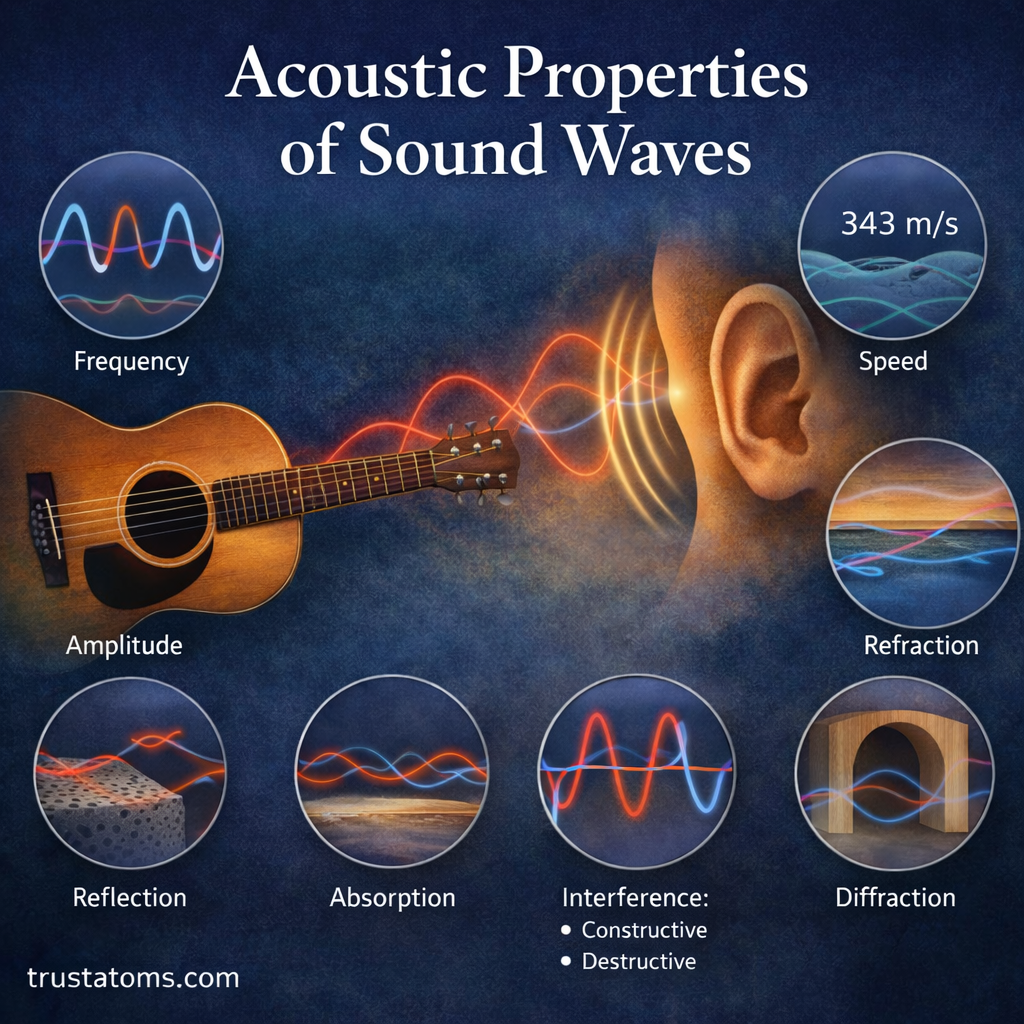
Sound is more than just something we hear — it is a mechanical wave that travels through matter, carrying energy through vibrations. The acoustic properties of sound waves determine how sound behaves in air, water, solids, and built environments.
Understanding these properties helps explain music, speech clarity, echoes, architectural acoustics, sonar systems, and noise control.
This guide breaks down the key acoustic properties in a clear, structured way.
What Is a Sound Wave?
A sound wave is a mechanical longitudinal wave that travels through a medium by compressing and expanding particles.
Unlike light, sound cannot travel through a vacuum. It requires:
- Air
- Water
- Solid materials
- Any medium with particles that can vibrate
As sound travels, particles oscillate back and forth parallel to the direction of wave motion.
Core Acoustic Properties of Sound Waves
Several measurable properties define how sound behaves.
Frequency
Frequency refers to how many wave cycles pass a point per second.
- Measured in hertz (Hz)
- Determines pitch
- Higher frequency = higher pitch
- Lower frequency = deeper sound
Human hearing typically ranges from about 20 Hz to 20,000 Hz.
Examples:
- Bass drum: low frequency
- Whistle: high frequency
Wavelength
Wavelength is the physical distance between repeating points in a wave, such as compressions.
Key relationships:
- Short wavelength = high frequency
- Long wavelength = low frequency
Wavelength affects how sound interacts with obstacles. Low-frequency sounds bend around objects more easily than high-frequency sounds.
Amplitude
Amplitude measures the maximum displacement of particles in the medium.
- Larger amplitude = louder sound
- Smaller amplitude = softer sound
Sound intensity is often measured in decibels (dB).
It’s important to note:
- Decibels use a logarithmic scale
- A small increase in dB represents a large increase in energy
Speed of Sound
The speed of sound depends on the medium.
Typical speeds:
- Air (room temperature): ~343 m/s
- Water: ~1,480 m/s
- Steel: ~5,960 m/s
Sound travels faster in materials where particles are tightly packed and strongly connected.
Temperature also affects speed. Warmer air allows sound to travel faster.
Acoustic Behavior in Different Media
Sound behaves differently depending on what it travels through.
In Gases
- Particles are widely spaced
- Sound travels relatively slowly
- More energy loss due to spreading
In Liquids
- Particles are closer together
- Faster transmission
- Used in sonar applications
In Solids
- Strong particle bonding
- Very fast transmission
- Vibrations travel efficiently through structures
This is why you can hear a train approaching by placing your ear on the tracks.
Reflection of Sound

When sound waves strike a surface, part of the energy may reflect.
Reflection depends on:
- Surface material
- Surface shape
- Angle of incidence
Smooth, hard surfaces reflect sound well.
Examples:
- Echoes in canyons
- Reverberation in large halls
- Sound bouncing off walls
Absorption of Sound
Absorption occurs when sound energy converts into heat inside a material.
Soft, porous materials absorb sound better than hard surfaces.
Examples:
- Curtains
- Carpets
- Acoustic foam
- Upholstered furniture
Absorption reduces echoes and improves clarity in indoor spaces.
Refraction of Sound
Refraction happens when sound changes direction due to variations in medium properties.
Common causes:
- Temperature gradients
- Wind speed differences
- Density changes
For example, sound may travel farther at night because cooler air near the ground bends waves downward.
Diffraction of Sound
Diffraction allows sound waves to bend around obstacles and pass through openings.
Low-frequency sounds diffract more easily than high-frequency sounds.
This explains why:
- You can hear bass from another room
- Low tones travel around corners
Interference of Sound Waves
When two sound waves meet, they combine through interference.
Constructive Interference
- Waves reinforce each other
- Sound becomes louder
Destructive Interference
- Waves cancel each other
- Sound becomes quieter
Noise-canceling headphones use destructive interference to reduce unwanted sounds.
Resonance and Natural Frequency
Every object has a natural frequency at which it vibrates most easily.
Resonance occurs when sound waves match this frequency.
Effects of resonance:
- Increased vibration amplitude
- Amplified sound
- Potential structural damage
Examples include:
- Musical instruments
- Singing that shatters glass
- Structural vibration in buildings
Acoustic Impedance
Acoustic impedance describes how much resistance a medium provides to sound transmission.
It depends on:
- Density of the material
- Speed of sound in that material
When sound moves between materials with different acoustic impedances:
- Some energy reflects
- Some energy transmits
This principle is essential in:
- Medical ultrasound imaging
- Speaker design
- Architectural acoustics
Loudness vs Intensity
Loudness is subjective. Intensity is physical.
Intensity:
- Measured in watts per square meter
- Objective measurement
Loudness:
- Perceived by the human ear
- Depends on frequency and intensity
Humans are more sensitive to mid-range frequencies than very low or very high ones.
Real-World Applications of Acoustic Properties
Understanding acoustic properties helps in:
- Designing concert halls
- Improving speech clarity in classrooms
- Engineering noise reduction systems
- Developing sonar and ultrasound technology
- Optimizing recording studios
- Building safer urban environments
Acoustics combines physics, engineering, architecture, and psychology.
Key Takeaways
- Sound is a mechanical longitudinal wave.
- Frequency determines pitch.
- Amplitude determines loudness.
- Speed depends on the medium and temperature.
- Reflection, absorption, refraction, and diffraction shape how sound travels.
- Interference and resonance dramatically affect sound intensity.
- Acoustic impedance governs energy transmission between materials.
The acoustic properties of sound waves explain everything from whispering conversations to powerful concert performances.
By understanding these principles, we better understand how energy moves through the world around us.