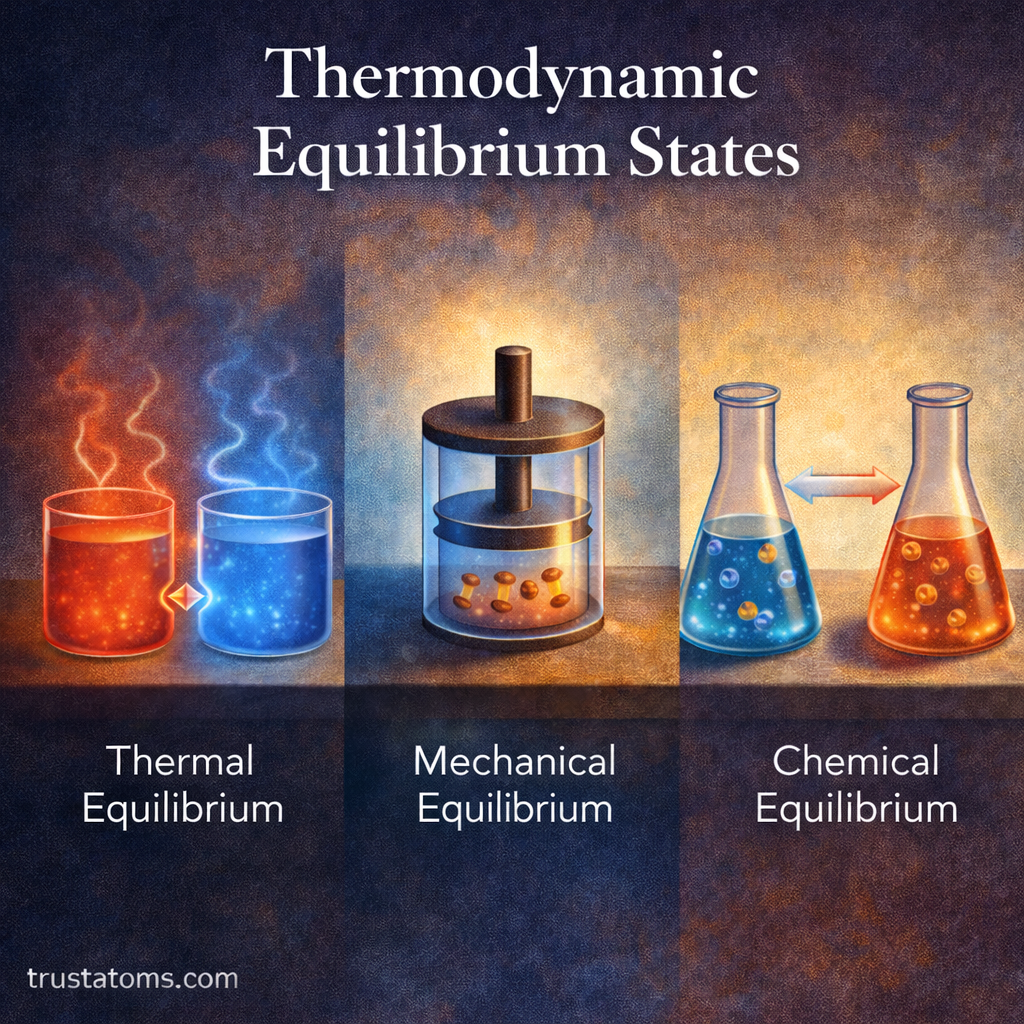
Thermodynamic equilibrium is one of the most important concepts in physics. It describes the condition of a system when its macroscopic properties stop changing over time.
When a system reaches thermodynamic equilibrium, it becomes stable. There are no net flows of energy or matter within the system or between the system and its surroundings.
Understanding thermodynamic equilibrium states is essential in:
- Heat transfer
- Chemical reactions
- Phase changes
- Engine design
- Atmospheric science
- Statistical mechanics
This guide explains the concept clearly and systematically.
What Is Thermodynamic Equilibrium?
A system is in thermodynamic equilibrium when all measurable properties remain constant in time, and no spontaneous processes occur within it.
Key characteristics include:
- Uniform temperature
- Uniform pressure (if no external forces vary)
- No net heat flow
- No net mass transfer
- No ongoing chemical change
Equilibrium does not mean particles stop moving. At the microscopic level, motion continues — but macroscopic averages remain constant.
The Three Conditions of Thermodynamic Equilibrium
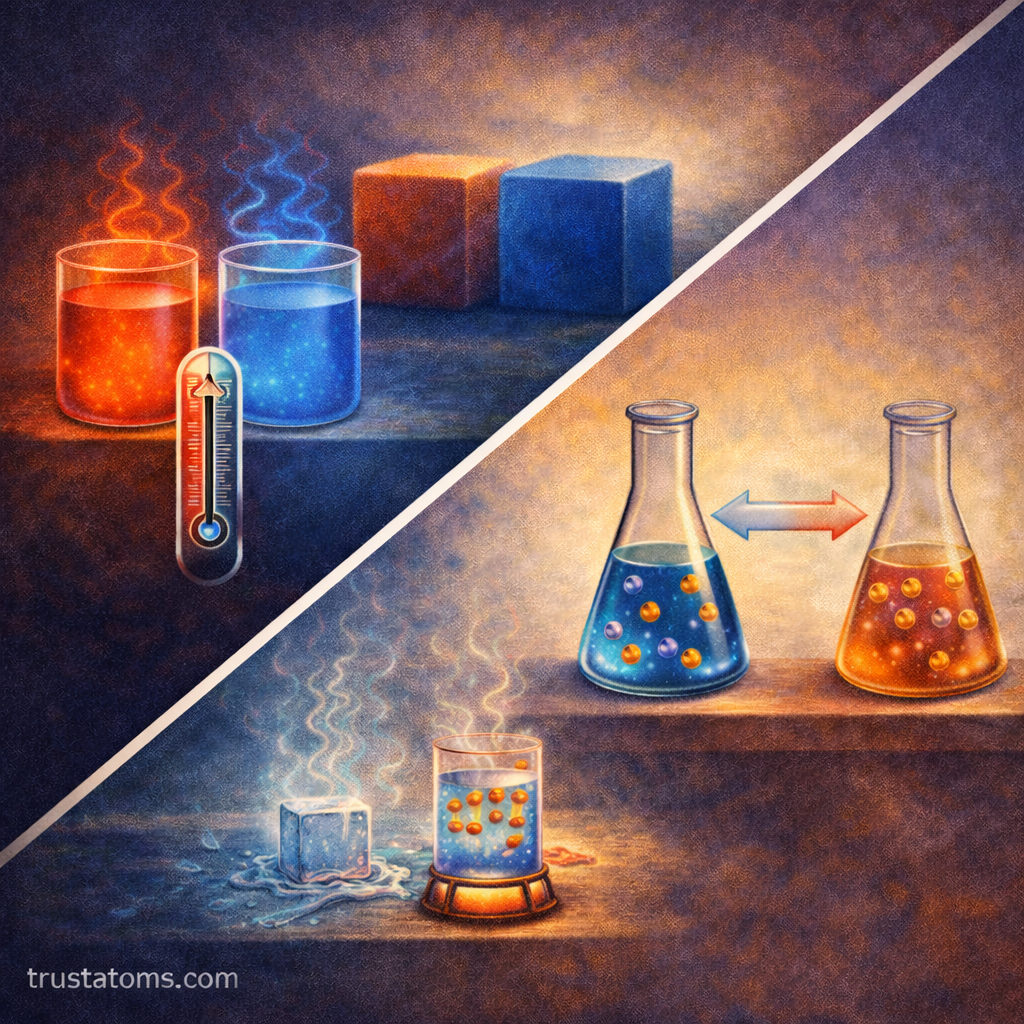
For complete thermodynamic equilibrium, three types of equilibrium must exist simultaneously.
Thermal Equilibrium
Thermal equilibrium occurs when temperature is uniform throughout the system.
- No heat flows between parts of the system
- If two systems are in thermal equilibrium with a third system, they are in equilibrium with each other
This principle forms the basis of temperature measurement.
Mechanical Equilibrium
Mechanical equilibrium exists when there are no unbalanced forces within the system.
- Pressure is uniform throughout
- No bulk motion occurs
- No acceleration of boundaries
For example, a gas inside a sealed container eventually reaches uniform pressure.
Chemical Equilibrium
Chemical equilibrium occurs when chemical reactions proceed at equal forward and reverse rates.
- Concentrations remain constant
- No net chemical change
- Reaction continues microscopically but with balanced rates
All three conditions must be satisfied for full thermodynamic equilibrium.
Local vs Global Equilibrium
Thermodynamic equilibrium can be described at different scales.
Global Equilibrium
- Entire system has uniform properties
- No gradients of temperature or pressure
Local Equilibrium
- Small regions are internally balanced
- Gradients may exist across the whole system
Local equilibrium is important in fluid dynamics and atmospheric physics.
Dynamic Nature of Equilibrium
Equilibrium is not static at the microscopic level.
Even in equilibrium:
- Molecules collide
- Energy exchanges occur
- Reactions continue
However:
- Statistical averages remain constant
- No net macroscopic change is observed
This is sometimes called dynamic equilibrium.
Thermodynamic Variables at Equilibrium
When equilibrium is reached, state variables become fixed.
Important thermodynamic variables include:
- Temperature
- Pressure
- Volume
- Internal energy
- Entropy
These variables define the system’s state completely.
Role of Entropy in Equilibrium
Entropy plays a central role in determining equilibrium.
A system in thermodynamic equilibrium:
- Maximizes entropy (for isolated systems)
- Minimizes free energy (for systems at constant temperature and pressure)
This reflects the tendency of natural systems to move toward the most probable macroscopic configuration.
Isolated, Closed, and Open Systems
Equilibrium behavior depends on the type of system.
Isolated System
- No exchange of energy or matter
- Eventually reaches maximum entropy
Example: A perfectly insulated container.
Closed System
- Energy exchange allowed
- No matter exchange
Example: A sealed piston that can exchange heat.
Open System
- Both energy and matter exchange allowed
True thermodynamic equilibrium is most strictly defined for isolated systems.
Phase Equilibrium
Phase equilibrium occurs when multiple phases coexist without change.
Examples:
- Ice and water at melting point
- Water and vapor at boiling point
- Liquid and gas in a sealed container
At phase equilibrium:
- Temperature remains constant
- Pressure remains constant
- Phase amounts remain stable
Phase diagrams map these equilibrium conditions.
Equilibrium in Heat Transfer
Consider two objects at different temperatures placed in contact.
What happens:
- Heat flows from hotter to colder object.
- Temperatures change over time.
- Eventually, both reach the same temperature.
At that point:
- Thermal equilibrium is achieved
- No further net heat flow occurs
This process illustrates the approach to equilibrium.
Time Required to Reach Equilibrium
Not all systems reach equilibrium quickly.
Factors affecting equilibrium time:
- Size of system
- Thermal conductivity
- Diffusion rates
- Reaction rates
- External constraints
Some systems take seconds. Others take geological timescales.
Metastable States
Sometimes systems appear stable but are not truly in equilibrium.
A metastable state:
- Is temporarily stable
- Can persist for long periods
- Eventually transitions to true equilibrium
Examples include:
- Supercooled liquids
- Supersaturated solutions
- Compressed springs
Thermodynamic Equilibrium in Statistical Mechanics
From a microscopic viewpoint:
- Systems contain enormous numbers of particles
- Many microscopic configurations are possible
- Equilibrium corresponds to the most statistically probable configuration
Statistical mechanics connects microscopic particle behavior to macroscopic equilibrium properties.
Why Thermodynamic Equilibrium Matters
Thermodynamic equilibrium allows physicists and engineers to:
- Predict system behavior
- Design engines and refrigerators
- Analyze chemical reactions
- Model atmospheric processes
- Study stellar interiors
Many thermodynamic equations only apply under equilibrium conditions.
Without equilibrium, systems become much more complex to analyze.
Key Takeaways
- Thermodynamic equilibrium means no macroscopic changes occur over time.
- It requires thermal, mechanical, and chemical equilibrium.
- Equilibrium is dynamic at the microscopic level.
- Entropy plays a central role in determining equilibrium states.
- Isolated systems naturally evolve toward maximum entropy.
- Phase equilibrium describes coexistence of different states of matter.
- Statistical mechanics explains equilibrium probabilistically.
Thermodynamic equilibrium states represent nature’s balance point — the condition toward which systems naturally evolve when left undisturbed.