Newton’s Third Law of Motion explains how forces interact between objects. It describes why rockets launch, why you move backward when you jump off a boat, and why walking is even possible.
The law introduces the concept of action–reaction forces, showing that forces always come in pairs.
In this guide, you’ll learn what Newton’s Third Law states, how action–reaction forces work, and where we see them in everyday life and advanced physics.
What Is Newton’s Third Law?
Newton’s Third Law states:
For every action, there is an equal and opposite reaction.
This means:
- When one object exerts a force on another object,
- The second object exerts an equal force in the opposite direction on the first object.
These two forces occur simultaneously.
They are always equal in magnitude and opposite in direction.
Understanding Action–Reaction Force Pairs
The key idea is that forces come in pairs.
If object A pushes on object B:
- Object A exerts a force on object B.
- Object B exerts an equal force back on object A.
Important details:
- The forces act on different objects.
- They do not cancel each other out.
- They are always equal and opposite.
Why Action–Reaction Forces Don’t Cancel
A common misconception is that action and reaction forces cancel each other.
They do not.
They act on different objects.
For example:
- When you push against a wall, you feel the wall pushing back.
- The wall doesn’t move because it’s attached to the Earth.
- The equal and opposite force is distributed across a much larger mass.
Because the objects are different, the forces affect them differently.
Everyday Examples of Newton’s Third Law

Newton’s Third Law explains many familiar experiences.
1. Walking
When you walk:
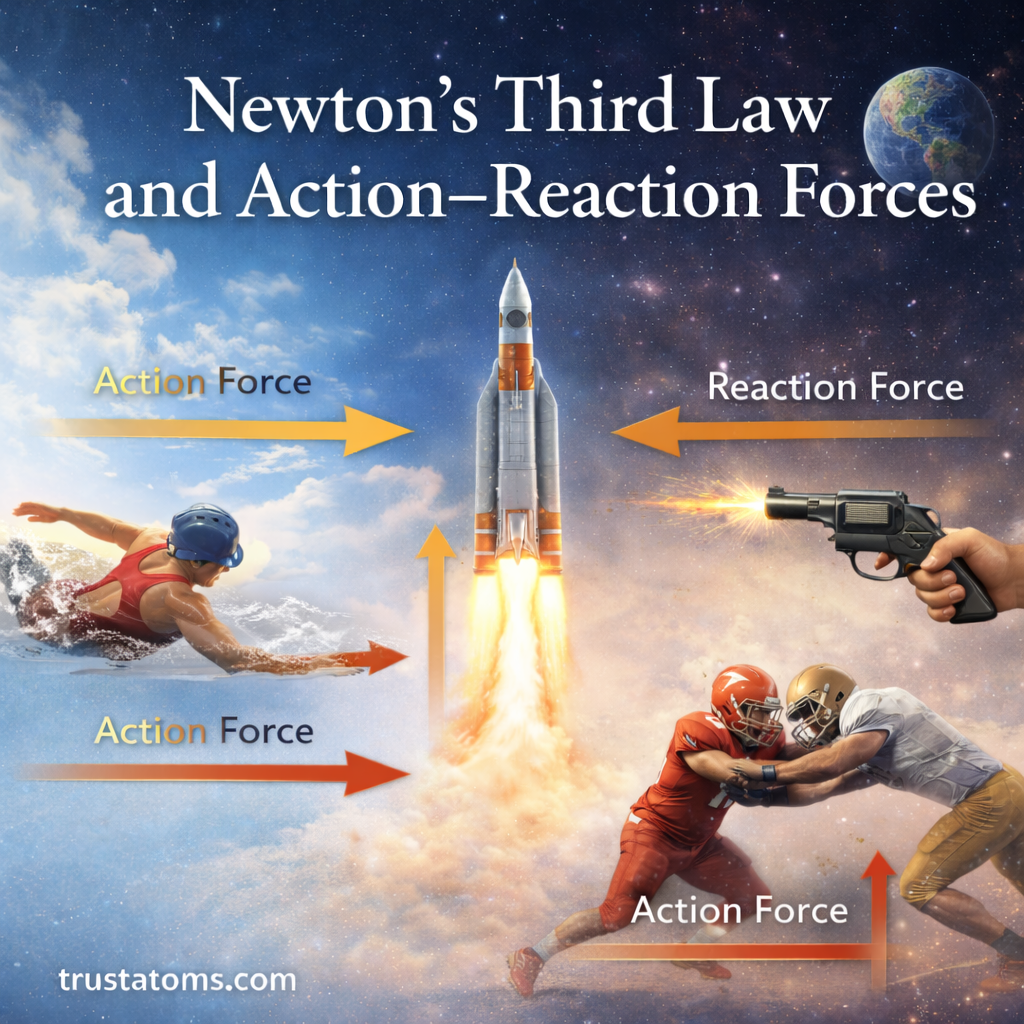
- Your foot pushes backward on the ground.
- The ground pushes forward on your foot.
That forward reaction force moves you ahead.
Without this force pair, walking wouldn’t be possible.
2. Swimming
When a swimmer pushes water backward:
- The swimmer exerts force on the water.
- The water exerts force forward on the swimmer.
This forward reaction moves the swimmer.
3. Jumping Off a Boat
If you jump forward off a small boat:
- You push backward on the boat.
- The boat moves backward in response.
The lighter the boat, the more noticeable the reaction.
4. Rocket Launches
Rockets operate using Newton’s Third Law.
- The engine pushes exhaust gases downward.
- The gases push the rocket upward.
This upward reaction force lifts the rocket into space.
5. Recoil of a Gun
When a gun is fired:
- The bullet moves forward.
- The gun recoils backward.
The forces are equal and opposite.
The difference in motion occurs because the bullet has much less mass than the gun.
How Newton’s Third Law Relates to the Other Laws
Newton’s Three Laws work together:
- First Law – Objects maintain motion unless acted upon by force.
- Second Law – Force equals mass times acceleration (F = ma).
- Third Law – Forces always occur in action–reaction pairs.
The Third Law explains how forces are exchanged between interacting objects.
Action–Reaction in Collisions
During collisions:
- Each object exerts force on the other.
- The forces are equal and opposite.
For example:
If a car hits a wall:
- The car pushes on the wall.
- The wall pushes back on the car.
Damage occurs based on:
- The mass of the objects.
- The acceleration involved.
- The duration of impact.
Newton’s Third Law explains the force interaction itself.
Momentum and Action–Reaction
Newton’s Third Law also connects to momentum conservation.
In isolated systems:
- Total momentum remains constant.
- Action–reaction forces help explain how momentum transfers between objects.
For example:
When two ice skaters push off each other:
- One moves left.
- One moves right.
Their momenta are equal in magnitude and opposite in direction.
Common Misconceptions
“The Reaction Happens After the Action”
No.
Action and reaction occur at the same time.
“Equal Forces Mean Equal Motion”
Not necessarily.
Motion depends on mass and acceleration (Newton’s Second Law).
A small object may accelerate more than a large object, even though the forces are equal.
“If Forces Are Equal, Nothing Moves”
Objects can move because the forces act on different objects.
Each object responds based on its mass.
Why Newton’s Third Law Matters
Understanding Newton’s Third Law helps explain:
- Rocket propulsion
- Engine mechanics
- Vehicle traction
- Athletic movement
- Fluid dynamics
- Space travel
It reveals how forces are exchanged in every interaction.
Without this law, we couldn’t explain motion caused by contact or propulsion.
Final Thoughts
Newton’s Third Law shows that forces never occur alone.
Every push has a pull.
Every action has a reaction.
These forces are equal, opposite, and simultaneous.
From walking and swimming to rockets and collisions, Newton’s Third Law governs how objects interact throughout the universe.
Understanding it completes the foundation of classical mechanics.