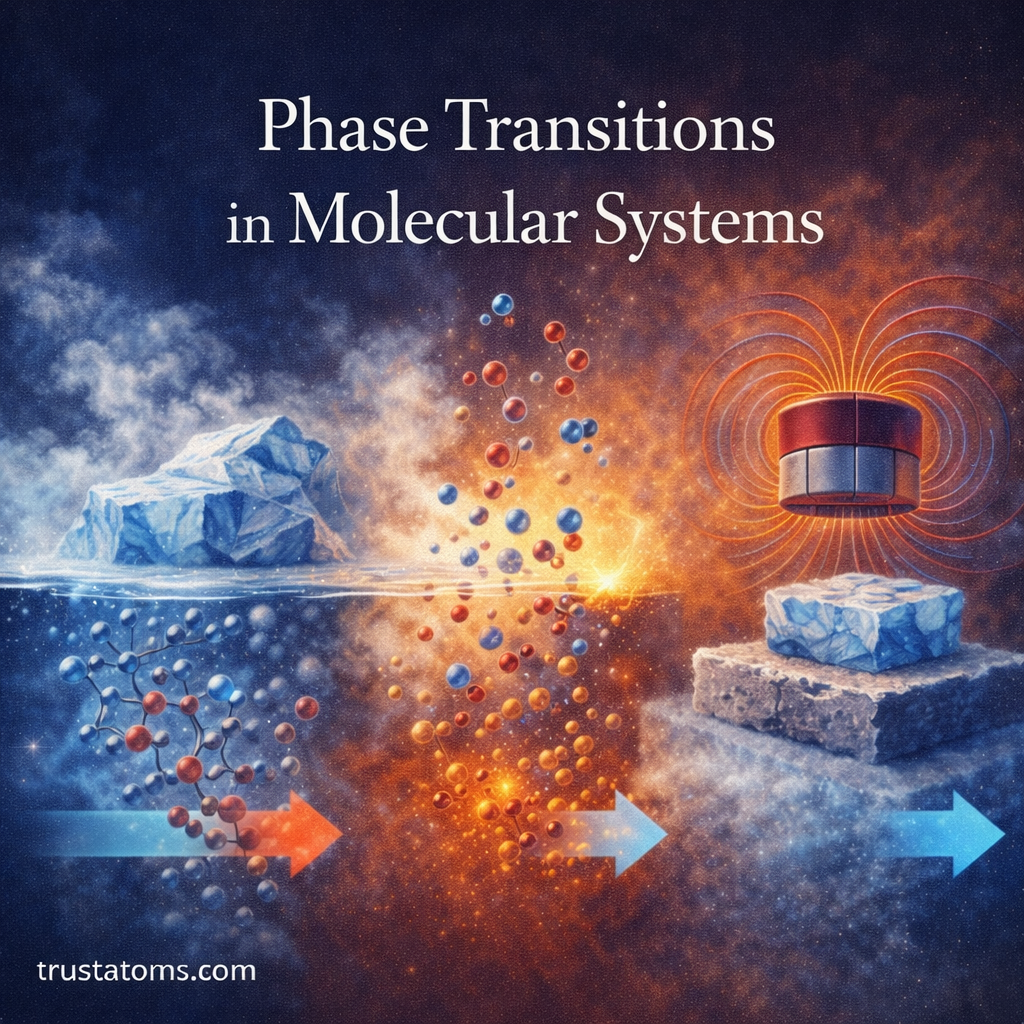
Phase transitions are among the most fascinating phenomena in physics. They explain how ice melts, how water boils, how magnets lose magnetism, and how exotic materials become superconductors.
At the heart of all these transformations are molecular interactions and collective behavior. Phase transitions in molecular systems reveal how microscopic forces give rise to dramatic macroscopic changes.
In this guide, we’ll explore what phase transitions are, the physics behind them, and why they matter in science and technology.
What Is a Phase Transition?
A phase transition occurs when a substance changes from one state of matter to another.
Common examples include:
- Solid → Liquid (melting)
- Liquid → Gas (boiling)
- Gas → Liquid (condensation)
- Liquid → Solid (freezing)
More complex examples include:
- Ferromagnetic → Paramagnetic
- Normal conductor → Superconductor
- Liquid helium → Superfluid
These changes happen because molecular organization and energy distribution shift under changing conditions like temperature or pressure.
Molecular View of Phases
To understand phase transitions, we must look at how molecules behave in different states.
Solid
- Molecules are tightly packed
- Vibrate around fixed positions
- Strong intermolecular forces dominate
Liquid
- Molecules remain close
- Can move past one another
- Intermolecular forces still significant
Gas
- Molecules are far apart
- Move freely and rapidly
- Weak intermolecular forces
Phase transitions occur when the balance between thermal energy and intermolecular forces changes.
Energy and Intermolecular Forces
Two competing factors determine phase:
- Thermal energy (related to temperature)
- Intermolecular forces (attractive forces between molecules)
When temperature increases:
- Molecular motion becomes more energetic
- Intermolecular forces are overcome
When temperature decreases:
- Motion slows
- Attractive forces dominate
Phase transitions occur at specific conditions where this balance shifts.
First-Order Phase Transitions
First-order transitions involve a sudden change in energy or structure.
Examples:
- Melting
- Boiling
- Sublimation
Characteristics:
- Latent heat is absorbed or released
- Volume may change abruptly
- Two phases can coexist at equilibrium
For example, at 0°C under standard pressure, ice and water can coexist.
Latent Heat and Molecular Rearrangement
During melting or boiling:
- Temperature remains constant
- Energy goes into breaking intermolecular bonds
This energy is called latent heat.
It does not increase temperature directly — instead, it rearranges molecular structure.
Second-Order (Continuous) Phase Transitions
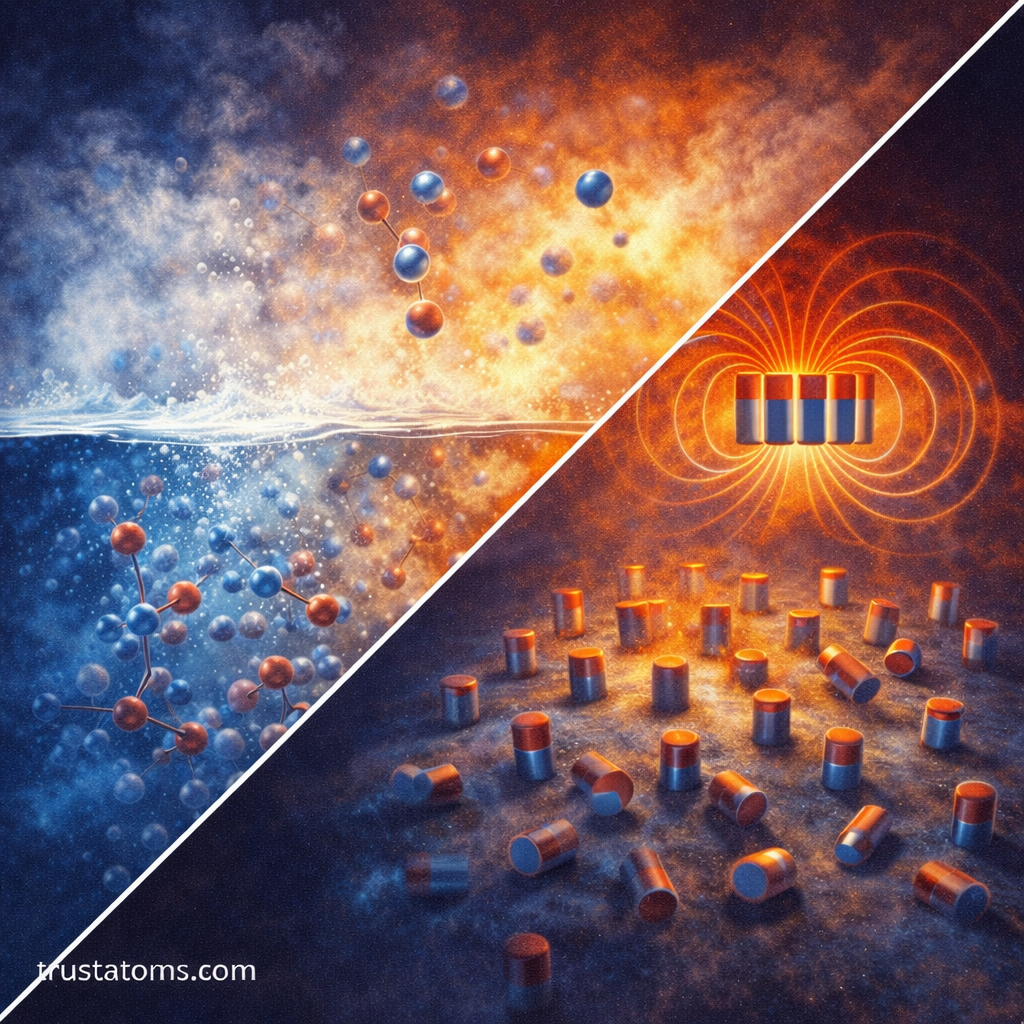
Second-order transitions occur more gradually.
Examples include:
- Ferromagnet to paramagnet transition
- Superconducting transition
- Liquid-gas critical point behavior
Characteristics:
- No latent heat
- No abrupt energy jump
- Continuous change in order
Physical properties like heat capacity or susceptibility may change dramatically.
The Role of Order and Symmetry
Phase transitions often involve changes in symmetry.
For example:
- A liquid has no fixed structure
- A crystal solid has an ordered lattice
When freezing occurs:
- Molecular positions become ordered
- Symmetry changes
In magnetism:
- Above critical temperature → spins are random
- Below critical temperature → spins align
Phase transitions often represent a shift from disorder to order (or vice versa).
Critical Point and Critical Phenomena
At certain conditions, distinctions between phases disappear.
For example:
- At the critical point of water
- Liquid and gas become indistinguishable
Near critical points:
- Density fluctuations become large
- Correlations extend over long distances
- Small changes have dramatic effects
This behavior is studied using statistical physics and scaling theory.
Molecular Systems and Statistical Mechanics
Phase transitions arise from collective behavior.
Individual molecules do not “decide” to change phase.
Instead:
- Interactions between many particles
- Long-range correlations
- Probability distributions
lead to emergent behavior.
Statistical mechanics provides the mathematical framework to understand:
- Why phase transitions occur
- How microscopic interactions create macroscopic states
- Why critical exponents appear universal
Phase Diagrams
A phase diagram maps conditions where phases exist.
Axes commonly include:
- Temperature
- Pressure
Key features:
- Phase boundaries
- Triple point (three phases coexist)
- Critical point
Phase diagrams summarize molecular behavior across conditions.
Real-World Examples
Water
- Solid, liquid, and gas phases
- Unusual density behavior
- Essential for climate and biology
Metals
- Solid-state transitions
- Crystal structure changes
- Magnetic transitions
Superconductors
- Electrical resistance drops to zero
- Occurs below critical temperature
- Used in MRI machines and particle accelerators
Liquid Crystals
- Used in display technology
- Exhibit properties between solid and liquid
Why Phase Transitions Matter
Understanding phase transitions helps us:
- Design better materials
- Improve refrigeration systems
- Predict weather and climate
- Develop quantum technologies
- Create more efficient energy systems
They are central to condensed matter physics and materials science.
Common Misconceptions
- Temperature always changes during a phase transition (it doesn’t in first-order transitions).
- Phase changes are purely macroscopic (they originate at molecular scale).
- All phase transitions involve melting or boiling (many occur in solids).
- Only temperature causes phase changes (pressure and magnetic fields also matter).
Recognizing the molecular basis clarifies these misunderstandings.
Phase Transitions and Universality
Remarkably, very different systems can show similar behavior near critical points.
Examples:
- Magnets
- Fluids
- Binary alloys
Despite different microscopic details, they follow similar mathematical patterns.
This concept is known as universality — one of the most profound discoveries in statistical physics.
Final Thoughts
Phase transitions in molecular systems demonstrate how collective molecular behavior shapes the physical world.
From ice melting to superconductivity, these transitions reveal the delicate balance between energy and intermolecular forces.
They show that dramatic macroscopic changes emerge from microscopic interactions — a powerful idea that sits at the heart of modern physics.
Understanding phase transitions deepens our knowledge of matter, energy, and the structure of the universe itself.