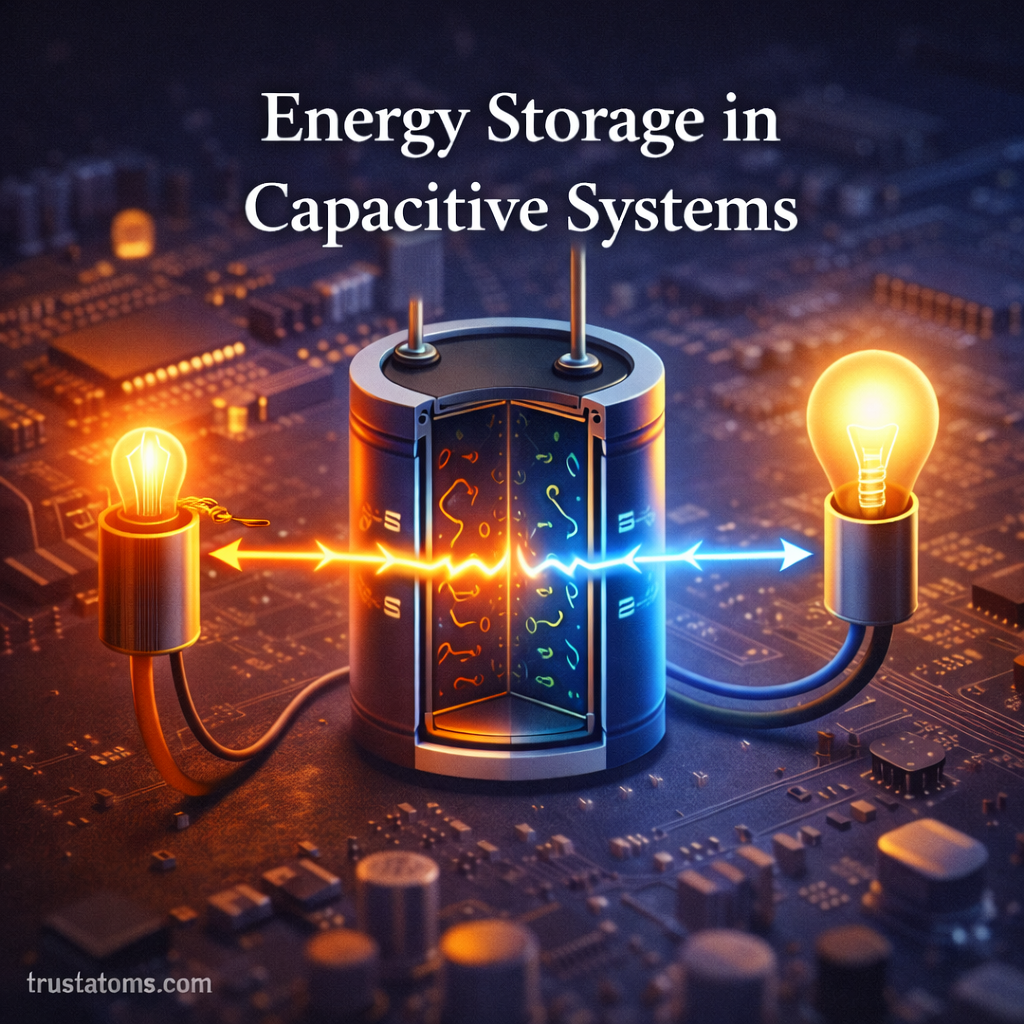
Capacitors are one of the most important components in electrical and electronic systems. From smartphones and power supplies to electric vehicles and industrial circuits, capacitive systems play a crucial role in storing and delivering energy quickly.
In this guide, we’ll explore how energy storage in capacitive systems works, the physics behind capacitance, and how capacitors are used in real-world applications.
What Is a Capacitor?
A capacitor is an electrical component designed to store energy in the form of an electric field.
It consists of three main parts:
- Two conductive plates
- An insulating material between them (called a dielectric)
- External terminals for connection to a circuit
When connected to a power source, the capacitor stores electrical energy by separating charges between the plates.
How Energy Storage in Capacitors Works
Capacitors store energy through electric charge separation.
Step-by-Step Process
- A voltage source is connected to the capacitor.
- Electrons accumulate on one plate.
- The opposite plate loses electrons.
- An electric field forms between the plates.
- Energy is stored within that electric field.
No current flows through the dielectric material. Instead, energy is stored in the electric field between the plates.
The Physics Behind Capacitance
Capacitance is the ability of a capacitor to store charge per unit voltage.
Capacitance depends on:
- Surface area of the plates
- Distance between the plates
- Type of dielectric material
Larger plates and smaller separation distances increase capacitance.
Energy Stored in a Capacitor
The energy stored increases with:
- Higher voltage
- Greater capacitance
This stored energy can be released quickly when needed.
The Role of the Dielectric Material
The dielectric is a non-conductive material placed between the plates.
Common dielectric materials include:
- Air
- Ceramic
- Glass
- Plastic films
- Electrolytes
The dielectric increases energy storage by:
- Reducing electric field strength
- Allowing more charge to accumulate
- Preventing direct current flow between plates
Different dielectric materials are chosen depending on voltage rating and application.
Charging and Discharging in Capacitive Systems
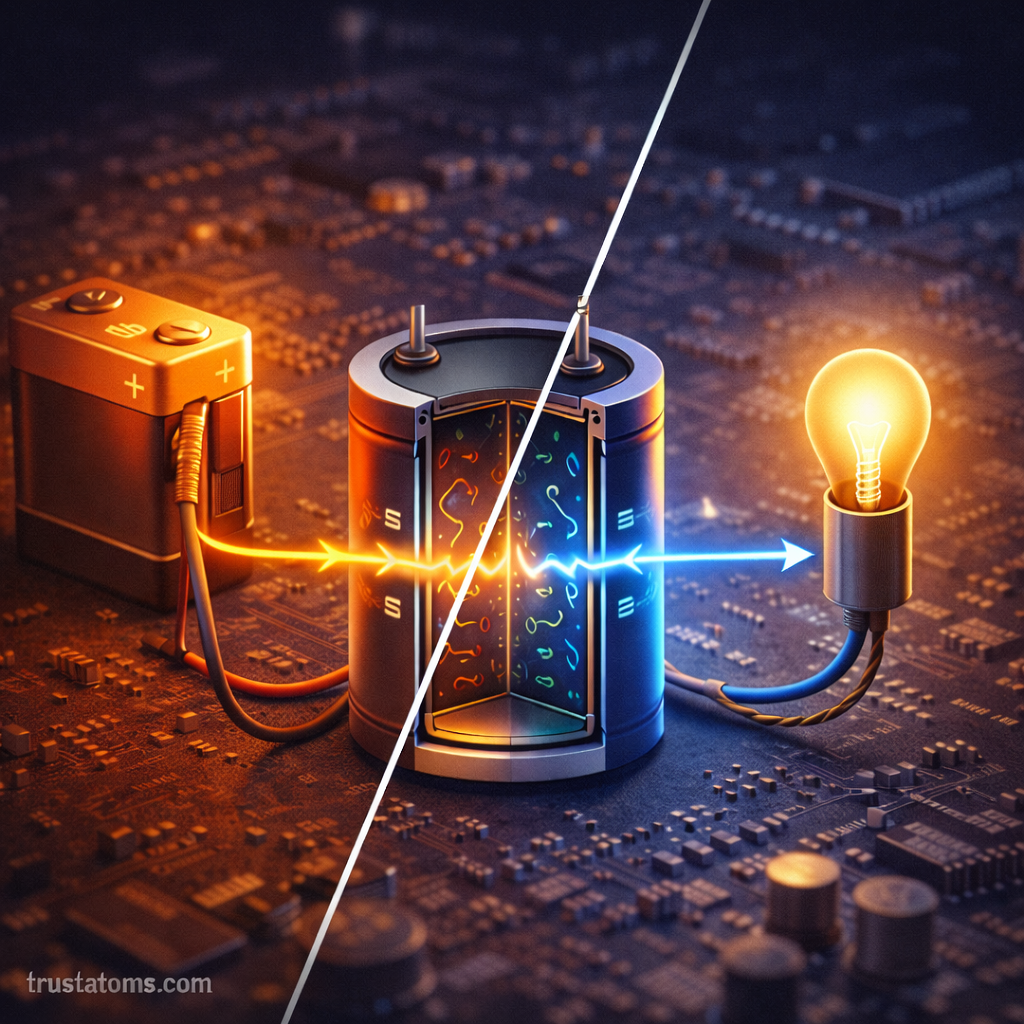
Capacitors do not instantly charge or discharge. The process follows a predictable pattern in circuits.
Charging Behavior
When connected to a power source:
- Current initially flows quickly
- Voltage across the capacitor rises gradually
- Charging slows as voltage approaches the source value
Discharging Behavior
When disconnected from the source and connected to a load:
- Stored energy flows out
- Voltage decreases over time
- Current gradually drops to zero
This time-based behavior is critical in timing circuits and signal processing.
Types of Capacitors
Different applications require different capacitor designs.
1. Ceramic Capacitors
- Small and inexpensive
- Used in electronic circuits
- Ideal for filtering and decoupling
2. Electrolytic Capacitors
- Higher capacitance values
- Used in power supply smoothing
- Polarized (must be connected correctly)
3. Film Capacitors
- Stable and reliable
- Used in audio systems and precision circuits
4. Supercapacitors
- Extremely high capacitance
- Used in energy backup systems
- Bridge gap between batteries and traditional capacitors
Applications of Capacitive Energy Storage
Capacitive systems are widely used across industries.
Power Supply Filtering
Capacitors smooth voltage fluctuations in power supplies by:
- Absorbing excess energy
- Releasing stored energy when voltage dips
Signal Processing
In electronic circuits, capacitors:
- Block direct current (DC)
- Allow alternating current (AC) signals to pass
- Shape signal frequencies
Energy Backup
Capacitors provide short-term energy storage in:
- Flash cameras
- Computer memory systems
- Emergency power systems
Motor Start Systems
Some electric motors use capacitors to:
- Create phase shifts
- Improve starting torque
Advantages of Capacitive Energy Storage
Capacitors offer several benefits:
- Fast charging and discharging
- Long operational lifespan
- High reliability
- Low maintenance
- Efficient short-term energy delivery
Unlike batteries, capacitors do not rely on chemical reactions, which reduces degradation.
Limitations of Capacitive Systems
Despite their usefulness, capacitors have limitations:
- Lower total energy storage compared to batteries
- Voltage drops during discharge
- Size increases significantly with higher capacitance
For long-term energy storage, batteries are more practical. Capacitors excel at rapid energy delivery and stabilization.
Capacitors vs Batteries
While both store energy, they function differently.
Capacitors
- Store energy in electric fields
- Charge and discharge rapidly
- Long life cycle
- Ideal for short bursts of energy
Batteries
- Store energy chemically
- Slower charging and discharging
- Higher total energy storage
- Suitable for sustained power supply
Modern systems often combine both for efficiency.
Why Energy Storage in Capacitive Systems Matters
Capacitive energy storage supports modern electronics by:
- Stabilizing power systems
- Improving signal clarity
- Protecting circuits from voltage spikes
- Enabling fast-response energy delivery
From consumer electronics to renewable energy systems, capacitors play a vital role in maintaining electrical stability and performance.
Final Thoughts
Energy storage in capacitive systems is a foundational concept in physics and electrical engineering.
By storing energy in electric fields, capacitors provide rapid energy release, voltage regulation, and signal control. While they cannot replace batteries for long-term storage, they are essential for stabilizing and optimizing electrical systems.
Understanding how capacitors work gives you insight into the invisible processes powering modern electronics.