When alternating current (AC) flows through a circuit, components behave differently than they do with direct current (DC). One of the most important AC concepts in physics and electrical engineering is inductive reactance.
Inductive reactance explains how inductors resist changes in current — not through resistance, but through electromagnetic effects. In this guide, we’ll break down what inductive reactance is, why it happens, how it depends on frequency, and why it matters in real-world AC circuits.
What Is Inductive Reactance?
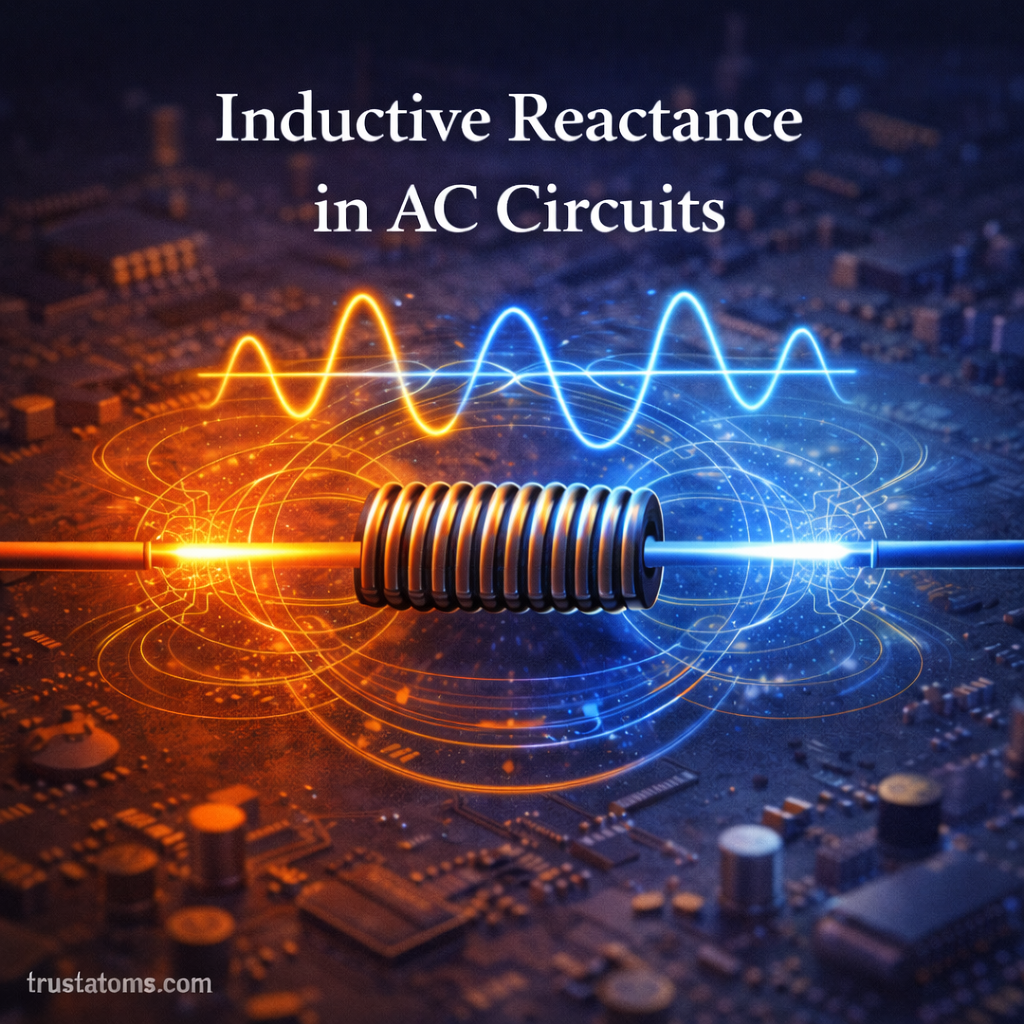
Inductive reactance is the opposition an inductor provides to alternating current due to the changing magnetic field it creates.
Unlike resistance:
- Resistance opposes both AC and DC.
- Inductive reactance only affects AC.
- Inductive reactance depends on frequency.
In simple terms, the faster the current changes direction, the more the inductor resists it.
How Inductors Work
An inductor is typically a coil of wire.
When current flows through the coil:
- A magnetic field forms around it.
- If the current changes, the magnetic field changes.
- A changing magnetic field induces a voltage.
- That induced voltage opposes the change in current.
This behavior is based on electromagnetic induction, discovered by Michael Faraday.
The induced voltage acts against the change in current — this is what creates inductive reactance.
Why Inductive Reactance Only Affects AC
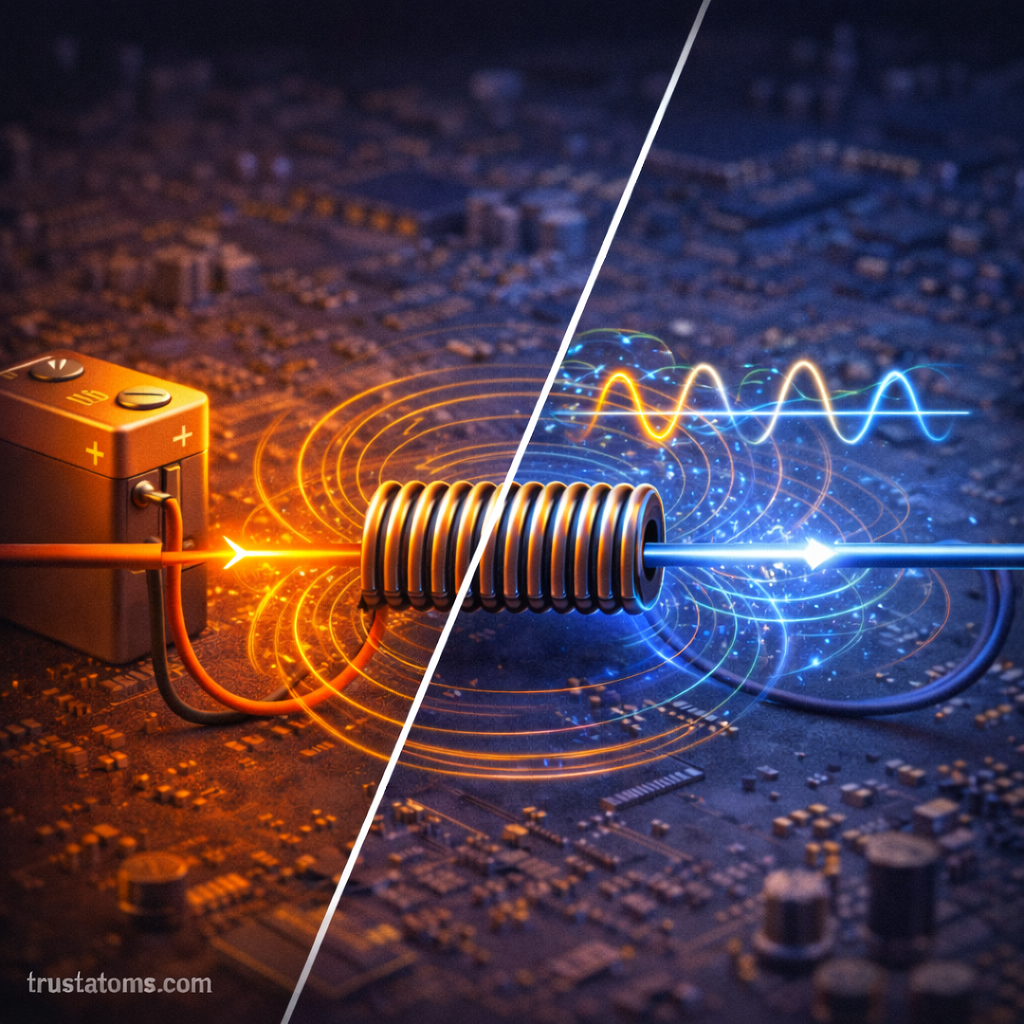
With direct current (DC):
- Current flows in one direction.
- After the initial switch-on moment, the current becomes steady.
- No continuous change means no ongoing induced voltage.
- Reactance effectively becomes zero after steady state.
With alternating current (AC):
- Current continuously changes direction.
- Magnetic fields constantly change.
- Continuous induced voltage occurs.
- The inductor continuously opposes the alternating current.
This is why inductive reactance is an AC-only phenomenon.
The Role of Frequency
Inductive reactance increases with frequency.
This means:
- Low-frequency AC → low reactance
- High-frequency AC → high reactance
At very high frequencies, an inductor can significantly restrict current flow.
This frequency dependence makes inductors extremely useful in filtering and signal control.
Inductive Reactance vs Resistance
Although both oppose current, they behave differently.
Resistance
- Converts electrical energy into heat
- Does not depend on frequency
- Current and voltage stay in phase
Inductive Reactance
- Does not dissipate energy as heat
- Stores energy temporarily in a magnetic field
- Depends on AC frequency
- Causes phase shift between voltage and current
This phase shift is one of the defining characteristics of inductive circuits.
Phase Shift in Inductive Circuits
In purely inductive AC circuits:
- Voltage leads current.
- Current lags behind voltage.
This happens because:
- Voltage changes first.
- Current builds gradually as the magnetic field forms.
- The inductor resists rapid changes.
This phase difference is important in AC power systems and signal processing.
Energy Storage in Inductors
Inductors temporarily store energy in magnetic fields.
During one part of the AC cycle:
- Energy is stored in the magnetic field.
During another part:
- That energy is returned to the circuit.
Unlike resistors, inductors do not permanently consume energy (in ideal conditions).
This energy exchange contributes to reactive power in AC systems.
Inductive Reactance in Real-World Circuits
Inductive reactance plays a major role in many electrical systems.
1. Transformers
Transformers rely on inductive principles to transfer energy between coils.
2. Electric Motors
Motors use magnetic fields and inductance to convert electrical energy into mechanical motion.
3. Power Transmission Systems
Long transmission lines exhibit inductive effects that influence voltage stability.
4. Filters and Signal Processing
Inductors are used in:
- Low-pass filters
- High-frequency blocking circuits
- Radio frequency tuning
Because reactance increases with frequency, inductors can block unwanted high-frequency signals.
Inductive Reactance in Combination Circuits
In most real circuits, inductors are combined with:
- Resistors
- Capacitors
This creates more complex behavior.
For example:
- In an RL circuit (resistor + inductor), current rises gradually when switched on.
- In an RLC circuit (resistor + inductor + capacitor), oscillations can occur.
These interactions are essential in electronics and communication systems.
Practical Example: AC Power Systems
In large electrical grids:
- Transmission lines have inductance.
- Inductive reactance affects voltage regulation.
- Engineers must manage reactive power.
If inductive reactance becomes too high, it can:
- Reduce system efficiency
- Cause voltage instability
Power factor correction techniques are often used to manage these effects.
Advantages of Inductive Reactance
Inductive reactance enables:
- Controlled current flow in AC circuits
- Frequency filtering
- Energy storage without heat loss
- Voltage transformation in transformers
- Efficient motor operation
It’s a foundational concept in electrical engineering.
Limitations and Challenges
While useful, inductive reactance can also cause issues:
- Voltage drops in long transmission lines
- Unwanted phase shifts
- Reduced power factor
- Complicated circuit design at high frequencies
Engineers must carefully design circuits to balance inductive effects.
Why Inductive Reactance Matters
Understanding inductive reactance helps explain:
- How AC circuits behave
- Why current lags voltage in certain systems
- How transformers operate
- Why motors require reactive power
- How frequency filters work
It bridges physics theory with real-world electrical applications.
Final Thoughts
Inductive reactance is the natural opposition an inductor provides to alternating current due to changing magnetic fields.
Unlike resistance, it does not waste energy as heat. Instead, it stores and releases energy in magnetic fields while creating phase differences between voltage and current.
From power grids to electronics and communication systems, inductive reactance shapes how AC circuits operate. Mastering this concept gives you deeper insight into the physics behind modern electrical technology.