Few equations in science are as famous as:
E = mc²
This simple relationship changed physics forever.
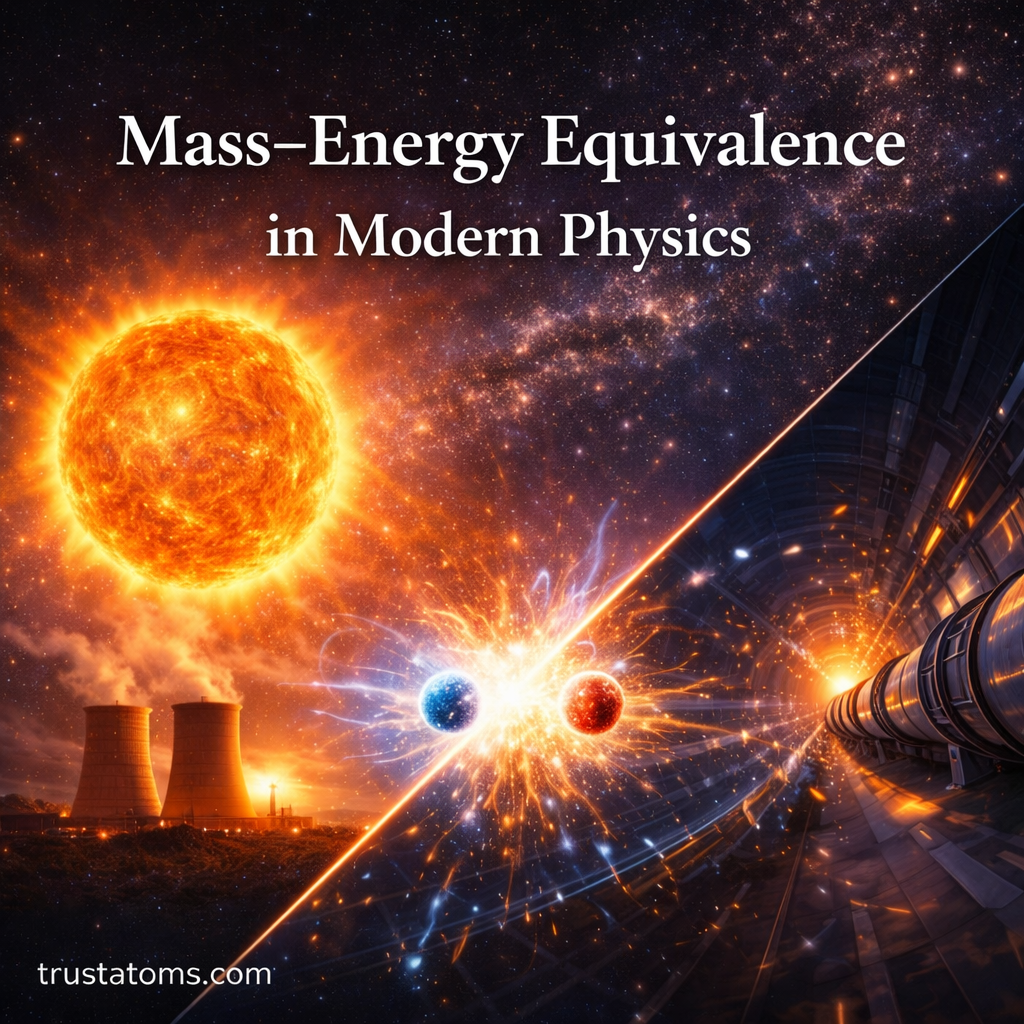
Mass–energy equivalence reveals that mass is not separate from energy. Instead, mass is a highly concentrated form of energy. This insight reshaped our understanding of nuclear reactions, particle physics, cosmology, and even the origin of the universe.
In this guide, we’ll explore what mass–energy equivalence means, where it comes from, and why it remains foundational in modern physics.
What Is Mass–Energy Equivalence?
Mass–energy equivalence states that:
- Mass can be converted into energy.
- Energy can contribute to mass.
- Mass and energy are two forms of the same physical quantity.
The relationship was introduced by Albert Einstein in 1905 as part of special relativity.
In simplified form:
E = mc²
Where:
- E = energy
- m = mass
- c = speed of light
Because the speed of light squared (c²) is an enormous number, even a small amount of mass corresponds to an enormous amount of energy.
Why the Speed of Light Is Squared
The presence of c² is not arbitrary.
The speed of light is fundamental in relativity because it:
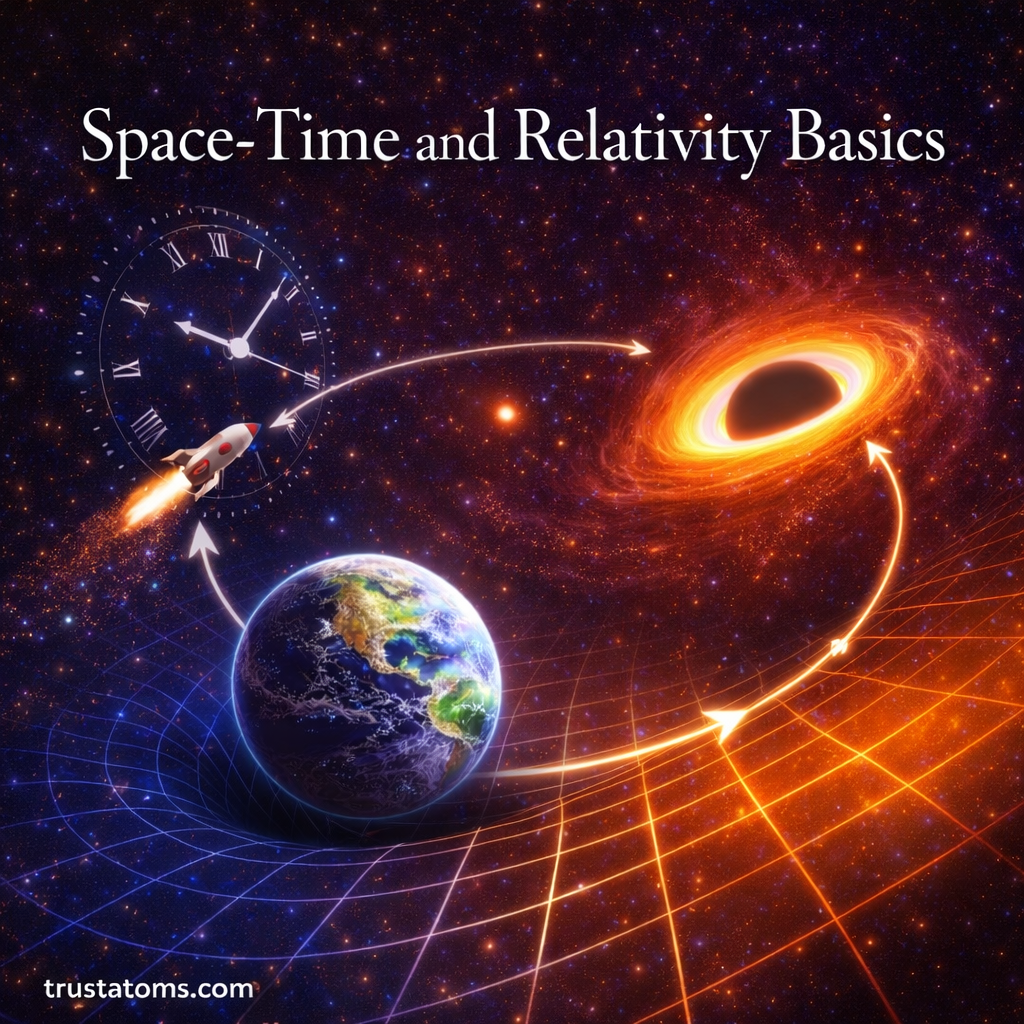
- Connects space and time
- Sets the maximum speed of information transfer
- Appears in the geometry of spacetime
Squaring it dramatically scales the energy value.
For perspective:
- 1 gram of mass contains roughly the energy of a large explosive device.
- The energy locked inside matter is vast.
This does not mean mass constantly turns into energy — it means the potential exists.
Rest Energy: Energy at Zero Motion
Mass–energy equivalence applies even when an object is not moving.
This energy is called rest energy.
Every object with mass contains:
- Intrinsic energy
- Independent of motion
- Present even at absolute rest
This was a revolutionary idea.
Before relativity, mass and energy were considered completely separate concepts.
Where Mass–Energy Conversion Happens
Mass converting into energy is not common in everyday life, but it happens in extreme conditions.
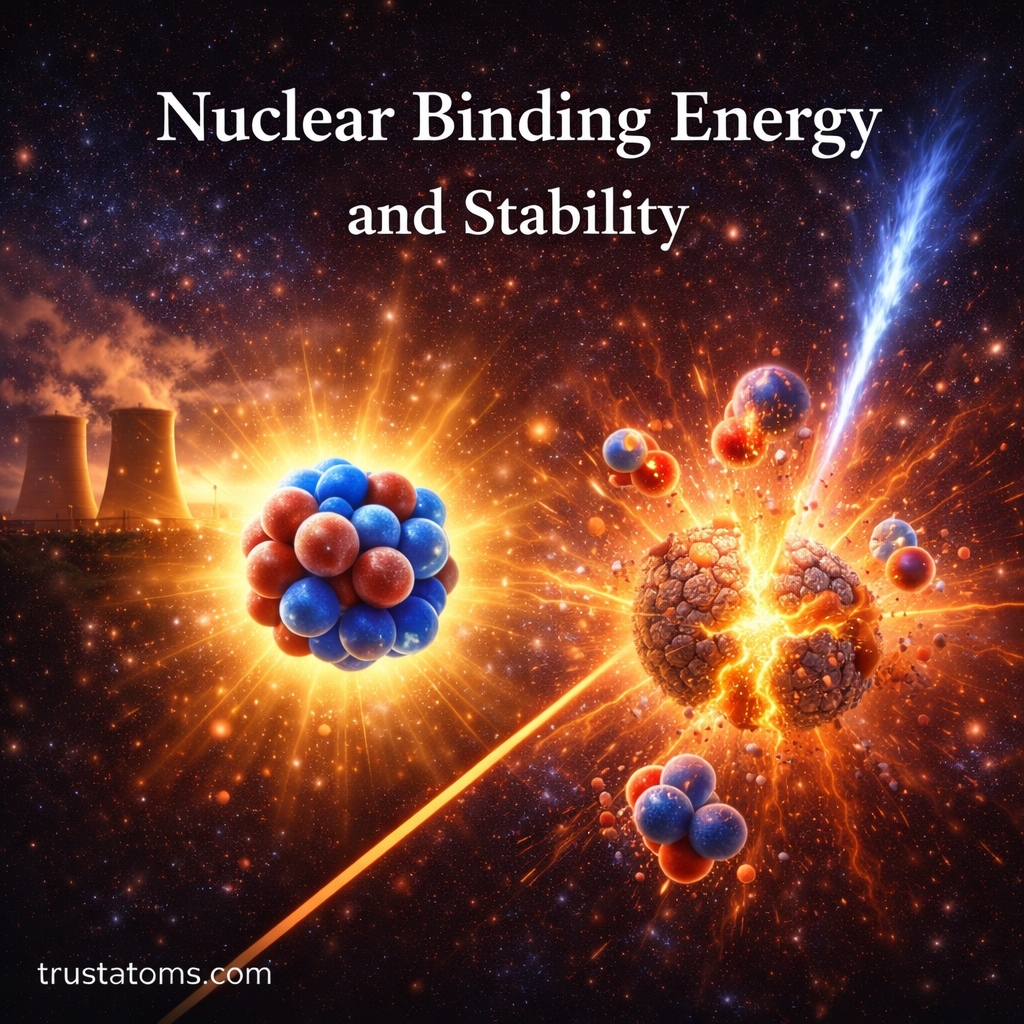
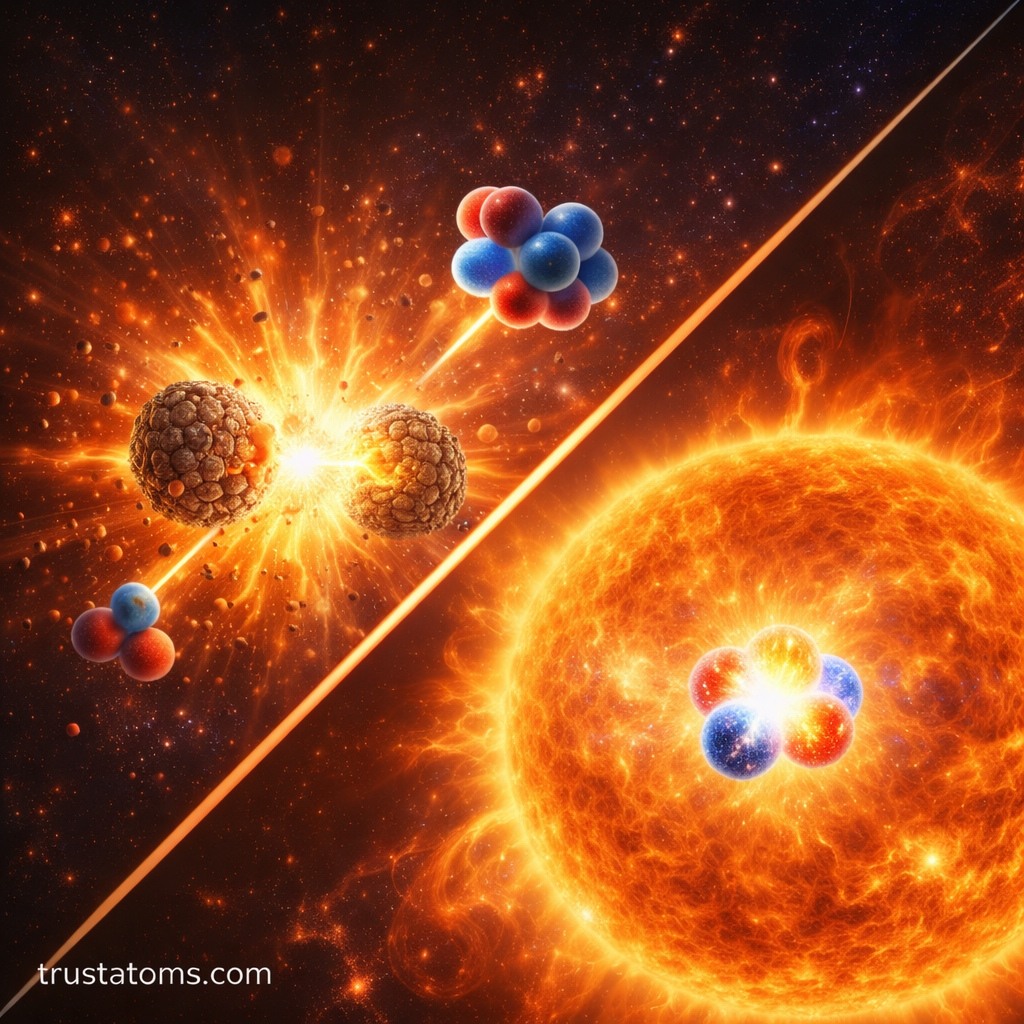
1. Nuclear Fusion
In the Sun:
- Hydrogen nuclei fuse into helium.
- The final mass is slightly less than the starting mass.
- The missing mass becomes energy.
This energy powers sunlight.
2. Nuclear Fission
In nuclear reactors:
- Heavy atoms like uranium split.
- The resulting fragments have slightly less mass.
- That mass difference is released as energy.
3. Particle–Antiparticle Annihilation
When a particle meets its antiparticle:
- Their mass converts entirely into energy.
- Typically released as photons.
This is the most complete form of mass-to-energy conversion observed.
The Role of Mass–Energy in Modern Physics
Mass–energy equivalence is essential in:
- Nuclear physics
- Particle accelerators
- Astrophysics
- Cosmology
At facilities like CERN, high-energy collisions convert kinetic energy into new particles.
In these experiments:
- Energy becomes mass.
- New particles are created.
- Conservation laws remain intact.
This confirms that mass can arise from energy under the right conditions.
Energy Contributing to Mass
Mass–energy equivalence works both ways.
Energy adds to mass.
For example:
- A heated object has slightly more mass than when it is cool.
- A compressed spring weighs more than an uncompressed one.
- A charged battery weighs slightly more than a discharged one.
The differences are tiny — far too small to measure in everyday life — but real.
Energy stored in a system contributes to its total mass.
Mass, Energy, and Momentum
In modern physics, mass–energy equivalence connects with the full energy–momentum relationship.
Total energy includes:
- Rest energy
- Kinetic energy
- Momentum contributions
In high-speed systems:
- Energy increases dramatically.
- Objects resist acceleration more strongly.
- Mass–energy becomes inseparable from motion.
This is especially important in relativistic systems.
Common Misconceptions
Mass–energy equivalence is often misunderstood.
Here are key clarifications:
- E = mc² does not mean mass constantly disappears.
- Ordinary chemical reactions convert negligible mass.
- Only nuclear and high-energy processes produce noticeable conversion.
The equation describes potential equivalence, not constant transformation.
Why Mass–Energy Equivalence Matters
Mass–energy equivalence explains:
- How stars produce energy.
- Why nuclear reactions are so powerful.
- How particles are created in accelerators.
- Why mass is not fundamentally separate from energy.
It also reshaped our philosophical understanding of matter.
Matter is not solid, static substance.
It is condensed energy.
The Broader Impact on Science
Mass–energy equivalence influenced:
- Nuclear energy development
- Particle physics discoveries
- Modern cosmology
- Black hole physics
- Early universe models
Without it, modern theoretical physics would collapse.
It connects relativity, quantum mechanics, and astrophysics into a unified framework.
Final Takeaways
- Mass and energy are equivalent forms of the same physical reality.
- Even stationary objects contain vast rest energy.
- Nuclear reactions convert small amounts of mass into large amounts of energy.
- Energy stored in a system increases its mass.
- Mass–energy equivalence is foundational in modern physics.
This simple equation reshaped humanity’s understanding of matter and power — and remains one of the most profound insights ever discovered.