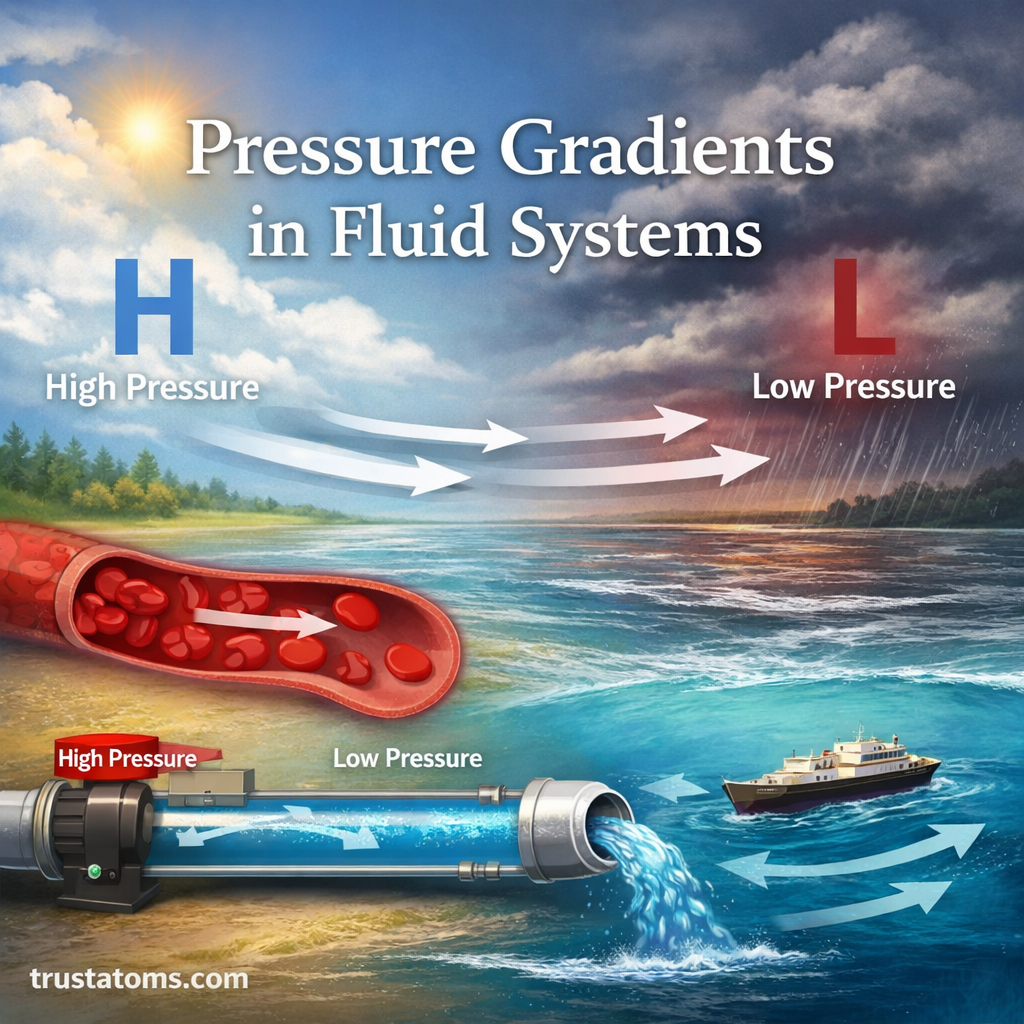
Fluids move for a reason. Whether it’s blood traveling through arteries, air circulating in the atmosphere, or water flowing through a pipe, the driving force is often a pressure gradient.
Understanding pressure gradients in fluid systems is essential in physics, engineering, meteorology, biology, and countless real-world applications. In this guide, we’ll break down what pressure gradients are, how they work, the equations behind them, and why they matter.
What Is a Pressure Gradient?
A pressure gradient is the rate at which pressure changes over a certain distance within a fluid.
In simple terms:
- If pressure is higher in one location
- And lower in another
- The fluid moves from high pressure to low pressure
This difference in pressure per unit distance is the pressure gradient.
Mathematically, the pressure gradient is expressed as:Pressure Gradient=ΔxΔP
Where:
- ΔP = change in pressure
- Δx = change in distance
The steeper the pressure gradient, the stronger the force pushing the fluid.
Why Fluids Move From High to Low Pressure
Fluids naturally move toward equilibrium.
When pressure is unevenly distributed:
- Regions of high pressure contain more force per unit area.
- Regions of low pressure contain less force per unit area.
- The imbalance creates a net force.
- The fluid accelerates toward the lower-pressure region.
This behavior follows Newton’s Second Law: a force causes acceleration. The pressure gradient creates the force.
The Pressure Gradient Force
In physics, the pressure gradient produces a force known as the pressure gradient force (PGF).
The force per unit volume is:F=−∇P
The negative sign means the force points from high pressure toward low pressure.
Key takeaway:
- Large pressure difference over short distance → Strong force
- Small pressure difference over long distance → Weak force
This principle governs airflow, water systems, hydraulics, and even ocean currents.
Pressure Gradients in Static Fluids
In a fluid at rest, pressure changes with height due to gravity. This is called hydrostatic pressure.
The equation is:P=P0+ρgh
Where:
- P₀ = reference pressure
- ρ = fluid density
- g = acceleration due to gravity
- h = height (or depth)
Here, the pressure gradient balances the gravitational force. That’s why pressure increases as you dive deeper underwater.
Pressure Gradients in Moving Fluids
When fluids are moving, pressure gradients actively drive the motion.
Two major principles help explain this:
Bernoulli’s Principle
Bernoulli’s equation shows the relationship between pressure, velocity, and height in a moving fluid:P+21ρv2+ρgh=constant
If fluid velocity increases, pressure decreases.
This explains:
- Airplane wing lift
- Spray bottles
- Chimneys drawing smoke upward
Poiseuille’s Law (Laminar Flow in Pipes)
For fluid flowing through a cylindrical pipe:Q=8μLπr4ΔP
Where:
- Q = flow rate
- r = pipe radius
- ΔP = pressure difference
- μ = viscosity
- L = pipe length
Important insight:
Flow rate increases directly with pressure difference.
A stronger pressure gradient → Faster fluid flow.
Real-World Examples of Pressure Gradients
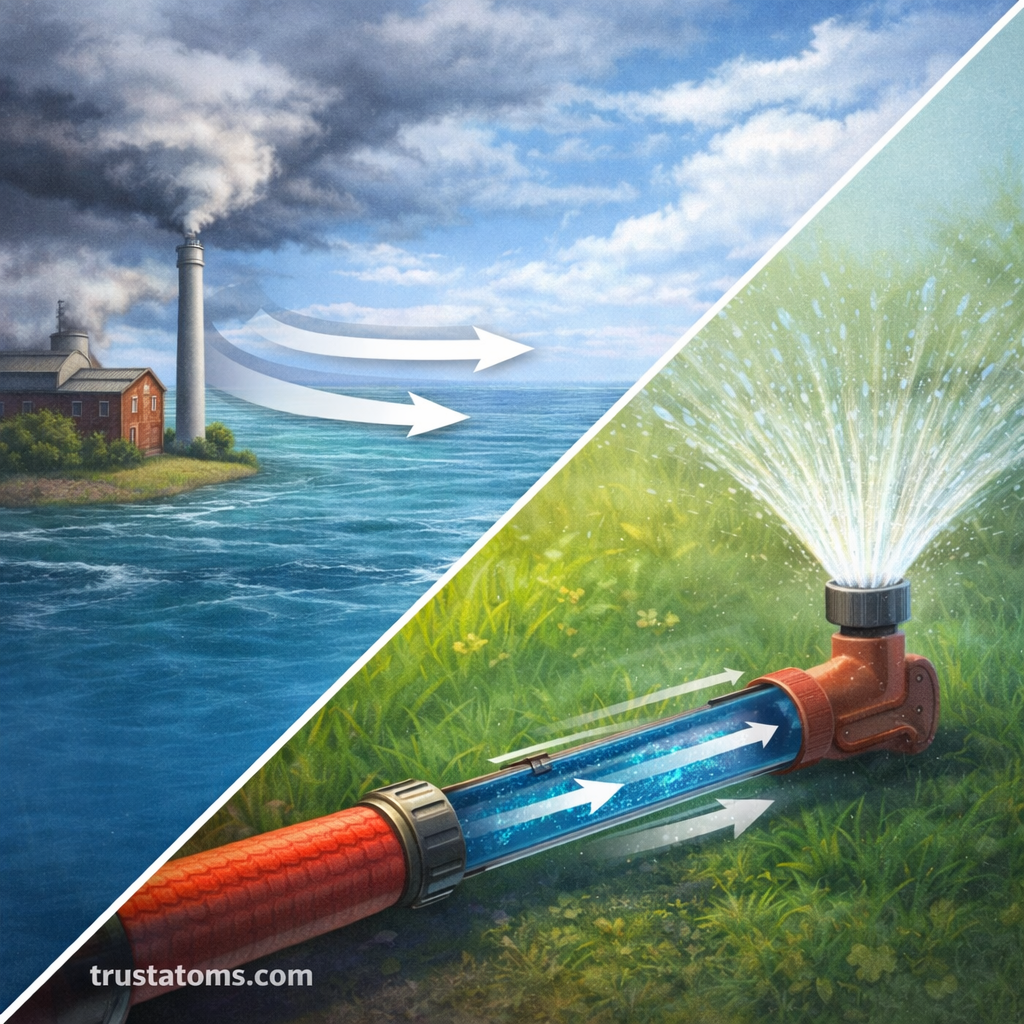
Pressure gradients appear everywhere in science and daily life.
1. Blood Circulation
Your heart creates a pressure gradient:
- High pressure in arteries
- Lower pressure in veins
Blood flows because of that difference.
2. Weather Systems
Wind forms due to atmospheric pressure gradients.
- High-pressure system
- Low-pressure system
- Air flows between them
The steeper the gradient, the stronger the wind.
3. Plumbing Systems
Water flows through pipes because pumps create pressure differences between entry and exit points.
4. Ocean Currents
Differences in pressure caused by temperature and salinity variations help drive large-scale water movement.
Factors That Affect Pressure Gradients
Several variables influence how strong a pressure gradient becomes:
Distance
Shorter distance between high and low pressure = stronger gradient.
Fluid Density
Denser fluids create larger pressure changes with depth.
Viscosity
High-viscosity fluids resist flow even with pressure differences.
Geometry of the System
Narrow pipes increase resistance and require stronger pressure gradients to maintain flow.
Pressure Gradient vs. Other Fluid Forces
Pressure gradient force is not the only force acting on fluids.
In moving systems, fluids also experience:
- Gravity
- Friction (viscous forces)
- External forces (like pumps or fans)
- Coriolis force (in atmospheric and ocean systems)
In real systems, motion results from the balance between these forces.
Pressure Gradients in Engineering Applications
Engineers design systems around controlled pressure differences.
Examples include:
- Hydraulic braking systems
- Air conditioning units
- Ventilation systems
- Industrial piping networks
- Rocket propulsion systems
Understanding how pressure gradients behave allows engineers to:
- Predict flow rates
- Prevent system failure
- Optimize energy efficiency
- Avoid dangerous pressure buildup
Common Misconceptions About Pressure Gradients
Let’s clear up a few misunderstandings:
Pressure is not the same as flow.
High pressure does not guarantee fast movement — the gradient matters.
Equal pressure means no flow.
If pressure is uniform, fluids remain stationary (ignoring external forces).
Pressure decreases “naturally” during flow.
In reality, pressure decreases because energy is transferred or lost due to friction.
Why Pressure Gradients Matter in Physics
Pressure gradients are fundamental to:
- Fluid mechanics
- Thermodynamics
- Meteorology
- Cardiovascular physiology
- Aerospace engineering
They explain how energy moves through fluids and how force is distributed across space.
Without pressure gradients, there would be no wind, no circulation, no pumping systems — and no controlled fluid transport.
Final Thoughts
Pressure gradients are the hidden drivers of motion in fluid systems.
They create forces.
They determine flow rates.
They shape weather patterns.
They power engineering systems.
From microscopic blood vessels to massive atmospheric systems, pressure gradients quietly govern how fluids behave.
Understanding them isn’t just academic — it’s essential to understanding how the physical world moves.