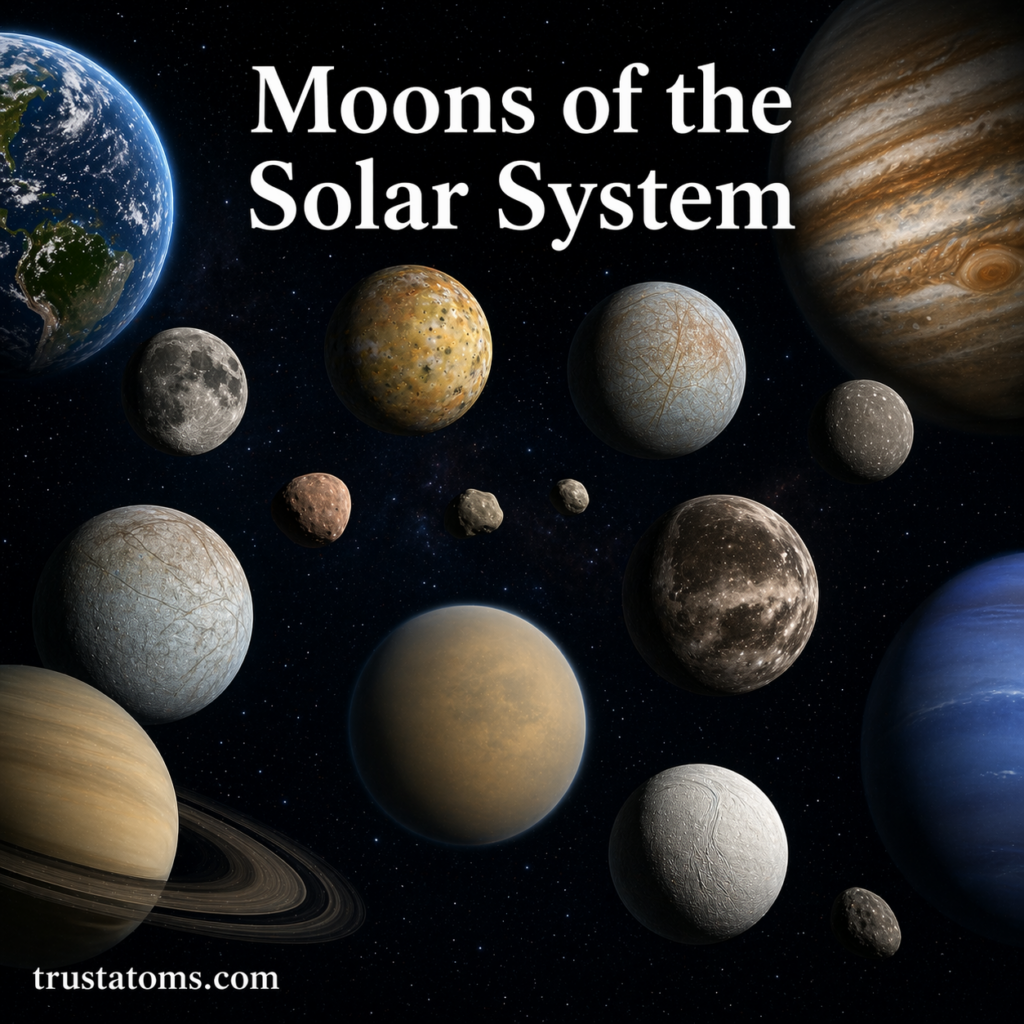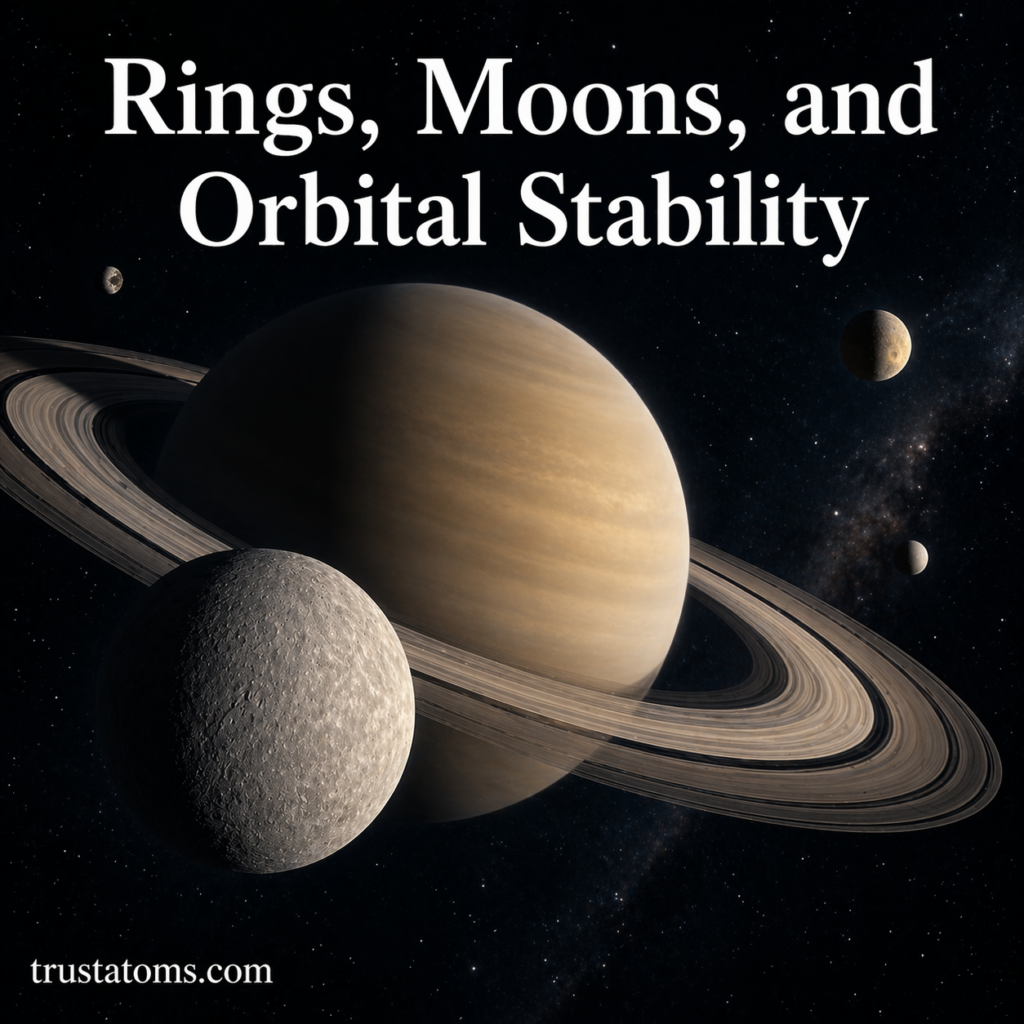
Across the solar system, planets are surrounded by intricate systems of moons and, in some cases, spectacular rings. These features aren’t random—they follow the precise rules of gravity and motion. Understanding how rings form, how moons orbit, and what keeps everything stable reveals the hidden structure behind planetary systems.
From the delicate rings of Saturn to the chaotic motion of irregular moons, orbital stability is key to keeping these systems intact over millions—or even billions—of years.
What Is Orbital Stability?
Orbital stability refers to the ability of an object—such as a moon, ring particle, or spacecraft—to maintain a consistent orbit over time without crashing into its parent planet or drifting away.
Stable orbits depend on a balance between:
- Gravitational pull from the planet
- The object’s velocity (forward motion)
- Interactions with other nearby bodies
If this balance is disrupted, orbits can change, decay, or become chaotic.
How Gravity Governs Motion
Gravity is the central force controlling all orbital systems.
Key Principles
- Objects in orbit are constantly “falling” toward the planet but moving forward fast enough to avoid collision
- Stronger gravity results in tighter, faster orbits
- Larger distances lead to slower orbital speeds
This balance creates predictable orbital paths, often in elliptical shapes.
Planetary Rings: Structure and Formation
Planetary rings are made up of countless small particles—ranging from dust grains to chunks of ice and rock—that orbit a planet in a flat, disk-like structure.
How Rings Form
Rings typically form through:
- The breakup of a moon due to tidal forces
- Collisions between moons or other bodies
- Leftover material from planetary formation
The Roche Limit
The Roche limit is a critical concept in ring formation. It defines the distance within which a celestial body will be torn apart by a planet’s tidal forces.
- Inside this limit: objects cannot clump together into moons
- Outside this limit: gravity allows material to form larger bodies
This is why rings exist close to planets, while moons form farther away.
Moons: Natural Satellites of Planets
Moons vary widely in size, composition, and orbital behavior.
Types of Moons
- Regular moons:
- Orbit close to the planet
- Have nearly circular, aligned orbits
- Likely formed from the same material as the planet
- Irregular moons:
- Orbit at greater distances
- Often have tilted or retrograde orbits
- Likely captured by the planet’s gravity
Orbital Resonance
Some moons interact gravitationally in a way that locks their orbital periods into simple ratios.
Examples include:
- 2:1 resonance (one moon orbits twice for every orbit of another)
- 4:2:1 resonance seen among some of Jupiter’s moons
Resonance can stabilize or destabilize orbits depending on the system.
The Relationship Between Rings and Moons
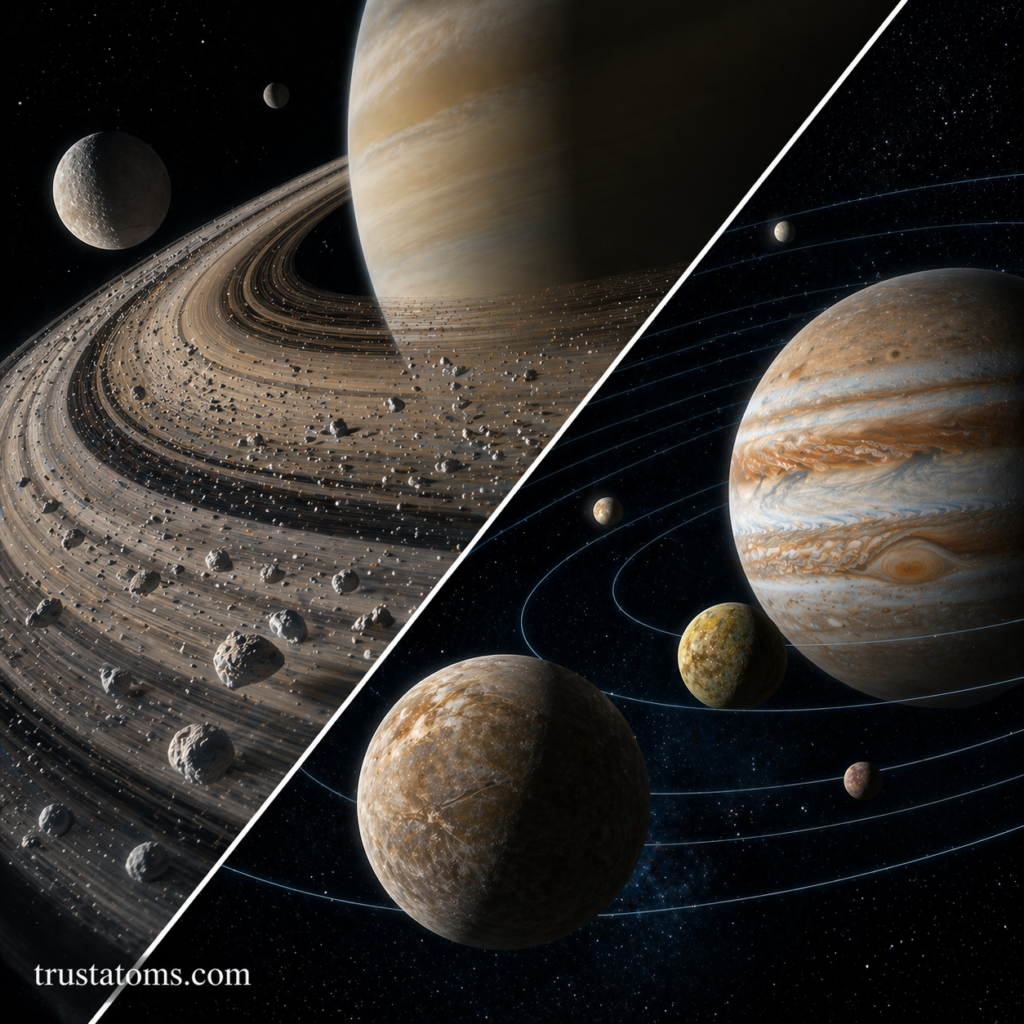
Rings and moons are closely connected.
- Rings can act as “birthplaces” for small moons
- Moons can shape rings through gravitational influence
- Some moons, called shepherd moons, help maintain ring structure
Shepherd Moons
Shepherd moons orbit near the edges of rings and:
- Keep ring particles confined
- Create gaps and sharp boundaries
- Prevent material from dispersing
Without these moons, rings would spread out and fade over time.
Orbital Stability in Complex Systems
In systems with multiple moons and rings, stability becomes more complex.
Factors That Influence Stability
- Distance from the planet
- Closer orbits are more stable but more affected by tidal forces
- Mass of the objects
- Larger moons exert stronger gravitational influence
- Orbital spacing
- Too close, and objects may collide or disrupt each other
- Resonances and interactions
- Can either stabilize motion or create long-term instability
When Orbits Become Unstable
Not all orbits remain stable forever. Instability can lead to dramatic changes.
Possible Outcomes
- Moons colliding with each other
- Objects being ejected from orbit
- Gradual orbital decay leading to planetary impact
- Ring systems dispersing over time
These processes can reshape entire planetary systems.
Real Examples from Our Solar System
Saturn’s Rings and Moons
- Saturn has the most prominent ring system
- Dozens of moons interact with the rings
- Shepherd moons help maintain ring structure
Jupiter’s Moons
- Large moons like Io, Europa, and Ganymede are in orbital resonance
- Gravitational interactions cause tidal heating, especially on Io
Uranus and Neptune
- Both have faint ring systems
- Irregular moons suggest past capture events
- Complex gravitational interactions shape their systems
Why Orbital Stability Matters
Orbital stability is essential for understanding how planetary systems evolve.
It helps scientists:
- Predict long-term behavior of moons and rings
- Understand how planets and satellites formed
- Identify stable regions for spacecraft missions
- Study exoplanet systems beyond our solar system
Stable systems can persist for billions of years, while unstable ones evolve rapidly.
Common Misconceptions
- Rings are not solid—they are made of countless individual particles
- Moons do not orbit randomly—they follow precise gravitational rules
- Stability does not mean permanence—systems can change over time
- Not all planets have rings, but many more than expected do
Final Thoughts
Rings, moons, and orbital stability reveal the delicate balance that governs planetary systems. Through gravity, motion, and interaction, these celestial features create dynamic environments that are constantly evolving.
By studying these systems, scientists gain deeper insight into the mechanics of the universe—and how order can emerge from complex gravitational forces.