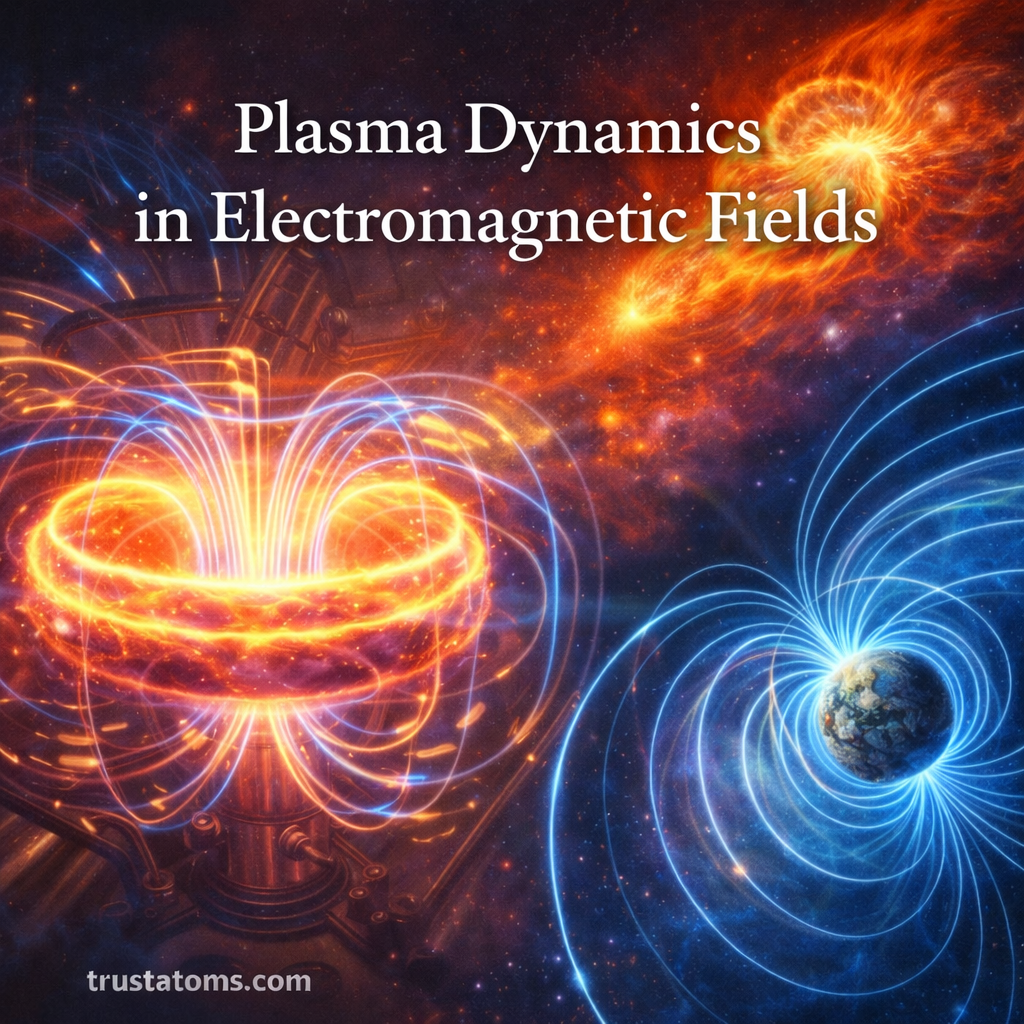
Plasma is often called the fourth state of matter.
It makes up stars, solar flares, lightning, neon lights, and much of the visible universe. But unlike solids, liquids, and gases, plasma behaves very differently — especially when exposed to electric and magnetic fields.
Understanding plasma dynamics in electromagnetic fields is essential in astrophysics, fusion research, space science, and advanced engineering.
In this guide, we’ll explore how plasma forms, how it responds to electric and magnetic forces, and why its motion is so complex and powerful.
What Is Plasma?
Plasma is an ionized gas.
That means:
- Atoms are separated into electrons and ions.
- The particles carry electric charge.
- The material becomes electrically conductive.
Because it contains charged particles, plasma responds strongly to electromagnetic forces.
This makes plasma fundamentally different from neutral gases.
Why Electromagnetic Fields Matter in Plasma
In ordinary fluids, motion is mainly influenced by:
- Pressure gradients
- Gravity
- Viscosity
In plasma, motion is heavily influenced by:
- Electric fields
- Magnetic fields
- Combined electromagnetic forces
These forces can dominate over pressure and gravity, especially in space environments.
The Lorentz Force: The Core of Plasma Motion
The motion of charged particles in plasma is governed by the Lorentz force.
Conceptually, it states that a charged particle experiences force due to:
- Electric fields (which accelerate particles directly)
- Magnetic fields (which change particle direction)
Electric fields push charged particles along the field direction.
Magnetic fields do something different — they cause particles to spiral or curve around magnetic field lines.
This curved motion leads to many unique plasma behaviors.
Charged Particle Motion in Magnetic Fields
When a charged particle enters a magnetic field:
- It experiences a sideways force.
- Its path becomes circular or spiral-shaped.
- It moves along magnetic field lines.
This creates:
- Helical motion
- Cyclotron orbits
- Magnetic confinement effects
These motions are central to plasma physics.
Plasma as a Fluid: Magnetohydrodynamics (MHD)
Although plasma consists of individual charged particles, large-scale behavior can be treated like a fluid.
The field that studies plasma as a conducting fluid is called magnetohydrodynamics (MHD).
MHD combines:
- Fluid dynamics
- Electromagnetism
In MHD, plasma motion and magnetic fields influence each other.
Moving plasma can:
- Stretch magnetic field lines
- Twist magnetic structures
- Generate electric currents
And magnetic fields can:
- Confine plasma
- Redirect plasma flow
- Store enormous amounts of energy
Plasma Confinement and Fusion Research
One of the biggest scientific challenges is controlling plasma for nuclear fusion.
Fusion requires:
- Extremely high temperatures
- Ionized hydrogen plasma
- Stable confinement
Because plasma is so hot, it cannot touch solid walls.
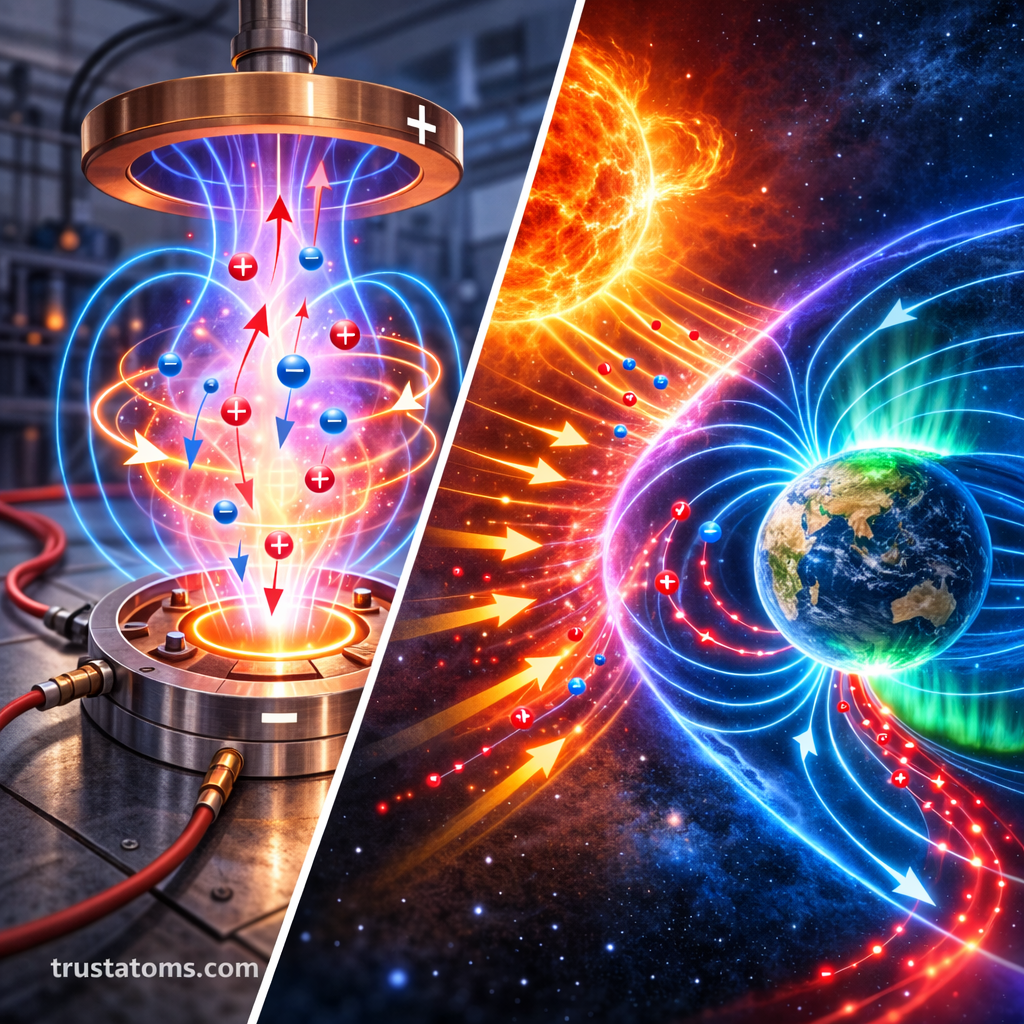
Magnetic fields are used to confine plasma in devices like:
- Tokamaks
- Stellarators
Magnetic confinement works by guiding plasma along closed magnetic loops.
Understanding plasma dynamics is critical to making fusion energy possible.
Plasma in Space: Solar and Astrophysical Phenomena
Most of the visible universe is plasma.
Examples include:
- The Sun
- Solar wind
- Auroras
- Interstellar medium
- Accretion disks around black holes
In space, plasma interacts with planetary magnetic fields.
For example:
- Solar wind particles follow Earth’s magnetic field lines.
- They collide with atmospheric particles.
- This creates auroras.
Magnetic reconnection events in the Sun can release enormous bursts of energy, driving solar flares and coronal mass ejections.
Waves in Plasma
Plasma supports special types of waves that do not occur in ordinary fluids.
Examples include:
- Alfvén waves
- Magnetosonic waves
- Plasma oscillations
These waves arise because electromagnetic forces interact with fluid motion.
Plasma waves play an important role in:
- Energy transport
- Space weather
- Laboratory plasma stability
Plasma Instabilities
Plasma is often unstable.
Small disturbances can grow rapidly due to electromagnetic interactions.
Common instabilities include:
- Kink instabilities
- Rayleigh–Taylor instability (in plasma contexts)
- Drift instabilities
These instabilities can:
- Disrupt fusion experiments
- Trigger solar eruptions
- Redistribute plasma energy
Managing plasma instabilities is one of the hardest problems in plasma physics.
Differences Between Neutral Fluids and Plasma
Plasma differs from normal fluids in several key ways:
- Strong electromagnetic interactions
- Collective behavior of charged particles
- Ability to generate and sustain electric currents
- High sensitivity to magnetic field structure
Unlike water or air, plasma motion is deeply intertwined with electric and magnetic fields.
Applications of Plasma Dynamics
Plasma research has major real-world impact.
Applications include:
- Nuclear fusion energy development
- Space weather prediction
- Satellite protection
- Plasma televisions and neon lighting
- Semiconductor manufacturing
- Plasma propulsion systems for spacecraft
Understanding plasma dynamics allows scientists to predict and control complex electromagnetic behavior.
Why Plasma Dynamics Is So Complex
Plasma dynamics combines multiple physical principles:
- Newton’s laws of motion
- Maxwell’s equations
- Fluid dynamics
- Thermodynamics
- Statistical mechanics
The result is highly nonlinear behavior.
Small changes in electromagnetic conditions can produce large-scale effects.
That’s why plasma is often described as chaotic and difficult to control.
The Big Picture
Plasma dynamics in electromagnetic fields reveals how charged matter moves, twists, and interacts across the universe.
From:
- The glowing surface of the Sun
- To experimental fusion reactors
- To glowing auroras in the sky
Plasma is shaped by electric and magnetic forces.
Understanding those forces allows scientists to:
- Predict solar storms
- Develop fusion energy
- Design advanced propulsion systems
- Explore the physics of the cosmos
Plasma may be the most common state of matter in the universe — and its behavior is one of the most fascinating frontiers in physics.