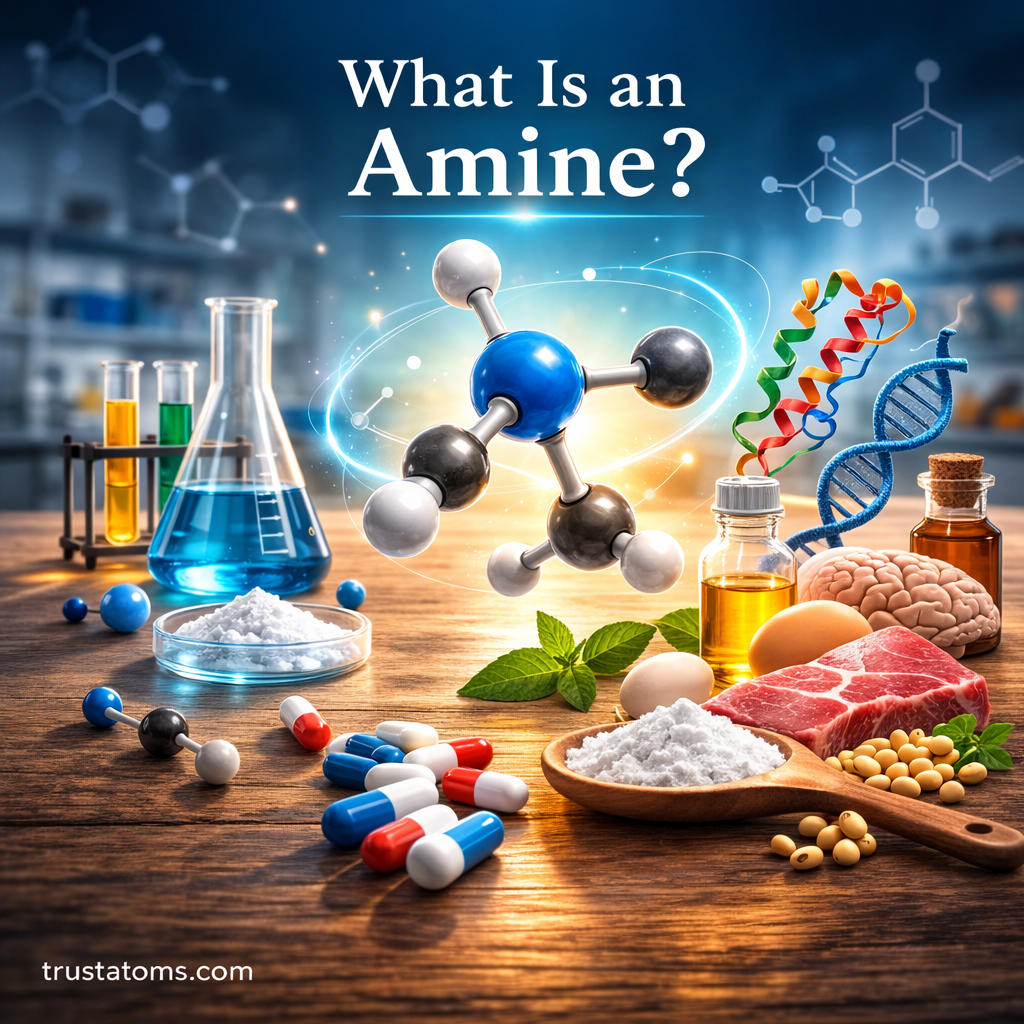
What Is an Amine?

Educational chemistry illustration showing a nitrogen-centered molecular model with laboratory glassware, pills, herbs, and food items representing the biological and industrial roles of amines.
Conceptual illustration showing an amine molecular model surrounded by laboratory equipment, medicines, and natural sources representing the importance of amines in biology and chemistry. trustatoms.com.

Amines are a class of organic compounds derived from ammonia. They are characterized by the presence of a nitrogen atom bonded to carbon-containing groups, which gives them distinctive chemical properties.

These compounds play essential roles in biology, pharmaceuticals, agriculture, and industrial chemistry. Amines are found in many important biological molecules, including amino acids, neurotransmitters, and vitamins. They are also widely used in manufacturing processes and chemical synthesis.

Understanding amines helps explain how nitrogen-containing compounds behave and why they are important in both natural systems and industrial applications.

Continue reading “What Is an Amine?”
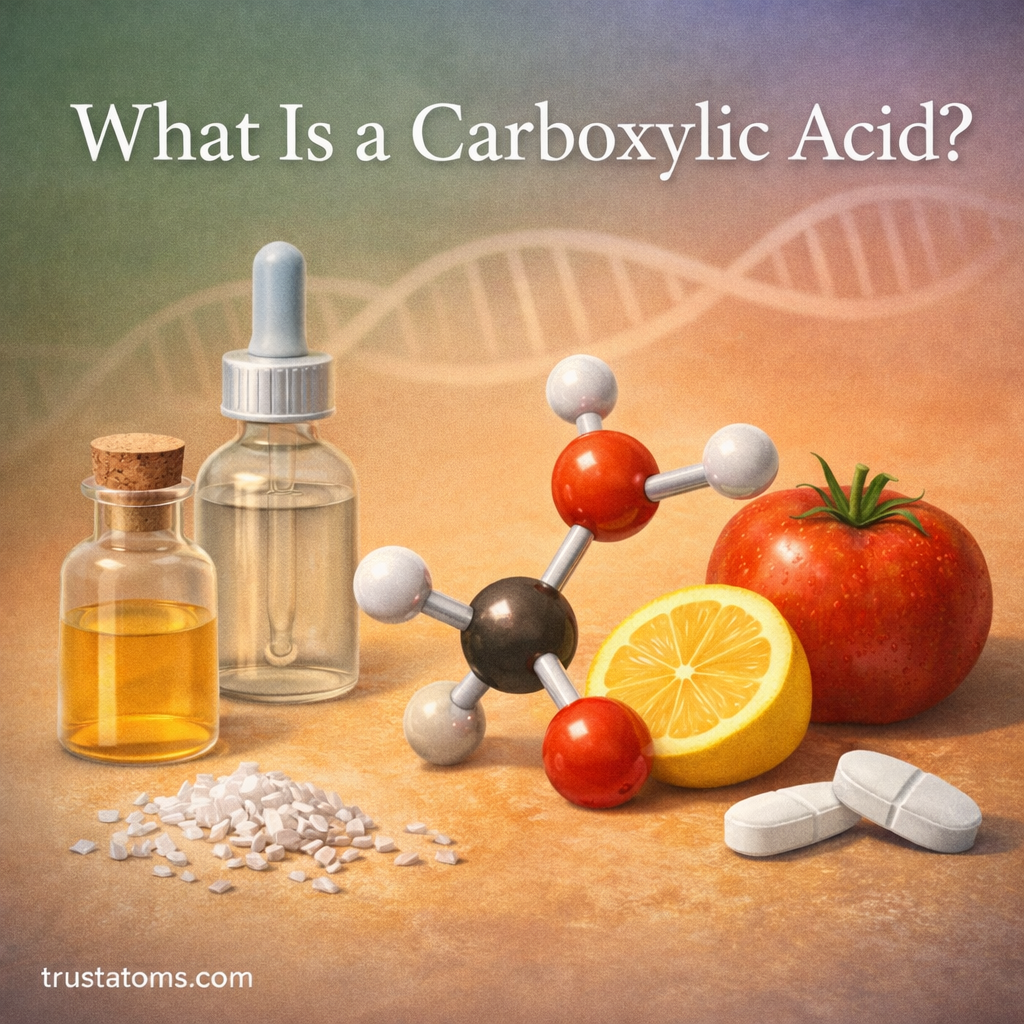
What Is a Carboxylic Acid?

Educational chemistry illustration showing a simple molecular model with lemon, tomato, and laboratory bottles representing natural sources and examples of carboxylic acids.
Conceptual illustration showing a molecular model with citrus, tomato, and laboratory materials representing common examples of carboxylic acids in food, chemistry, and industry. trustatoms.com.

Carboxylic acids are an important class of organic compounds widely found in nature, food, biology, and industrial chemistry. These molecules are defined by the presence of a carboxyl group, a functional group consisting of a carbon atom double-bonded to oxygen and single-bonded to a hydroxyl group.

Carboxylic acids play key roles in many biological and chemical processes. They appear in substances such as vinegar, fatty acids in food, metabolic molecules inside cells, and numerous industrial products.

Understanding carboxylic acids helps explain how acids behave in organic chemistry and why these compounds are so important in both natural systems and chemical manufacturing.

Continue reading “What Is a Carboxylic Acid?”

What Is an Ester?

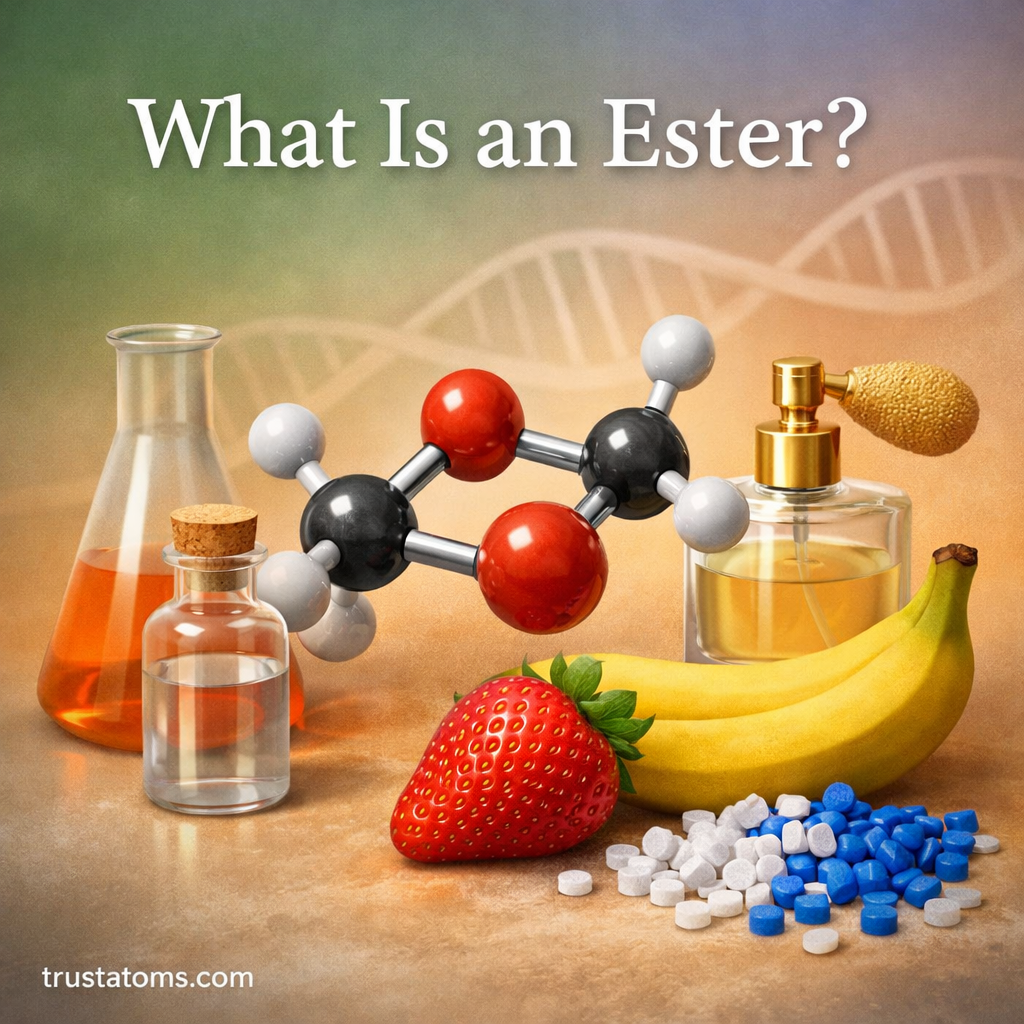
Educational illustration showing an ester molecular model surrounded by fruit, perfume, and laboratory glassware representing ester compounds and their role in flavors and fragrances.
Conceptual illustration showing an ester molecule with fruit, perfume, and lab equipment representing how esters contribute to scents, flavors, and chemistry applications. trustatoms.com.

Esters are a class of organic compounds widely found in nature and commonly used in everyday products such as perfumes, flavorings, and solvents. Chemically, an ester forms when an alcohol reacts with a carboxylic acid in a process known as esterification.

These compounds are known for their pleasant, often fruity aromas, which is why they are frequently used in artificial flavorings and fragrances. Beyond their smells, esters also play important roles in biology, chemistry, and industrial manufacturing.

Understanding esters helps explain how many natural scents and flavors are produced, as well as how certain plastics, solvents, and biological molecules function.

Continue reading “What Is an Ester?”

What Is a Hydrocarbon?

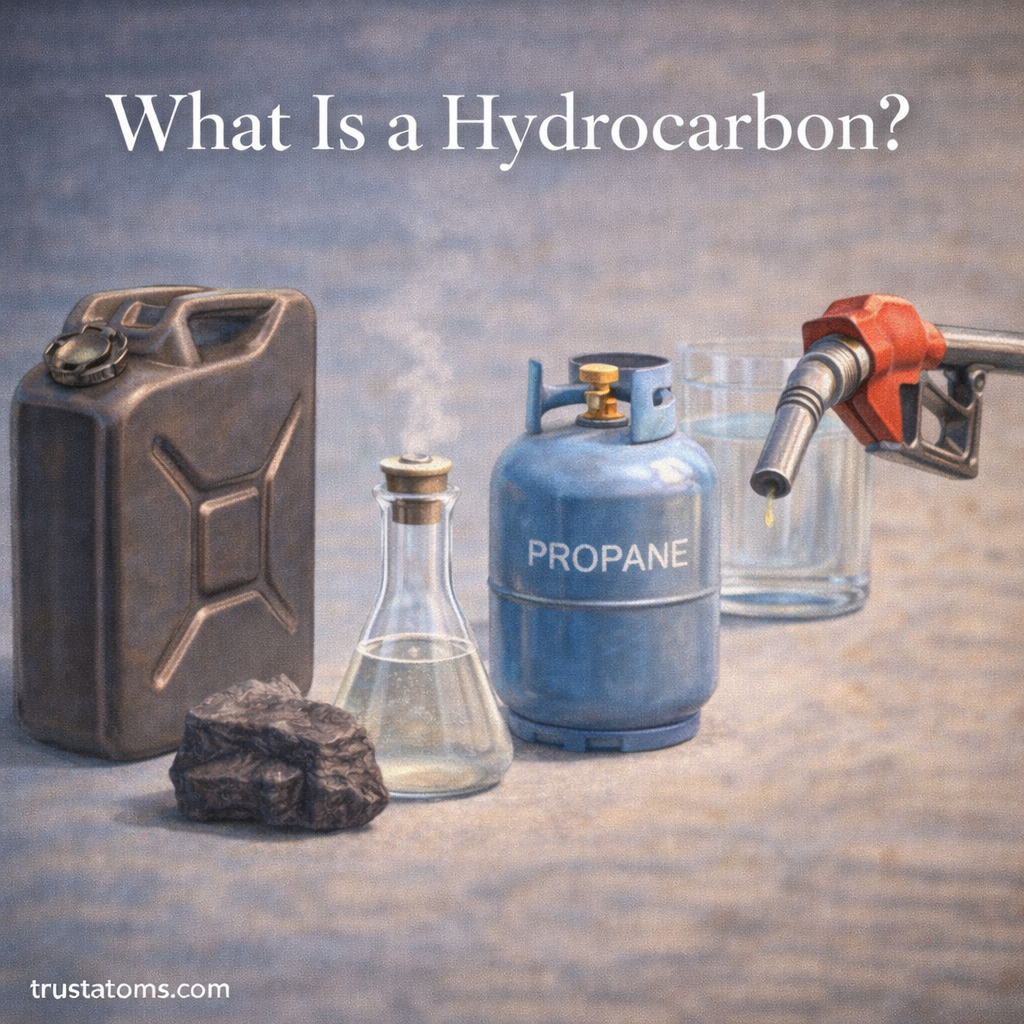
Educational illustration showing hydrocarbon-related materials including coal, gasoline container, propane tank, and fuel pump nozzle.
Illustration showing common hydrocarbon sources such as coal, gasoline, and propane used as fuels and energy resources. trustatoms.com.

Hydrocarbons are some of the most important compounds in chemistry and modern industry. They form the foundation of many fuels, plastics, and organic chemicals used in everyday life.

At their core, hydrocarbons are simple molecules made entirely of hydrogen and carbon atoms. Despite this simplicity, hydrocarbons can form a wide variety of structures and play a central role in energy production and organic chemistry.

This guide explains what hydrocarbons are, how they are classified, and why they are important in science and industry.

Continue reading “What Is a Hydrocarbon?”

What Is a Solute?

Educational illustration showing examples of solutes such as sugar dissolving in tea, minerals dissolving in water, and carbon dioxide bubbles in soda.
Illustration showing examples of solutes dissolving in liquids, including sugar in tea, minerals in water, and carbon dioxide in soda. trustatoms.com.

In chemistry, many substances dissolve into others to form solutions. When this happens, one substance spreads throughout another at the molecular level. The substance that gets dissolved is called the solute.

Solutes play a fundamental role in chemistry, biology, and everyday life. From sugar dissolving in coffee to oxygen dissolving in water for aquatic life, solutes help explain how substances mix and interact.

This guide explains what a solute is, how it works in solutions, common examples, and how solutes differ from solvents.

Continue reading “What Is a Solute?”

What Is a Solvent?

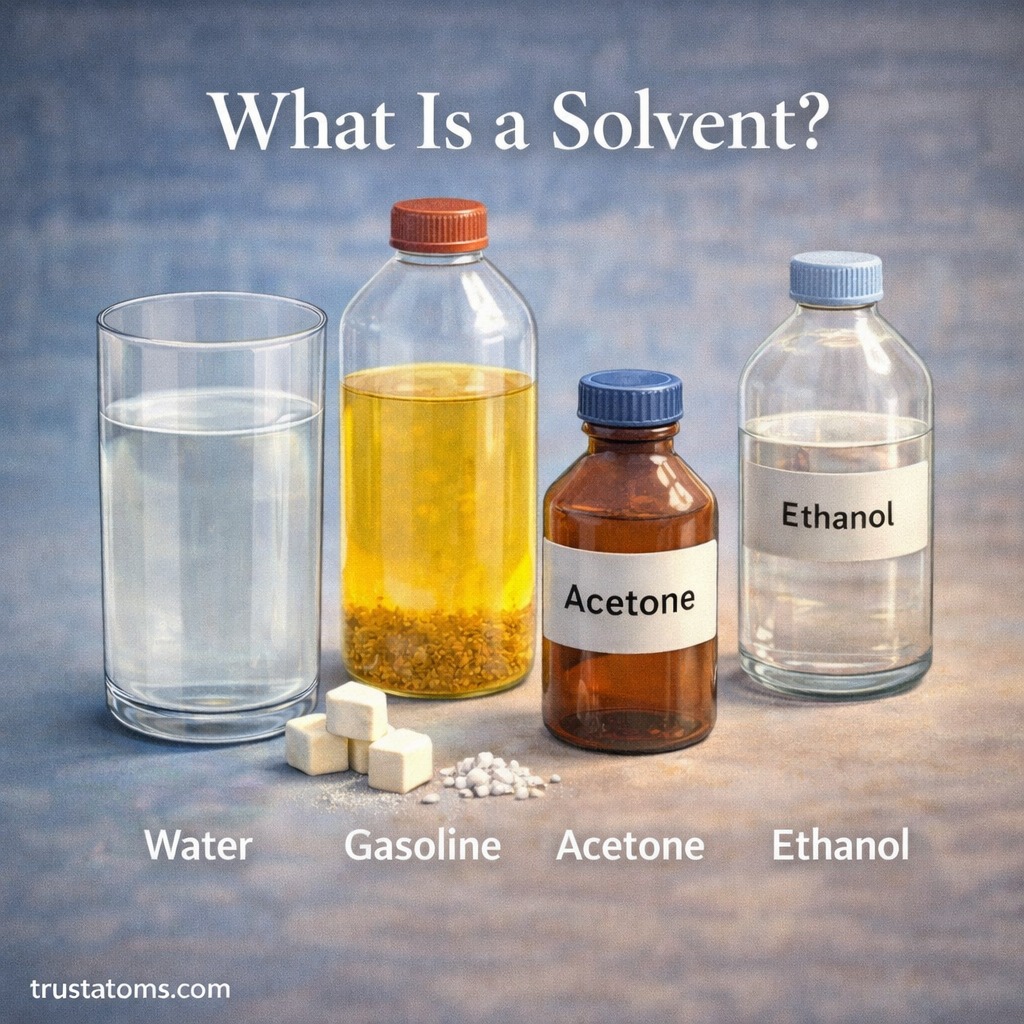
Educational illustration showing examples of solvents including water, gasoline, acetone, and ethanol used to dissolve substances.
Illustration showing common chemical solvents such as water, gasoline, acetone, and ethanol that dissolve other substances to form solutions. trustatoms.com.

In chemistry, many substances mix together to form solutions. In every solution, one substance dissolves another. The substance that performs the dissolving is called the solvent.

Solvents play a major role in chemistry, biology, medicine, and industry. From salt dissolving in water to chemicals used in manufacturing, solvents help substances mix, react, and move through systems.

This guide explains what a solvent is, how it works, common examples, and why solvents are important in chemistry.

Continue reading “What Is a Solvent?”

What Is a Colloid?

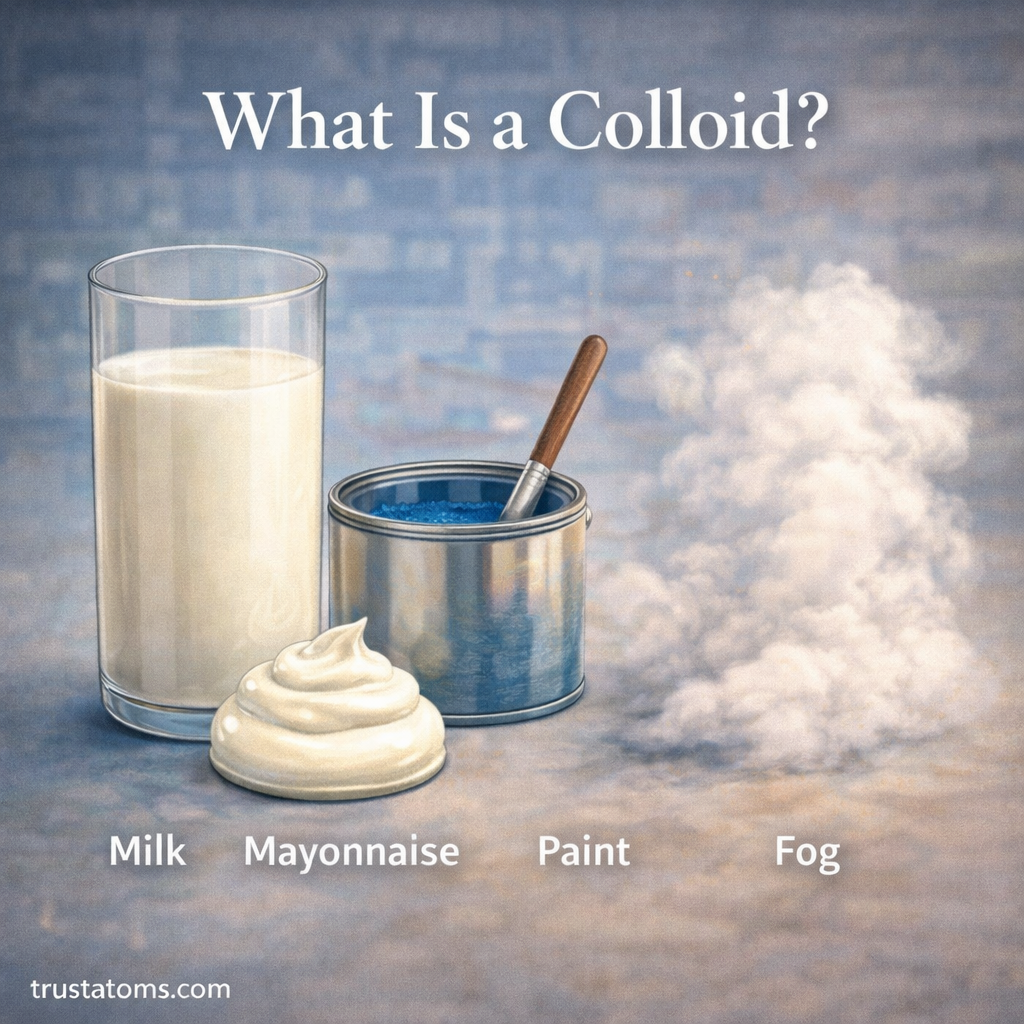
Educational illustration showing examples of colloids including milk, mayonnaise, paint, and fog.
Illustration showing common examples of colloids such as milk, mayonnaise, paint, and fog where tiny particles remain dispersed in a medium. trustatoms.com.

In chemistry, many mixtures do not fit neatly into the categories of solutions or suspensions. Some mixtures contain particles that are small enough to stay dispersed but large enough to scatter light. These mixtures are called colloids.

Colloids are extremely common in everyday life. Milk, fog, mayonnaise, paint, and even whipped cream are examples of colloidal mixtures. Understanding colloids helps explain how particles behave in many natural and industrial systems.

This guide explains what a colloid is, how it works, its key characteristics, and examples of colloids found in daily life.

Continue reading “What Is a Colloid?”

What Is a Suspension?

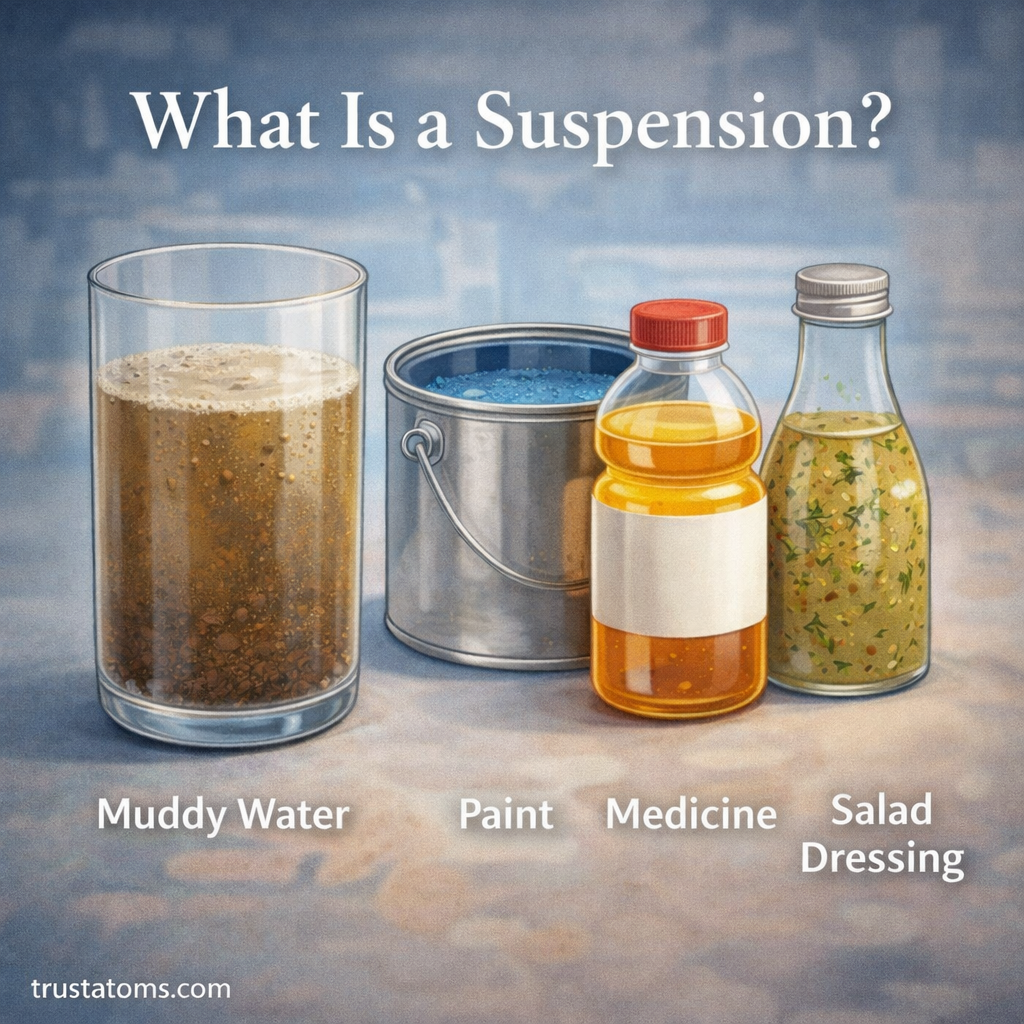
Educational illustration showing examples of suspensions including muddy water, paint, liquid medicine, and salad dressing.
Illustration showing common examples of suspensions such as muddy water, paint, liquid medicine, and salad dressing. trustatoms.com.

In chemistry, mixtures can behave in different ways depending on the size of the particles and how evenly they are distributed. One important type of mixture is called a suspension.

Suspensions are common in both natural systems and everyday products. From muddy water to certain medicines and paints, suspensions help scientists understand how solid particles can remain temporarily mixed within liquids.

This guide explains what a suspension is, how it works, examples of suspensions, and how suspensions differ from other mixtures like solutions and colloids.

Continue reading “What Is a Suspension?”

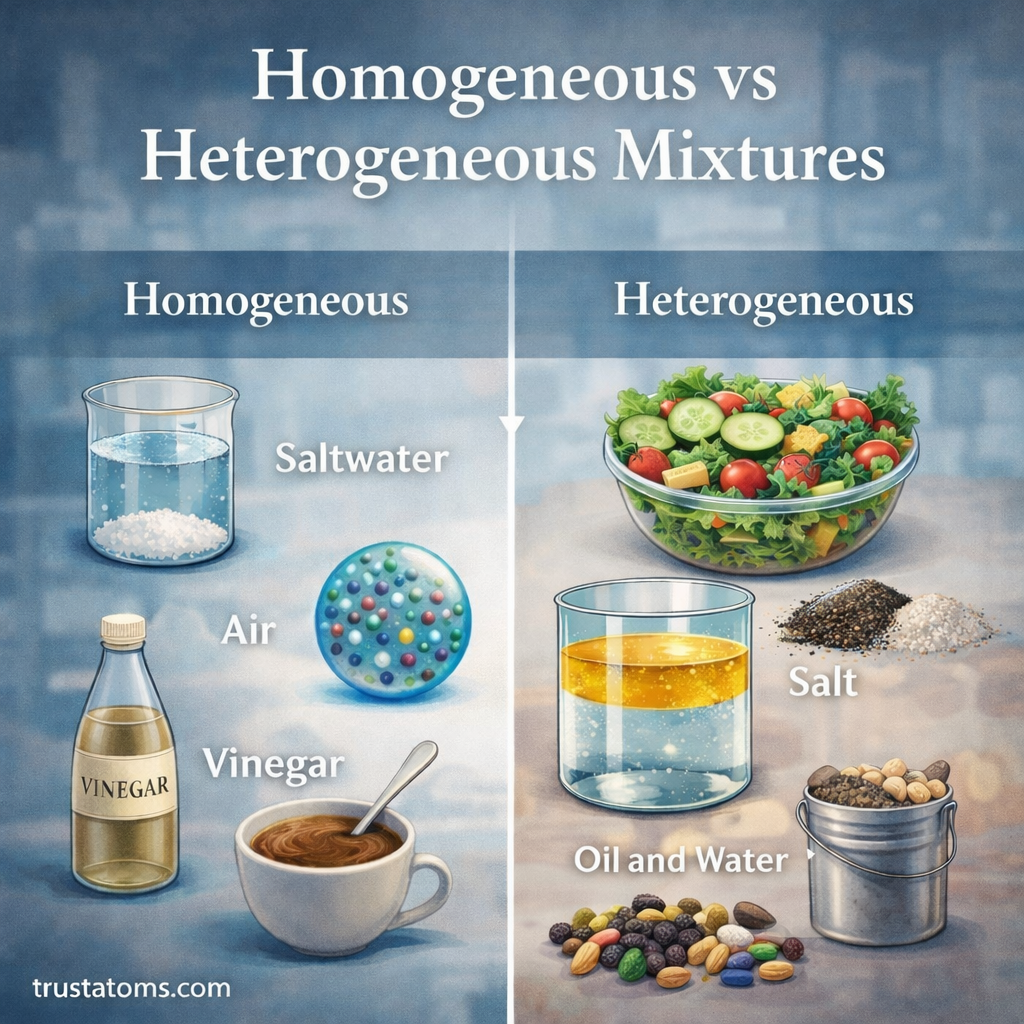
Homogeneous vs Heterogeneous Mixtures

Educational diagram comparing homogeneous and heterogeneous mixtures with examples including saltwater, air, vinegar, oil and water, salad, and mixed materials.
Diagram comparing homogeneous and heterogeneous mixtures with everyday examples such as saltwater, air, vinegar, oil and water, and salad. trustatoms.com.

Mixtures are combinations of two or more substances that are physically combined rather than chemically bonded. While mixtures can vary widely in appearance and composition, they are commonly classified into two main categories: homogeneous mixtures and heterogeneous mixtures.

Understanding the difference between these two types of mixtures helps explain how substances interact, how materials are separated, and how many everyday products are formed.

This guide explores the characteristics, examples, and key differences between homogeneous and heterogeneous mixtures.

Continue reading “Homogeneous vs Heterogeneous Mixtures”

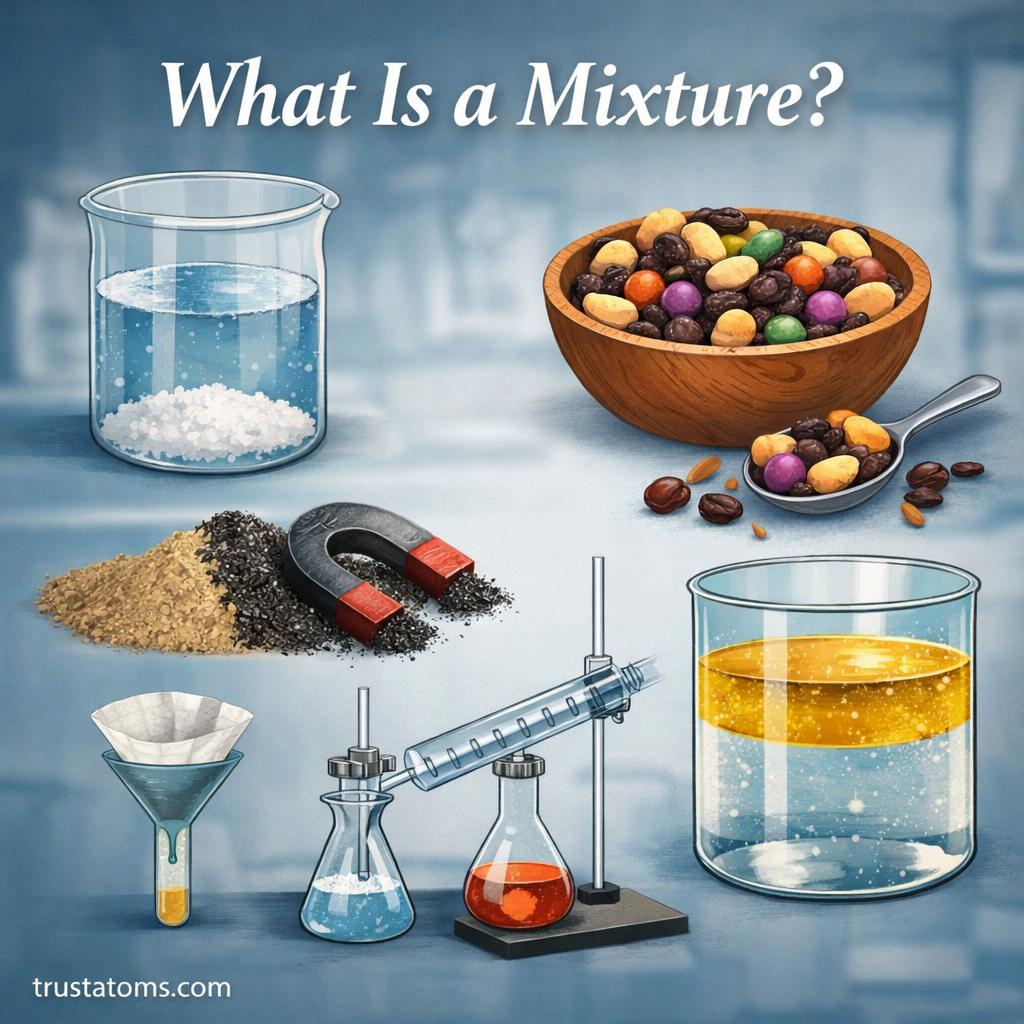
What Is a Mixture?

Educational illustration showing examples of mixtures including saltwater, trail mix, sand and iron filings with a magnet, and oil and water layers.
Illustration showing common examples of mixtures such as saltwater, trail mix, magnetic separation of sand and iron, and oil and water. trustatoms.com.

Mixtures are one of the most common types of matter encountered in everyday life. From the air we breathe to the food we eat, mixtures are everywhere. In chemistry, understanding mixtures helps explain how substances combine physically while still maintaining their individual properties.

This guide explains what a mixture is, the different types of mixtures, and how mixtures differ from compounds.

Continue reading “What Is a Mixture?”