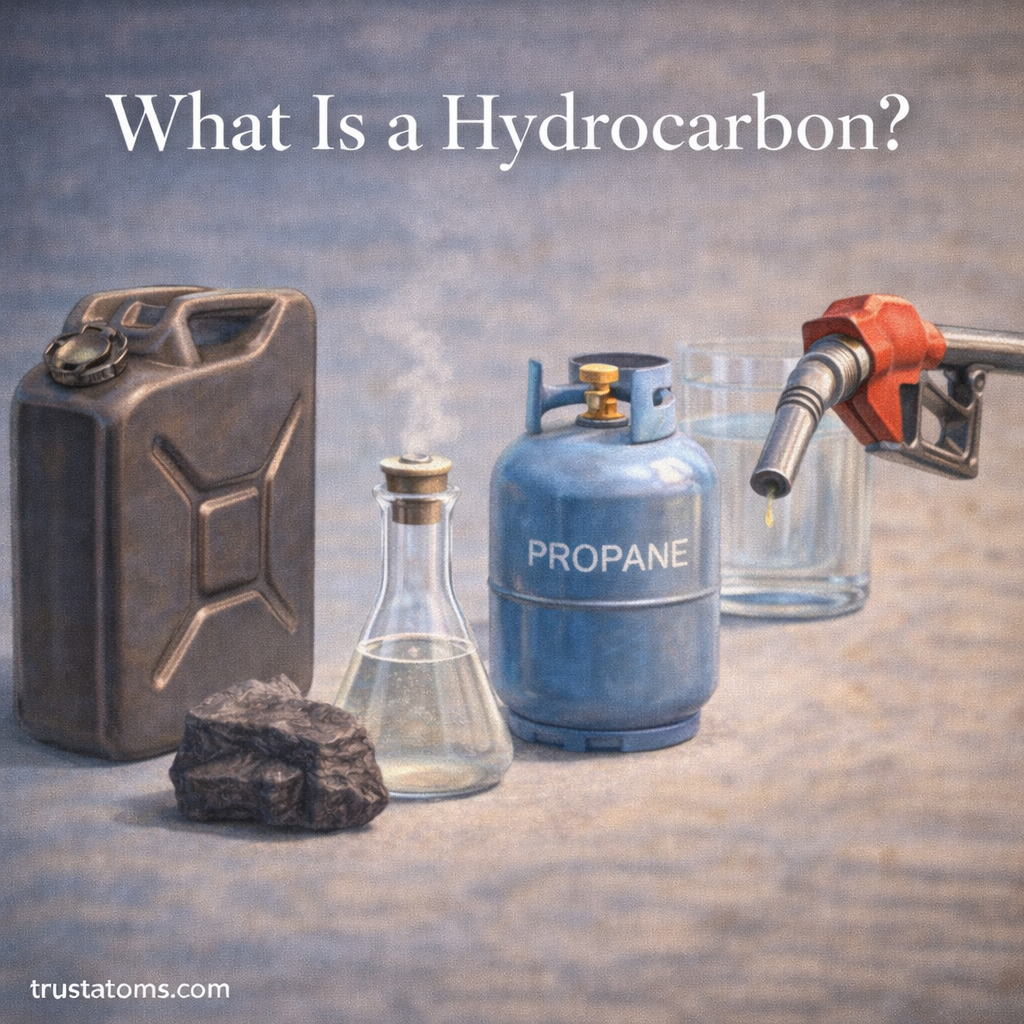
A hydrocarbon is an organic compound made entirely of carbon and hydrogen atoms. Hydrocarbons can form chains, branches, and rings, creating substances with different properties and uses, from methane in natural gas to compounds used to manufacture plastics.
These compounds are studied in chemistry because their bonding patterns explain how fuels burn, how industrial chemicals react, and how carbon-based materials are produced. Hydrocarbons occur naturally in petroleum and natural gas, but they can also be manufactured through chemical processes.
Definition of a Hydrocarbon
A hydrocarbon contains only two elements: carbon (C) and hydrogen (H). Carbon atoms can form four covalent bonds, allowing them to connect with other carbon atoms and hydrogen atoms in many different arrangements.
Methane (CH₄) is the simplest hydrocarbon, containing one carbon atom and four hydrogen atoms. Propane (C₃H₈) contains three carbon atoms, while octane (C₈H₁₈) contains eight. Changes in molecular size and structure affect boiling point, volatility, and chemical behavior.
Hydrocarbons are part of organic chemistry, but not every organic compound is a hydrocarbon. For example, an alcohol in chemistry contains an oxygen-bearing hydroxyl group, so ethanol (C₂H₆O) is not a hydrocarbon.
Hydrocarbons are also important starting materials for making other compounds. In industrial chemistry, organometallic compounds in catalysis help explain how certain metal-containing catalysts transform hydrocarbons into useful chemical products.
How Hydrocarbons Form and Where They Are Found
Many commercially important hydrocarbons occur in petroleum and natural gas. According to geological evidence, these fossil resources formed as buried organic matter underwent chemical changes under heat and pressure over millions of years.
Crude oil contains a complex mixture of hydrocarbons, ranging from relatively small molecules to larger compounds. Natural gas consists mainly of methane, often with smaller amounts of ethane, propane, and other gases.
Coal is another fossil fuel, but it is not itself a pure hydrocarbon or simply a mixture of hydrocarbons. It is a complex carbon-rich material that also contains oxygen, sulfur, nitrogen, mineral matter, and other components.
Hydrocarbons can also be produced through biological and industrial processes. Some microorganisms generate methane, while chemical manufacturing can convert existing hydrocarbon feedstocks into different molecules.
Types of Hydrocarbons
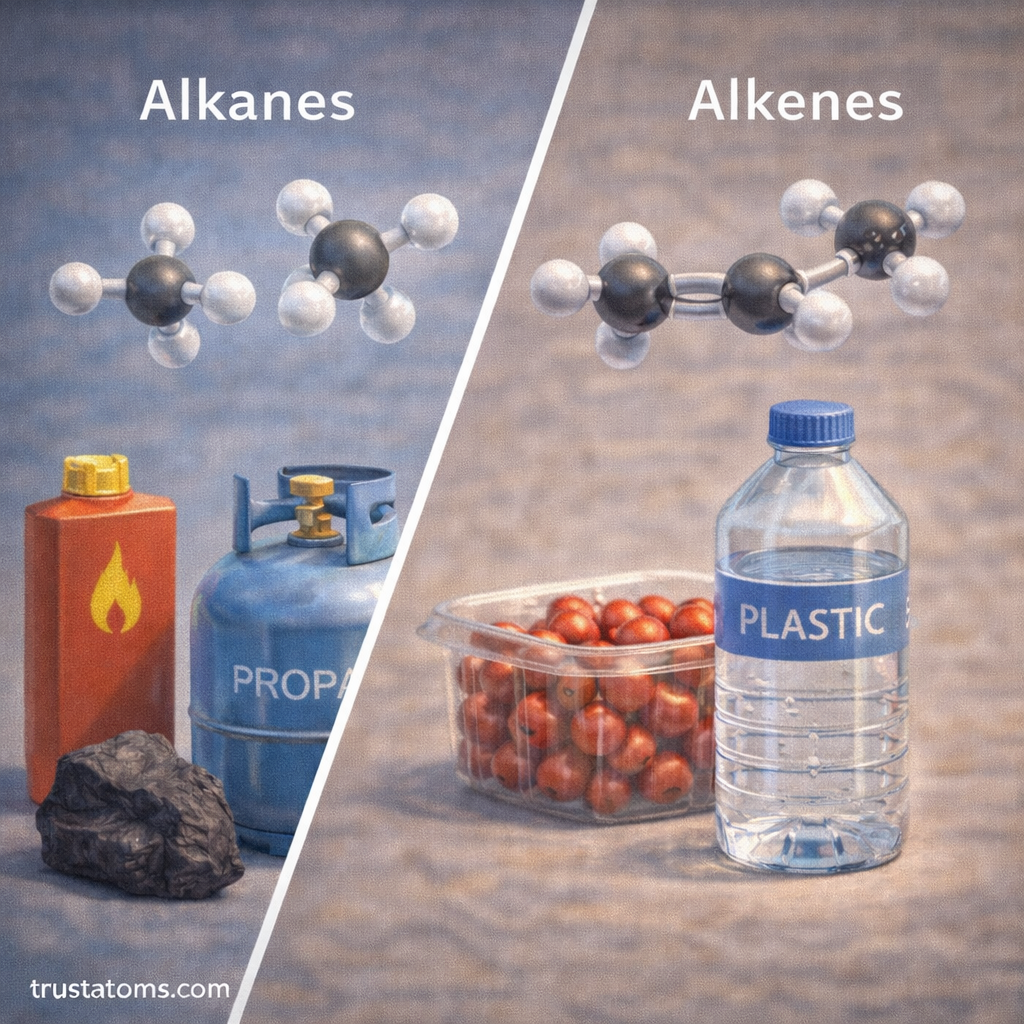
Hydrocarbons are classified according to their carbon bonding and molecular structures. The main groups include alkanes, alkenes, alkynes, and aromatic hydrocarbons.
Alkanes: Saturated Hydrocarbons
Alkanes are hydrocarbons that contain single bonds between carbon atoms. They are called saturated hydrocarbons because their carbon atoms carry the maximum number of hydrogen atoms allowed by their bonding arrangements.
Examples include methane (CH₄), ethane (C₂H₆), propane (C₃H₈), and butane (C₄H₁₀). Acyclic alkanes follow the general formula CₙH₂ₙ₊₂. Many are used as fuels because their combustion releases substantial energy.
Alkenes: Hydrocarbons With Double Bonds
Alkenes contain at least one double bond between carbon atoms. They are unsaturated hydrocarbons, and their carbon–carbon double bonds allow reactions such as addition and polymerization.
Ethene (C₂H₄) and propene (C₃H₆) are common examples. Ethene molecules can join together through polymerization to form polyethylene, a plastic widely used in packaging and containers.
Alkynes: Hydrocarbons With Triple Bonds
Alkynes contain at least one carbon–carbon triple bond. The simplest example is ethyne (C₂H₂), commonly called acetylene. Acetylene is used in oxyacetylene torches because burning it with oxygen can produce a high-temperature flame suitable for metalworking.
Aromatic Hydrocarbons: Stable Ring Systems
Aromatic hydrocarbons contain special ring systems with delocalized electrons. Benzene (C₆H₆) is a familiar example, consisting of six carbon atoms arranged in a ring with hydrogen atoms attached.
Aromatic compounds are important industrial feedstocks, but some, including benzene, present serious health hazards and require controlled handling.
Comparing Common Hydrocarbon Types
| Type | Bonding Feature | Example | Common Application |
|---|---|---|---|
| Alkane | Carbon–carbon single bonds | Propane (C₃H₈) | Heating and cooking fuel |
| Alkene | Carbon–carbon double bond | Ethene (C₂H₄) | Plastic manufacturing |
| Alkyne | Carbon–carbon triple bond | Ethyne (C₂H₂) | Welding and metal cutting |
| Aromatic | Delocalized electrons in aromatic rings | Benzene (C₆H₆) | Chemical manufacturing |
How Hydrocarbon Structure Affects Properties
Hydrocarbons are generally nonpolar or weakly polar, so most do not dissolve readily in water. They are usually more soluble in nonpolar liquids, and their physical properties vary considerably with molecular size and shape.
Small hydrocarbons such as methane and propane are gases at room temperature and ordinary pressure. Larger hydrocarbons may be liquids or solids because increasing molecular size generally strengthens intermolecular attractions.
Branching also affects properties. For example, straight-chain pentane and its more highly branched isomers have the same molecular formula, C₅H₁₂, but different boiling points because their molecular shapes influence intermolecular forces.
Hydrocarbon Combustion: A Worked Example
When a hydrocarbon burns completely in sufficient oxygen, its carbon atoms form carbon dioxide and its hydrogen atoms form water. The reaction releases energy that can be used for heating, transportation, or electricity generation.
For methane, the balanced combustion equation is:
CH₄ + 2O₂ → CO₂ + 2H₂O
This equation shows that one methane molecule reacts with two oxygen molecules to produce one carbon dioxide molecule and two water molecules. On a larger scale, burning one mole of methane requires two moles of oxygen and theoretically produces one mole of carbon dioxide and two moles of water.
When oxygen is insufficient, incomplete combustion can produce carbon monoxide and soot. Carbon monoxide is particularly dangerous because it is a poisonous gas that can accumulate in poorly ventilated spaces.
Everyday Uses of Hydrocarbons
Hydrocarbons provide both energy and raw materials for manufacturing. Their applications depend on their molecular structure, reactivity, and physical properties.
- Transportation: gasoline, diesel, and aviation fuels contain mixtures of hydrocarbons.
- Heating and cooking: natural gas and propane are commonly burned to produce heat.
- Plastics: ethene and propene are used to manufacture polyethylene and polypropylene.
- Industrial chemicals: hydrocarbons provide starting materials for solvents, synthetic rubber, and other chemical products.
Many finished products derived from hydrocarbons are not themselves hydrocarbons. For example, polyester fabrics contain oxygen atoms, while some detergents contain sulfur or other elements in addition to carbon and hydrogen.
Environmental Effects of Hydrocarbon Use
Burning fossil-derived hydrocarbons releases carbon dioxide, a greenhouse gas that contributes to climate change. Combustion can also produce pollutants, including nitrogen oxides, carbon monoxide, and particulate matter, depending on the fuel and burning conditions.
Unburned hydrocarbons can affect air quality, and methane released into the atmosphere is itself a potent greenhouse gas. Petroleum leaks and spills may contaminate soil and water and harm ecosystems.
These concerns encourage improvements in combustion efficiency, pollution controls, leak prevention, and the development of energy sources that reduce dependence on fossil fuels.
Frequently Asked Questions
Is gasoline a hydrocarbon?
Gasoline is not a single hydrocarbon. It is a mixture containing many hydrocarbons, along with additives and sometimes oxygen-containing compounds such as ethanol. Its exact composition varies by formulation.
Are all hydrocarbons fossil fuels?
No. Hydrocarbons can occur naturally outside fossil fuel deposits and can also be produced synthetically. Methane, for example, can be generated by microorganisms under oxygen-free conditions.
What is the difference between saturated and unsaturated hydrocarbons?
Saturated hydrocarbons contain only single carbon–carbon bonds, while unsaturated hydrocarbons contain carbon–carbon double or triple bonds. This distinction affects their chemical reactivity and the reactions they can undergo.
Hydrocarbons are compounds made exclusively of carbon and hydrogen, but differences in their bonds and structures produce a wide range of properties. Alkanes are widely used as fuels, while alkenes, alkynes, and aromatic hydrocarbons support many chemical manufacturing processes. Understanding their composition and reactions also helps explain both the usefulness and environmental consequences of hydrocarbon-based resources.
Sources: OpenStax, Organic Chemistry: A Tenth Edition; IUPAC, Compendium of Chemical Terminology (Gold Book); U.S. Energy Information Administration, Energy Explained.