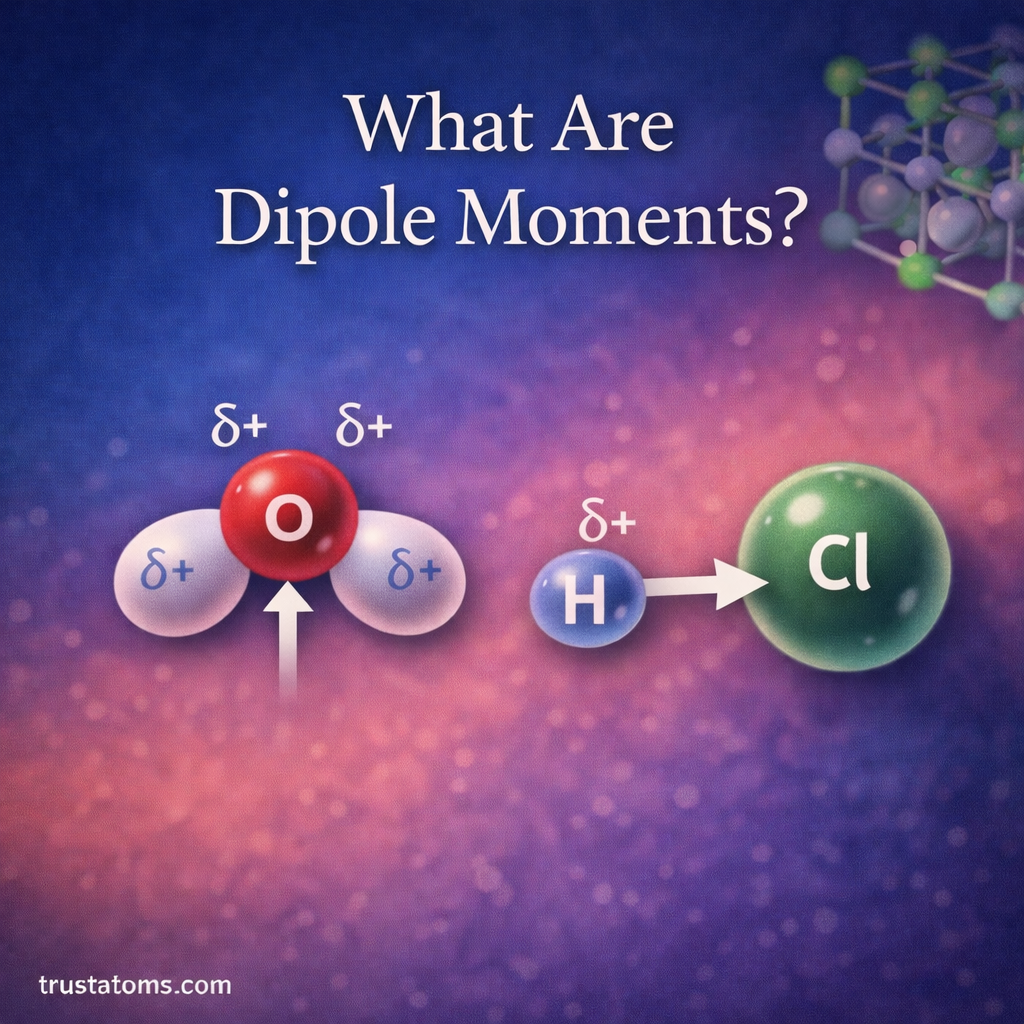
What Are Dipole Moments?

Chemistry diagram showing dipole moments in water and hydrogen chloride molecules with arrows indicating electron attraction.
Illustration of dipole moments showing electron attraction in water and hydrogen chloride molecules. trustatoms.com.

Dipole moments are an important concept in chemistry that describe how electrical charge is distributed within a molecule. When electrons are not shared evenly between atoms, parts of the molecule become slightly positive or slightly negative.

This separation of charge creates a dipole, which affects how molecules interact with each other. Dipole moments help chemists understand molecular polarity, intermolecular forces, solubility, and chemical reactions.

By studying dipole moments, scientists can predict how molecules behave in liquids, gases, biological systems, and chemical reactions.

Continue reading “What Are Dipole Moments?”
What Is Bond Polarity?

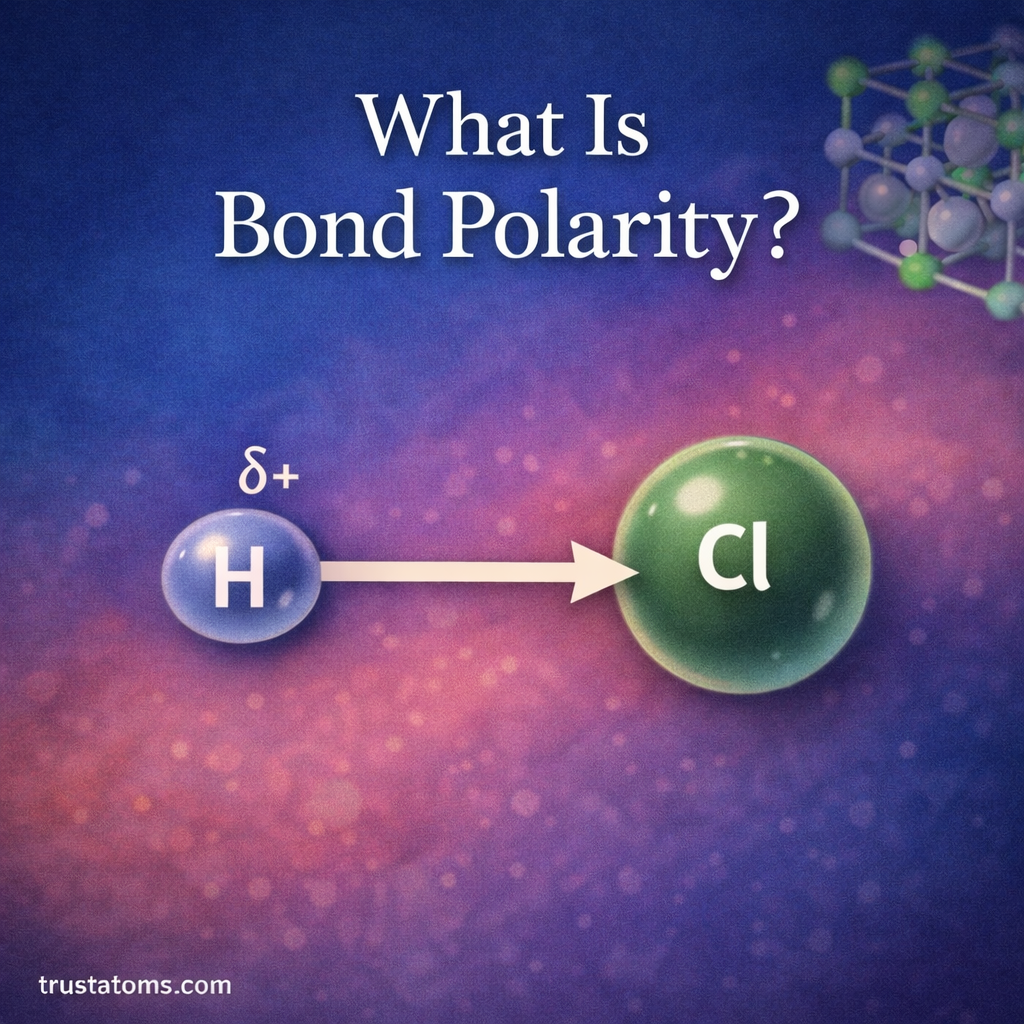
Chemistry diagram showing a polar bond between hydrogen and chlorine with a dipole arrow and partial charges illustrating bond polarity.
Simple chemistry illustration of bond polarity showing unequal electron sharing between hydrogen and chlorine atoms. trustatoms.com.

Bond polarity is a fundamental concept in chemistry that explains how electrons are shared between atoms in a chemical bond. Some atoms pull shared electrons more strongly than others, creating an uneven distribution of electron density.

This unequal sharing produces partial positive and partial negative regions within molecules, which affects how substances interact, dissolve, and react chemically.

Understanding bond polarity helps explain many chemical behaviors, including why water dissolves salt, how molecules attract each other, and why some substances mix while others do not.

Continue reading “What Is Bond Polarity?”

What Is Electronegativity Difference?

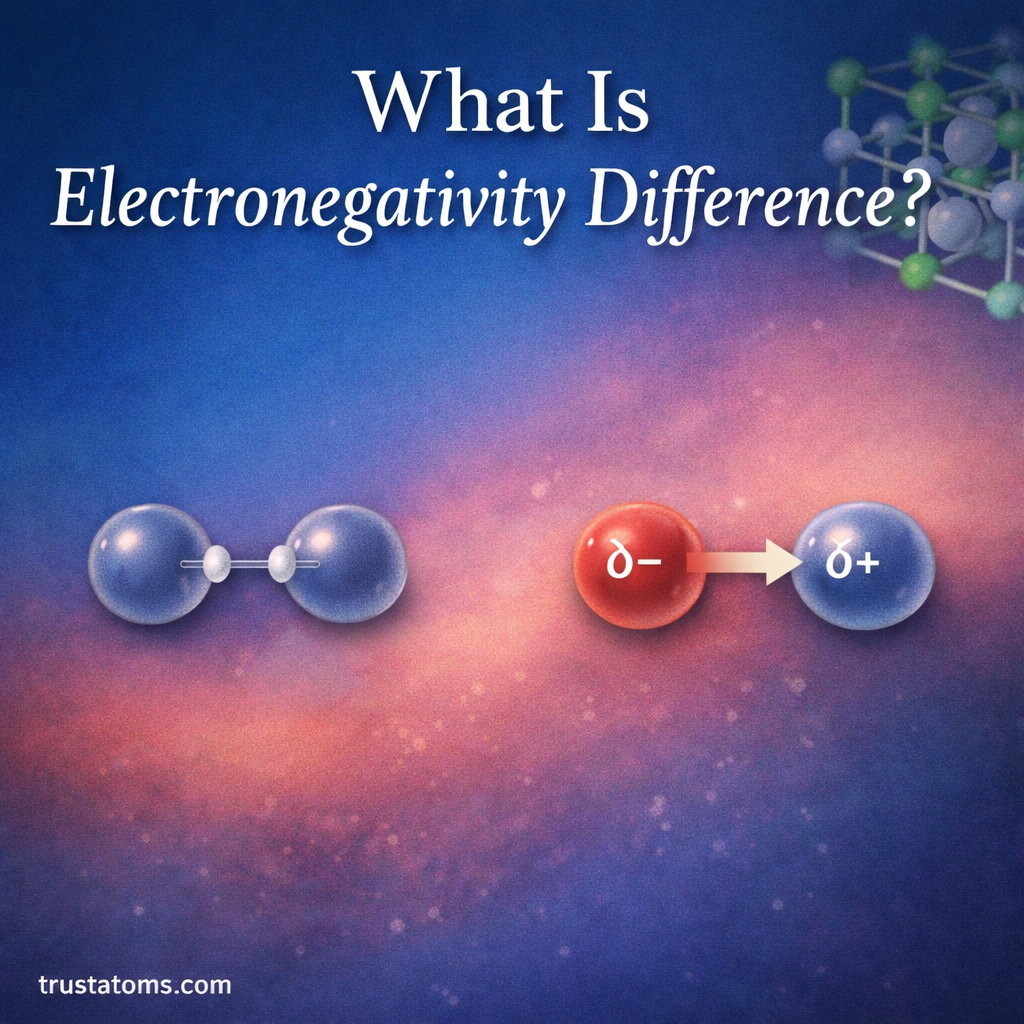
Simple chemistry diagram showing two bonded atoms with partial charges illustrating electronegativity difference.
Educational chemistry diagram illustrating electronegativity difference between two bonded atoms. trustatoms.com.

Electronegativity difference is one of the most important ideas in chemistry for understanding how atoms bond together. It helps explain why some molecules share electrons evenly, while others pull electrons toward one atom more strongly.

This concept plays a major role in predicting bond type, molecular polarity, and chemical behavior. From water molecules to salts like sodium chloride, electronegativity differences influence how substances form and interact.

In this guide, we’ll explore what electronegativity difference means, how it works, and why it matters in chemistry.

Continue reading “What Is Electronegativity Difference?”

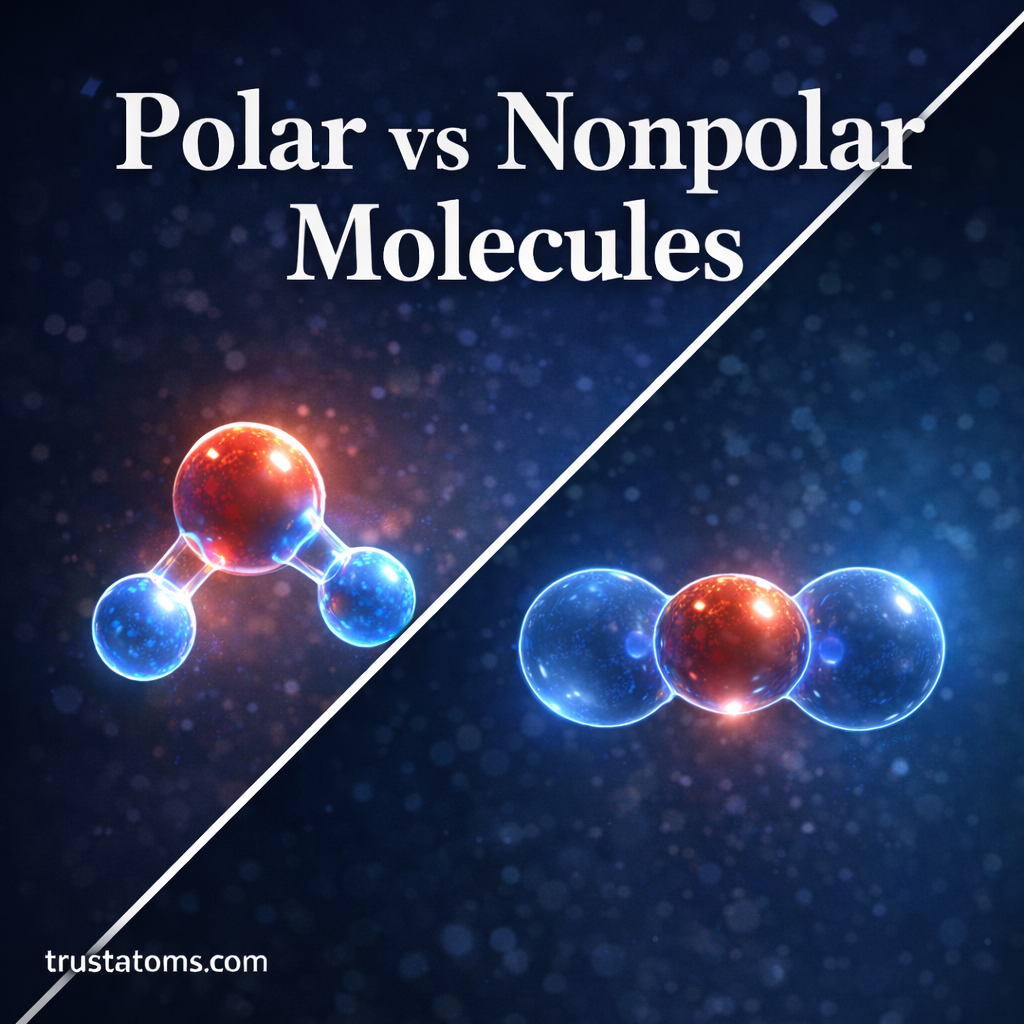
Polar vs Nonpolar Molecules

Educational split illustration comparing a bent polar molecule with a symmetrical nonpolar molecule to show differences in electron distribution.
Simple chemistry illustration comparing a polar molecule and a nonpolar molecule to demonstrate how molecular shape affects charge distribution. trustatoms.com.

Molecules behave differently depending on how their electrons are distributed. Some molecules have an uneven distribution of electrical charge, while others share electrons evenly across their structure. These differences create two major categories in chemistry: polar molecules and nonpolar molecules.

Understanding the difference between polar and nonpolar molecules helps explain many chemical properties, including solubility, intermolecular forces, and how substances interact with one another. From water dissolving salt to oil separating from water, molecular polarity plays a key role in the behavior of matter.

Continue reading “Polar vs Nonpolar Molecules”

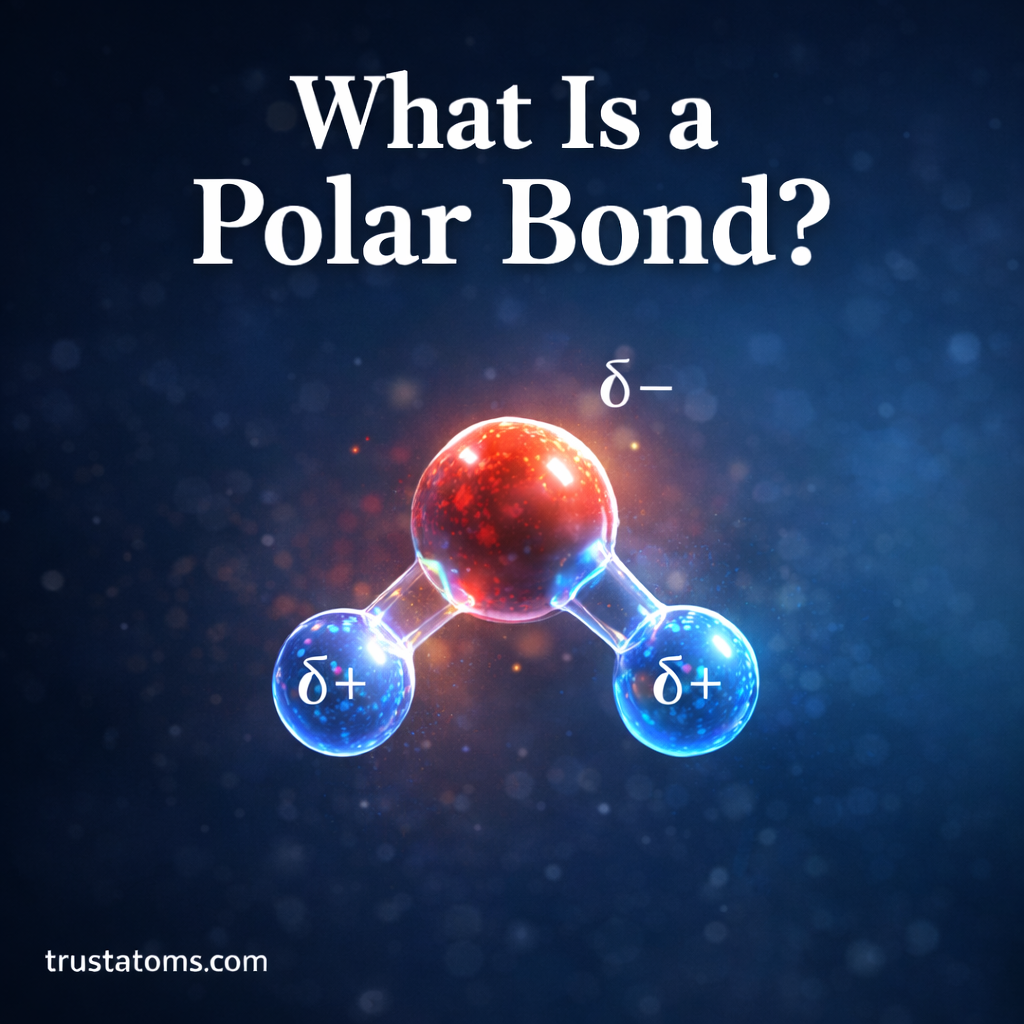
What Is a Polar Bond?

Educational chemistry illustration showing a water molecule with uneven electron distribution representing a polar covalent bond.
Illustration of a water molecule demonstrating how electrons are shared unevenly between atoms in a polar bond. trustatoms.com.

Chemical bonds allow atoms to join together and form molecules. While some bonds share electrons evenly, others distribute electrons unevenly between atoms. These unevenly shared bonds are called polar bonds, and they play a major role in chemistry, biology, and everyday life.

Polar bonds explain why water dissolves many substances, how biological molecules interact, and why some compounds behave differently from others. Understanding polar bonds helps reveal how atoms form stable molecules and how those molecules interact with their environment.

Continue reading “What Is a Polar Bond?”

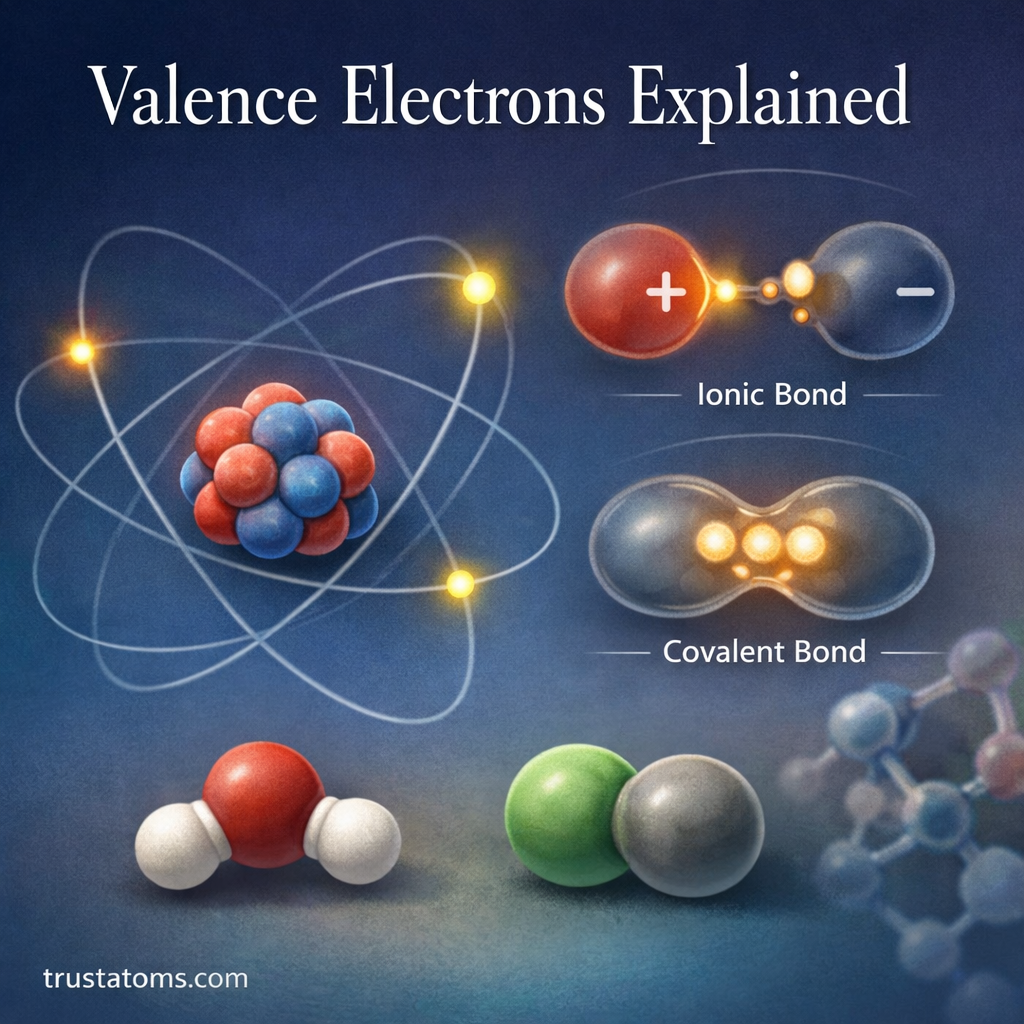
Valence Electrons Explained

Educational chemistry illustration showing an atom with electrons orbiting the nucleus and the outer shell representing valence electrons.
Simple educational illustration of an atom highlighting the outer shell where valence electrons are located. trustatoms.com.

Valence electrons are the electrons located in the outermost shell of an atom. These electrons play a critical role in determining how atoms interact, bond, and form molecules.

In chemistry, understanding valence electrons helps explain why elements behave the way they do, how chemical bonds form, and why certain reactions occur. From the formation of water to the structure of complex molecules, valence electrons are at the center of chemical behavior.

Continue reading “Valence Electrons Explained”

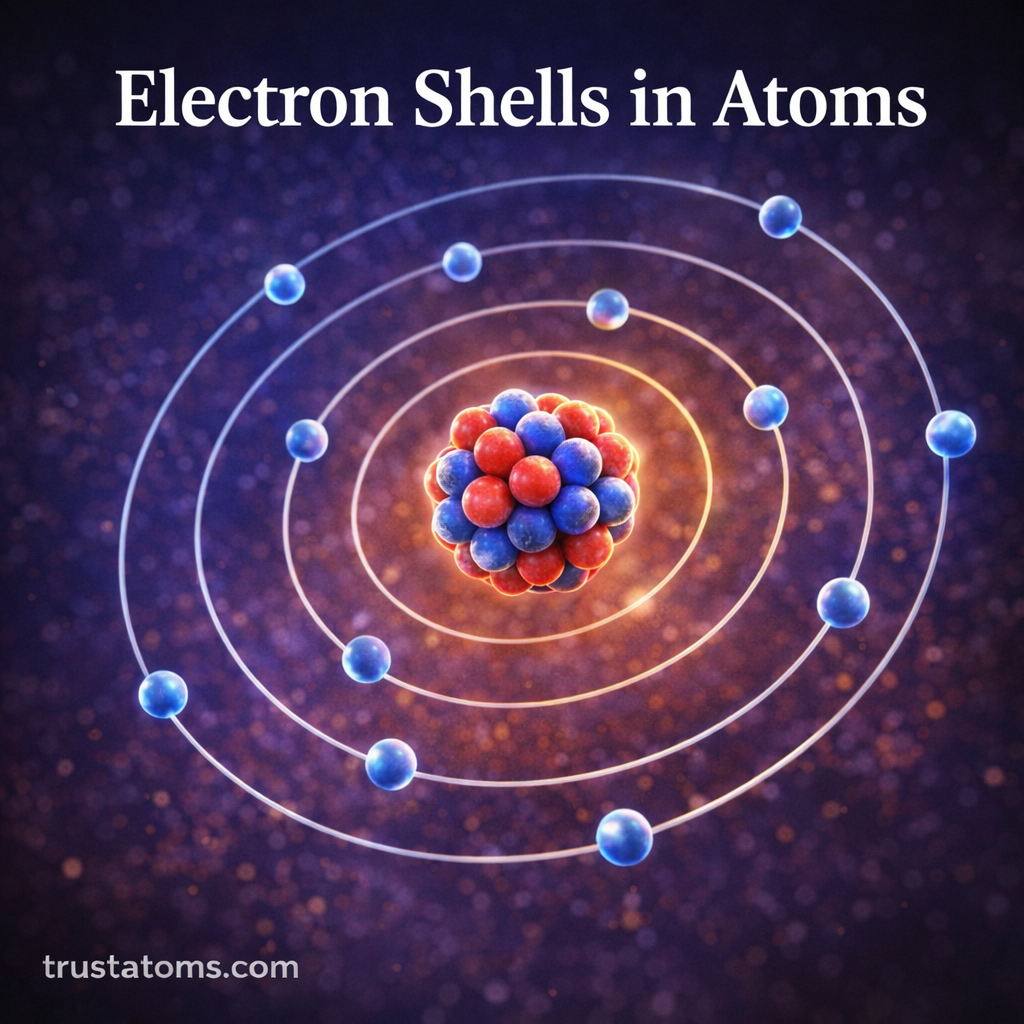
Electron Shells in Atoms

Educational atom diagram showing multiple electron shells surrounding a nucleus to explain electron energy levels in atoms.
Scientific illustration showing electron shells surrounding an atomic nucleus to demonstrate how electrons occupy energy levels in atoms. trustatoms.com.

Atoms may seem simple at first glance, but their internal structure is surprisingly organized. One of the key concepts in atomic structure is the arrangement of electron shells, which are the energy levels where electrons exist around the nucleus.

Electron shells determine how atoms interact with one another, how chemical bonds form, and why elements behave differently on the periodic table. Understanding electron shells is essential for learning how chemistry works at the atomic level.

Continue reading “Electron Shells in Atoms”

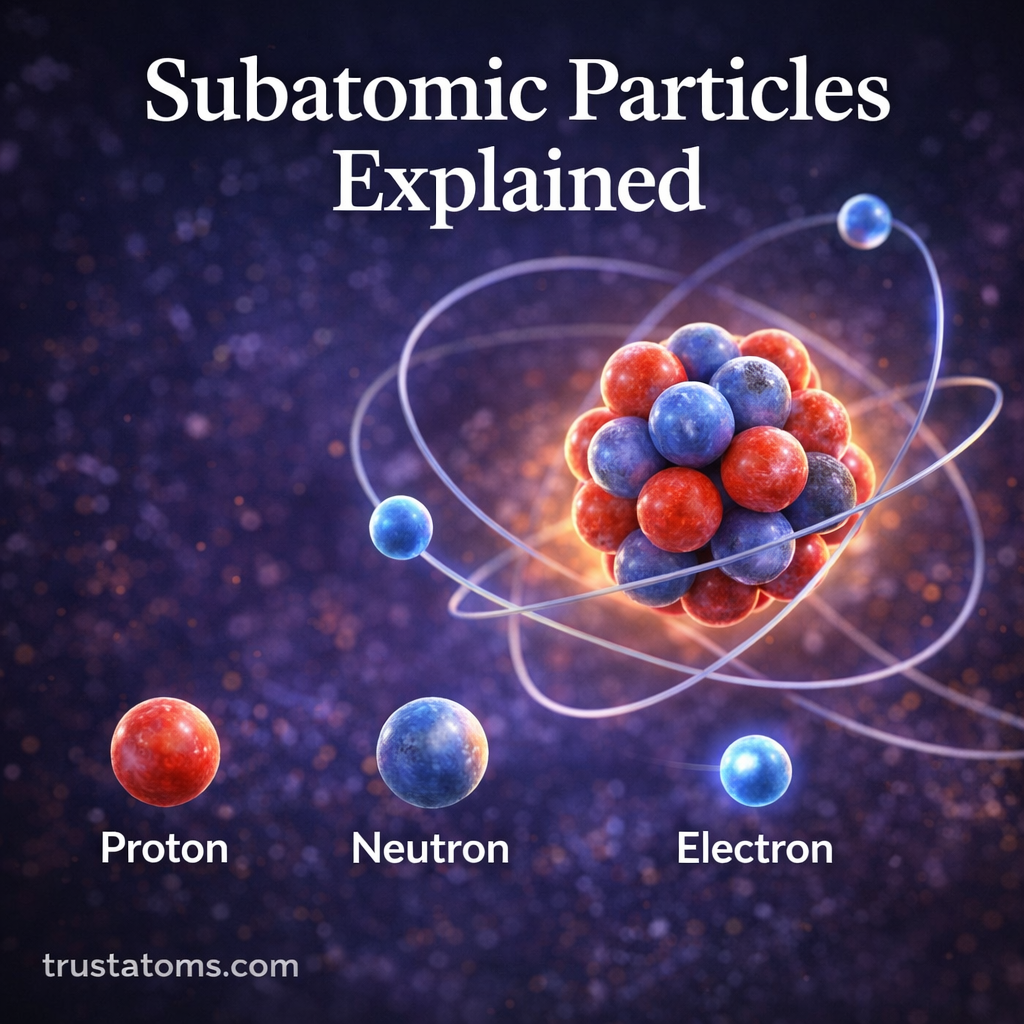
Subatomic Particles Explained

Educational illustration of an atom showing protons and neutrons in the nucleus with electrons surrounding it to explain subatomic particles.
Scientific illustration showing the three main subatomic particles—protons, neutrons, and electrons—within a simplified atom model. trustatoms.com.

Everything in the universe—from the air we breathe to the stars in distant galaxies—is made of atoms. But atoms themselves are not the smallest units of matter. Inside every atom are even smaller components called subatomic particles.

Subatomic particles determine how atoms behave, how elements interact, and how chemical reactions occur. Understanding these particles is essential for studying chemistry, physics, and the structure of matter.

This guide explains the three main subatomic particles, their properties, and how they work together to form atoms.

Continue reading “Subatomic Particles Explained”

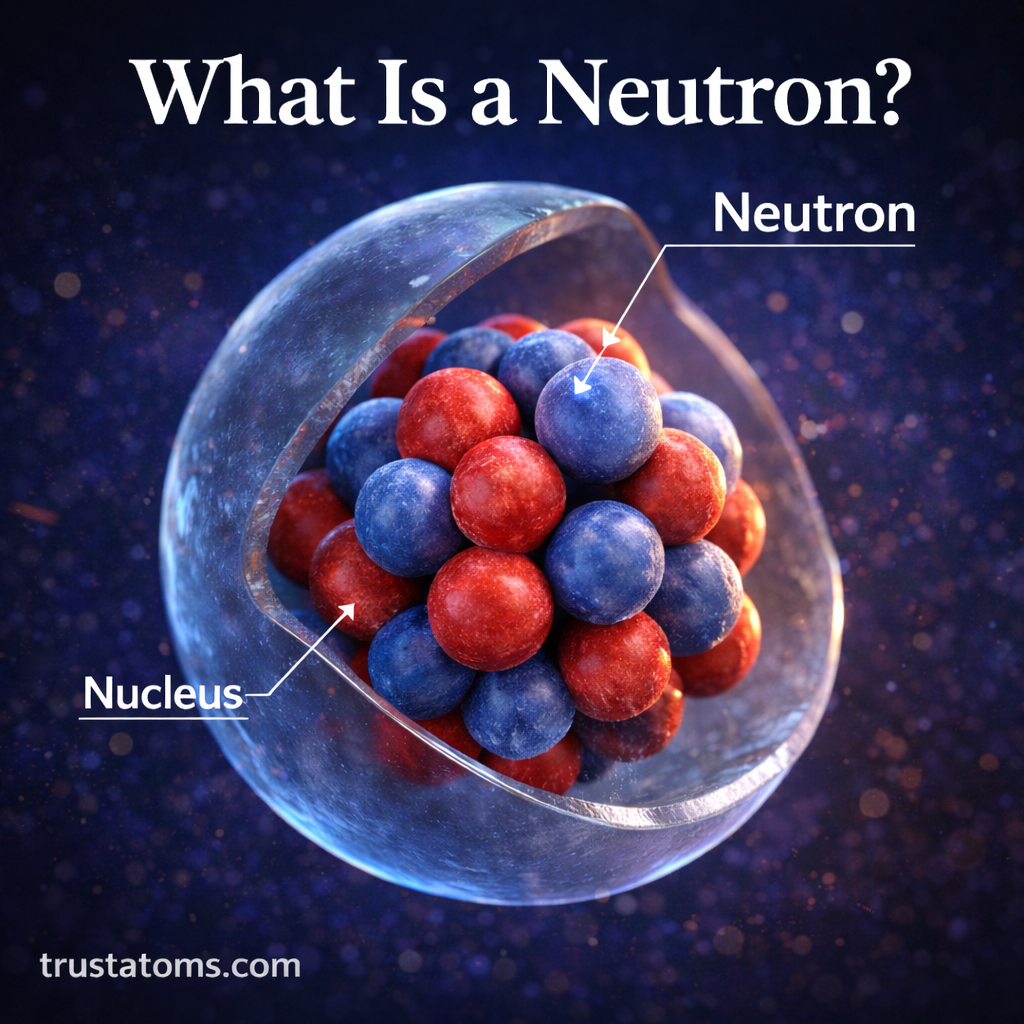
What Is a Neutron?

Educational illustration showing neutrons and protons clustered inside an atomic nucleus to explain what a neutron is in chemistry.
Illustration of an atomic nucleus highlighting neutrons among protons at the center of an atom. trustatoms.com.

A neutron is one of the three fundamental subatomic particles that make up atoms. Along with protons and electrons, neutrons help form the structure of all matter in the universe.

Although neutrons do not carry an electrical charge, they play an essential role in stabilizing atomic nuclei and determining different forms of elements known as isotopes.

Understanding neutrons helps explain atomic stability, nuclear reactions, and how elements behave in chemistry and physics.

Continue reading “What Is a Neutron?”

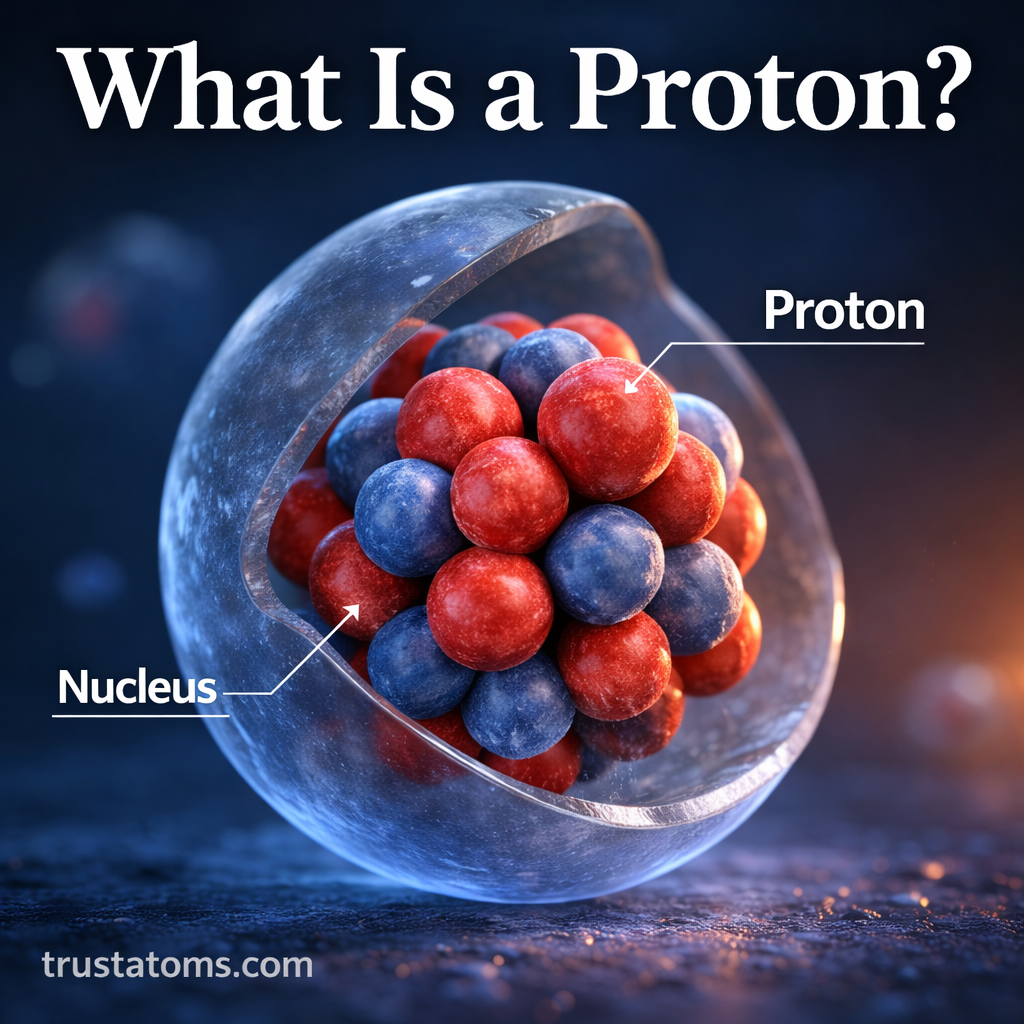
What Is a Proton?

Educational illustration showing an atomic nucleus made of protons and neutrons to explain what a proton is in chemistry.
Illustration of an atomic nucleus highlighting protons as key particles located at the center of atoms. trustatoms.com.

A proton is one of the fundamental particles that make up atoms. Along with neutrons and electrons, protons are essential components of all matter in the universe. These tiny particles play a critical role in determining the identity of every chemical element.

Understanding protons helps explain atomic structure, chemical reactions, and why different elements behave the way they do.

Continue reading “What Is a Proton?”