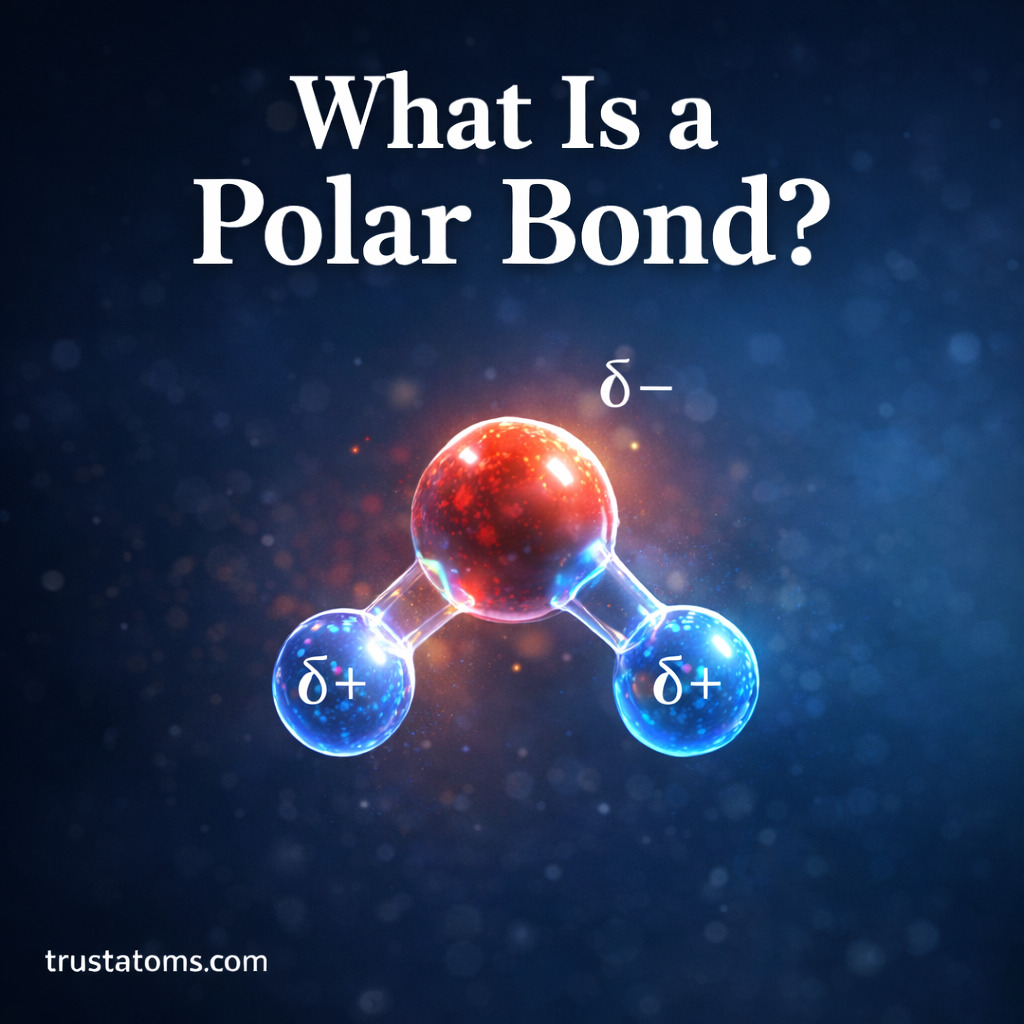
A polar bond is a covalent chemical bond in which two atoms share electrons unequally because one atom attracts the electrons more strongly. This unequal sharing creates partial positive and negative charges at opposite ends of the bond.
Chemical bonds allow atoms to join together and form molecules. While some bonds share electrons evenly, others distribute electrons unevenly between atoms. These unevenly shared bonds are called polar bonds, and they play a major role in chemistry, biology, and everyday life.
Polar bonds help explain why water dissolves many substances, why certain molecules attract each other, and how compounds interact with living cells. They also help distinguish polar and nonpolar molecules, which can behave very differently even when they contain similar atoms.
What Is a Polar Bond?
A polar bond forms when two covalently bonded atoms attract their shared electrons with different strengths. The more strongly attracting atom develops a partial negative charge (δ−), while the other develops a partial positive charge (δ+).
These are partial charges rather than the full charges typically assigned to ions. The electrons remain shared between the atoms, but their distribution is uneven.
This unequal distribution is called bond polarity. It produces a bond dipole, whose magnitude can be described using a dipole moment, a measure of charge separation.
For example, in hydrogen chloride (HCl), chlorine attracts the bonding electrons more strongly than hydrogen. Chlorine becomes partially negative, and hydrogen becomes partially positive, even though the molecule is electrically neutral overall.
Why Polar Bonds Form
Polar bonds form because bonded atoms differ in their ability to attract electrons. Electronegativity is a measure of how strongly an atom attracts electrons in a chemical bond.
When two atoms have different electronegativities, their shared electrons are drawn closer to the more electronegative atom. This creates an uneven electron distribution and partial charges.
For a typical polar covalent bond, four characteristics can be identified:
- The atoms share bonding electrons.
- One atom attracts those electrons more strongly.
- Partial positive and negative charges develop.
- The separation of charge produces a bond dipole.
Polar vs Nonpolar Bonds
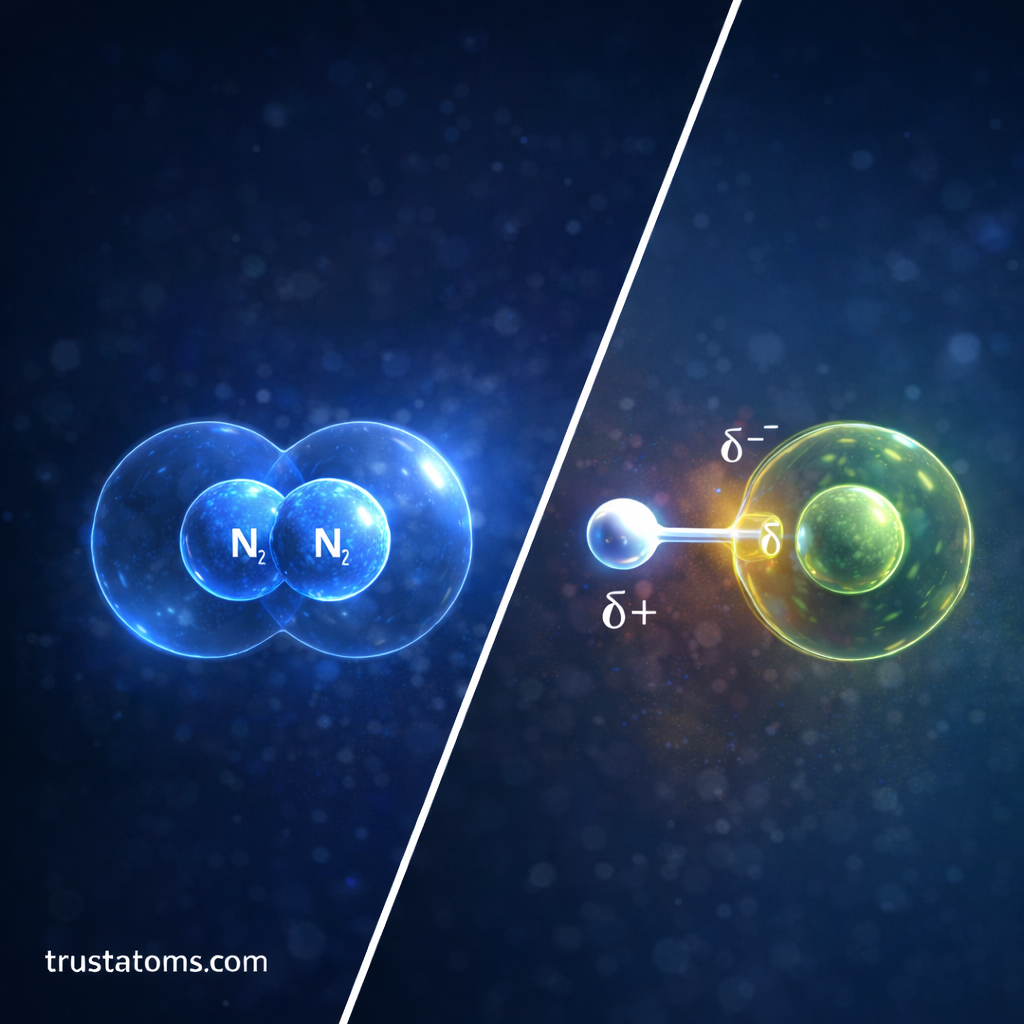
The main difference between polar and nonpolar covalent bonds is how evenly the bonding electrons are distributed.
| Property | Polar Bond | Nonpolar Bond |
|---|---|---|
| Electron sharing | Unequal | Equal or nearly equal |
| Electronegativity difference | Noticeable | Zero or very small |
| Partial charges | Present | Absent or negligible |
| Examples | H–Cl, O–H | H–H, O=O |
Hydrogen gas (H₂) has a nonpolar bond because both hydrogen atoms attract electrons equally. In hydrogen chloride (HCl), chlorine attracts the shared electrons more strongly, creating a polar bond.
How Electronegativity Difference Predicts Bond Polarity
Electronegativity differences determine whether a bond becomes polar. As the difference increases, the bonding electrons generally become more unevenly distributed.
On the Pauling electronegativity scale, oxygen has a value of approximately 3.44 and hydrogen has a value of 2.20. Their difference is 1.24, which indicates a substantially polar O–H covalent bond.
Introductory chemistry courses often use approximate guidelines:
- 0 to about 0.4: generally nonpolar covalent
- About 0.5 to 1.7: generally polar covalent
- Above about 1.7: often predominantly ionic
These ranges are teaching guidelines, not strict boundaries. Bonding exists along a continuum, and the actual behavior of a compound depends on more than electronegativity difference alone.
Example of Polar Bonds in Water
Water (H₂O) is a familiar example of polar covalent bonding. Each water molecule contains two O–H bonds, and oxygen attracts the shared electrons more strongly than hydrogen.
As a result, oxygen carries a partial negative charge, while each hydrogen carries a partial positive charge. Water also has a bent molecular shape, with an H–O–H bond angle of approximately 104.5 degrees.
Because of this bent shape, the two bond dipoles do not cancel. Water has an overall molecular dipole, allowing neighboring water molecules to form hydrogen bonds with one another.
These interactions contribute to water’s relatively high boiling point, surface tension, and ability to dissolve many ionic and polar substances. For example, water can surround sodium and chloride ions when table salt dissolves, helping separate and disperse them throughout the liquid.
A Polar Bond Does Not Always Mean a Polar Molecule
A molecule can contain polar bonds and still be nonpolar overall. The determining factor is whether its individual bond dipoles cancel because of the molecule’s three-dimensional shape.
Water: Polar Bonds and a Polar Molecule
Water’s bent shape prevents its O–H bond dipoles from canceling. This gives the entire molecule a positive side and a negative side.
Carbon Dioxide: Polar Bonds but a Nonpolar Molecule
Carbon dioxide (CO₂) contains two polar C=O bonds. However, the molecule is linear, with the oxygen atoms on opposite sides of the carbon atom. Its equal bond dipoles point in opposite directions and cancel, making carbon dioxide nonpolar overall.
This distinction explains why identifying individual bond types is only the first step in determining a molecule’s overall polarity.
How Polar Bonds Affect Solubility and Molecular Attraction
Polar bonds influence how molecules interact with neighboring molecules and surrounding substances. In polar molecules, charge separation can create dipole–dipole attractions, while certain bonds involving hydrogen enable hydrogen bonding.
A useful chemistry guideline is “like dissolves like.” Polar solvents tend to dissolve many polar or ionic substances, while nonpolar solvents are generally better at dissolving nonpolar substances.
For instance, ethanol contains a polar O–H group that interacts favorably with water. Cooking oils, which consist largely of molecules with extensive nonpolar hydrocarbon regions, do not mix readily with water.
Polarity also affects boiling points, molecular recognition, and interactions between biological molecules. However, these properties depend on molecular size, shape, and other intermolecular forces as well as bond polarity.
Everyday Examples of Polar Bonds
Polar bonds occur in many common substances:
- Water: O–H bonds contribute to hydrogen bonding and solvent behavior.
- Ethanol: Its O–H bond helps it mix with water and makes it useful in cleaning products.
- Ammonia: Its N–H bonds and pyramidal molecular shape produce a polar molecule.
- Sugar: Numerous polar O–H bonds help many sugars interact with and dissolve in water.
These examples show how the distribution of electrons within chemical bonds can influence the behavior of an entire substance.
Frequently Asked Questions
Is a polar bond the same as an ionic bond?
No. In a polar covalent bond, atoms share electrons unequally. Ionic bonding involves electrostatic attraction between oppositely charged ions, commonly formed after electron transfer. The distinction is not always absolute because chemical bonds can have both covalent and ionic character.
Which atom becomes partially negative in a polar bond?
The more electronegative atom becomes partially negative (δ−) because it attracts the shared bonding electrons more strongly. The less electronegative atom becomes partially positive (δ+).
Can a molecule with polar bonds be nonpolar?
Yes. If the molecule’s shape causes its bond dipoles to cancel, the molecule can be nonpolar overall. Carbon dioxide is a common example because its two polar C=O bonds are arranged symmetrically in a straight line.
A polar bond results from unequal electron sharing between bonded atoms, producing partial charges and a bond dipole. To predict how a substance behaves, examine both the electronegativity difference within its bonds and the arrangement of those bonds in the molecule. Together, these factors help explain water’s properties, molecular attractions, and differences in solubility.
Sources: OpenStax, Chemistry 2e; IUPAC, Compendium of Chemical Terminology (Gold Book); Chemistry LibreTexts, Chemical Bonding and Molecular Polarity.