Seismic waves are one of the most powerful tools scientists use to study what lies beneath Earth’s surface. Because we cannot directly observe most of Earth’s interior, these waves provide critical clues about the structure, composition, and physical state of the planet’s layers.
What Are Seismic Waves?
Seismic waves are vibrations that travel through Earth, typically generated by:
- Earthquakes
- Volcanic activity
- Explosions (natural or human-made)
These waves move outward from their source in all directions, carrying energy through different materials inside the planet.
Types of Seismic Waves
Seismic waves are divided into two main categories:
- Body waves (travel through Earth’s interior)
- Surface waves (travel along Earth’s surface)
Body Waves
Body waves are essential for understanding Earth’s internal structure because they pass through the planet’s layers.
P-Waves (Primary Waves)
P-waves are the fastest seismic waves and are the first to be detected by instruments.
Key Characteristics
- Travel through solids, liquids, and gases
- Compress and expand material (like sound waves)
- Move in a straight, push-pull motion
Why They Matter
Because P-waves can travel through all states of matter, they help scientists detect:
- Changes in material density
- Boundaries between layers
S-Waves (Secondary Waves)
S-waves are slower than P-waves and arrive second at seismic stations.
Key Characteristics
- Travel only through solids
- Move material side-to-side (shear motion)
- Cannot pass through liquids
Why They Matter
The absence of S-waves in certain regions reveals important information:
- Indicates the presence of liquid layers, such as the outer core
- Helps map internal boundaries
Surface Waves
Surface waves travel along Earth’s exterior and are typically responsible for the most damage during earthquakes.
Types of Surface Waves
- Love waves: Cause horizontal ground movement
- Rayleigh waves: Produce rolling, wave-like motion
Key Characteristics
- Slower than body waves
- Stronger near the surface
- Lose energy more slowly, making them more destructive
How Seismic Waves Reveal Earth’s Interior
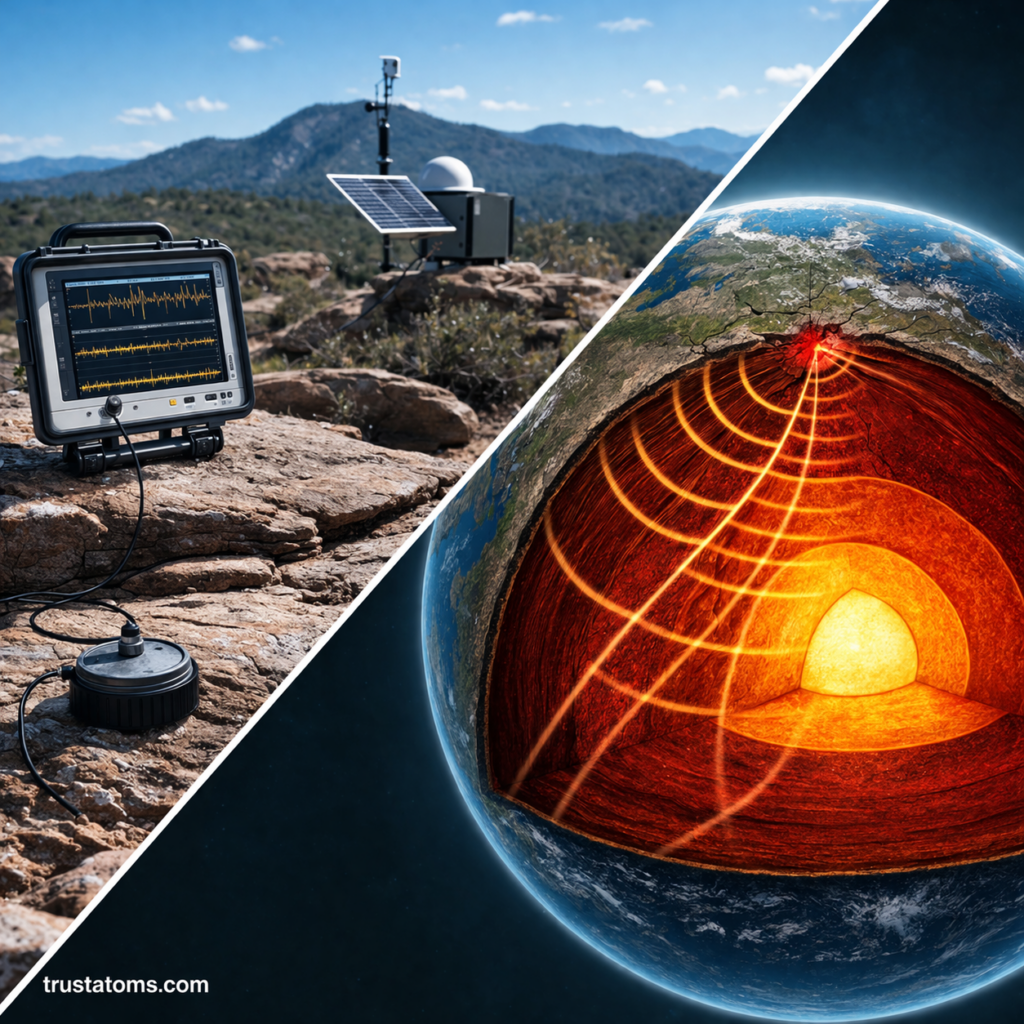
Seismic waves change speed and direction depending on the material they pass through. Scientists analyze these changes to build models of Earth’s interior.
Refraction and Reflection
When seismic waves encounter boundaries between different materials:
- Refraction: Waves bend as they change speed
- Reflection: Waves bounce off boundaries
These behaviors help identify:
- Layer thickness
- Material transitions
- Internal discontinuities
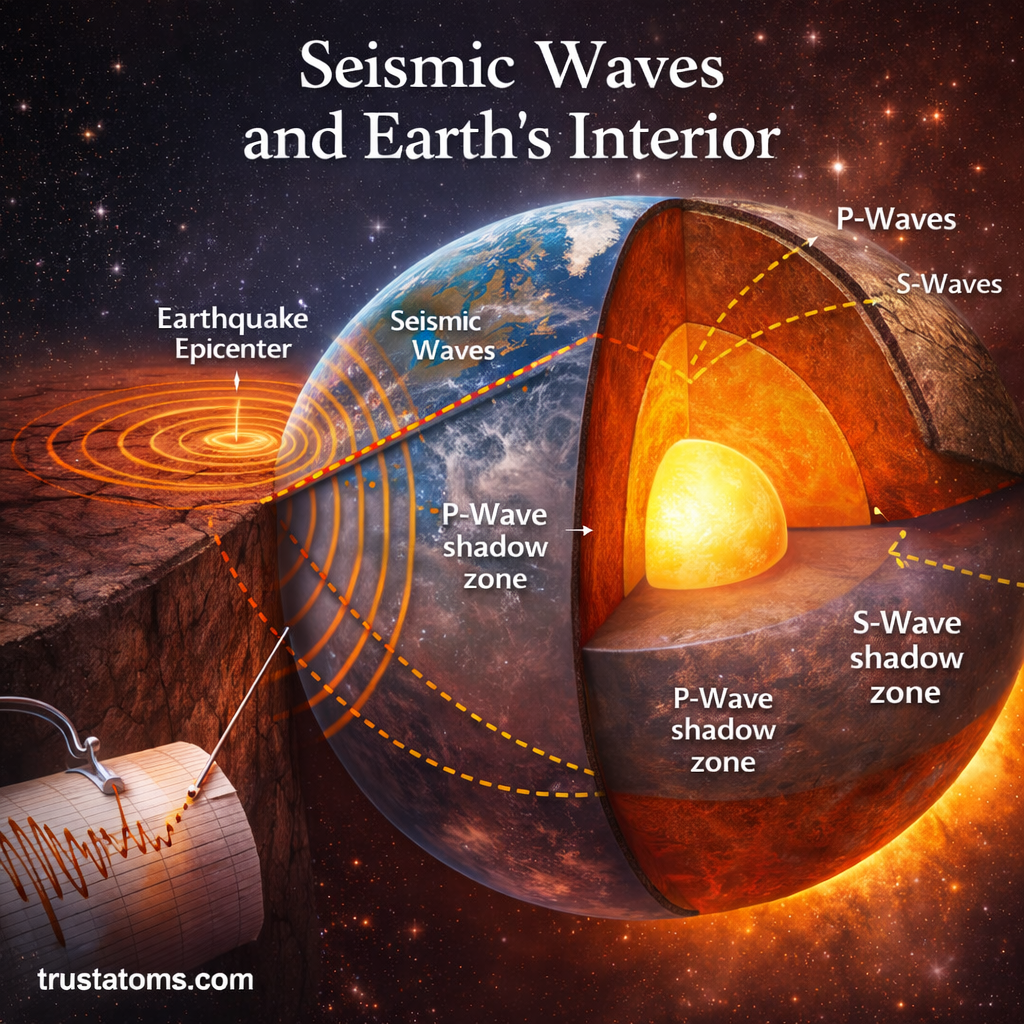
Seismic Shadow Zones
Shadow zones are areas where certain seismic waves are not detected.
Key Insights
- S-wave shadow zones confirm that the outer core is liquid
- P-wave shadow zones reveal changes in density and composition
These gaps in wave detection provide strong evidence about Earth’s internal structure.
Key Boundaries Inside Earth
Seismic data has revealed several important boundaries within the planet.
Major Discontinuities
- Mohorovičić Discontinuity (Moho):
Separates the crust from the mantle - Gutenberg Discontinuity:
Marks the boundary between the mantle and the liquid outer core - Lehmann Discontinuity:
Separates the outer core from the solid inner core
Each boundary is identified by changes in seismic wave behavior.
Tools Used to Measure Seismic Waves
Scientists use specialized instruments and networks to detect and analyze seismic activity.
Seismographs
- Record ground motion
- Measure wave arrival times
- Provide data for locating earthquakes
Global Seismic Networks
- Thousands of stations worldwide
- Allow precise mapping of wave paths
- Help build detailed models of Earth’s interior
Why Seismic Waves Matter
Seismic waves are essential for both scientific research and practical applications.
Understanding Earth’s Structure
- Reveal the layered nature of Earth
- Confirm the existence of a liquid outer core
- Provide insight into temperature and pressure conditions
Earthquake Analysis
- Help determine earthquake location and magnitude
- Improve hazard prediction and preparedness
Resource Exploration
- Used in oil, gas, and mineral exploration
- Identify underground structures
Key Takeaways
- Seismic waves are vibrations that travel through Earth
- P-waves travel through solids and liquids; S-waves only through solids
- Surface waves cause most earthquake damage
- Shadow zones and wave behavior reveal Earth’s internal layers
- Seismic studies have identified major boundaries like the Moho and core layers
Conclusion
Seismic waves act like natural probes, allowing scientists to “see” inside Earth without direct access. By studying how these waves travel, bend, and disappear, researchers have uncovered the planet’s layered structure and gained a deeper understanding of its dynamic processes. From earthquake analysis to mapping the core, seismic waves remain one of the most important tools in Earth science.