Understanding tectonic plates and the structure of the lithosphere is essential to explaining how Earth’s surface evolves. From earthquakes and volcanoes to mountain building and ocean formation, these processes are driven by the dynamic outer shell of our planet.
What Is the Lithosphere?
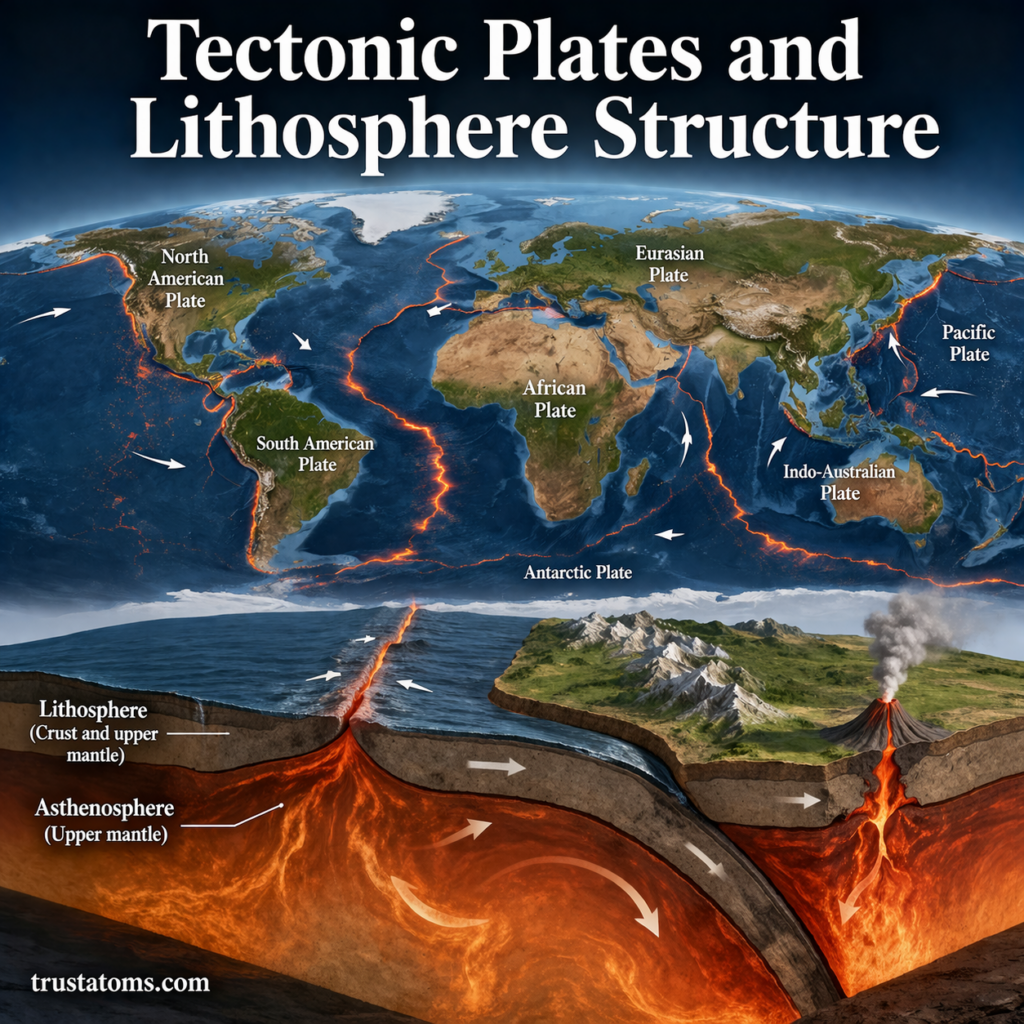
The lithosphere is the rigid outer layer of Earth. It includes:
- The crust (continental and oceanic)
- The uppermost part of the mantle
This layer behaves as a solid, brittle shell that is broken into large sections known as tectonic plates.
Key Characteristics of the Lithosphere
- Thickness ranges from about 50 km (oceanic regions) to 200+ km (continental regions)
- Cooler and more rigid than deeper layers
- Floats on the semi-fluid asthenosphere beneath it
What Are Tectonic Plates?
Tectonic plates are massive slabs of lithosphere that move slowly over the asthenosphere. These plates carry continents, oceans, and everything on Earth’s surface.
Major Tectonic Plates
Some of the largest plates include:
- Pacific Plate
- North American Plate
- Eurasian Plate
- African Plate
- Antarctic Plate
- Indo-Australian Plate
- South American Plate
Plate Movement
Tectonic plates move at rates of:
- 1 to 10 centimeters per year (about the speed fingernails grow)
This movement may seem slow, but over millions of years, it reshapes the planet.
Structure Beneath the Lithosphere
Below the lithosphere lies the asthenosphere, a softer, ductile layer of the mantle.
Asthenosphere Features
- Partially molten and capable of flow
- Allows tectonic plates to move
- Transfers heat from deeper within Earth
This layer acts like a conveyor system, enabling plate tectonics.
Types of Plate Boundaries
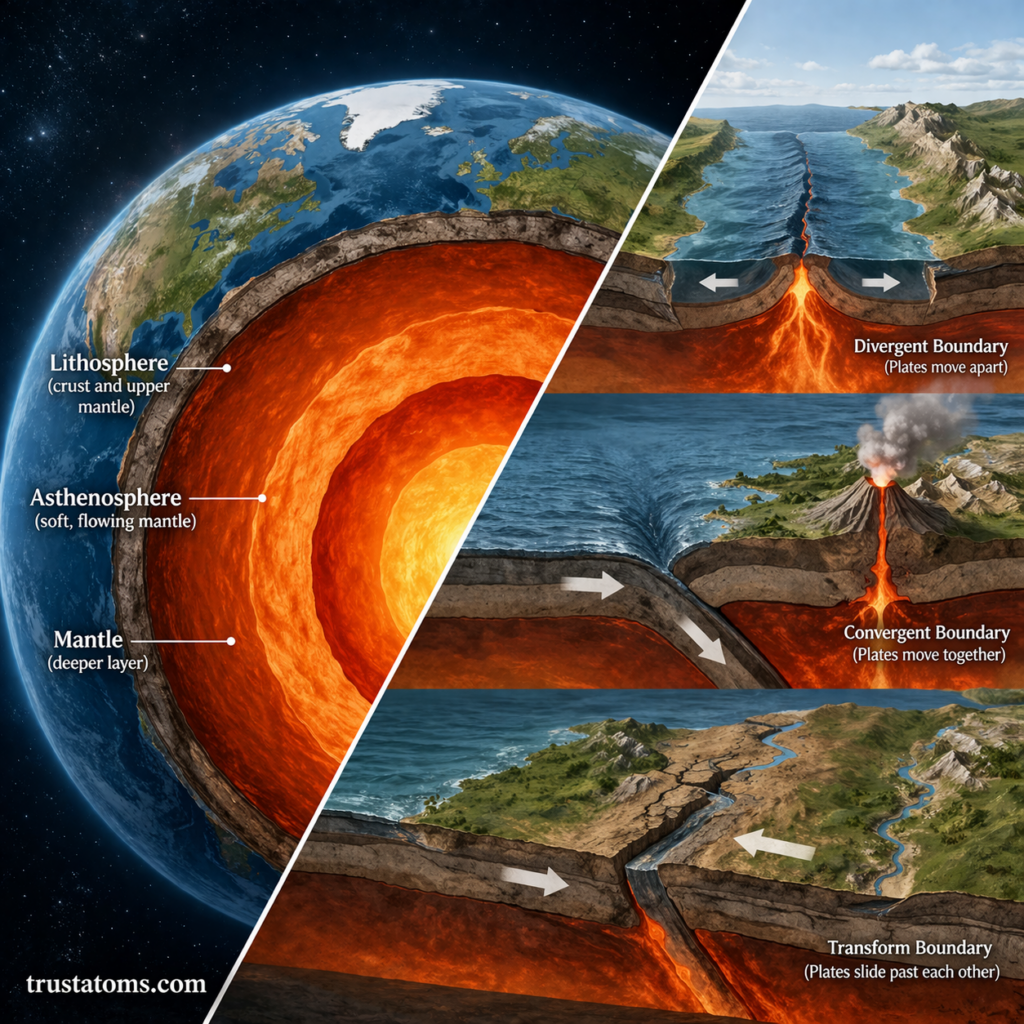
Where tectonic plates meet, they form boundaries. These are the most geologically active areas on Earth.
1. Divergent Boundaries
Plates move away from each other.
Common features:
- Mid-ocean ridges
- New crust formation
- Volcanic activity
Example: Mid-Atlantic Ridge
2. Convergent Boundaries
Plates move toward each other.
Outcomes depend on plate types:
- Oceanic + Continental → Subduction and volcanoes
- Oceanic + Oceanic → Island arcs
- Continental + Continental → Mountain ranges
Example: Himalayas
3. Transform Boundaries
Plates slide past each other horizontally.
Common features:
- Earthquakes
- Fault lines
Example: San Andreas Fault
How Tectonic Plates Move
Plate movement is driven by heat from Earth’s interior. This heat creates convection currents in the mantle.
Main Driving Forces
- Mantle convection: Hot material rises, cool material sinks
- Ridge push: Gravity pushes plates away from mid-ocean ridges
- Slab pull: Dense, sinking plates pull the rest of the plate along
Oceanic vs. Continental Lithosphere
The lithosphere is not uniform. It differs depending on whether it is oceanic or continental.
Oceanic Lithosphere
- Thinner (about 50–100 km)
- Denser and younger
- Mostly basaltic rock
- Continuously recycled at subduction zones
Continental Lithosphere
- Thicker (up to 200+ km)
- Less dense and older
- Composed mainly of granite
- Rarely recycled
Geological Features Created by Plate Tectonics
Plate interactions shape Earth’s surface in dramatic ways.
Common Features
- Mountain ranges (e.g., Himalayas)
- Volcanoes (e.g., Pacific Ring of Fire)
- Ocean trenches (deepest parts of oceans)
- Rift valleys (formed at divergent boundaries)
Why Tectonic Plates Matter
Plate tectonics is the foundation of modern geology. It explains:
- The distribution of earthquakes and volcanoes
- The formation of continents and oceans
- The recycling of Earth’s crust
- Long-term climate and geological cycles
Without plate tectonics, Earth would be a very different planet—likely less dynamic and less capable of supporting life as we know it.
Final Thoughts
The lithosphere and tectonic plates work together as a dynamic system that constantly reshapes Earth’s surface. Though movement is slow, the long-term effects are powerful, creating the landscapes and geological activity we observe today.
By understanding tectonic plates and lithosphere structure, we gain insight into Earth’s past, present, and future.