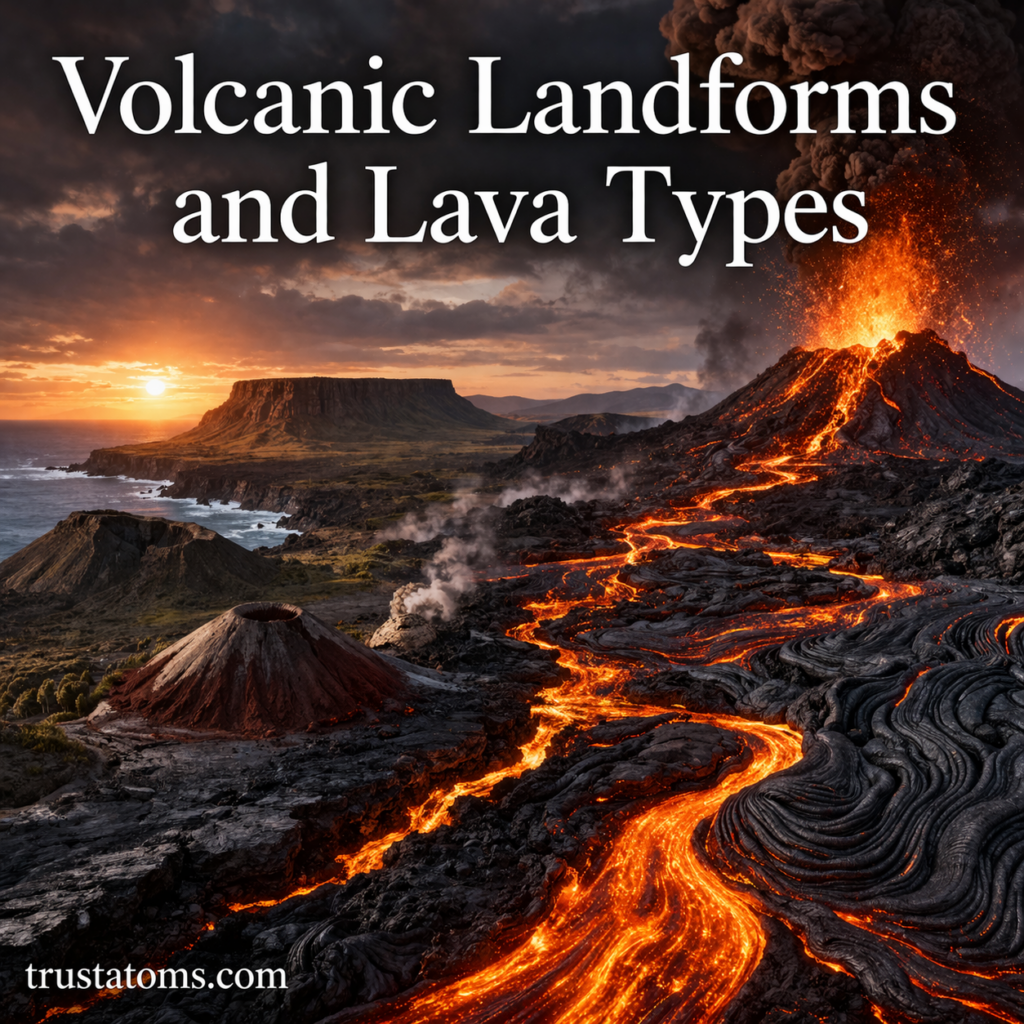
Volcanoes are powerful forces that shape Earth’s surface in dramatic and lasting ways. From towering mountains to vast lava plains, volcanic activity creates a wide range of landforms. At the center of these formations is lava—molten rock that behaves differently depending on its composition.
Understanding volcanic landforms and lava types helps explain how landscapes evolve and why volcanoes vary so much in appearance and behavior.
What Is Lava?
Lava is molten rock that reaches Earth’s surface during a volcanic eruption. Before it erupts, it is called magma.
What determines lava behavior?
The way lava flows depends on several factors:
- Temperature
- Chemical composition (especially silica content)
- Gas content
- Viscosity (how thick or runny it is)
These properties directly influence the shape and type of volcanic landforms that form.
Major Types of Lava
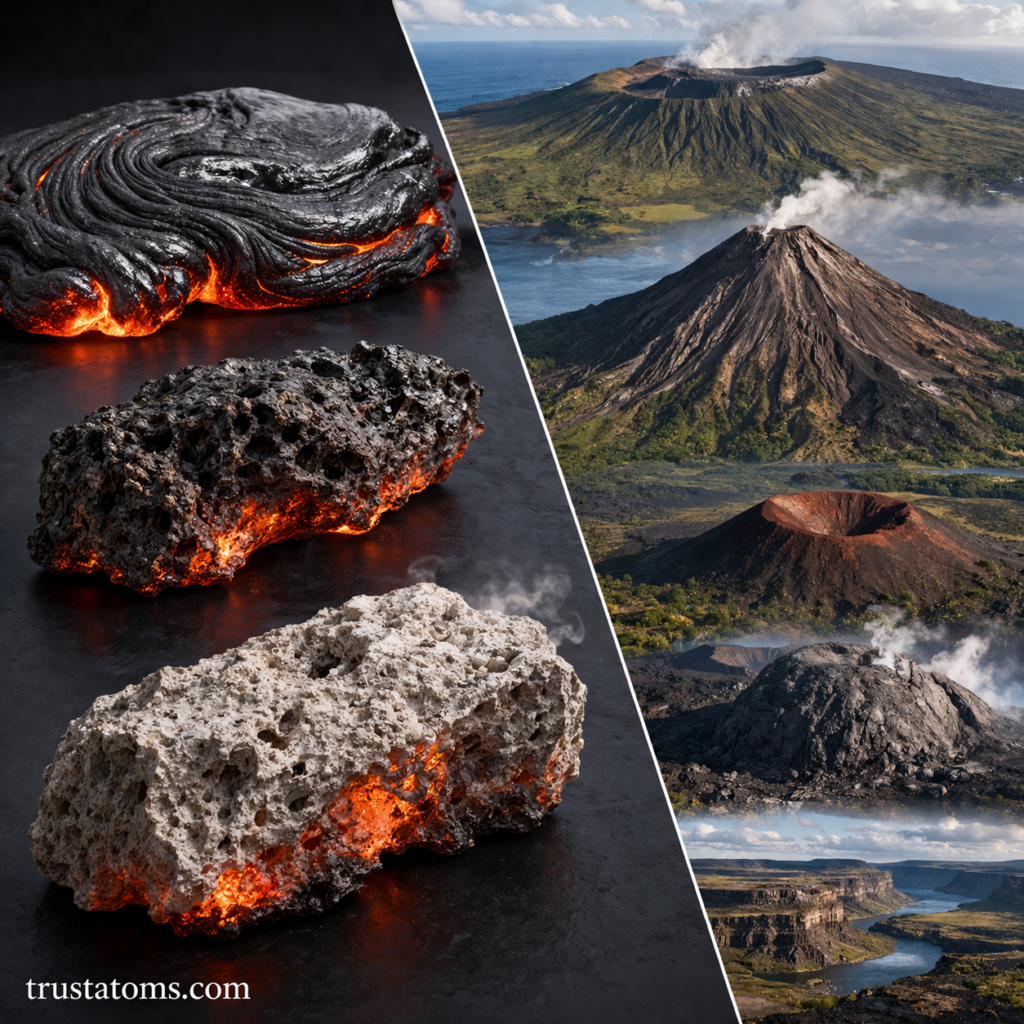
Different lava types produce different eruption styles and landforms.
Basaltic Lava (Low Silica)
Basaltic lava is the most common type on Earth.
Characteristics:
- Low silica content
- Very fluid (low viscosity)
- Flows easily over long distances
- Typically produces gentle eruptions
This type of lava is responsible for large, broad volcanic features.
Andesitic Lava (Intermediate Silica)
Andesitic lava has moderate silica content and viscosity.
Characteristics:
- Thicker than basaltic lava
- Slower-moving flows
- Can produce explosive eruptions
- Builds steeper volcanic structures
This lava type often forms classic cone-shaped volcanoes.
Rhyolitic Lava (High Silica)
Rhyolitic lava is the most viscous and silica-rich.
Characteristics:
- Very thick and sticky
- Traps gases easily
- Leads to highly explosive eruptions
- Moves slowly or may not flow far
This lava is associated with some of the most violent volcanic events.
Common Volcanic Landforms
The interaction between lava type and eruption style creates a variety of landforms.
Shield Volcanoes
Shield volcanoes are wide, gently sloping structures formed by fluid lava.
Key features
- Broad, dome-like shape
- Built from repeated basaltic lava flows
- Eruptions are typically non-explosive
These volcanoes can cover large areas and grow over long periods.
Composite Volcanoes (Stratovolcanoes)
Composite volcanoes are steep, cone-shaped mountains built from layers of lava and ash.
Key features
- Alternating layers of lava and volcanic debris
- More explosive eruptions
- Steeper slopes than shield volcanoes
They are among the most recognizable volcanic landforms.
Cinder Cone Volcanoes
Cinder cones are smaller, steep-sided volcanoes formed from volcanic fragments.
Key features
- Built from ash, cinders, and small rocks
- Short-lived eruptions
- Steep, symmetrical shape
They often form quickly and may appear in volcanic fields.
Lava Plateaus
Lava plateaus are vast, flat regions formed by repeated lava flows.
Key features
- Created by low-viscosity basaltic lava
- Lava spreads over wide areas
- Forms layered rock structures
These plateaus can cover thousands of square miles.
Lava Domes
Lava domes form when thick lava piles up near the vent instead of flowing away.
Key features
- Rounded, mound-like shape
- Formed by viscous lava (usually rhyolitic)
- Can grow slowly over time
These structures are often unstable and can collapse suddenly.
How Lava Type Shapes Landforms
The connection between lava and landforms is straightforward: the properties of lava determine how it moves and solidifies.
General patterns
- Low-viscosity lava → flows easily → creates broad, gentle landforms
- High-viscosity lava → resists flow → builds steep or explosive structures
This relationship explains why volcanoes vary so much across different regions.
Why Volcanic Landforms Matter
Volcanic landforms are more than just geological features—they impact ecosystems, climate, and human activity.
Their importance
- Create fertile soils for agriculture
- Influence landscapes and ecosystems
- Provide insight into Earth’s interior processes
- Pose hazards such as eruptions and lava flows
Understanding these landforms helps scientists assess risks and better predict volcanic behavior.
Key Takeaways
- Lava types are classified by silica content and viscosity
- Basaltic lava creates broad, gentle landforms like shield volcanoes
- Andesitic and rhyolitic lava form steeper and more explosive structures
- Volcanic landforms include shield volcanoes, composite volcanoes, cinder cones, lava domes, and plateaus
- The behavior of lava directly determines the shape of the landscape
Final Thoughts
Volcanic landforms are a visible reminder of Earth’s internal energy at work. The diversity of these features reflects the complexity of the processes beneath the surface.
By studying lava types and how they shape the land, we gain a clearer understanding of how Earth continues to change—and how these changes affect the world around us.