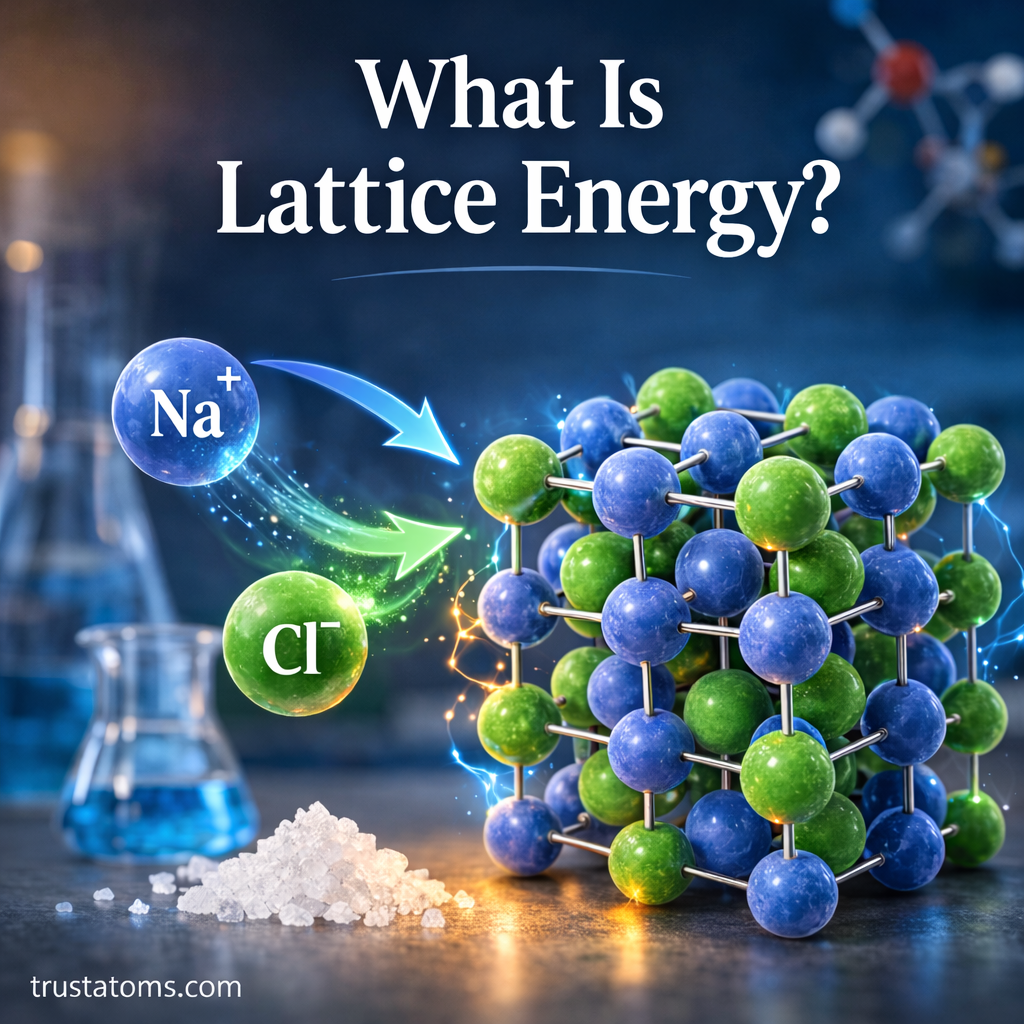
Lattice energy is a key concept in chemistry that explains the strength of attraction between oppositely charged ions in an ionic compound. It represents the amount of energy released when gaseous ions combine to form a solid ionic crystal.
In simple terms, lattice energy measures how strongly ions hold together in a crystal lattice.
This concept helps chemists understand why some ionic compounds are very stable, why some dissolve easily in water, and why different salts have different melting points.
Understanding Ionic Compounds
Before exploring lattice energy, it is helpful to understand ionic bonding.
Ionic compounds form when atoms transfer electrons and become charged particles called ions.
There are two main types of ions:
- Cations – positively charged ions (lose electrons)
- Anions – negatively charged ions (gain electrons)
For example:
- Sodium (Na) loses one electron to become Na⁺
- Chlorine (Cl) gains one electron to become Cl⁻
These oppositely charged ions attract each other through electrostatic forces, forming an ionic compound such as sodium chloride (NaCl).
Instead of existing as separate molecules, ionic compounds form large repeating crystal structures.
What Is Lattice Energy?
Lattice energy is defined as:
The energy released when one mole of an ionic solid forms from its gaseous ions.
When positive and negative ions come together to form a crystal lattice, energy is released because the system becomes more stable.
The stronger the attraction between ions, the higher the lattice energy.
High lattice energy means:
- Strong ionic bonds
- High stability
- High melting and boiling points
Low lattice energy means:
- Weaker ionic attractions
- Easier separation of ions
- Often greater solubility in water
The Crystal Lattice Structure
In an ionic compound, ions arrange themselves into a three-dimensional repeating pattern called a crystal lattice.
This arrangement allows each ion to interact with multiple oppositely charged ions, maximizing attraction and stability.
Characteristics of a crystal lattice include:
- Regular repeating structure
- Balanced positive and negative charges
- Strong electrostatic forces between ions
For example, in sodium chloride:
- Each sodium ion is surrounded by six chloride ions
- Each chloride ion is surrounded by six sodium ions
This repeating structure creates a stable ionic solid.
Factors That Affect Lattice Energy
Two main factors determine the magnitude of lattice energy.
1. Ionic Charge
The greater the charges of the ions, the stronger the attraction between them.
For example:
- Magnesium oxide (Mg²⁺ and O²⁻) has higher lattice energy than sodium chloride (Na⁺ and Cl⁻)
This is because double charges create stronger electrostatic forces.
2. Ionic Size
Smaller ions allow the charges to be closer together, increasing the strength of attraction.
Examples:
- Lithium fluoride (LiF) has higher lattice energy than potassium iodide (KI)
This occurs because:
- Li⁺ and F⁻ ions are smaller
- Smaller ions sit closer together
- Closer charges create stronger attraction
Lattice Energy and Coulomb’s Law
The strength of attraction between ions follows the principles of electrostatics described by Coulomb’s Law.
Coulomb’s Law explains that electrostatic force depends on:
- The magnitude of the charges
- The distance between them
In ionic compounds:
- Higher charges increase attraction
- Shorter distances between ions increase attraction
This relationship explains why lattice energy increases with larger ionic charges and smaller ionic radii.
How Chemists Calculate Lattice Energy
Lattice energy cannot be measured directly for most ionic compounds, but it can be calculated using theoretical models.
One of the most important methods is the Born–Haber cycle.
The Born–Haber Cycle
The Born–Haber cycle is a thermochemical cycle that uses Hess’s Law to determine lattice energy.
It combines several energy steps involved in forming an ionic compound from its elements.
Typical steps include:
- Sublimation of a metal atom
- Ionization of the metal
- Dissociation of a nonmetal molecule
- Electron gain by the nonmetal
- Formation of the ionic crystal
By combining these energy values, chemists can calculate lattice energy indirectly.
Why Lattice Energy Is Important
Lattice energy plays a major role in many chemical and physical properties of ionic compounds.
1. Stability of Ionic Compounds
High lattice energy means ions are strongly attracted and difficult to separate, making the compound more stable.
2. Melting and Boiling Points
Ionic compounds with high lattice energy generally have:
- Higher melting points
- Higher boiling points
For example, magnesium oxide melts at a much higher temperature than sodium chloride because its lattice energy is much larger.
3. Solubility in Water
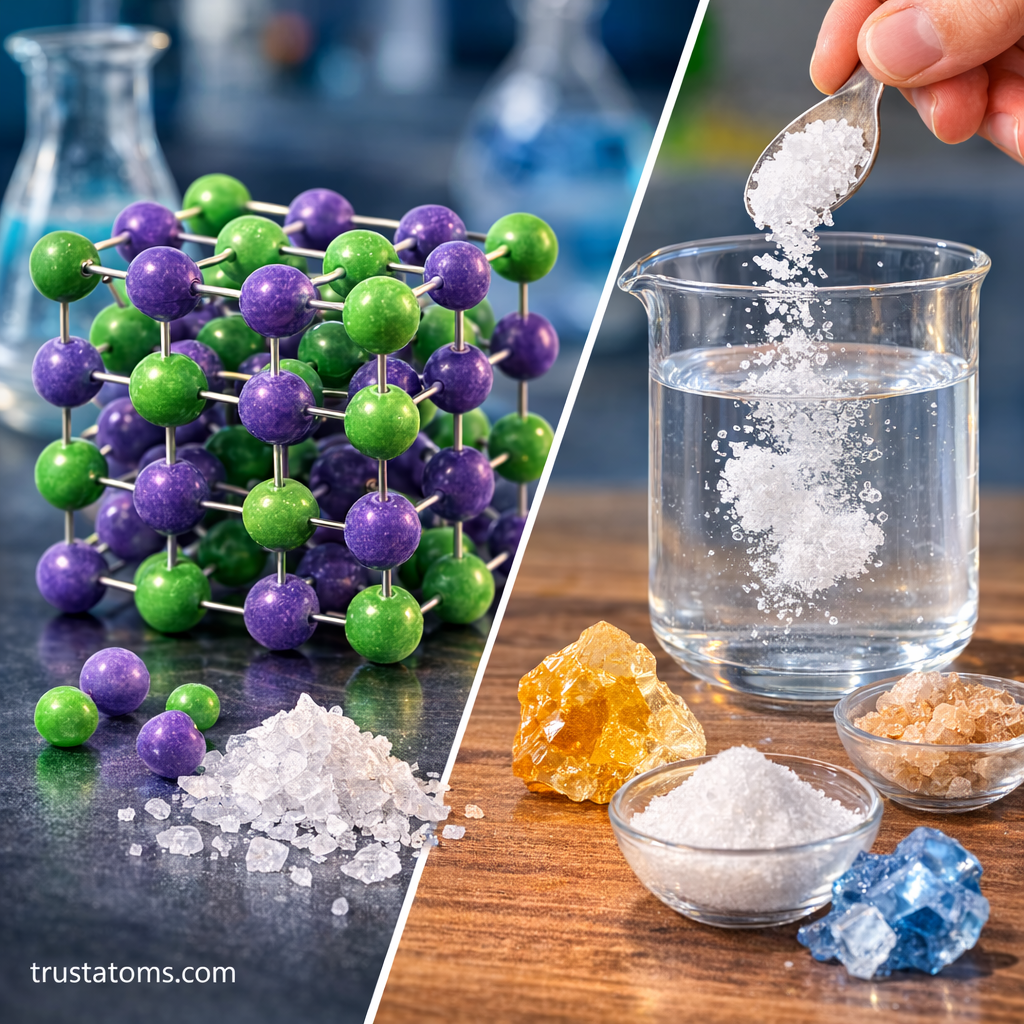
When ionic compounds dissolve in water, the water molecules must overcome lattice energy to separate the ions.
If lattice energy is very high:
- The compound may dissolve slowly
- Or may be poorly soluble
If lattice energy is lower:
- The compound dissolves more easily
4. Hardness of Ionic Solids
Strong ionic attractions make many ionic solids:
- Hard
- Brittle
- Resistant to deformation
When layers of ions shift, like charges can align and repel each other, causing the crystal to fracture.
Examples of Lattice Energy in Common Compounds
Different ionic compounds have very different lattice energies depending on ion size and charge.
Examples include:
| Compound | Relative Lattice Energy |
|---|---|
| Sodium chloride (NaCl) | Moderate |
| Potassium iodide (KI) | Lower |
| Magnesium oxide (MgO) | Very high |
| Calcium oxide (CaO) | High |
Compounds containing highly charged and small ions usually have the greatest lattice energies.
Key Takeaways
Lattice energy is the energy released when gaseous ions combine to form an ionic crystal lattice.
Important ideas to remember include:
- It measures the strength of ionic attractions
- Higher ionic charges increase lattice energy
- Smaller ionic radii increase lattice energy
- Lattice energy influences stability, melting point, hardness, and solubility
- The Born–Haber cycle is commonly used to calculate lattice energy
Understanding lattice energy helps chemists predict how ionic compounds behave in chemical reactions and physical processes.