
Forces usually bring to mind pushes and pulls caused by fields — gravity, electromagnetism, or mechanical contact.
But in statistical mechanics, some forces arise for a completely different reason.
They are not driven by energy minimization alone, but by entropy maximization.
These are called entropic forces.
Entropic forces play a central role in:
- Polymer elasticity
- Osmosis
- Colloidal interactions
- Biological molecular motion
- Emergent gravity theories
Understanding entropic forces helps explain how large-scale behavior emerges from microscopic randomness.
What Is Entropy?
In statistical mechanics, entropy measures the number of microscopic configurations consistent with a macroscopic state.
In simple terms:
- Higher entropy = more possible arrangements
- Lower entropy = fewer possible arrangements
Systems naturally evolve toward states with greater entropy because those states are statistically more probable.
This statistical tendency can generate effective forces.
What Is an Entropic Force?
An entropic force is not caused by a fundamental interaction.
Instead, it emerges because a system tends to move toward configurations with higher entropy.
Key idea:
The “force” appears because some configurations allow more microscopic possibilities than others.
As the system evolves toward greater probability, it behaves as if a force is acting.
Classic Example: Polymer Elasticity
A simple example is a flexible polymer chain in solution.
Imagine a long molecular chain made of many connected segments.
- Each segment can point in different directions.
- The chain can coil in many possible ways.
When the polymer is stretched:
- The number of possible configurations decreases.
- Entropy drops.
When released:
- The chain recoils.
- Entropy increases.
The restoring force is not due to stored mechanical energy alone.
It arises because coiled configurations are statistically favored.
This elastic behavior is primarily entropic in origin.
Entropic Force vs. Fundamental Force
It is important to distinguish entropic forces from fundamental interactions.
Fundamental forces include:
- Gravity
- Electromagnetism
- Strong nuclear force
- Weak nuclear force
Entropic forces:
- Are emergent
- Arise from collective statistical behavior
- Depend on temperature
- Disappear at absolute zero
They are macroscopic consequences of microscopic randomness.
Osmotic Pressure as an Entropic Effect
Osmosis is another example.
When a solution and pure solvent are separated by a semipermeable membrane:
- Solvent molecules move to balance concentrations.
- The system evolves toward higher entropy.
Osmotic pressure behaves like a force pushing solvent across the membrane.
But the driving factor is not a new interaction.
It is the statistical tendency toward more accessible configurations.
Depletion Forces in Colloids
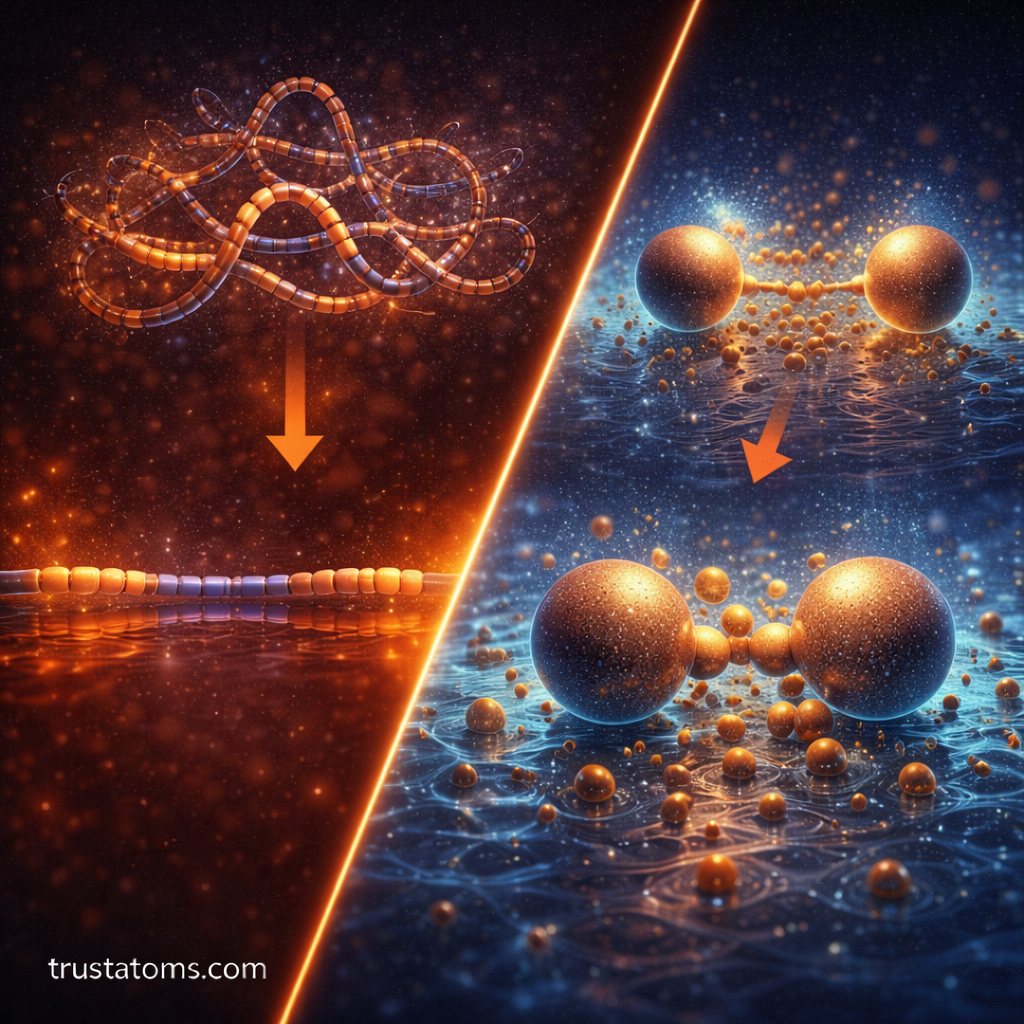
In mixtures of large and small particles, an effective attraction can appear between large particles.
Why?
- Small particles occupy space.
- When two large particles move close together, excluded volume decreases.
- This increases the space available to small particles.
- Total entropy increases.
The result:
Large particles experience an effective attractive force.
Again, the system behaves as though a force exists — but it is entropy-driven.
Temperature Dependence
Entropic forces depend directly on temperature.
At higher temperatures:
- Thermal motion increases.
- Entropic effects become stronger.
At absolute zero:
- Entropy is minimized.
- Entropic forces vanish.
This temperature dependence distinguishes them from fundamental forces like gravity.
The Statistical Origin of Entropic Forces
In statistical mechanics, systems are described by probability distributions over microstates.
The macroscopic behavior emerges from:
- Averaging over enormous numbers of configurations.
- Maximizing entropy under constraints.
If moving in one direction increases the number of accessible microstates, the system will statistically favor that direction.
This bias appears as a force.
In reality, it is a probability gradient.
Entropic Forces in Biology
Entropic forces are crucial in biological systems.
Examples include:
- Protein folding
- DNA elasticity
- Membrane fluctuations
- Molecular motor activity
Biological molecules constantly fluctuate due to thermal motion.
Their large-scale behavior often reflects entropic optimization rather than mechanical pushing.
Life operates in a regime where entropy and energy compete continuously.
Entropic Gravity (A Speculative Idea)
Some theoretical physicists have proposed that gravity itself might be an emergent entropic force.
In this view:
- Gravity is not fundamental.
- It arises from information and entropy changes associated with spacetime.
While still debated, this idea highlights how powerful statistical reasoning can be in explaining physical laws.
Even if gravity remains fundamental, entropic principles clearly shape many physical systems.
Why Entropic Forces Matter
Entropic forces demonstrate a profound principle:
Order and structure can emerge from randomness.
They show how:
- Microscopic disorder leads to predictable macroscopic behavior.
- Probability gradients can mimic mechanical forces.
- Temperature plays a central role in physical dynamics.
From soft materials to biological cells, entropic forces govern behavior at scales far removed from fundamental particle interactions.
Key Characteristics of Entropic Forces
To summarize, entropic forces:
- Arise from entropy maximization
- Depend on temperature
- Are emergent, not fundamental
- Reflect statistical probability differences
- Vanish when thermal motion stops
They reveal how thermodynamics and mechanics intersect.
Final Thoughts
Entropic forces challenge the intuition that forces must come from direct interactions.
Instead, they show that systems move in ways that increase their number of possible microscopic arrangements.
The apparent “push” or “pull” is really a statistical effect.
In statistical mechanics, probability becomes power.
And from that probability, forces emerge.
Understanding entropic forces deepens our insight into soft matter physics, biological systems, and the fundamental structure of reality itself.