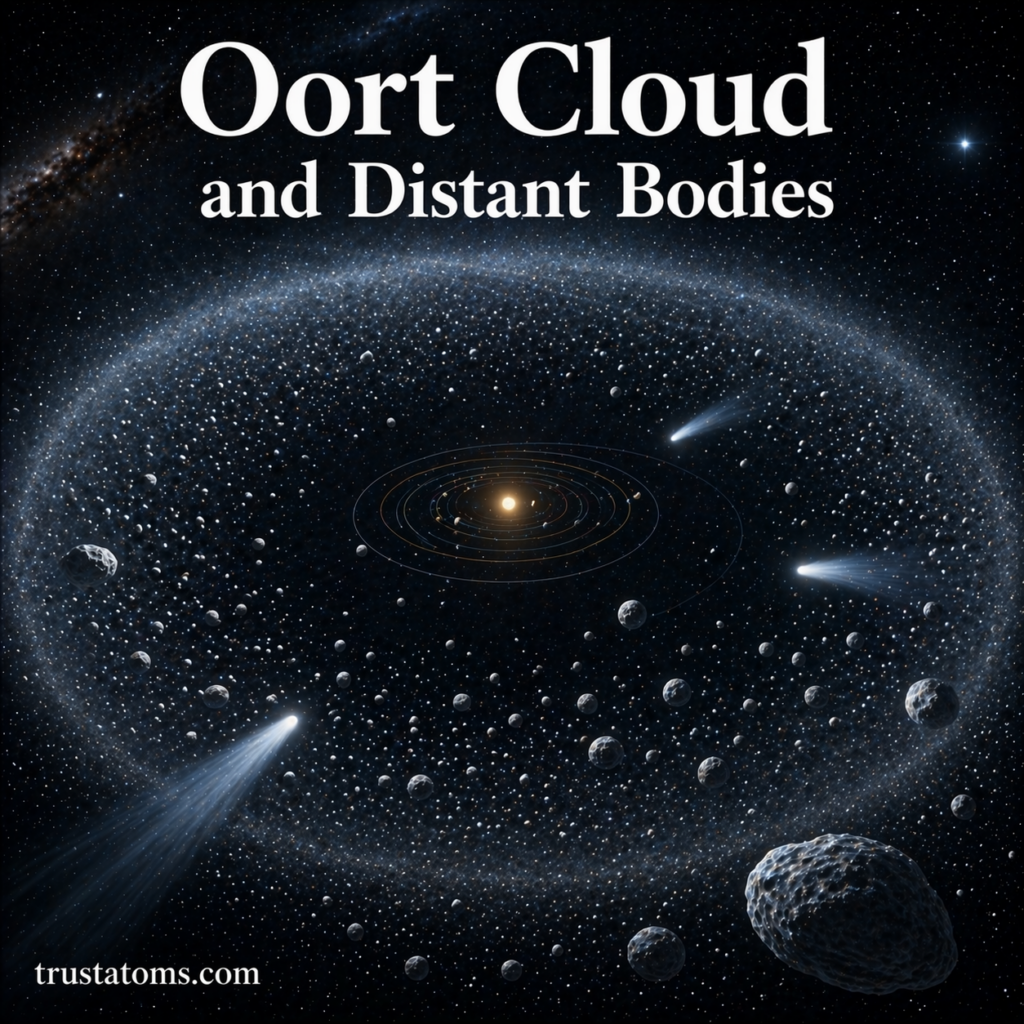
At the farthest reaches of the solar system lies a mysterious and largely unseen region known as the Oort Cloud. This distant zone is believed to be a vast spherical shell of icy objects that surrounds our solar system and extends incredibly far into space.
Although it has never been directly observed, the Oort Cloud plays a crucial role in our understanding of comets, planetary formation, and the true scale of the solar system.
What Is the Oort Cloud?
The Oort Cloud is a theoretical region of icy bodies that exists far beyond the orbit of Neptune.
It is thought to extend from about 2,000 astronomical units (AU) to as far as 100,000 AU from the Sun—nearly halfway to the nearest stars.
Key Characteristics
- Spherical in shape, unlike the flat Kuiper Belt
- Contains billions (or trillions) of icy objects
- Extremely distant and loosely bound to the Sun’s gravity
- Source of long-period comets
Why Haven’t We Seen the Oort Cloud?
Despite its importance, the Oort Cloud has never been directly imaged.
Reasons It Remains Unseen
- Objects are too small and dim to detect easily
- The region is incredibly far from the Sun
- Current telescopes lack the sensitivity for direct observation
Scientists infer its existence based on the behavior of long-period comets entering the inner solar system.
Structure of the Oort Cloud
The Oort Cloud is believed to have two main regions:
1. Inner Oort Cloud (Hills Cloud)
- Denser and closer to the Sun
- Acts as a reservoir feeding the outer cloud
- More stable due to stronger solar gravity
2. Outer Oort Cloud
- Extends much farther into space
- Loosely bound to the Sun
- Easily influenced by nearby stars and galactic forces
This outer region is thought to be the primary source of long-period comets.
What Are Distant Solar System Bodies?
Beyond the planets, there are numerous distant objects that exist in regions like the Oort Cloud and beyond.
Types of Distant Bodies
- Long-period comets
- Icy planetesimals (leftover building blocks of planets)
- Possible undiscovered dwarf planets
These objects are remnants from the early solar system, preserved in cold, distant environments.
The Origin of the Oort Cloud
Scientists believe the Oort Cloud formed early in the solar system’s history.
Formation Process
- Small icy objects formed near the giant planets
- Gravitational interactions—especially with Jupiter and Saturn—scattered these objects outward
- Some were ejected into distant, spherical orbits, forming the Oort Cloud
This process explains why the cloud surrounds the solar system in all directions.
The Oort Cloud and Comets
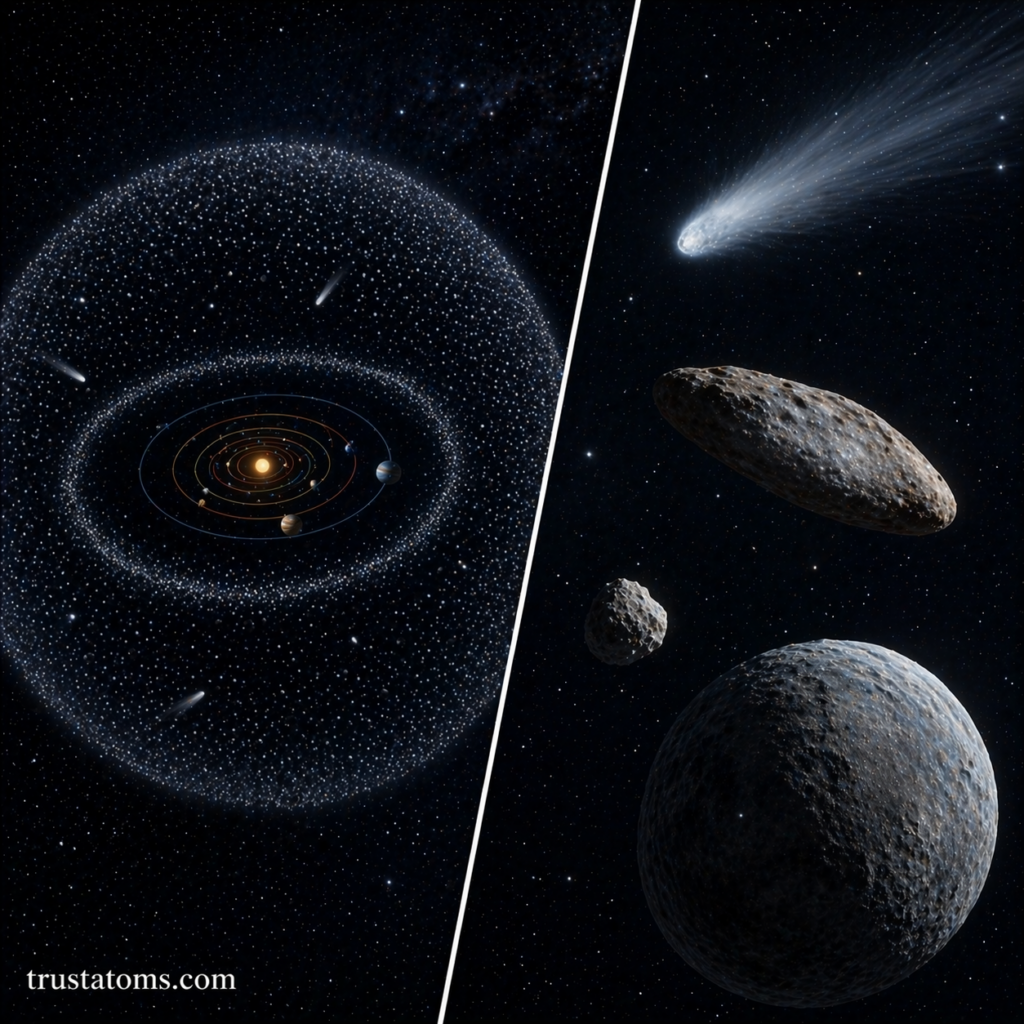
The Oort Cloud is the primary source of long-period comets.
How Comets Are Sent Inward
- Passing stars or gravitational disturbances alter orbits
- Objects are nudged toward the inner solar system
- As they approach the Sun, they become visible comets
Unlike short-period comets, these can take thousands or even millions of years to complete an orbit.
How Far Does the Solar System Extend?
The Oort Cloud defines the outermost boundary of the Sun’s gravitational influence.
Scale Comparison
- Earth orbits at 1 AU from the Sun
- Neptune orbits at about 30 AU
- The Oort Cloud may extend to 100,000 AU or more
This means the solar system is far larger than the region occupied by the planets.
Why the Oort Cloud Matters
Even though it is distant and difficult to study, the Oort Cloud is essential for understanding the solar system.
Scientific Importance
- Provides clues about early solar system dynamics
- Explains the origin of long-period comets
- Helps define the boundary between our solar system and interstellar space
Studying this region also helps astronomers understand how other star systems might form similar structures.
Could There Be Unknown Objects Out There?
The vast distance and limited observation make it possible that large objects remain undiscovered.
Possibilities
- Undetected dwarf planets
- Massive icy bodies
- Objects influenced by external gravitational forces
Some theories even suggest the presence of a distant, unseen planet influencing outer solar system objects.
Common Misconceptions About the Oort Cloud
“It’s just like the Kuiper Belt”
The Kuiper Belt is flat and relatively close, while the Oort Cloud is spherical and extremely distant.
“It’s empty space”
It likely contains trillions of icy bodies, though spread across a vast volume.
“It’s been directly observed”
Its existence is inferred, not directly seen.
Final Thoughts
The Oort Cloud represents one of the most distant and mysterious regions of our solar system. Though we cannot see it directly, its influence is evident in the comets that travel from the depths of space into our skies.
By studying these distant bodies, scientists continue to expand our understanding of the solar system’s origins, structure, and place within the galaxy.