When materials are subjected to forces, they respond by changing shape. Sometimes that change is temporary. Other times, it is permanent.
These two types of mechanical behavior are known as elastic deformation and plastic deformation.
Understanding the difference is essential in physics, engineering, materials science, construction, aerospace design, and manufacturing.
From bending a paperclip to designing skyscrapers, deformation governs how structures survive — or fail — under stress.
What Is Deformation?
Deformation occurs when an external force causes a material to change:
- Length
- Shape
- Volume
- Internal structure
The force applied per unit area is called stress.
The resulting change in shape or size is called strain.
The relationship between stress and strain determines how a material behaves.
Elastic Deformation
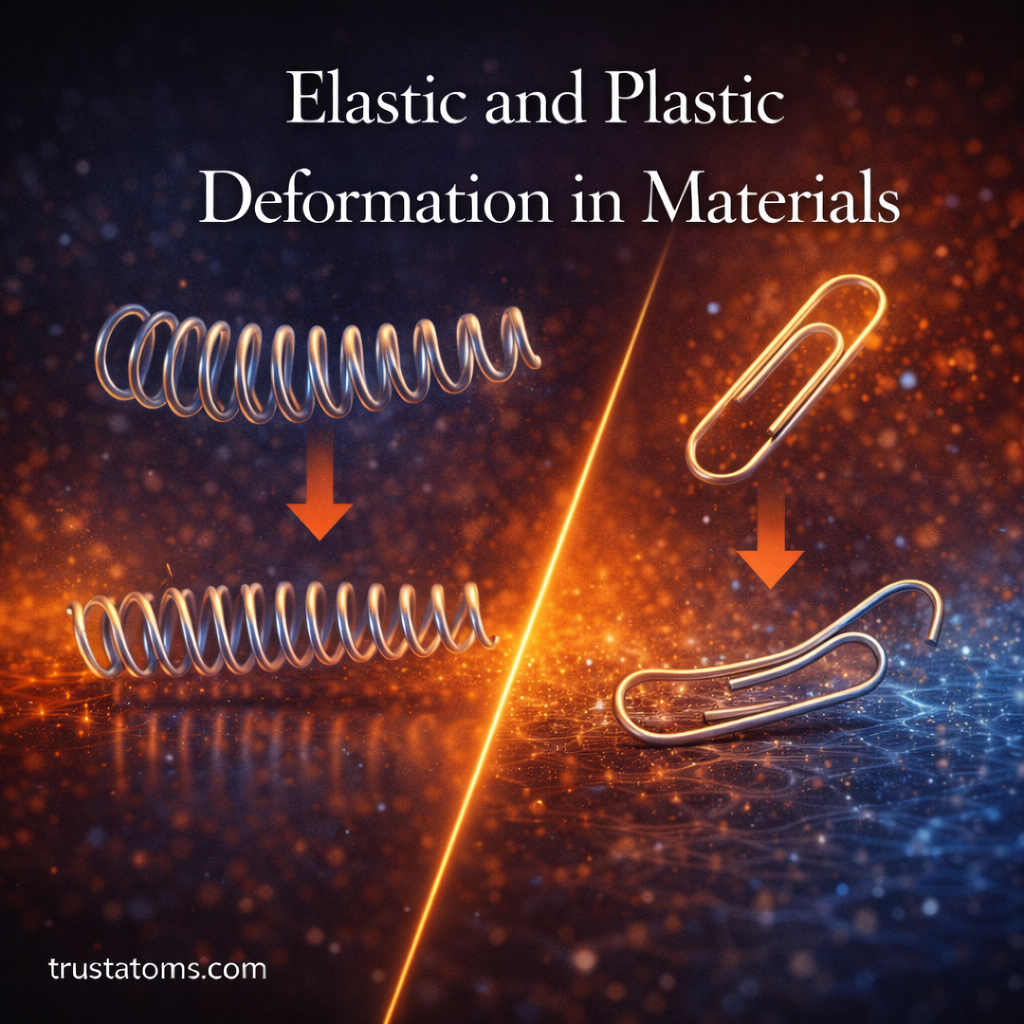
Elastic deformation is reversible.
When the applied force is removed:
- The material returns to its original shape.
- No permanent damage remains.
This behavior occurs when the material’s internal atomic bonds are stretched but not broken.
Everyday Examples
- Stretching a rubber band
- Compressing a spring
- Slightly bending a metal ruler
As long as the force remains below a certain threshold, the material behaves elastically.
Hooke’s Law
For many materials at small deformations, stress is proportional to strain.
This proportional relationship is described by Hooke’s Law.
Key idea:
- Double the applied force → double the deformation
- Remove the force → material returns to original shape
The proportionality constant is called the elastic modulus (or Young’s modulus for tensile stress).
Different materials have different stiffness values.
Examples:
- Steel: high stiffness
- Rubber: low stiffness
- Glass: brittle but relatively stiff
The Elastic Limit
Elastic behavior continues only up to a specific stress level.
This threshold is called the elastic limit or yield point.
Beyond this point:
- The material no longer fully recovers.
- Permanent changes begin.
The yield point marks the transition from elastic to plastic behavior.
Plastic Deformation

Plastic deformation is permanent.
When the applied stress exceeds the yield point:
- Atomic layers slide past one another.
- Crystal structures rearrange.
- The material does not return to its original shape.
Even if the force is removed, the deformation remains.
Common Examples
- Bending a paperclip too far
- Hammering metal into shape
- Forming car body panels
Plastic deformation is essential in manufacturing processes like forging, rolling, and stamping.
Microscopic Mechanisms
On an atomic scale, materials are made of repeating crystal structures.
Elastic deformation:
- Slight stretching of atomic bonds
- No rearrangement of structure
Plastic deformation:
- Movement of defects called dislocations
- Permanent rearrangement of atomic layers
The motion of dislocations allows metals to deform without fracturing immediately.
Stress-Strain Curve
The stress-strain curve visually represents material behavior.
It typically includes:
- Elastic region (linear behavior)
- Yield point
- Plastic region
- Ultimate strength
- Fracture point
Key features:
- Slope of elastic region → stiffness
- Yield strength → start of permanent deformation
- Ultimate strength → maximum stress before failure
Different materials have very different curves.
Ductile vs. Brittle Materials
Materials respond differently after yielding.
Ductile Materials
- Undergo significant plastic deformation before breaking
- Examples: steel, copper, aluminum
- Can absorb large amounts of energy
Brittle Materials
- Fracture with little plastic deformation
- Examples: glass, ceramics, cast iron
- Crack suddenly without warning
Understanding this distinction is critical for safety and design.
Strain Hardening
Some materials become stronger as they undergo plastic deformation.
This process is called strain hardening (or work hardening).
During plastic deformation:
- Dislocation density increases
- Further motion becomes harder
- Material strength rises
This is why cold-worked metals can become stronger but less ductile.
Temperature Effects
Temperature significantly affects deformation behavior.
At higher temperatures:
- Atoms move more freely
- Materials become softer
- Plastic deformation becomes easier
At lower temperatures:
- Materials become more brittle
- Risk of sudden fracture increases
This explains why some metals fracture more easily in cold environments.
Creep and Time-Dependent Deformation
Deformation does not always occur instantly.
Under constant stress over long periods, materials may slowly deform. This is called creep.
Creep is important in:
- Turbine blades
- Jet engines
- Power plants
- Structural supports
High temperature accelerates creep processes.
Why Elastic and Plastic Deformation Matter
These behaviors determine:
- Structural safety
- Load limits
- Manufacturing techniques
- Material selection
- Failure prediction
Engineers must know:
- How much stress a material can handle
- Whether deformation will be temporary or permanent
- When fracture may occur
Without this knowledge, bridges would collapse, aircraft would fail, and machinery would malfunction.
Applications in Real Life
Elastic and plastic deformation are central to:
- Building construction
- Automotive design
- Aerospace engineering
- Metal forming industries
- Biomedical implants
- Earthquake-resistant structures
Modern engineering depends on carefully balancing stiffness, strength, and ductility.
Key Differences at a Glance
Elastic Deformation:
- Reversible
- Occurs below yield point
- No permanent structural change
Plastic Deformation:
- Permanent
- Occurs beyond yield point
- Involves atomic rearrangement
Both behaviors are essential — one allows flexibility, the other enables shaping and manufacturing.
Final Thoughts
Elastic and plastic deformation reveal how materials respond to stress at both macroscopic and atomic levels.
Elasticity allows structures to flex safely.
Plasticity allows materials to be shaped and formed.
Together, they define the mechanical behavior of nearly everything built in the modern world.
From bending a spoon to designing spacecraft, understanding deformation is fundamental to physics and engineering.