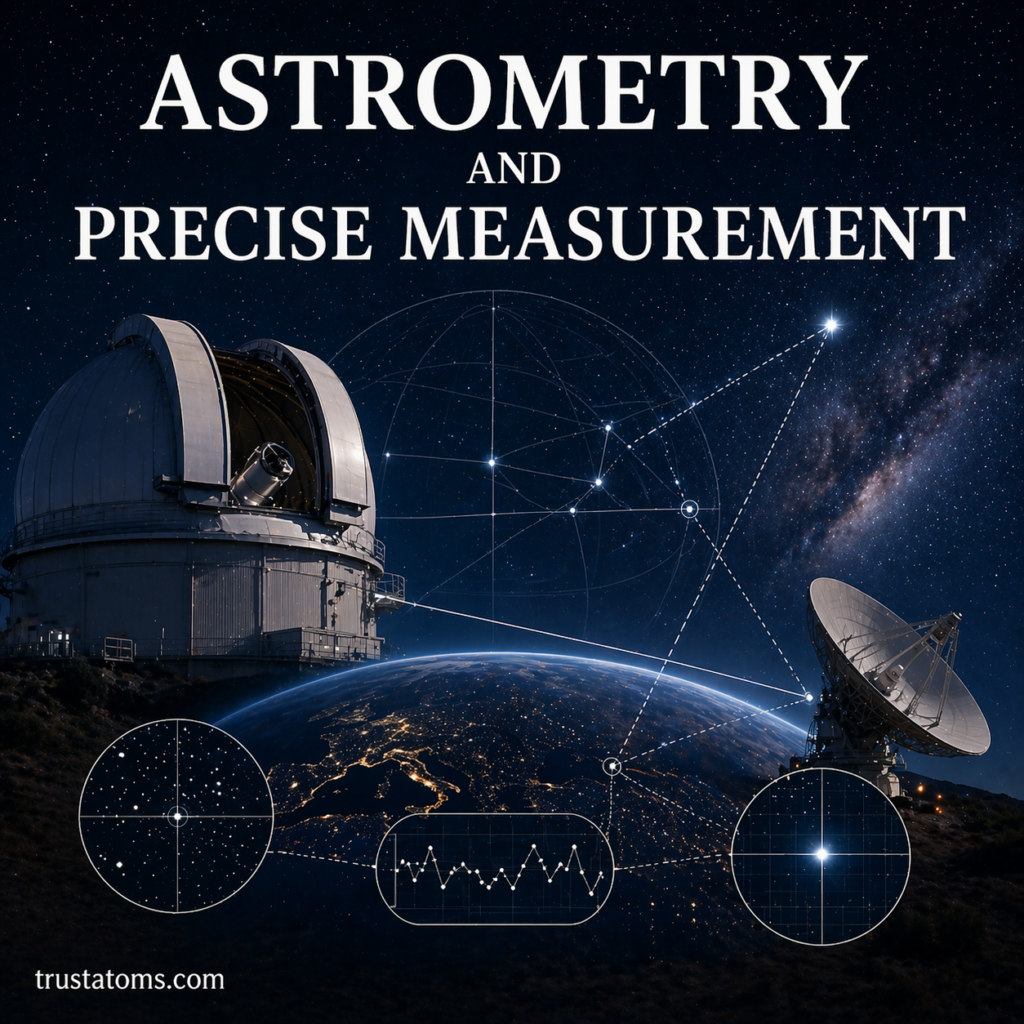
Measuring the positions and movements of celestial objects is one of the oldest practices in astronomy. Today, this field—known as astrometry—has become one of the most precise and important tools for understanding the universe.
From mapping nearby stars to detecting distant planets, astrometry plays a critical role in modern space science.
What Is Astrometry?
Astrometry is the branch of astronomy that focuses on the precise measurement of the positions, distances, and motions of celestial objects.
These objects include:
- Stars
- Planets
- Asteroids
- Galaxies
By tracking how these objects move over time, astronomers can build accurate models of how the universe is structured and how it evolves.
Why Astrometry Matters
Astrometry may sound technical, but its impact is enormous.
Key contributions include:
- Mapping the structure of the Milky Way
- Measuring distances to stars
- Detecting unseen planets and companions
- Improving spacecraft navigation
- Refining our understanding of gravity and motion
Without astrometry, much of modern astronomy would lack the precision needed for reliable discoveries.
How Positions Are Measured in the Sky
Astronomers use a coordinate system similar to latitude and longitude on Earth.
The main coordinates are:
- Right Ascension (RA) → measures east-west position
- Declination (Dec) → measures north-south position
These coordinates are mapped onto an imaginary sphere surrounding Earth, known as the celestial sphere.
Measuring Stellar Distance: Parallax
One of the most important tools in astrometry is parallax.
What is parallax?
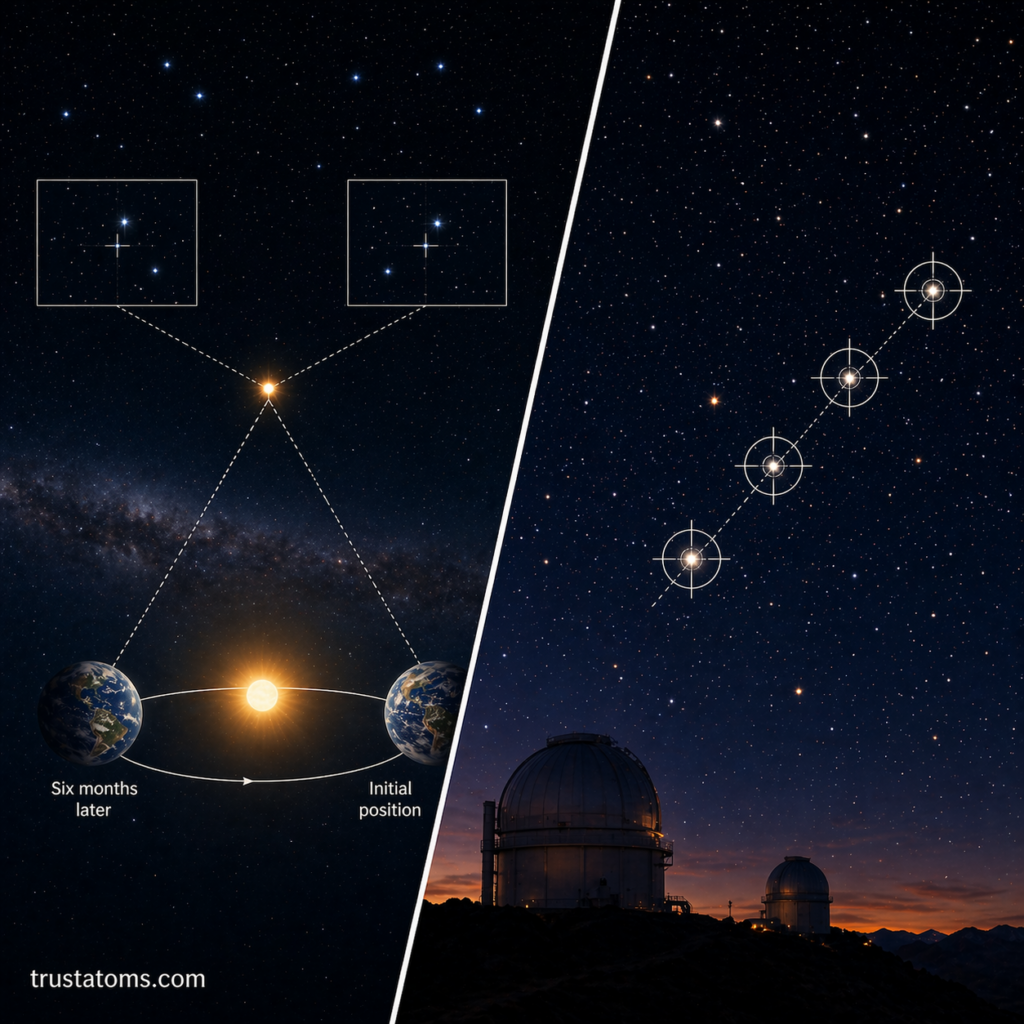
Parallax is the apparent shift in position of a nearby star when viewed from different points in Earth’s orbit around the Sun.
How it works:
- Observe a nearby star from one side of Earth’s orbit
- Observe it again six months later from the opposite side
- Measure the tiny shift against distant background stars
Key idea:
- The closer the star, the larger the shift
- The farther the star, the smaller the shift
This method allows astronomers to calculate distances with remarkable accuracy.
Proper Motion: Tracking Movement Over Time
Stars are not stationary—they move through space.
Proper motion refers to:
- The slow, steady movement of a star across the sky
- Measured over years or decades
By combining proper motion with distance measurements, astronomers can determine:
- A star’s actual velocity
- Its direction of travel
- Its place within the galaxy
Astrometry and Exoplanet Discovery
Astrometry can even reveal planets around distant stars.
How?
A planet’s gravity causes its host star to:
- Wobble slightly
- Shift position over time
By measuring this tiny motion, astronomers can:
- Detect unseen planets
- Estimate their mass
- Determine their orbit
This method complements other techniques like:
- Transit observations
- Radial velocity measurements
Tools and Missions in Astrometry
Modern astrometry relies on highly advanced instruments and space missions.
Ground-based tools:
- Large telescopes with precision detectors
- Long-term observation programs
Space-based missions:
- Gaia
- Hubble Space Telescope
The Gaia mission, in particular, is mapping billions of stars with unprecedented accuracy, creating the most detailed 3D map of the Milky Way ever made.
Challenges in Precise Measurement
Astrometry requires extreme precision—often measuring angles smaller than a fraction of a degree.
Key challenges include:
- Atmospheric distortion (for ground telescopes)
- Instrument calibration errors
- Tiny measurement scales (microarcseconds)
- Long observation times
Even slight errors can significantly affect results, making accuracy essential.
Real-World Applications of Astrometry
Astrometry is not just theoretical—it has practical uses:
In space exploration:
- Guiding spacecraft trajectories
- Navigating deep-space missions
In science:
- Studying dark matter distribution
- Understanding galaxy formation
In technology:
- Improving star catalogs used in navigation systems
Final Thoughts
Astrometry may not be as visually dramatic as black holes or supernovae, but it is one of the most foundational tools in astronomy. By precisely measuring where objects are and how they move, scientists can unlock the structure and dynamics of the universe.
Every accurate map of the stars—and every discovery that depends on position and motion—begins with astrometry.