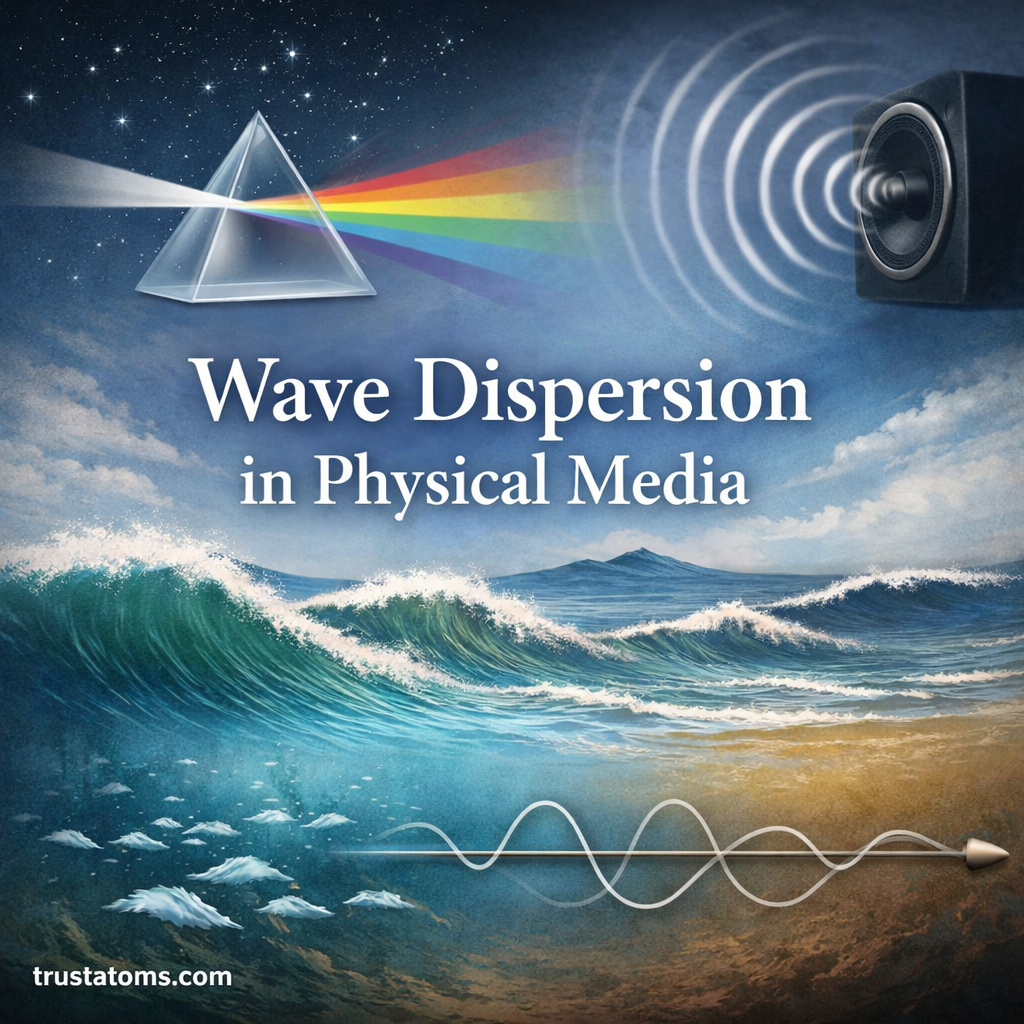
Wave dispersion is one of the most important — and often misunderstood — concepts in physics. It explains why ocean swells stretch out over distance, why a prism splits white light into colors, and why signals traveling through materials can lose clarity.
In simple terms, dispersion occurs when different frequencies (or wavelengths) of a wave travel at different speeds through a physical medium.
This article breaks down wave dispersion in physical media in a clear, practical way — with real-world examples and the physics behind it.
What Is Wave Dispersion?
Wave dispersion happens when the speed of a wave depends on its frequency or wavelength.
If all frequencies move at the same speed, the wave shape remains intact.
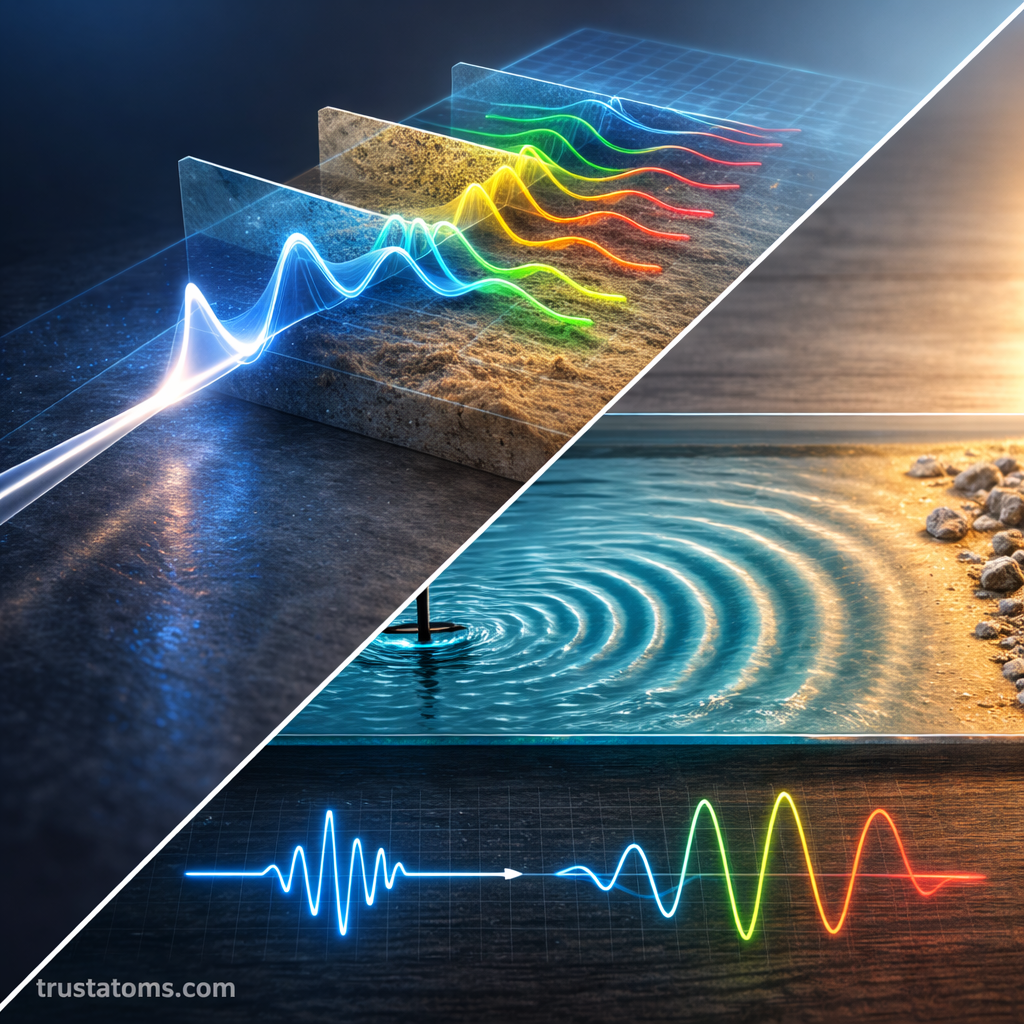
If different frequencies move at different speeds, the wave packet spreads out over time. This spreading is called dispersion.
Mathematically, dispersion appears when wave velocity depends on wavelength:
- Phase velocity (vₚ) = ω / k
- ω = angular frequency
- k = wave number
If ω is not proportional to k, the medium is dispersive.
Why Dispersion Happens in Physical Media
Dispersion occurs because physical media respond differently to different frequencies.
A medium has:
- Mass
- Elastic properties
- Internal structure
- Electromagnetic characteristics (for light)
These properties influence how quickly energy can propagate.
When the restoring forces or inertia in a system depend on frequency, different components of the wave move differently — producing dispersion.
Key Types of Wave Dispersion
1. Optical Dispersion
This occurs when light travels through a material and different colors move at different speeds.
White light contains many wavelengths. In materials like glass:
- Shorter wavelengths (blue/violet) slow down more
- Longer wavelengths (red) travel slightly faster
This is why prisms create rainbows.
Optical dispersion explains:
- Rainbows in the sky
- Chromatic aberration in lenses
- Fiber optic signal spreading
2. Water Wave Dispersion
Ocean waves are naturally dispersive.
For deep-water waves:
- Longer wavelengths travel faster
- Shorter wavelengths travel slower
That’s why after a storm, distant observers see long, rolling swells first — the shorter waves lag behind.
3. Sound Wave Dispersion
In many common gases like air, sound dispersion is minimal at normal frequencies.
However, in:
- Solid materials
- Structured media
- Plasma
Sound waves can become dispersive due to complex interactions between particles.
4. Mechanical Wave Dispersion in Strings and Rods
On an ideal stretched string under uniform tension, waves are nearly non-dispersive.
But in real materials:
- Bending stiffness
- Internal friction
- Structural boundaries
Cause dispersion.
This affects:
- Musical instruments
- Seismic waves
- Engineering vibrations
Phase Velocity vs Group Velocity
Understanding dispersion requires distinguishing between two speeds:
Phase Velocity
The speed of individual wave crests.
Formula:
vₚ = ω / k
Group Velocity
The speed of the overall wave packet (energy transport).
Formula:
v_g = dω / dk
In dispersive media:
- Phase velocity ≠ group velocity
This difference causes wave spreading.
What Is a Dispersion Relation?
A dispersion relation connects frequency (ω) and wave number (k).
It defines how waves behave in a medium.
Examples:
- Non-dispersive medium: ω = v k
- Dispersive medium: ω = f(k), where the relationship is nonlinear
The curvature of the dispersion relation determines how strongly waves spread.
Real-World Applications of Wave Dispersion
Dispersion is not just theoretical. It affects multiple fields.
Telecommunications
In fiber optics:
- Different light wavelengths travel at slightly different speeds.
- Over long distances, pulses spread.
- This limits bandwidth and data rates.
Engineers design dispersion-compensating systems to fix this.
Astronomy
Light traveling through interstellar plasma experiences dispersion.
This helps astronomers:
- Measure cosmic distances
- Study pulsars
- Detect fast radio bursts
Earthquake Science
Seismic waves disperse as they move through Earth’s layered structure.
This helps geophysicists:
- Map Earth’s interior
- Understand crust and mantle composition
- Predict wave arrival patterns
Musical Acoustics
String instruments can experience slight dispersion.
This influences:
- Harmonic tuning
- Tone color
- Sound quality
Dispersion vs Diffraction vs Attenuation
These wave behaviors are often confused.
Here’s the difference:
- Dispersion: Frequencies travel at different speeds.
- Diffraction: Waves bend around obstacles.
- Attenuation: Wave amplitude decreases over distance.
- Interference: Waves combine constructively or destructively.
Only dispersion changes the relative spacing of wave components.
Mathematical Insight (Simplified)
Consider a wave packet made of many frequencies.
If:
- v_g depends on frequency
- Higher frequencies move faster or slower
Then over time:
- The packet stretches
- Peaks separate
- The original shape changes
The stronger the curvature of the dispersion relation, the faster the spreading.
Can a Medium Be Non-Dispersive?
Yes.
An ideal medium is non-dispersive when:
- Wave speed is constant
- ω is directly proportional to k
Examples:
- Sound in ideal air (approximately)
- Waves on an ideal tension-only string
However, most real-world materials show at least slight dispersion.
Why Wave Dispersion Matters in Physics
Wave dispersion reveals:
- How materials store and transfer energy
- How signals degrade over distance
- How wave behavior reflects internal structure
It connects mechanics, electromagnetism, quantum physics, and relativity.
In quantum mechanics, dispersion relations determine:
- Particle behavior
- Energy-momentum relationships
- Wavefunction evolution
Dispersion is foundational to modern physics.
Final Thoughts
Wave dispersion in physical media explains why waves don’t always stay intact as they travel.
When different frequencies move at different speeds:
- Wave packets spread
- Signals distort
- Natural patterns evolve
From rainbows to radio waves to ocean swells, dispersion shapes the physical world in visible and invisible ways.
Understanding it gives deeper insight into how energy moves through matter — and why nature rarely behaves in perfectly simple ways.