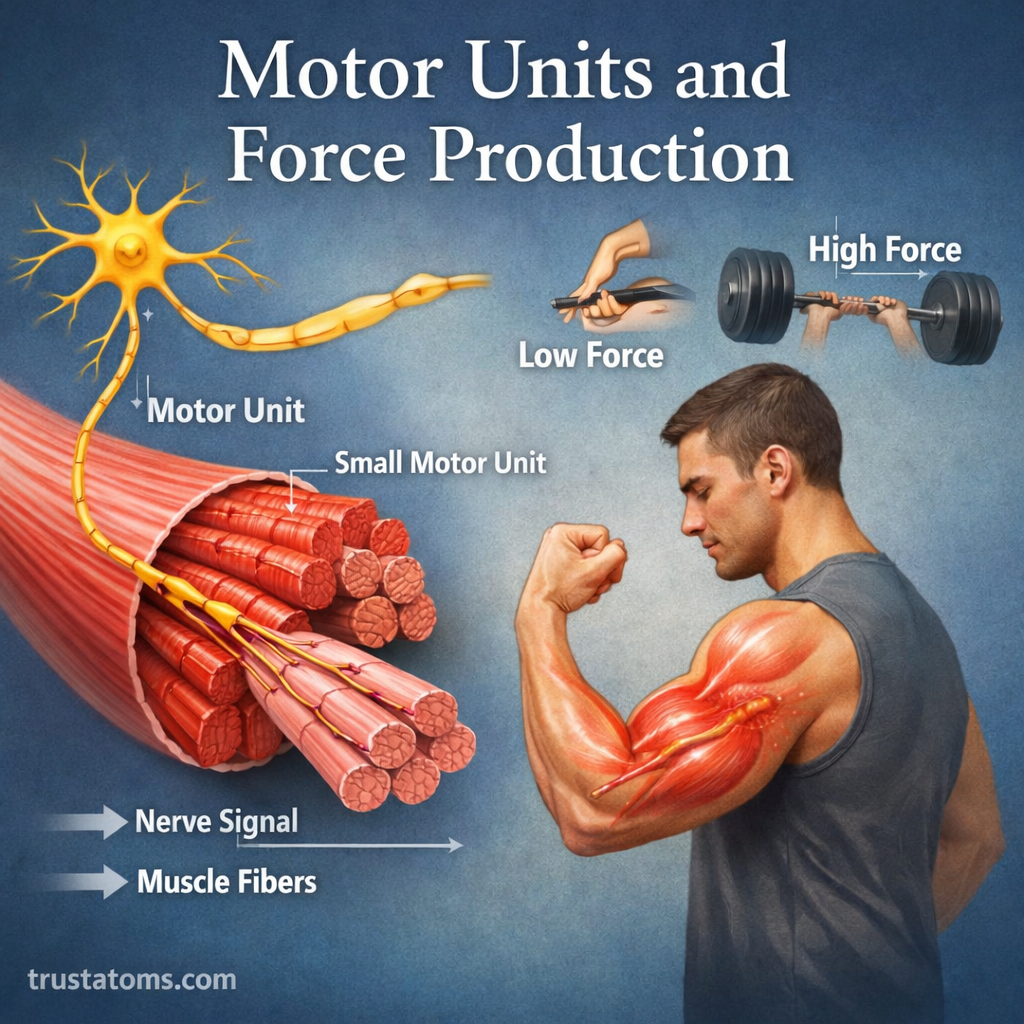
Motor units produce muscle force by activating groups of skeletal muscle fibers under the control of individual motor neurons. The nervous system adjusts force by recruiting more motor units and changing how frequently their motor neurons send electrical impulses.
This system allows the same muscles to perform delicate tasks, such as holding a pencil, and demanding actions, such as lifting a heavy object. Understanding motor units connects muscle physiology with human anatomy and explains how the nervous system controls strength, precision, and movement.
What Is a Motor Unit?
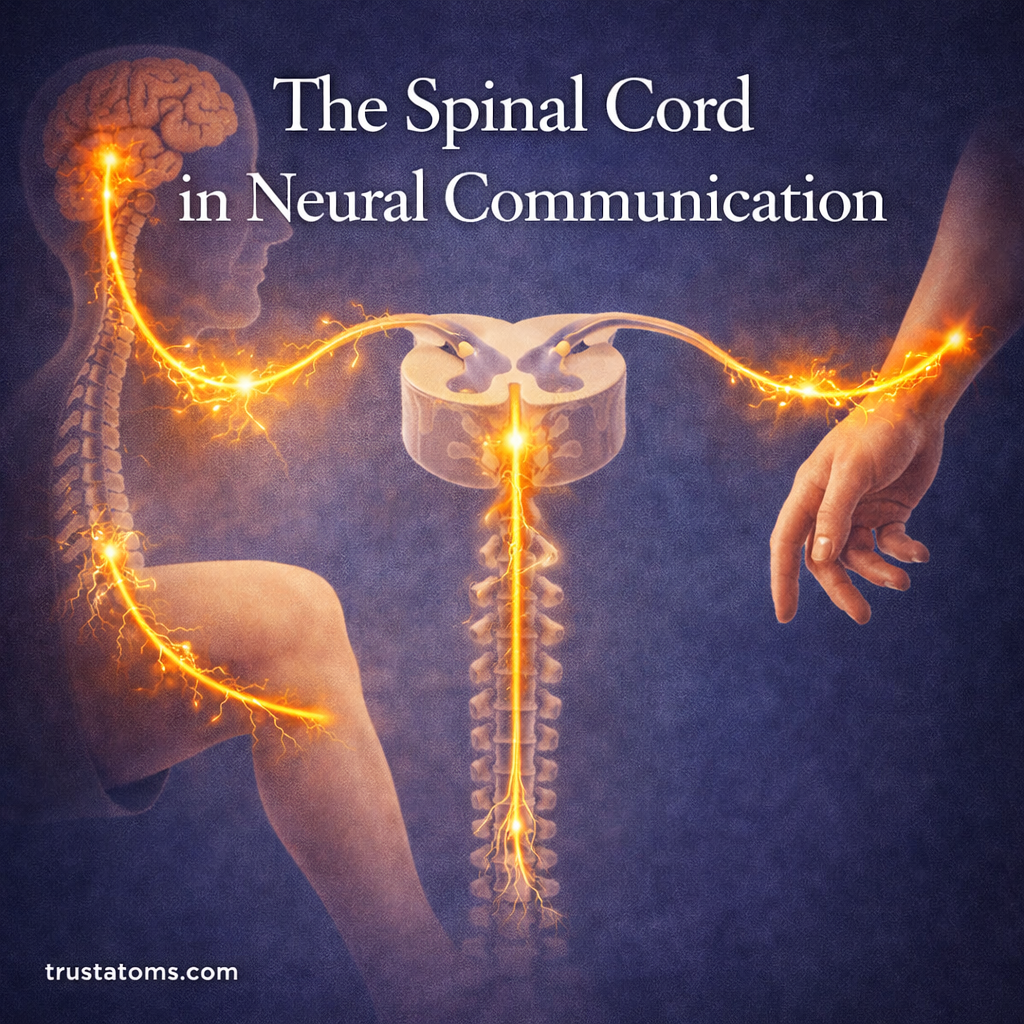
A motor unit consists of one alpha motor neuron and all the skeletal muscle fibers it innervates. The motor neuron’s axon branches to reach multiple muscle fibers, allowing one nerve cell to activate an entire group.
Each connection between a motor neuron terminal and a muscle fiber is called a neuromuscular junction. The Neuromuscular Junction explains how acetylcholine transfers the nerve signal to the muscle membrane.
Motor units are part of the pathways described in Somatic Nervous System in Voluntary Control. Their muscle fibers contain contractile proteins arranged into structures explained in Skeletal Muscle Structure and Function.
Small and Large Motor Units
Motor units vary in the number and characteristics of their muscle fibers. These differences help muscles balance precise control with the ability to generate substantial force.
Small Motor Units for Precise Movements
Small motor units contain relatively few muscle fibers. Activating one produces a modest change in force, making them useful in muscles requiring fine adjustments, such as those controlling eye position and delicate hand movements.
Small, low-threshold motor units often contain slow, fatigue-resistant fibers, although motor unit size and physiological characteristics vary across muscles.
Large Motor Units for Greater Force
Large motor units innervate more muscle fibers and can contribute greater force when activated. They are particularly useful during demanding movements involving major limb muscles.
Many high-threshold motor units contain fast-contracting fibers capable of producing substantial force. Some fatigue more rapidly than slow motor units, especially during repeated intense contractions.
How Motor Unit Recruitment Increases Force
Motor unit recruitment is the process of activating additional motor units as a muscle needs to produce more force. During a light task, relatively few units may be active. As resistance increases, the nervous system recruits additional units to raise total muscle tension.
Recruitment generally follows the size principle: lower-threshold motor neurons are activated before larger, higher-threshold motor neurons during gradually increasing voluntary contractions.
- Low-force activity: Primarily recruits low-threshold motor units suited to sustained, controlled contractions.
- Moderate-force activity: Adds motor units as the required muscle tension increases.
- High-force activity: Recruits additional high-threshold motor units capable of contributing greater force.
This orderly pattern helps the nervous system produce smooth changes in force rather than activating every muscle fiber at maximum intensity for every movement.
How Firing Rate Changes Muscle Tension
Recruitment is not the only way to increase force. The nervous system also changes how frequently active motor neurons generate action potentials, a mechanism called rate coding.
A single action potential usually produces a brief muscle twitch. If another impulse arrives before the muscle fiber fully relaxes, the mechanical responses overlap and generate greater tension. This is called temporal summation.
At sufficiently high stimulation frequencies, individual twitches can merge into a sustained contraction known as fused tetanus. In muscle physiology, tetanus describes this sustained contraction and should not be confused with the infectious disease of the same name.
Recruitment and rate coding operate together. Their relative contributions depend on the muscle, task, and force level.
The All-or-None Principle in Motor Units
When the motor neuron sends a signal, all the muscle fibers within that unit are normally activated together. This is known as the all-or-none principle.
More precisely, an action potential is an all-or-none electrical event, and a successfully transmitted motor neuron impulse normally activates each healthy muscle fiber belonging to that motor unit.
This does not mean every contraction produces identical force. The tension generated by a muscle fiber depends on factors such as its starting length, previous activity, stimulation frequency, and fatigue.
Whole muscles can therefore produce many different force levels even though individual muscle action potentials follow an all-or-none pattern.
Other Factors That Affect Muscle Force
Motor neuron activity determines which muscle fibers are activated, but the force produced also depends on the mechanical and physiological condition of those fibers.
- Muscle fiber type: Slow fibers generally resist fatigue well, while fast fibers can produce higher power during rapid contractions.
- Muscle length: Force depends partly on the overlap between actin and myosin filaments and the contribution of passive tissues.
- Contraction velocity: During shortening contractions, maximum force generally decreases as shortening speed increases.
- Muscle size: Greater physiological cross-sectional area generally increases the capacity to generate force.
- Fatigue: Sustained or repeated activity can reduce force output through changes in neural drive and processes within muscle fibers.
Motor Units in Everyday Movement

Everyday activities require different combinations of motor unit recruitment and firing frequency. The neural pathways that organize these actions are discussed in Motor Neurons and Movement Control.
Holding a pen requires carefully regulated force from hand and finger muscles. Carrying groceries requires greater activation of muscles in the hands, arms, shoulders, and trunk. Sprinting demands rapid, forceful contractions that recruit high-threshold motor units in major leg muscles.
Example: Picking Up a Coin Versus Performing a Squat
Imagine picking up a coin between your thumb and index finger. The nervous system activates motor units in the hand muscles and adjusts their firing patterns to generate enough grip force without losing precision.
Now consider standing up from a deep squat while holding a heavy barbell. The quadriceps, gluteal muscles, and other stabilizing muscles must generate much greater force. The nervous system recruits additional motor units, including higher-threshold units, and adjusts firing rates to meet the demand.
Both actions use the same basic principles, but the number and characteristics of active motor units differ. This explains how skeletal muscles can support both fine motor control and powerful movements.
How Strength Training Changes Motor Unit Activity
Strength training can increase force production through adaptations in both the nervous system and muscle tissue.
Early Neural Adaptations
During the early stages of resistance training, strength may improve before substantial muscle growth occurs. Changes in neural drive, motor unit recruitment, firing behavior, and coordination can contribute to these improvements.
Practice also helps the nervous system coordinate the muscles needed for a specific exercise while reducing unnecessary activity in opposing muscles.
Longer-Term Muscle Adaptations
With continued resistance training, muscle fibers may increase in size through hypertrophy. Larger muscles generally have a greater capacity to generate force, although strength remains influenced by neural control and movement technique.
Training effects are specific to the demands imposed. Heavy resistance, rapid movements, and sustained endurance activities emphasize different combinations of force, speed, and fatigue resistance.
Common Misunderstandings About Motor Units
Does a Stronger Contraction Mean Each Fiber Contracts More Fully?
Not necessarily. Stronger whole-muscle contractions often involve recruiting additional motor units and increasing stimulation frequency. Individual muscle fibers can also generate different amounts of tension depending on their physiological conditions.
Is Muscle Size the Only Factor That Determines Strength?
No. Muscle size contributes to force capacity, but neural activation, muscle architecture, joint position, and movement technique also affect measured strength.
Frequently Asked Questions
What is the difference between a motor neuron and a motor unit?
A motor neuron is a nerve cell that transmits signals to muscle fibers. A motor unit includes that motor neuron and all the skeletal muscle fibers it controls.
Why are smaller motor units usually recruited first?
Smaller, lower-threshold motor neurons generally require less synaptic input to become active. Their recruitment allows gradual increases in force before larger, higher-threshold units are added.
Can motor units become more effective with training?
Training can improve how the nervous system activates and coordinates motor units. These adaptations contribute to strength gains alongside changes in muscle size and other muscular properties.
Motor units allow the nervous system to scale muscle force by combining recruitment with changes in firing frequency. Their different sizes and physiological characteristics help explain the contrast between precise hand movements and high-force activities such as lifting. Training, fatigue, and muscle mechanics further influence how much force the activated fibers ultimately produce.
This article is for general education and is not medical advice. Talk to a qualified health professional about any medical concern.
Sources: OpenStax, Anatomy and Physiology 2e; Guyton and Hall Textbook of Medical Physiology; American College of Sports Medicine (ACSM).