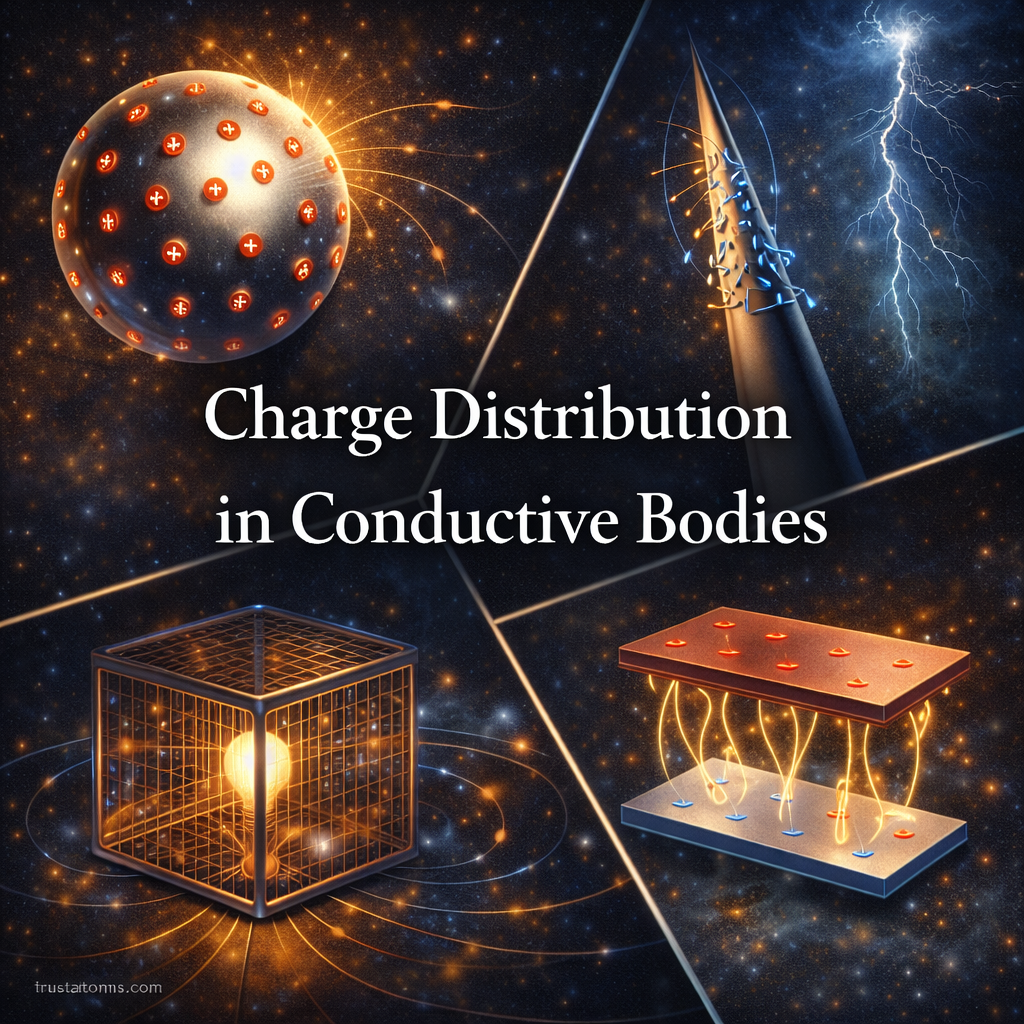
Charge distribution in conductive bodies is a foundational concept in electromagnetism. It explains why electric charges move to the surface of metals, why lightning rods work, and why electric fields behave differently inside and outside conductors.
Understanding how charge arranges itself in conductive materials helps explain everything from circuit behavior to shielding in electronic devices.
In this article, we’ll explore how charges distribute in conductors, the physics behind electrostatic equilibrium, and real-world applications of these principles.
What Is a Conductor?
A conductor is a material in which electric charges can move freely.
In most conductive solids:
- Electrons are loosely bound.
- They can move throughout the material.
- Positive atomic nuclei remain fixed in place.
Common conductors include:
- Copper
- Aluminum
- Silver
- Gold
Because charges are mobile, conductors behave very differently from insulators when placed in electric fields.
How Charges Move in Conductors
When excess charge is placed on a conductor:
- Electrons repel each other.
- They move apart as much as possible.
- The system seeks electrostatic equilibrium.
Electrostatic equilibrium occurs when:
- Charges are no longer moving.
- The electric field inside the conductor is zero.
- The charge distribution is stable.
This redistribution happens extremely quickly — nearly instantaneously at macroscopic scales.
Why Charges Reside on the Surface
One of the most important results in electrostatics is:
Excess charge in a conductor resides on its surface.
Here’s why:
- If charge were inside, it would create an internal electric field.
- That field would cause further charge motion.
- Charges continue moving until the internal field becomes zero.
The only configuration that produces zero electric field inside a conductor is one where all excess charge is located on the surface.
Electric Field Inside a Conductor
At electrostatic equilibrium:
- The electric field inside a conductor is zero.
- The electric potential is constant throughout the conductor.
This means:
- No net force acts on charges inside.
- Charges stop moving.
- The conductor becomes an equipotential region.
This property is central to many applications in electrical engineering and physics.
Charge Distribution on Irregular Surfaces

Charge does not distribute evenly on all conductors.
It depends strongly on shape.
Key principle:
Charge density is higher at sharp points and edges.
Why?
- Electric field strength increases near regions of small curvature.
- Charges crowd at sharp tips.
- Stronger local fields form near pointed surfaces.
This explains why lightning rods are pointed — the sharp tip enhances electric field strength and encourages controlled discharge.
Conductors in External Electric Fields
When a conductor is placed in an external electric field:
- Charges rearrange.
- Negative charges shift opposite the field direction.
- Positive charges shift in the field direction.
This redistribution creates:
- An induced surface charge pattern.
- A field that cancels the internal electric field.
- Zero electric field inside the conductor.
This phenomenon is called electrostatic shielding.
The Faraday Cage Effect
A direct consequence of charge distribution principles is the Faraday cage.
A Faraday cage:
- Is a conductive enclosure.
- Shields its interior from external electric fields.
Because:
- Charges rearrange on the outer surface.
- The internal field remains zero.
Applications include:
- Protecting electronic equipment.
- Shielding sensitive instruments.
- Aircraft protection from lightning.
Surface Charge Density
Surface charge density refers to:
- The amount of charge per unit area on a conductor’s surface.
It varies depending on:
- Geometry
- Nearby charges
- External electric fields
Regions with greater curvature have higher surface charge density.
Conductors and Electrostatic Potential
In electrostatic equilibrium:
- The entire conductor has the same electric potential.
- No voltage difference exists inside the conductor.
This is why:
- Metal wires in circuits quickly reach uniform potential.
- Short circuits can occur if two points at different potentials are connected.
Understanding this principle is essential in circuit analysis.
Conductive Spheres and Symmetry
For simple shapes like spheres:
- Charge distributes uniformly over the surface.
- The external electric field behaves as if all charge were concentrated at the center.
This symmetry simplifies many electrostatics problems.
Spherical conductors are often used in theoretical analysis because of this property.
Induction and Charge Separation
Charge distribution also explains electrostatic induction.
Induction occurs when:
- A charged object is brought near a neutral conductor.
- Charges inside the conductor rearrange.
- Opposite charge accumulates closer to the external charge.
If the conductor is grounded during this process:
- Net charge can be transferred.
- The conductor becomes permanently charged.
This principle is used in:
- Electrostatic generators.
- Capacitors.
- Industrial charging processes.
Charge Distribution in Capacitors
Capacitors rely on controlled charge distribution.
They consist of:
- Two conductive plates.
- Separated by an insulator.
When connected to a voltage source:
- Positive charge accumulates on one plate.
- Negative charge accumulates on the other.
The electric field forms between the plates, storing energy in the system.
Real-World Applications
Understanding charge distribution is critical in:
- Electrical circuit design
- High-voltage engineering
- Lightning protection systems
- Electrostatic painting
- Semiconductor fabrication
Modern electronics depend on predictable conductive behavior.
Common Misconceptions
“Charge Spreads Evenly Everywhere”
Charge spreads evenly only in symmetric shapes like spheres.
In irregular shapes:
- Distribution varies.
- Sharp edges accumulate more charge.
“There Is Always an Electric Field Inside Conductors”
In electrostatic equilibrium, the electric field inside a conductor is zero.
Fields exist only:
- At the surface
- Outside the conductor
Final Thoughts
Charge distribution in conductive bodies is governed by simple but powerful principles.
In electrostatic equilibrium:
- Excess charge resides on the surface.
- The internal electric field is zero.
- The conductor becomes an equipotential region.
From lightning rods and Faraday cages to capacitors and circuit design, these ideas form the backbone of classical electromagnetism.
Understanding how charge arranges itself inside conductors provides essential insight into both theoretical physics and practical engineering systems.