The outer planets—Jupiter, Saturn, Uranus, and Neptune—represent some of the most mysterious and scientifically valuable destinations in our solar system.
After groundbreaking missions like Juno and Cassini–Huygens, scientists are now planning the next generation of missions to push exploration even further.
This article explores upcoming missions, what they aim to discover, and why the outer planets remain a top priority for space agencies.
Why Explore the Outer Planets?
The outer planets hold clues to the formation of the solar system and the potential for life beyond Earth.
Key Reasons for Exploration
- They formed early and shaped planetary evolution
- Contain unique atmospheres and magnetic fields
- Host moons with subsurface oceans
- Provide insight into exoplanet systems
Studying these distant worlds helps scientists understand not just our solar system, but planetary systems across the galaxy.
Upcoming Missions to Jupiter
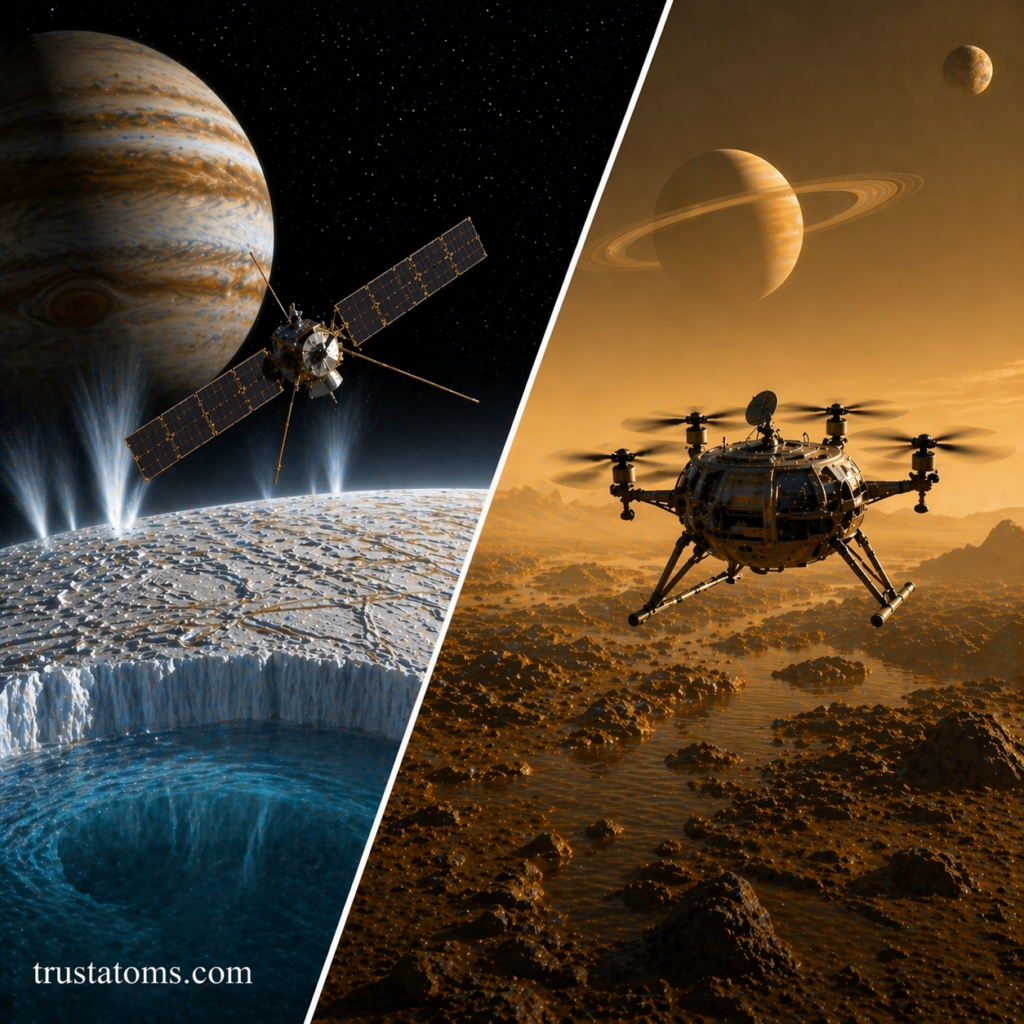
Jupiter continues to be a major focus due to its size and diverse system of moons.
Europa Clipper (NASA)
One of the most anticipated missions is Europa Clipper.
Mission Goals
- Study Europa’s icy surface
- Investigate its subsurface ocean
- Search for conditions that could support life
Why Europa Matters
- Likely contains a global ocean beneath its ice
- May have hydrothermal activity
- Considered one of the best places to search for extraterrestrial life
JUICE Mission (ESA)
The Jupiter Icy Moons Explorer by the European Space Agency focuses on Jupiter’s largest moons.
Target Moons
- Ganymede
- Callisto
- Europa (flybys)
Key Objectives
- Study subsurface oceans
- Analyze magnetic fields
- Understand moon formation
JUICE will be the first mission to orbit Ganymede, the largest moon in the solar system.
Future Missions to Saturn and Its Moons
Saturn’s system remains a major target following the success of Cassini.
Dragonfly Mission to Titan
Dragonfly is a revolutionary mission planned for Saturn’s moon Titan.
What Makes Dragonfly Unique
- A rotorcraft (drone-like vehicle)
- Capable of flying between locations on Titan
- Will explore surface chemistry and geology
Mission Goals
- Study organic molecules
- Investigate prebiotic chemistry
- Assess habitability
Titan’s Earth-like processes make it one of the most intriguing destinations in the solar system.
Missions to Uranus and Neptune
The ice giants remain largely unexplored, with only brief visits from Voyager 2.
Proposed Uranus Orbiter and Probe
Scientists are pushing for a dedicated mission to Uranus.
Potential Objectives
- Study atmosphere and weather patterns
- Analyze ring systems
- Investigate moons for subsurface oceans
Uranus is considered a top priority for future planetary missions due to its unique tilt and composition.
Future Neptune Exploration
Neptune is even more distant and mysterious.
Key Areas of Interest
- Supersonic winds and extreme weather
- Magnetic field structure
- Moon Triton, which may have a subsurface ocean
Triton is especially exciting because it could be a captured object from the outer solar system.
Technologies Powering Future Missions
Exploring the outer planets requires cutting-edge technology.
Key Innovations
- Advanced propulsion systems for long-distance travel
- Nuclear power (RTGs) for energy far from the Sun
- Autonomous navigation due to communication delays
- High-resolution instruments for detailed data collection
These advancements make missions more efficient, durable, and capable than ever before.
Challenges of Deep Space Exploration
Reaching and studying the outer planets comes with significant obstacles.
Major Challenges
- Vast distances (years or decades of travel)
- Extreme cold and radiation
- Limited sunlight for solar power
- Communication delays with Earth
Despite these challenges, continued innovation is making deep space exploration more feasible.
The Search for Life Beyond Earth
One of the biggest drivers of outer planet exploration is the search for life.
Most Promising Locations
- Europa’s subsurface ocean
- Enceladus (Saturn’s moon with water plumes)
- Titan’s complex organic chemistry
These environments may host microbial life or the building blocks necessary for life to emerge.
What the Future Holds
The next decades of space exploration will focus heavily on the outer solar system.
What to Expect
- More missions targeting ocean worlds
- Increased international collaboration
- Robotic explorers capable of landing and flying
- Continued breakthroughs in planetary science
Each mission builds on past discoveries, bringing us closer to answering fundamental questions about life and the universe.
Final Thoughts
Future missions to the outer planets represent the next great leap in space exploration. With advanced spacecraft, ambitious goals, and a growing focus on habitability, scientists are preparing to explore some of the most distant and fascinating worlds in our solar system.
From flying drones on Titan to orbiting icy moons and probing distant ice giants, the future of planetary exploration is just beginning—and it promises discoveries that could change how we understand our place in the universe.