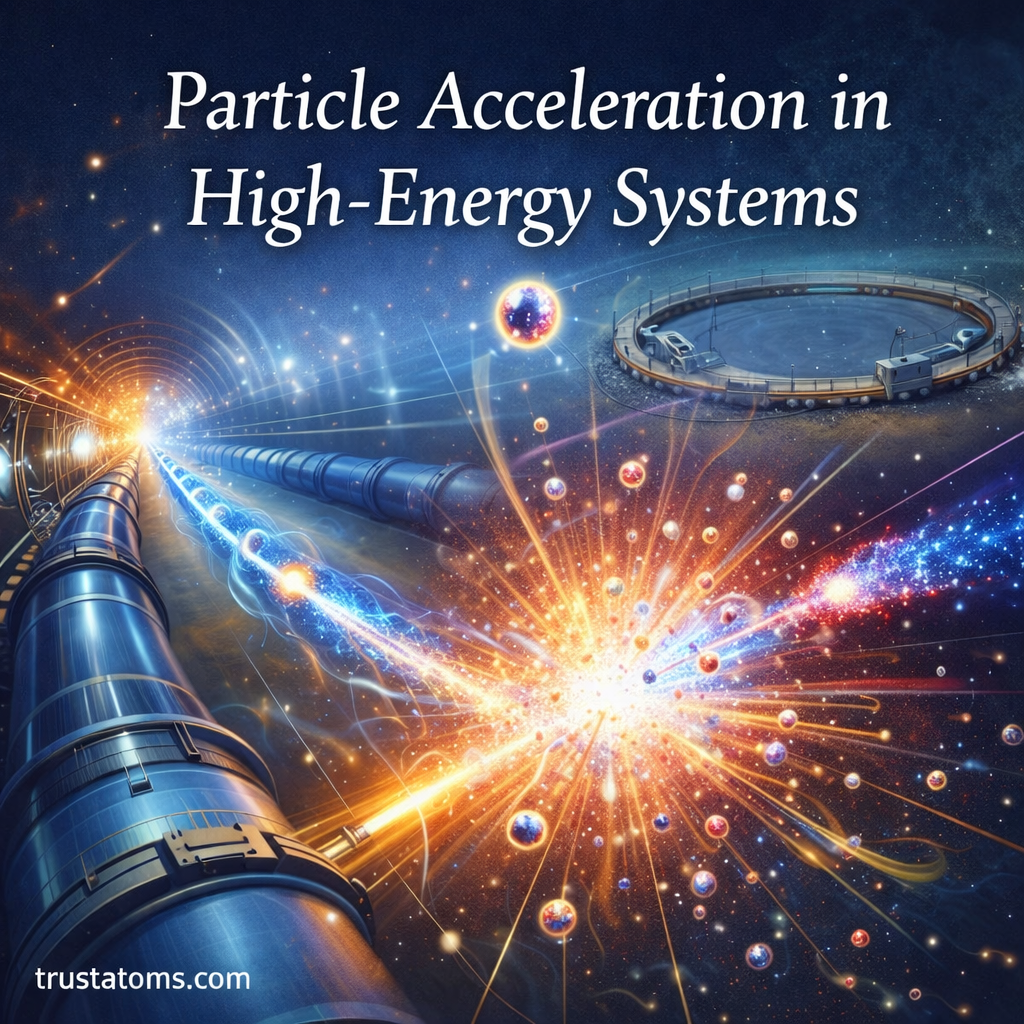
Particle acceleration in high-energy systems is one of the most powerful tools in modern physics. It allows scientists to probe the fundamental structure of matter, recreate conditions from the early universe, and develop advanced medical and industrial technologies.
From giant underground accelerators to compact hospital machines, particle acceleration plays a central role in both research and real-world applications.
This guide explains how particle acceleration works, the types of high-energy systems used today, and why it matters.
What Is Particle Acceleration?
Particle acceleration is the process of increasing the speed — and therefore the energy — of charged particles such as:
- Electrons
- Protons
- Ions
In physics, energy and speed are closely related. The faster a particle moves, the more kinetic energy it carries.
High-energy systems use electric and magnetic fields to push particles to extremely high speeds — sometimes close to the speed of light.
Why Accelerate Particles?
There are several major reasons scientists accelerate particles:
- To study fundamental particles and forces
- To create controlled high-energy collisions
- To produce radiation for medical treatments
- To analyze materials at atomic scales
When particles collide at high energy, they can reveal new particles or interactions that are otherwise impossible to observe.
The Basic Principle of Acceleration
Charged particles respond to electric fields.
- An electric field applies force.
- Force causes acceleration.
- Acceleration increases energy.
Magnetic fields are used to:
- Bend particle paths
- Focus beams
- Keep particles confined in circular systems
Together, electric and magnetic fields form the backbone of high-energy acceleration systems.
Types of High-Energy Particle Accelerators
Linear Accelerators (Linacs)
Linear accelerators push particles in a straight line using a series of accelerating sections.
Key characteristics:
- Particles pass through sequential electric field regions.
- Energy increases step by step.
- Used in medical radiation therapy and research.
Linacs are simpler than circular systems and widely used in hospitals.
Circular Accelerators
Circular accelerators bend particle paths into loops using magnetic fields.
Two common types include:
- Cyclotrons
- Synchrotrons
Particles gain energy each time they pass through accelerating regions.
Advantages:
- Particles can be accelerated over long effective distances.
- Very high energies can be achieved.
Large research facilities use this design to study fundamental physics.
Colliders
In colliders, two particle beams travel in opposite directions and collide head-on.
Why this matters:
- Head-on collisions maximize available energy.
- More energy increases the chance of discovering new particles.
Colliders are used in high-energy physics experiments to explore the structure of matter.
What Makes a System “High-Energy”?
A high-energy system typically involves:
- Extremely fast particle speeds
- Very strong electric fields
- Powerful superconducting magnets
- Advanced vacuum systems
Particles must travel in near-perfect vacuum conditions. Even a tiny air molecule could disrupt a high-speed particle beam.
High-energy systems often require:
- Cryogenic cooling
- Precision engineering
- Massive computational monitoring
Relativistic Effects at High Speeds
As particles approach the speed of light:
- Their effective mass increases.
- Time dilation effects become measurable.
- Classical physics transitions to relativistic physics.
At high energy levels, Einstein’s theory of relativity becomes essential for accurate predictions.
This is why high-energy particle acceleration is closely connected to modern theoretical physics.
Applications of High-Energy Particle Acceleration
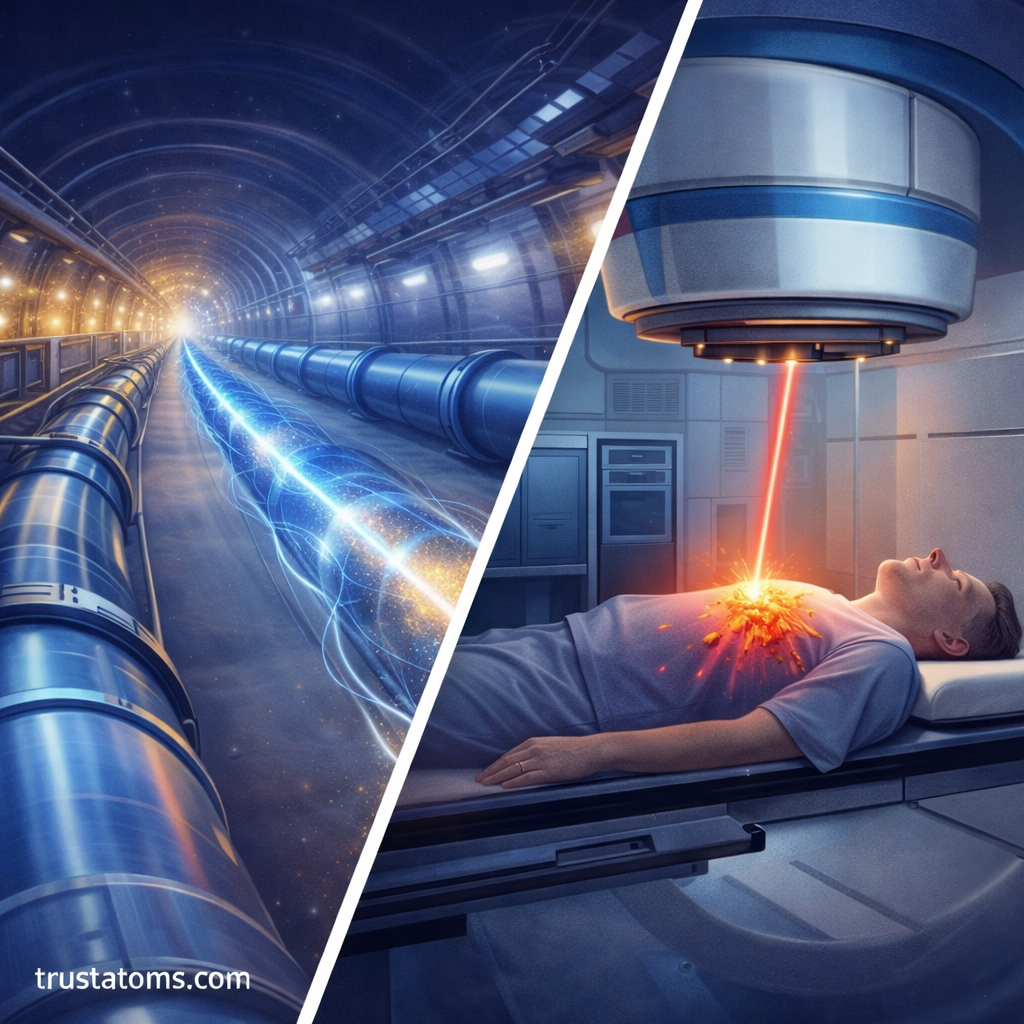
Particle acceleration is not just theoretical. It has powerful real-world uses.
1. Medical Treatments
Radiation therapy uses accelerated particles to:
- Target cancer cells
- Minimize damage to surrounding tissue
- Deliver precise energy doses
Proton therapy is one advanced example.
2. Materials Science
Accelerated particles can:
- Probe atomic structures
- Reveal defects in materials
- Study magnetic and electronic properties
This helps develop stronger, lighter, and more efficient materials.
3. Industrial Applications
Particle beams are used to:
- Sterilize medical equipment
- Inspect cargo containers
- Modify semiconductor materials
High-energy systems support modern manufacturing and safety technologies.
4. Fundamental Physics Research
High-energy collisions allow scientists to:
- Study subatomic particles
- Test theoretical predictions
- Explore forces governing the universe
Many groundbreaking discoveries in physics have come from particle accelerators.
Challenges in High-Energy Systems
Building and operating these systems is complex.
Major challenges include:
- Energy consumption
- Heat management
- Magnetic field precision
- Beam stability
- Radiation shielding
High-energy systems require strict safety protocols due to intense radiation and electrical power.
Energy Transfer in Particle Acceleration
In high-energy systems:
- Electrical energy powers the accelerator.
- Electric fields transfer energy to particles.
- Particles convert that energy into kinetic motion.
- Collisions release energy into new particles or radiation.
This energy conversion process is central to experimental physics.
The Future of Particle Acceleration
Research is exploring:
- Plasma-based acceleration methods
- More compact accelerator designs
- Higher energy efficiency systems
- Portable medical accelerators
Scientists aim to make systems smaller, more affordable, and more powerful.
Emerging technologies could dramatically reduce the size of future high-energy accelerators while maintaining extreme performance.
Why Particle Acceleration Matters
Particle acceleration in high-energy systems helps answer some of the biggest questions in science:
- What is matter made of?
- How did the universe begin?
- What forces govern reality?
It also improves everyday life through medicine, engineering, and industrial innovation.
Understanding the principles behind particle acceleration provides insight into both cutting-edge research and practical technology.
Final Takeaway
Particle acceleration in high-energy systems relies on:
- Electric fields to increase particle energy
- Magnetic fields to control particle motion
- Precision engineering and advanced physics
These systems allow scientists to explore matter at its most fundamental level while delivering real-world benefits across medicine, materials science, and industry.
High-energy particle acceleration stands at the intersection of theoretical physics and applied technology — pushing the boundaries of what we know about the universe.