Astronomy is no longer just about observing the night sky—it’s about analyzing massive amounts of data. Modern telescopes and space missions collect enormous datasets, and advanced analysis techniques are required to turn that raw information into meaningful discoveries.
From detecting distant galaxies to identifying exoplanets, astronomy data analysis plays a critical role in understanding the universe. Organizations like NASA and ESA rely on sophisticated methods to process and interpret cosmic data.
What Is Astronomy Data Analysis?
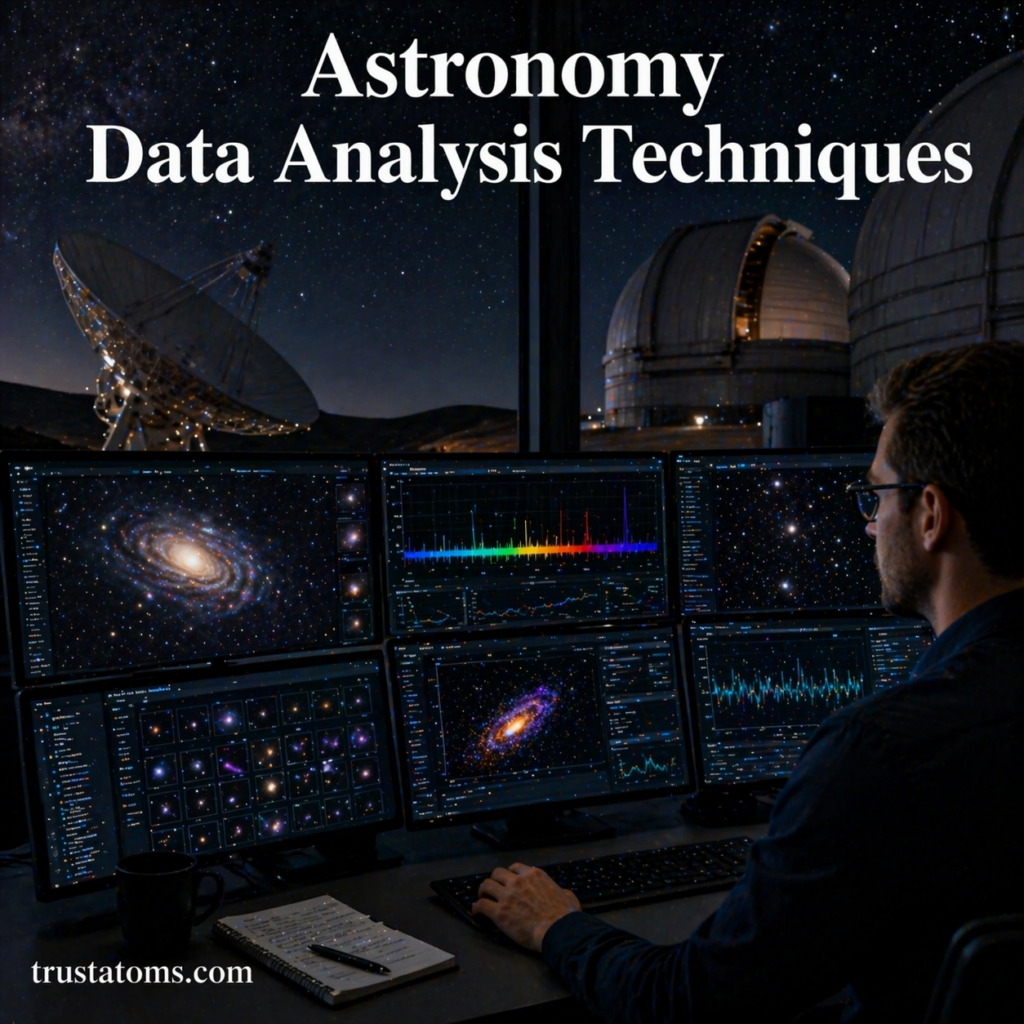
Astronomy data analysis involves collecting, processing, and interpreting data from telescopes and instruments.
Types of data analyzed:
- Images (optical, infrared, X-ray, etc.)
- Spectra (light broken into wavelengths)
- Time-series data (changes over time)
- Radio signals
The goal is to extract patterns, identify objects, and uncover physical properties of celestial bodies.
The Data Collection Process
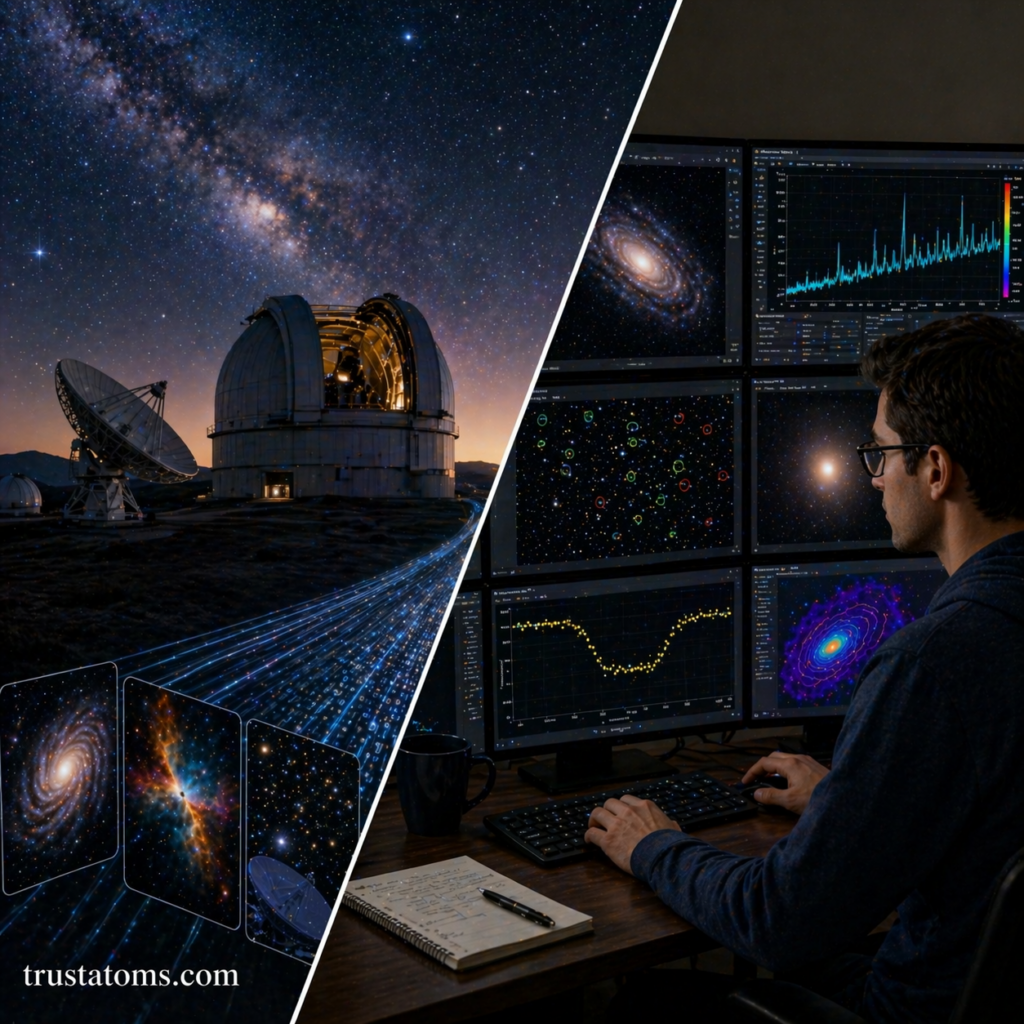
Before analysis begins, data must be gathered using advanced instruments.
Common sources of data:
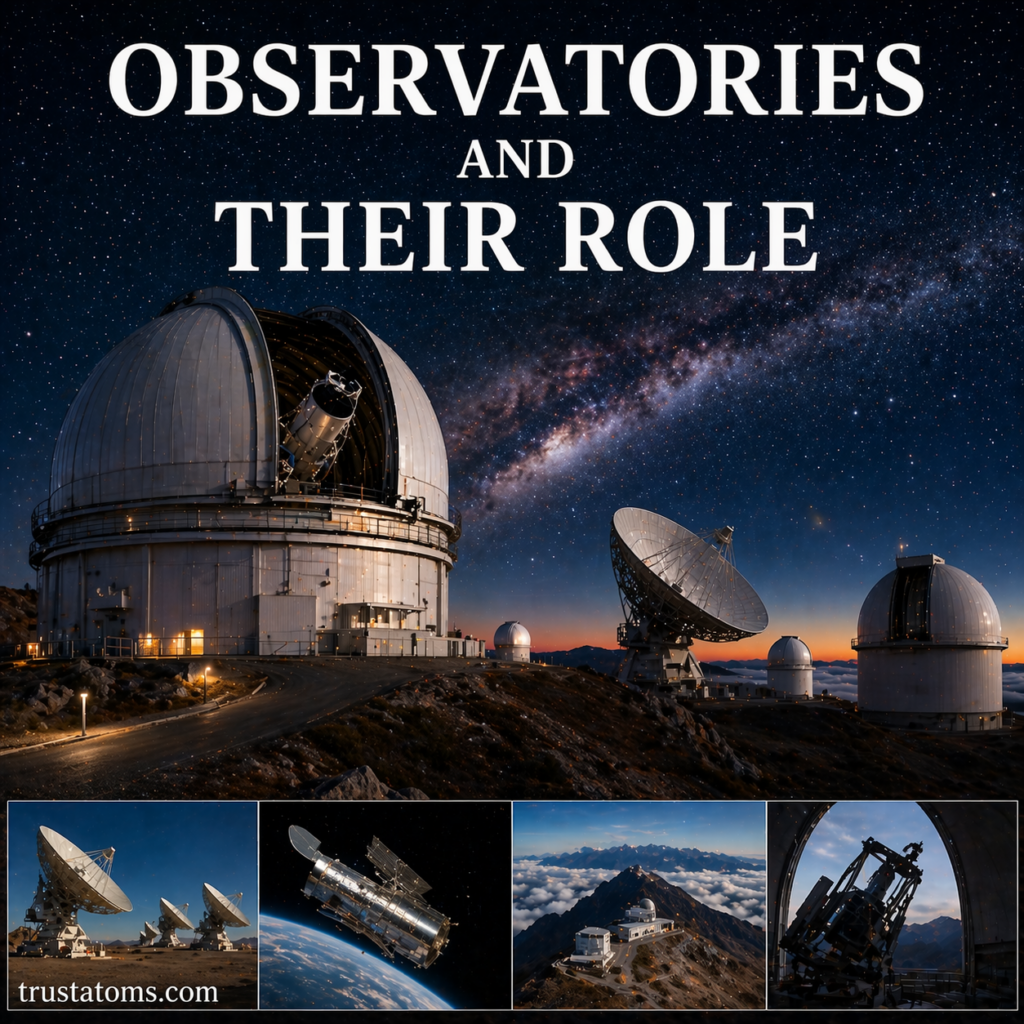
- Ground-based observatories
- Space telescopes like Hubble Space Telescope
- Radio telescope arrays
- Sky surveys and missions
Basic workflow:
- Capture raw observational data
- Store and organize datasets
- Prepare data for processing
- Apply analysis techniques
This pipeline ensures that data is accurate and usable.
Image Processing Techniques
Astronomical images often require significant processing to reveal useful information.
Key methods:
- Noise reduction to remove unwanted signals
- Calibration to correct instrument errors
- Image stacking to improve clarity
- Contrast enhancement to highlight features
These techniques help astronomers detect faint objects and structures.
Spectral Analysis
Spectroscopy is one of the most powerful tools in astronomy.
What spectral analysis reveals:
- Chemical composition of stars and galaxies
- Temperature and density
- Motion through Doppler shifts
- Redshift for measuring distance
By analyzing how light is distributed across wavelengths, scientists can determine what objects are made of and how they behave.
Time-Series Analysis
Some astronomical phenomena change over time, requiring time-based analysis.
Common applications:
- Studying variable stars
- Detecting exoplanet transits
- Monitoring supernova events
- Tracking pulsars
Techniques used:
- Light curve analysis
- Period detection algorithms
- Signal smoothing
These methods help identify repeating patterns and transient events.
Statistical Methods in Astronomy
Because of the vast amount of data, statistical analysis is essential.
Common statistical techniques:
- Regression analysis
- Probability modeling
- Error estimation
- Data fitting
Statistics help astronomers distinguish real signals from noise and uncertainty.
Machine Learning and AI in Astronomy
Artificial intelligence is transforming astronomy data analysis.
Applications of AI:
- Classifying galaxies automatically
- Detecting exoplanets in large datasets
- Identifying anomalies or rare events
- Processing massive sky surveys
Machine learning models can analyze data faster and more efficiently than traditional methods.
Big Data Challenges in Astronomy
Modern astronomy deals with enormous volumes of data.
Key challenges:
- Managing terabytes to petabytes of data
- Processing data in real time
- Storing and sharing datasets
- Ensuring data accuracy and consistency
Advanced computing systems and cloud technologies are often required.
Tools and Software Used
Astronomers rely on specialized tools to analyze data.
Popular tools:
- Python libraries (NumPy, SciPy, AstroPy)
- Data visualization software
- Image processing platforms
- Simulation tools
These tools enable researchers to process and interpret complex datasets efficiently.
How Data Analysis Leads to Discoveries
Astronomy data analysis is behind many major discoveries.
Examples:
- Detection of exoplanets using transit data
- Mapping dark matter through gravitational lensing
- Identifying distant galaxies via redshift
- Discovering new types of cosmic events
Without data analysis, these discoveries would not be possible.
The Future of Astronomy Data Analysis
As technology advances, data analysis techniques continue to evolve.
Emerging trends:
- AI-driven discovery pipelines
- Real-time data processing
- Integration of multi-wavelength data
- More automated observatories
Future missions will generate even more data, making advanced analysis techniques increasingly important.
Final Thoughts
Astronomy data analysis is the bridge between observation and understanding. By transforming raw data into meaningful insights, scientists can explore the universe in ways that were once unimaginable.
As data continues to grow in scale and complexity, new techniques will unlock even deeper insights into the cosmos.