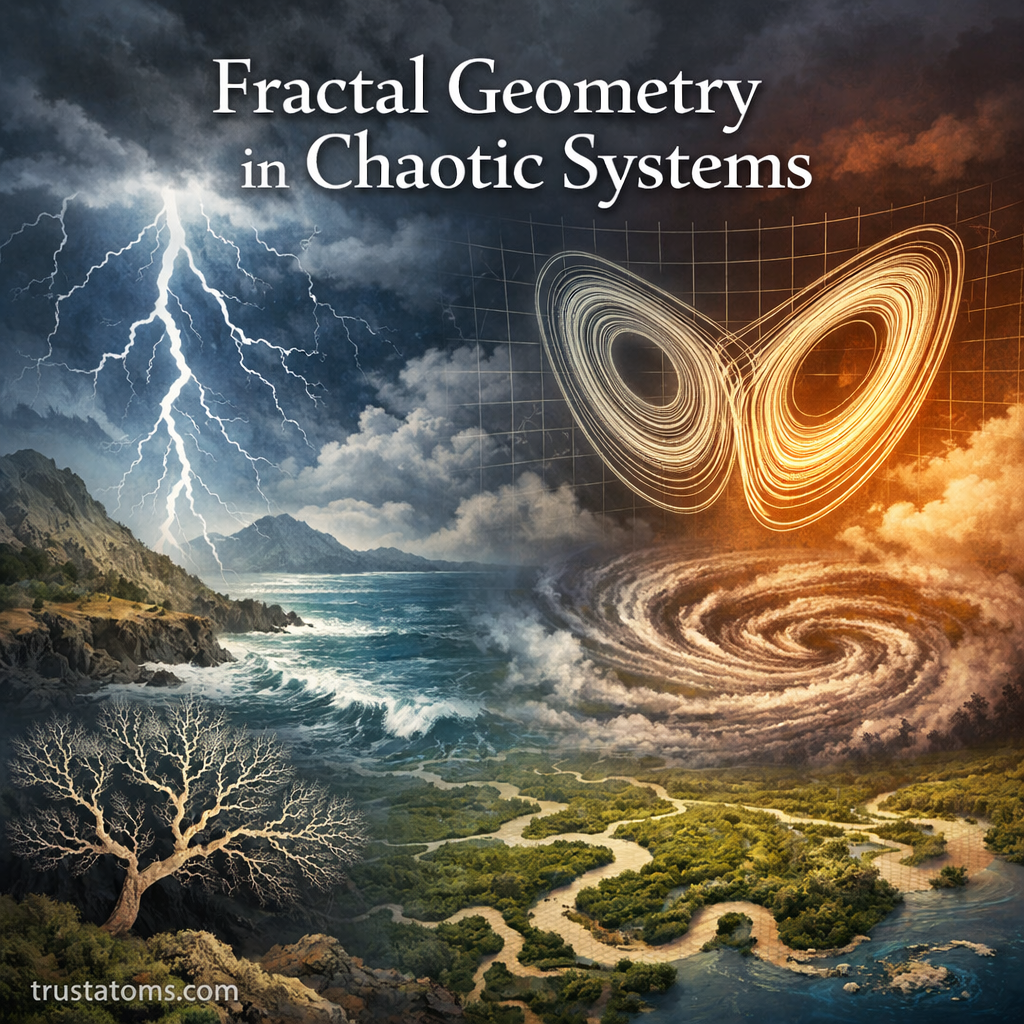
Fractal geometry reveals a hidden order inside what looks like randomness. From lightning bolts and coastlines to turbulent fluids and weather patterns, many chaotic systems produce intricate shapes that repeat at different scales. These patterns, known as fractals, help scientists understand how complexity emerges in nature.
In physics, fractal geometry provides a bridge between chaos theory and real-world phenomena. It explains how unpredictable systems can still follow underlying mathematical rules, even when their behavior seems wildly irregular.
What Is Fractal Geometry?
Fractal geometry studies shapes and patterns that display self-similarity across different scales. This means that when you zoom in on a small section of the structure, it resembles the larger whole.
Unlike traditional geometry (which focuses on smooth lines and simple shapes), fractal geometry deals with:
- Irregular, fragmented shapes
- Infinite detail at every scale
- Patterns generated through repeated processes
- Non-integer (fractional) dimensions
A key concept is the fractal dimension, which measures how completely a fractal fills space. Unlike a line (1D) or a surface (2D), fractals often have dimensions that fall between whole numbers, reflecting their complex structure.
Understanding Chaotic Systems
A chaotic system is one that:
- Is highly sensitive to initial conditions
- Appears random despite being deterministic
- Evolves according to fixed physical laws
This sensitivity is often called the “butterfly effect,” where small differences in starting conditions can lead to dramatically different outcomes.
Examples of chaotic systems include:
- Weather systems
- Fluid turbulence
- Planetary motion under certain conditions
- Population dynamics
While chaotic systems are unpredictable in detail, their long-term behavior often settles into structured patterns called attractors — and many of these attractors are fractal in shape.
Strange Attractors and Fractals
One of the most important connections between chaos and fractals appears in strange attractors.
A strange attractor is a geometric structure in phase space toward which a chaotic system evolves. Unlike simple circular or elliptical attractors, strange attractors:
- Have intricate, folded structures
- Never intersect themselves
- Display fractal dimensions
These attractors reveal that even chaotic motion is confined within a hidden geometric framework.
In physical systems, strange attractors appear in:
- Turbulent fluid flow
- Electrical circuits with nonlinear components
- Climate models
- Chemical reaction systems
Fractal geometry allows physicists to visualize and measure the complexity of these attractors.
Self-Similarity in Nature
Fractal patterns are not limited to abstract mathematical systems. They appear throughout the natural world, especially in systems influenced by nonlinear dynamics.
Examples include:
- Branching patterns in trees and blood vessels
- Coastlines and mountain ranges
- Lightning strikes
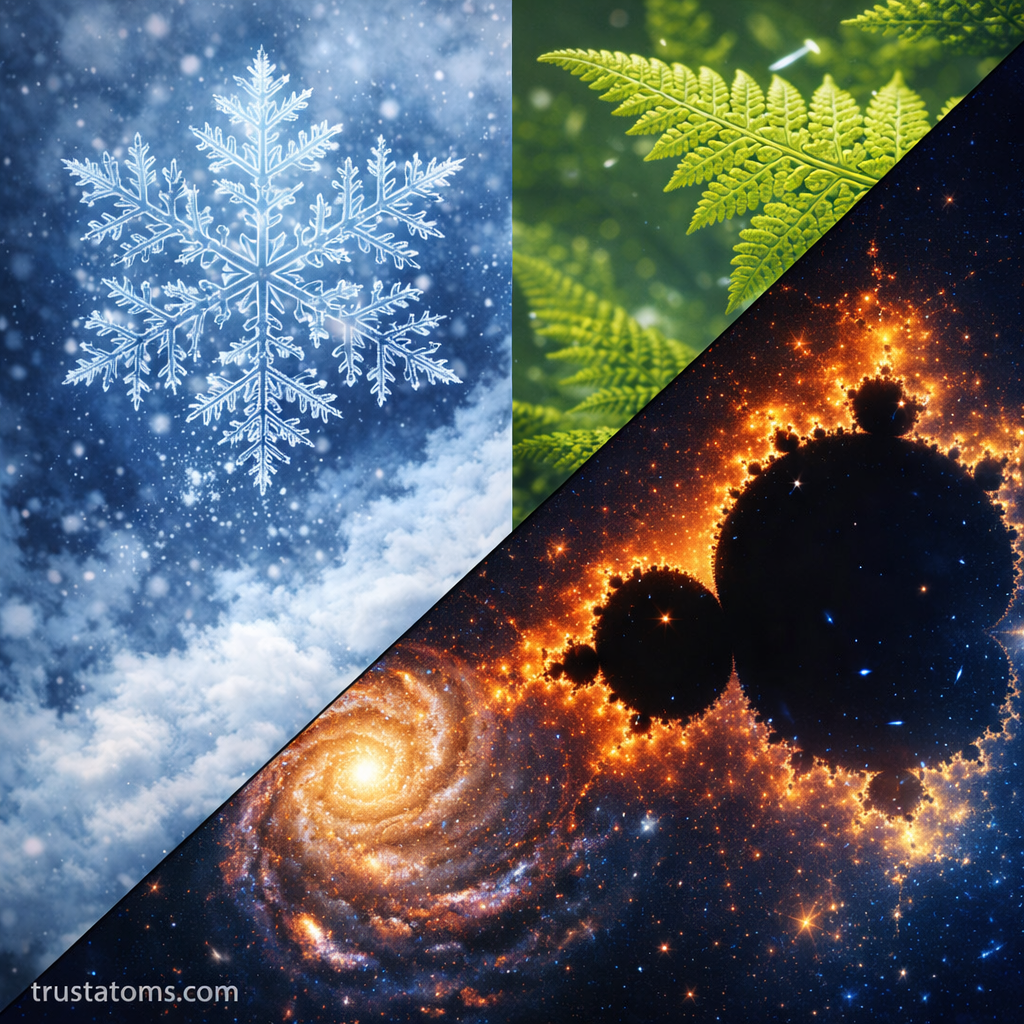
- Snowflakes
- River networks
In many cases, these structures arise from simple repeated growth rules interacting with environmental constraints. The result is a fractal pattern emerging from chaotic processes.
Fractal Geometry and Turbulence
Turbulence is one of the most challenging problems in physics. When fluids flow chaotically, they produce swirling eddies of many different sizes.
These eddies:
- Break down into smaller vortices
- Transfer energy across scales
- Form nested structures
This cascade of motion creates a fractal-like hierarchy. Scientists use fractal dimensions to describe how turbulence distributes energy across space.
Understanding these patterns helps in:
- Aerodynamics
- Climate science
- Oceanography
- Engineering design
Fractal analysis provides tools to measure complexity in systems where exact prediction is impossible.
Mathematical Foundations of Fractals in Chaos
Fractals in chaotic systems typically arise from nonlinear equations. When a system includes feedback loops or exponential growth and decay, its solutions can produce:
- Repeated folding and stretching
- Recursive iteration
- Sensitive dependence on initial conditions
Through iteration, simple rules generate infinitely complex patterns.
In chaotic systems, fractals often appear in:
- Phase space trajectories
- Basin boundaries between outcomes
- Probability distributions
The mathematics shows that chaos is not pure disorder. It is structured unpredictability.
Why Fractal Geometry Matters in Physics
Fractal geometry helps physicists move beyond the limits of classical smooth models.
It provides:
- A framework for describing irregular natural forms
- Tools for quantifying complexity
- Insight into scale-invariant behavior
- Better models for real-world nonlinear systems
By recognizing fractal structure in chaotic systems, scientists can better understand patterns that were once dismissed as noise.
Applications Across Scientific Fields
The study of fractal geometry in chaotic systems influences many areas of science and technology:
- Meteorology: Modeling cloud formation and storm systems
- Astrophysics: Studying galaxy clustering
- Medicine: Analyzing heart rhythms and neural activity
- Materials science: Understanding fracture patterns
- Ecology: Modeling population fluctuations
In each case, fractal patterns emerge from nonlinear dynamics and feedback processes.
The Deeper Insight: Order Within Disorder
At first glance, chaos suggests randomness and unpredictability. But fractal geometry reveals a deeper truth:
Chaotic systems are governed by deterministic rules that generate complex, repeating patterns across scales.
This insight reshapes how we understand complexity in the universe. Instead of viewing irregular shapes as exceptions, physics now recognizes them as fundamental expressions of nonlinear dynamics.
Fractals show that the universe does not rely solely on smooth lines and perfect symmetry. It thrives on intricate structures born from repeated interactions and feedback.
Final Thoughts
Fractal geometry in chaotic systems demonstrates that complexity is not the absence of order — it is a different kind of order.
By studying fractals, physicists uncover hidden structures within turbulence, weather, biological systems, and even cosmic phenomena. These patterns help bridge mathematics and reality, revealing that chaos is not randomness, but structured unpredictability.
As research continues, fractal analysis remains a powerful tool for exploring the most complex systems in nature.