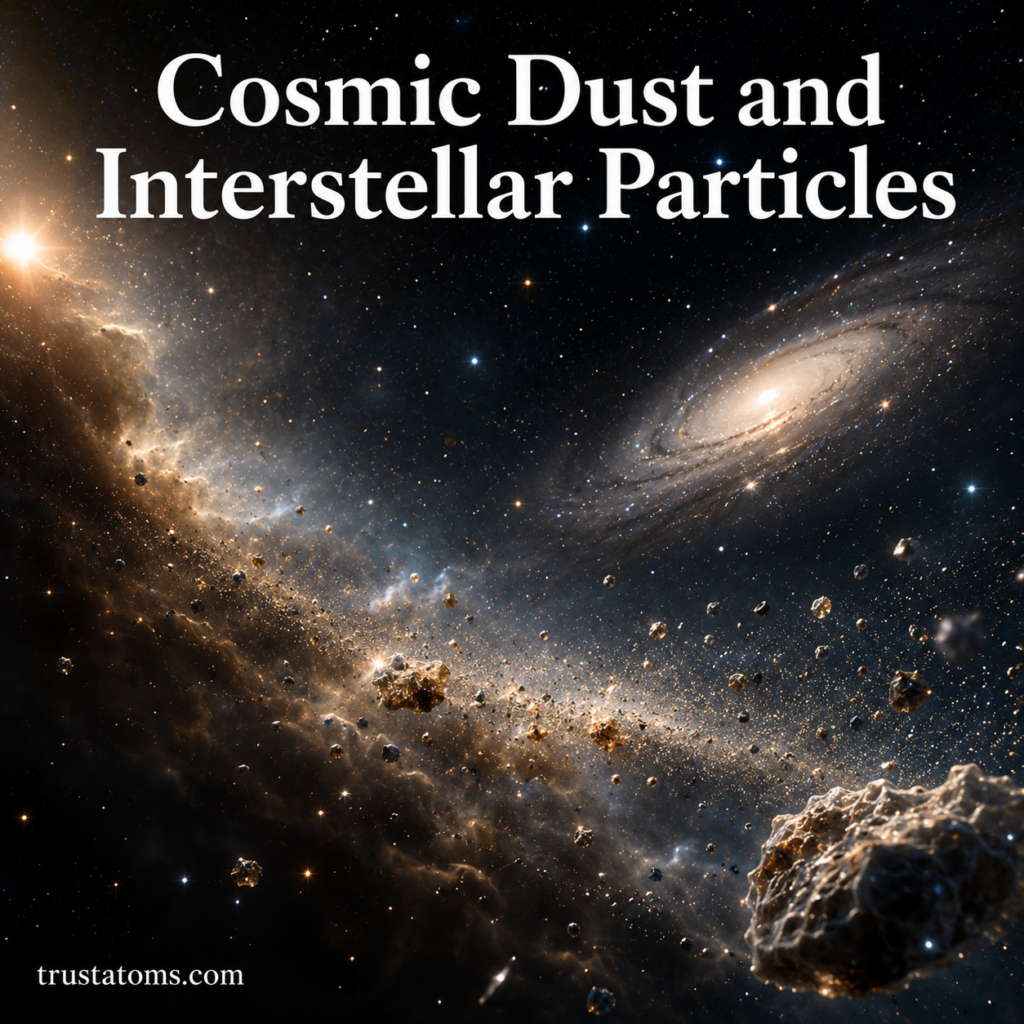
Space is often imagined as completely empty, but the universe is actually filled with tiny particles drifting between stars and galaxies. These microscopic materials, known as cosmic dust and interstellar particles, play major roles in the formation of stars, planets, moons, and even complex molecules.
Although individual dust grains are extremely small, vast clouds of interstellar material can stretch across enormous distances and shape the appearance and evolution of galaxies.
Modern astronomy has revealed that cosmic dust is not simply debris floating in space — it is an important ingredient in many astrophysical processes that help build planetary systems and influence how light travels across the universe.
This guide explores what cosmic dust is, where interstellar particles come from, how scientists study them, and why they matter in astronomy.
What Is Cosmic Dust?
Cosmic dust consists of extremely small solid particles found throughout space.
Most dust grains are:
- Smaller than a grain of sand
- Often microscopic in size
- Made of various elements and compounds
These particles may contain:
- Carbon
- Silicon
- Iron
- Oxygen
- Ice compounds
- Organic molecules
Cosmic dust exists in:
- Interstellar space
- Nebulae
- Planetary systems
- Comets
- Asteroid regions
- Galaxies
Even though individual grains are tiny, enormous collections of dust can strongly influence astronomical observations and cosmic evolution.
What Are Interstellar Particles?
Interstellar particles refer to material drifting between stars within galaxies.
This material includes:
- Dust grains
- Gas atoms
- Molecules
- Plasma particles
- Charged particles from stars
The region containing this material is called the interstellar medium (ISM).
The ISM is not empty vacuum but a dynamic environment containing:
- Hydrogen gas
- Helium
- Dust clouds
- Magnetic fields
- Cosmic rays
These materials constantly interact with stars and galactic processes.
Where Cosmic Dust Comes From
Cosmic dust forms through several astrophysical processes.
Dying Stars
Many dust particles originate from aging stars.
As stars evolve, they may release material into space through:
- Stellar winds
- Outer layer expansion
- Supernova explosions
These events eject heavy elements created inside stars.
The released material later cools and condenses into dust grains.
Supernova Explosions
Supernovae contribute large amounts of interstellar material.
When massive stars explode:
- Heavy elements spread into space
- Shock waves compress surrounding gas
- Dust particles form within cooling debris
Supernova remnants enrich galaxies with elements needed for future stars and planets.
Planetary Collisions
Dust also forms from collisions between:
- Asteroids
- Comets
- Planetary bodies
- Moon fragments
These impacts create debris clouds that can remain in space for long periods.
Young planetary systems often contain large dusty disks produced by frequent collisions.
Types of Cosmic Dust
Different kinds of dust exist depending on composition and environment.
Silicate Dust
Silicate particles contain minerals rich in:
- Silicon
- Oxygen
- Magnesium
- Iron
These grains resemble some rocky materials found on Earth.
Carbon-Based Dust
Carbon-rich dust may include:
- Graphite-like materials
- Complex organic compounds
- Soot-like particles
Some carbon molecules detected in space are surprisingly complex.
Ice-Coated Dust
In colder regions, dust grains can become coated with frozen compounds such as:
- Water ice
- Ammonia
- Methane
- Carbon dioxide
These icy grains are important in star and planet formation.
Interstellar Dust Clouds
Cosmic dust often gathers into large clouds called nebulae.
Nebulae may appear:
- Bright and glowing
- Dark and opaque
- Colorful in astronomical images
Dust clouds can:
- Scatter light
- Absorb radiation
- Block visible starlight
Some dark nebulae hide stars behind dense dust layers.
How Dust Affects Light
Cosmic dust strongly influences how astronomers observe the universe.
Absorption
Dust absorbs some wavelengths of light.
This can make distant stars appear:
- Dimmer
- Redder
- Harder to observe
This effect is called interstellar extinction.
Scattering
Dust particles also scatter light.
Shorter wavelengths scatter more easily, which can produce:
- Reflection nebulae
- Blue-tinted dust clouds
- Glowing cosmic structures
These interactions help create some of the most beautiful astronomical images.
Infrared Astronomy and Dust
Visible light often cannot penetrate dense dust clouds.
However, infrared radiation can pass through dust more effectively.
Infrared telescopes allow scientists to study:
- Hidden star-forming regions
- Dust temperatures
- Molecular clouds
- Embedded protostars
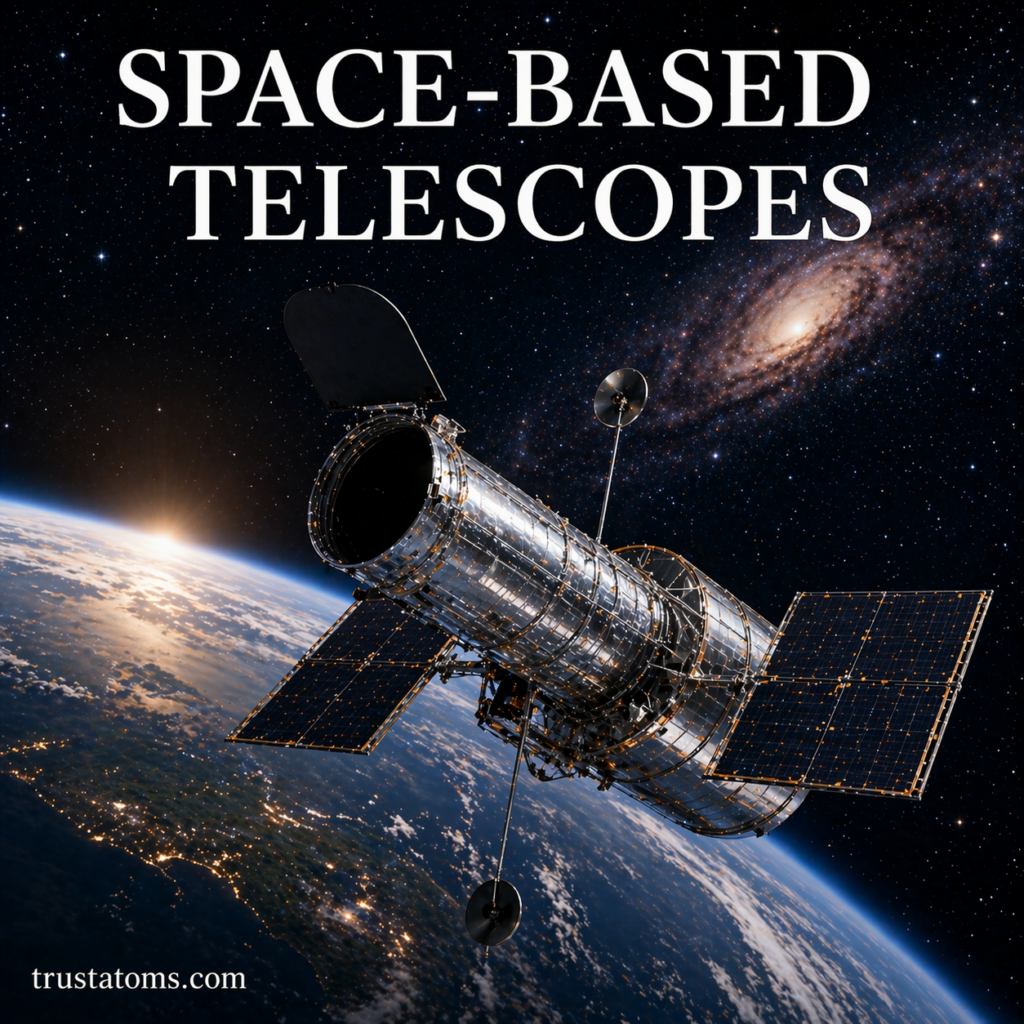
Space observatories such as the James Webb Space Telescope have dramatically improved dust observations.
Dust and Star Formation
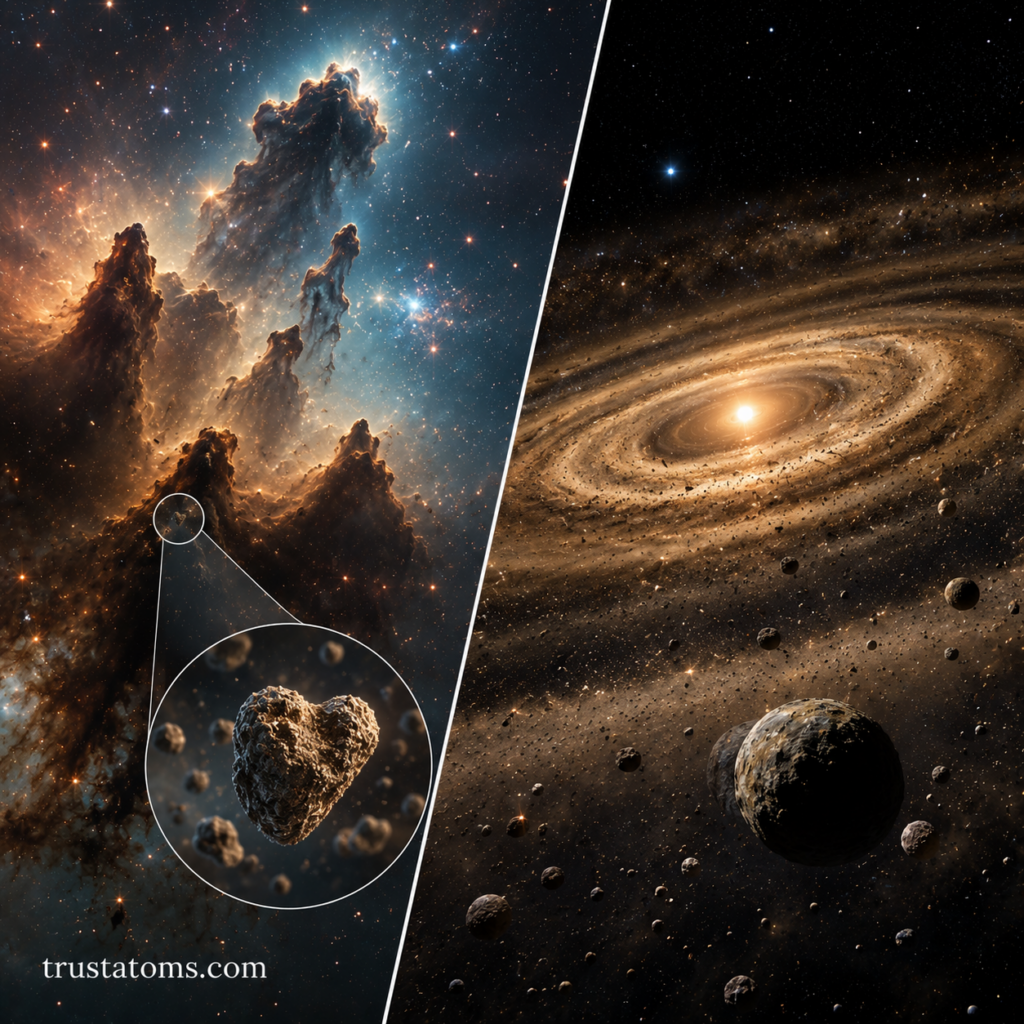
Cosmic dust plays a major role in star formation.
Inside giant molecular clouds:
- Gas and dust gather together
- Gravity compresses the material
- Dense regions collapse
- Protostars begin forming
Dust helps cool collapsing clouds by radiating heat away.
Without cooling, star formation would become much more difficult.
Protoplanetary Disks
Young stars are often surrounded by rotating disks of gas and dust.
These protoplanetary disks are the birthplaces of planets.
Within these disks:
- Dust grains collide
- Particles stick together
- Larger bodies gradually form
Over time, this process may produce:
- Planets
- Moons
- Asteroids
- Comets
Scientists believe Earth and the solar system formed through similar processes billions of years ago.
Cosmic Dust and Organic Molecules
Some dust clouds contain surprisingly complex chemistry.
Astronomers have detected:
- Organic molecules
- Carbon chains
- Alcohol compounds
- Amino acid precursors
Dust grains may help chemical reactions occur by providing surfaces where molecules can form.
This raises important questions about:
- Prebiotic chemistry
- Molecular evolution
- Conditions related to life-supporting environments
Cosmic Rays and Charged Particles
Interstellar space also contains high-energy particles called cosmic rays.
These particles include:
- Protons
- Atomic nuclei
- Electrons
Cosmic rays may originate from:
- Supernova remnants
- Pulsars
- Black holes
- Active galaxies
Magnetic fields influence how these charged particles move through space.
Cosmic rays interact with dust and gas throughout the galaxy.
Zodiacal Dust in the Solar System
Our solar system contains its own dust environment.
Zodiacal dust comes mainly from:
- Comets
- Asteroid collisions
Sunlight reflecting off this dust creates a faint glow called zodiacal light.
This glow is sometimes visible:
- Before sunrise
- After sunset
- In dark sky conditions
Dust Around Black Holes and Galaxies
Cosmic dust also exists around massive galactic structures.
Dust near active galactic nuclei can:
- Obscure central black holes
- Absorb energetic radiation
- Re-emit energy in infrared wavelengths
Galaxies rich in dust often experience active star formation.
Dust distribution helps astronomers study galactic evolution.
How Scientists Study Cosmic Dust
Researchers use many methods to analyze interstellar particles.
Telescopes
Astronomers use:
- Infrared telescopes
- Radio observatories
- Optical telescopes
- Ultraviolet instruments
Different wavelengths reveal different dust properties.
Spectroscopy
Spectroscopy helps identify:
- Dust composition
- Molecular structures
- Chemical signatures
Different materials absorb and emit characteristic wavelengths.
Space Missions
Some spacecraft directly collect interstellar dust particles.
Examples include:
- Stardust mission
- Cassini spacecraft
- Ulysses mission
Laboratory analysis helps scientists study particle chemistry and structure.
Challenges in Dust Research
Studying cosmic dust is difficult because:
- Dust particles are extremely tiny
- Observations are indirect
- Dust clouds vary greatly
- Many regions are distant or obscured
Scientists combine:
- Computer models
- Telescope data
- Laboratory experiments
to better understand interstellar environments.
Why Cosmic Dust Matters
Cosmic dust is essential to many astronomical processes.
It influences:
- Star formation
- Planet formation
- Galactic evolution
- Chemical reactions
- Light propagation
Without cosmic dust:
- Planets may not form efficiently
- Molecular chemistry would change
- Many stars would form differently
Dust is not simply leftover material — it actively shapes the universe.
Future Research on Interstellar Particles
Future astronomy missions may provide:
- Better infrared imaging
- More detailed dust chemistry
- Improved galaxy mapping
- Advanced interstellar particle collection
Researchers continue studying:
- Organic chemistry in space
- Dust grain growth
- Planetary formation processes
- Interstellar cloud evolution
New observations may deepen understanding of how cosmic structures develop over time.
Final Thoughts
Cosmic dust and interstellar particles are fundamental components of the universe. Although tiny in size, these materials influence the formation of stars, planets, galaxies, and complex chemical compounds across space.
By studying dust clouds, interstellar chemistry, and microscopic particles, astronomers gain insight into how cosmic systems evolve and how planetary environments may eventually emerge.
As telescope technology and space missions continue advancing, cosmic dust research will remain an important part of understanding the structure and history of the universe.