Habitability beyond Earth refers to the possibility that planets, moons, or other environments outside our planet could support life. Scientists evaluate this potential by searching for liquid water, usable energy, essential chemical ingredients, and environmental conditions that could sustain biological activity.
Earth remains the only world where life has been confirmed, but discoveries of distant planets and subsurface oceans have expanded the search for suitable environments. In modern astronomy, habitability research combines observations of celestial objects with knowledge from chemistry, geology, biology, and planetary science.
Advances in telescopes, planetary science, astrobiology, and atmospheric analysis have dramatically expanded the search for potentially habitable worlds throughout the universe. However, identifying favorable conditions is not the same as discovering living organisms.
What Does Habitability Mean?
In planetary science, habitability describes an environment’s capacity to support life under particular conditions. Most investigations focus on life resembling organisms on Earth because terrestrial biology provides the only confirmed example of living systems.
Scientists generally examine several interconnected requirements:
- Liquid water: A medium in which biological chemical reactions can occur.
- Energy: Sunlight or chemical reactions capable of supporting metabolism.
- Chemical ingredients: Elements and compounds needed to construct and maintain biological molecules.
- Suitable physical conditions: Temperatures, pressures, and radiation levels compatible with potential organisms.
- Environmental persistence: Conditions that remain suitable long enough for biological processes to operate.
A planet might possess water but lack accessible energy, or have a suitable temperature while experiencing an atmosphere that prevents stable surface water. Habitability therefore requires evaluating several factors together.
Atmospheric observations provide part of this evidence. Exoplanet Atmosphere Analysis explains how astronomers investigate gases and environmental conditions on distant worlds.
Why Liquid Water Is Central to the Search
All confirmed life on Earth depends on liquid water. Water dissolves many substances, transports nutrients, participates in chemical reactions, and helps regulate temperature.
For these reasons, scientists often follow a water-centered approach when searching for potentially habitable environments. They investigate surface lakes and oceans, underground water reservoirs, and possible liquid oceans beneath icy crusts.
Liquid water alone does not establish habitability. A world also needs conditions that make biological chemistry possible, including appropriate energy sources and access to useful chemical compounds.
Researchers sometimes consider whether unfamiliar life could use solvents other than water. Such possibilities remain hypothetical because no independently confirmed alternative form of life has been discovered.
The Habitable Zone Around a Star
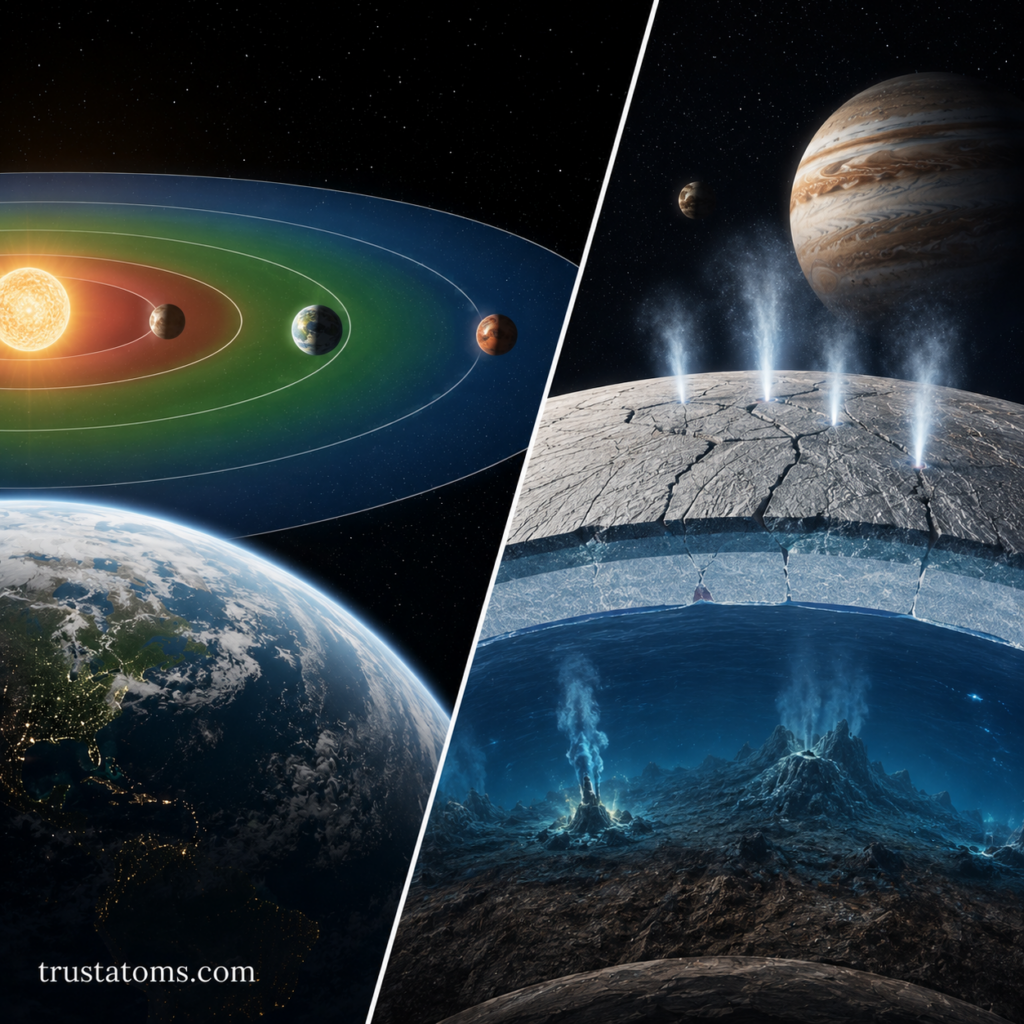
The habitable zone is the range of distances around a star where a rocky planet with suitable atmospheric conditions could maintain liquid water on its surface.
This region is sometimes called the Goldilocks zone. Planets receiving excessive stellar energy may become too hot for stable surface oceans, while planets receiving too little energy may develop frozen surfaces.
The boundaries depend on the star’s brightness and the planet’s atmosphere. The Habitable Zone Concept explores how stellar radiation and greenhouse warming determine where surface liquid water might persist.
Importantly, the habitable zone is a screening tool rather than a guarantee of life. It does not establish whether a planet actually possesses water, a protective atmosphere, or biological activity.
Why Distance From a Star Is Not Enough
Two planets receiving similar amounts of starlight can have very different surface conditions. Atmospheric composition, pressure, cloud cover, geology, and planetary history all influence temperature and water stability.
Venus illustrates the importance of atmospheric effects. Although its size resembles Earth’s, its dense carbon dioxide atmosphere produces extreme greenhouse heating, resulting in surface temperatures of approximately 465 degrees Celsius.
Mars provides another contrast. Geological evidence indicates that liquid water existed on its surface in the past, but its present atmosphere is too thin to support stable, widespread surface oceans.
These examples show why researchers must consider planetary evolution rather than relying exclusively on present-day distance from a star.
Exoplanets as Candidates for Habitability
Exoplanets are planets orbiting stars outside our solar system. Astronomers have confirmed thousands of these worlds, including rocky planets, gas giants, and planets unlike any found in our planetary system.
Researchers use several methods to investigate their properties:
- Transit observations: Measure how much a star dims when a planet crosses in front of it, helping estimate planetary size.
- Radial velocity measurements: Detect changes in a star’s motion caused by an orbiting planet, providing information about planetary mass.
- Spectroscopy: Examines light at different wavelengths to investigate atmospheric gases when observations permit.
- Direct imaging: Attempts to separate a planet’s light from the much brighter light of its host star.
Combining mass and radius estimates helps scientists calculate average density, which can indicate whether a planet is likely rocky or rich in gases and other volatile materials.
A Concrete Example: TRAPPIST-1 and Its Seven Planets
The TRAPPIST-1 system provides a useful example of how scientists evaluate potentially habitable worlds. It contains seven approximately Earth-sized planets orbiting a small, cool star about 40 light-years from Earth.
Several of these planets receive levels of stellar energy that make them interesting targets for habitability research. TRAPPIST-1e, for example, is frequently studied because its size and received starlight make it a candidate for investigating possible temperate conditions.
However, astronomers have not confirmed that TRAPPIST-1e has surface oceans, a life-supporting atmosphere, or living organisms. Its actual conditions depend on atmospheric composition, stellar activity, and other properties that remain uncertain.
The system demonstrates an essential distinction: identifying a promising candidate is an early stage of investigation, not evidence that the planet is inhabited.
Super-Earths and Rocky Worlds
Super-Earths are planets more massive than Earth but less massive than Neptune, although definitions vary. Their name describes their size or mass rather than their surface conditions.
Some super-Earths may be rocky, while others could possess substantial atmospheres or large quantities of water-rich material. A planet’s mass alone cannot reveal whether it has a solid surface suitable for Earth-like life.
Researchers investigate density, stellar radiation, and possible atmospheric properties to distinguish different planetary environments. Even worlds with Earth-like dimensions may have temperatures and pressures that differ dramatically from Earth’s.
Rocky planets are not the only candidates for habitability. Research into Europa and Subsurface Oceans demonstrates why scientists also consider environments hidden beneath ice.
Red Dwarf Stars and Their Habitability Challenges
Red dwarfs are smaller, cooler stars than the Sun. Because they are relatively faint, their habitable zones lie much closer to the star.
This makes potentially temperate planets easier to detect through repeated transits. However, close orbital distances introduce challenges, including strong stellar activity and possible tidal locking.
A tidally locked planet keeps approximately the same hemisphere facing its star. Such a planet could experience major differences between its day and night sides, although atmospheric circulation or oceans might redistribute heat.
Stellar flares and high-energy radiation can also affect atmospheric chemistry and contribute to atmospheric loss under some conditions. Scientists use climate models to investigate whether particular planets could remain habitable despite these challenges.
How Atmospheres Influence Planetary Habitability
An atmosphere can regulate surface temperature, transport heat, and maintain pressure that allows liquid water to remain stable. Its composition also determines how strongly a planet absorbs and releases radiation.
Carbon dioxide and water vapor are greenhouse gases that influence planetary temperatures. Nitrogen can contribute atmospheric pressure, while other gases provide information about geological or chemical processes.
Atmospheres are not automatically beneficial. A very dense greenhouse atmosphere can produce extreme heating, while an extremely thin atmosphere may provide insufficient pressure for stable surface water.
Scientists therefore study atmospheric composition, pressure, cloud behavior, and energy balance together when evaluating potential surface conditions.
Magnetic Fields and Atmospheric Protection
Planetary magnetic fields can influence how charged particles from stellar winds interact with atmospheres. Earth’s magnetic field helps redirect many incoming charged particles and shapes the surrounding magnetosphere.
However, a global magnetic field is not an absolute requirement for atmospheric survival or habitability. Atmospheric retention also depends on gravity, atmospheric composition, stellar radiation, and the planet’s history.
Venus, for example, lacks an Earth-like global magnetic field but retains an extremely dense atmosphere. Scientists therefore avoid treating magnetic protection as a simple yes-or-no test for habitability.
Icy Moons as Potential Habitats
Some moons may maintain liquid water beneath frozen surfaces even though they orbit far beyond the Sun’s traditional habitable zone.
Europa: An Ocean Beneath Ice
Europa, one of Jupiter’s moons, has strong evidence for a global subsurface ocean beneath its icy crust. Gravitational interactions with Jupiter and neighboring moons produce tidal heating that can help maintain liquid water.
Scientists are especially interested in whether Europa’s ocean interacts with its rocky interior, potentially providing chemical energy and materials relevant to biological processes.
Enceladus: Water Plumes From an Underground Ocean
Saturn’s moon Enceladus ejects water-rich plumes from fractures near its south pole. NASA’s Cassini spacecraft detected water vapor, organic compounds, and other materials associated with these emissions.
Evidence also supports hydrothermal activity involving water and rock beneath the surface. These findings indicate potentially useful chemical energy sources, although no life has been detected on Enceladus.
What Extremophiles Teach Scientists About Life
Extremophiles are organisms that survive or thrive in environments considered harsh by human standards. Examples include microorganisms living near deep-sea hydrothermal vents, in highly acidic waters, or within extremely salty environments.
Some organisms obtain energy from chemical reactions rather than sunlight. This demonstrates that ecosystems can function without direct access to solar energy when suitable chemical resources are available.
Such discoveries broaden the range of environments scientists investigate. Nevertheless, surviving extreme conditions does not mean an organism could originate under those same conditions, and Earth’s extremophiles do not establish that life exists elsewhere.
Biosignatures and the Search for Evidence of Life
A biosignature is a measurable feature that may indicate biological activity. Potential examples include atmospheric gases, unusual chemical combinations, or patterns of organic compounds.
Oxygen and methane attract particular interest because biological processes can produce them on Earth. However, nonbiological processes can also generate these gases, so their presence alone does not demonstrate life.
Researchers examine whether an observed chemical combination is difficult to explain through known geological, atmospheric, or photochemical processes. They must also consider measurement uncertainty and alternative interpretations.
A convincing discovery would require multiple independent lines of evidence, careful testing, and the elimination of plausible nonbiological explanations.
How Space Telescopes Investigate Habitability
Modern telescopes help astronomers measure planetary sizes, temperatures, orbital properties, and atmospheric characteristics. Their capabilities differ depending on the planet’s distance, host star, and observational geometry.
The James Webb Space Telescope observes infrared light and can investigate atmospheric molecules in selected exoplanets. The Hubble Space Telescope has also contributed atmospheric measurements and observations of planets orbiting distant stars.
Future observatories may improve direct imaging and atmospheric measurements of smaller rocky planets. These capabilities could help scientists distinguish potentially habitable environments from worlds with unsuitable surface conditions.
Even powerful telescopes cannot ordinarily photograph the surface of an Earth-sized exoplanet in useful detail. Most habitability assessments therefore rely on indirect measurements and models.
Why Confirming Habitability Is Difficult
Several uncertainties limit what astronomers can conclude about distant worlds. Planetary atmospheres may be difficult to detect, and measurements often provide incomplete information about surface conditions.
- Limited observations: Many planets are too distant or faint for detailed atmospheric measurements.
- Unknown surface conditions: Planetary radius and orbital distance do not establish the presence of oceans or continents.
- Changing environments: Stellar activity, atmospheric loss, and geological processes can alter habitability over time.
- Uncertain biological requirements: Scientists know only one confirmed example of life and cannot assume all possible organisms share identical needs.
Scientists address these limitations by combining observations with laboratory experiments, planetary climate simulations, and studies of Earth’s most unusual environments.
Future Missions and the Search for Habitable Worlds
NASA’s Europa Clipper mission is designed to investigate Europa’s ice shell, ocean-related properties, composition, and potential habitability. It is not designed to directly confirm the presence of living organisms.
ESA’s Jupiter Icy Moons Explorer, known as JUICE, is studying the Jupiter system with particular attention to the icy moons and their environments.
Beyond the solar system, improved telescope observations and planetary models may help identify promising rocky exoplanets for further study. Researchers are also developing methods to distinguish biological signals from chemical processes that occur without life.
Frequently Asked Questions
Have scientists discovered a habitable planet beyond Earth?
Scientists have identified planets that may possess conditions favorable for life, but no planet beyond Earth has been confirmed to support living organisms. Many candidates lack the detailed atmospheric and surface measurements needed to establish their actual habitability.
Can life exist outside a star’s habitable zone?
Possibly. Subsurface oceans on icy moons may remain liquid through tidal or internal heating, even far from their stars. Such environments could potentially support microbial life if sufficient energy and chemical resources are available.
Does finding oxygen in an exoplanet atmosphere prove life exists?
No. Oxygen can be produced through nonbiological processes, including reactions involving water and stellar radiation. Scientists would need additional evidence and careful analysis before interpreting atmospheric oxygen as a sign of life.
Habitability beyond Earth is evaluated through evidence about water, energy, chemistry, and environmental stability rather than planetary appearance or distance from a star alone. Rocky exoplanets and icy ocean moons offer different settings to investigate, but determining whether any of them actually hosts life remains an unanswered scientific question.
Sources: NASA Astrobiology Program, Habitability and the Search for Life resources; NASA Exoplanet Exploration Program, Exoplanet Science resources; National Academies of Sciences, Engineering, and Medicine, An Astrobiology Strategy for the Search for Life in the Universe (2019).