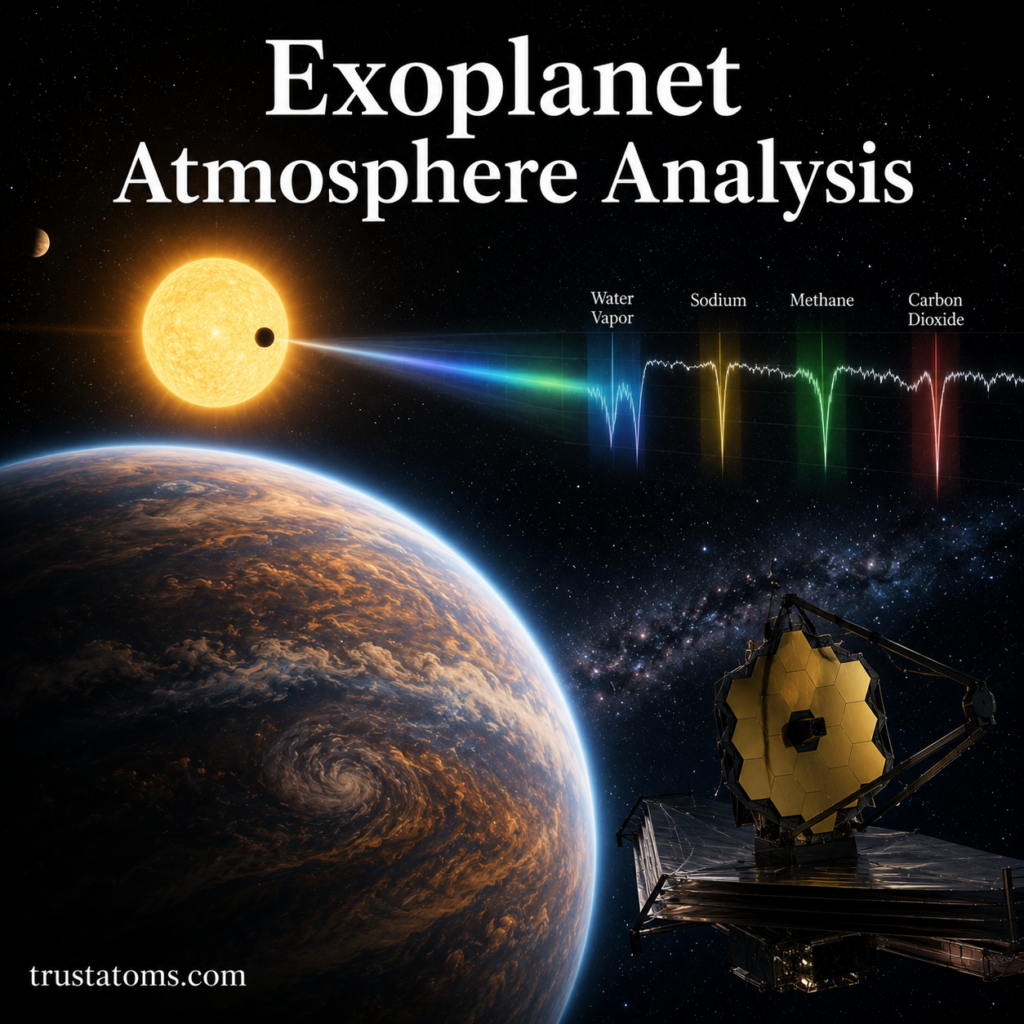
Thousands of exoplanets — planets orbiting stars outside our solar system — have been discovered over the past few decades. While finding these distant worlds is impressive on its own, one of the most exciting areas of modern astronomy involves studying their atmospheres.
Exoplanet atmosphere analysis allows scientists to investigate the gases, temperatures, weather systems, and chemical compositions surrounding distant planets. These studies help researchers better understand how planets form, how they evolve, and whether some worlds may potentially support conditions suitable for life.
Using advanced telescopes and spectroscopy techniques, astronomers can analyze tiny changes in light from stars and planets to uncover information about atmospheres located light-years away from Earth.
This guide explores how exoplanet atmospheres are studied, what scientists look for, and why atmospheric analysis has become one of the most important fields in astronomy.
What Is an Exoplanet Atmosphere?
An atmosphere is a layer of gases surrounding a planet.
Like Earth’s atmosphere, exoplanet atmospheres may contain:
- Hydrogen
- Helium
- Water vapor
- Carbon dioxide
- Methane
- Oxygen
- Nitrogen
- Clouds and aerosols
Atmospheres can vary dramatically depending on:
- Planet size
- Distance from the host star
- Temperature
- Gravity
- Chemical history
- Stellar radiation exposure
Some exoplanets may have thick, scorching atmospheres, while others may possess thin or even nearly nonexistent atmospheric layers.
Why Exoplanet Atmospheres Matter
Atmospheres provide valuable clues about a planet’s environment and history.
By studying atmospheres, scientists can estimate:
- Surface conditions
- Temperature ranges
- Atmospheric pressure
- Weather patterns
- Chemical activity
- Potential habitability
Atmospheric analysis also helps researchers classify planets into categories such as:
- Gas giants
- Ice giants
- Rocky terrestrial planets
- Super-Earths
- Mini-Neptunes
Understanding atmospheric chemistry may eventually help scientists identify planets with conditions that could support biological processes.
How Scientists Detect Exoplanet Atmospheres
Exoplanets are extremely difficult to observe directly because stars are much brighter than the planets orbiting them.
Astronomers therefore rely on indirect observation methods.
Transit Method
One of the most important techniques for atmosphere analysis is the transit method.
A transit occurs when a planet passes in front of its host star from Earth’s perspective.
During a transit:
- The planet blocks a small portion of starlight
- Some light passes through the planet’s atmosphere
- Atmospheric gases absorb specific wavelengths
- Telescopes analyze the filtered light
This process creates a spectral fingerprint that reveals atmospheric composition.
Spectroscopy and Atmospheric Signatures
Spectroscopy is the primary tool used to study exoplanet atmospheres.
Different gases absorb light at specific wavelengths.
By analyzing absorption patterns, scientists can identify atmospheric compounds.
Detected substances may include:
- Water vapor
- Sodium
- Potassium
- Carbon monoxide
- Methane
- Carbon dioxide
Each chemical leaves a unique signature within the observed spectrum.
Spectroscopy allows researchers to study atmospheres without physically visiting the planets.
Transmission Spectroscopy
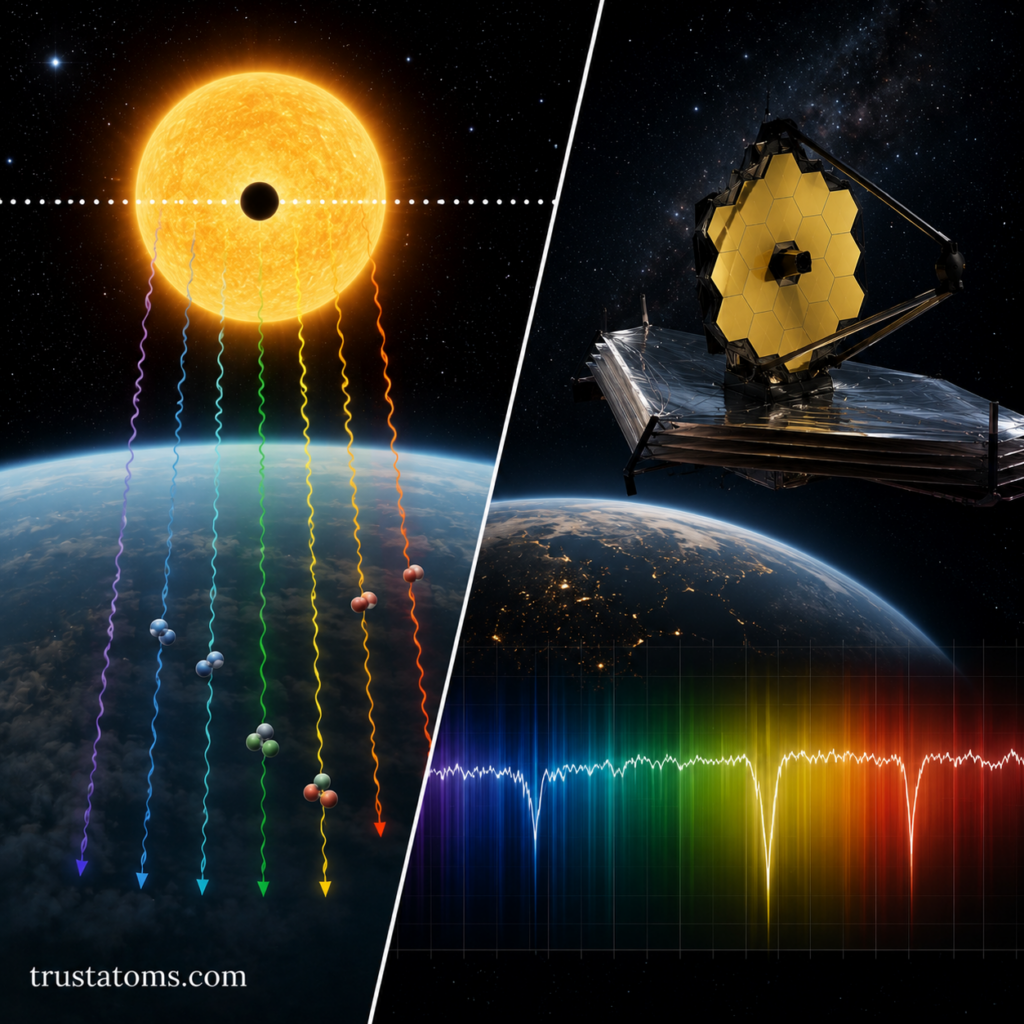
Transmission spectroscopy occurs during planetary transits.
As starlight passes through the atmosphere:
- Certain wavelengths are absorbed
- Others pass through
- Instruments measure tiny changes in brightness
This technique is especially effective for:
- Large planets
- Hot Jupiters
- Atmospheres with thick gas layers
Transmission spectroscopy has become one of the most widely used methods in exoplanet science.
Emission Spectroscopy
Scientists can also study heat and light emitted by planets themselves.
Emission spectroscopy analyzes:
- Infrared radiation
- Thermal energy
- Atmospheric heat distribution
This helps researchers estimate:
- Atmospheric temperatures
- Day-night temperature differences
- Energy circulation patterns
Infrared telescopes are particularly important for this type of analysis.
Direct Imaging
In some cases, astronomers directly image exoplanets.
This is challenging because stars greatly outshine nearby planets.
Advanced systems help block starlight using:
- Coronagraphs
- Adaptive optics
- Image processing techniques
Direct imaging allows scientists to study:
- Atmospheric clouds
- Heat signatures
- Planetary brightness
- Orbital motion
Young giant planets are often easier to image because they emit more infrared heat.
What Scientists Look for in Atmospheres
Atmospheric analysis focuses on identifying important environmental features.
Water Vapor
Water vapor is one of the most searched-for atmospheric compounds.
Its presence may suggest:
- Active atmospheric chemistry
- Potential cloud systems
- Conditions involving liquid water under certain environments
Water vapor has already been detected on several exoplanets.
Oxygen and Ozone
Oxygen attracts scientific interest because it is associated with biological activity on Earth.
However:
- Oxygen can also form through non-biological processes
- Detection alone does not confirm life
Scientists often study oxygen alongside:
- Ozone
- Methane
- Carbon dioxide
- Water vapor
Combined atmospheric signatures may provide stronger clues about planetary conditions.
Methane and Carbon Compounds
Methane plays an important role in atmospheric chemistry.
It may result from:
- Geological activity
- Chemical reactions
- Biological processes in some environments
Methane is especially interesting when found together with oxygen because the two gases normally react and disappear over time unless continuously replenished.
Clouds and Hazes
Many exoplanets appear to contain thick cloud layers or atmospheric hazes.
These clouds may contain:
- Water droplets
- Silicate particles
- Metal vapors
- Hydrocarbon compounds
Clouds can complicate atmospheric analysis by blocking deeper spectral observations.
However, they also reveal valuable information about:
- Temperature
- Atmospheric circulation
- Weather systems
Hot Jupiters and Atmospheric Research
Hot Jupiters were among the first exoplanets with detectable atmospheres.
These are:
- Massive gas giants
- Located very close to their stars
- Extremely hot
Because they are large and easier to detect, they became important early targets for atmospheric analysis.
Studies of hot Jupiters revealed:
- High-speed winds
- Extreme temperatures
- Evaporating atmospheres
- Exotic cloud chemistry
Some worlds may experience temperatures hot enough to vaporize metals.
Super-Earth Atmospheres
Super-Earths are planets larger than Earth but smaller than Neptune.
Scientists are especially interested in these planets because some orbit within habitable zones.
Questions researchers investigate include:
- Do super-Earths retain thick atmospheres?
- Could liquid water exist?
- What gases dominate these atmospheres?
- Are they rocky or gas-rich?
Atmospheric studies may eventually help distinguish potentially Earth-like worlds from uninhabitable planets.
The Habitable Zone
The habitable zone refers to the region around a star where temperatures may allow liquid water to exist under suitable conditions.
Atmospheres strongly influence habitability because they regulate:
- Surface temperature
- Radiation protection
- Climate stability
- Water retention
A planet’s distance from its star alone does not determine whether conditions are potentially suitable for life.
Atmospheric composition is equally important.
Space Telescopes Used in Atmosphere Analysis
Several major observatories contribute to exoplanet atmosphere research.
Hubble Space Telescope
Hubble helped detect:
- Water vapor
- Atmospheric clouds
- Chemical signatures
It pioneered many atmospheric observation techniques.
James Webb Space Telescope (JWST)
JWST has dramatically improved exoplanet atmosphere analysis through advanced infrared capabilities.
It can study:
- Fainter planets
- Smaller rocky worlds
- Detailed atmospheric chemistry
- Temperature structures
JWST is expected to transform understanding of exoplanet atmospheres over the coming years.
Ground-Based Observatories
Large Earth-based telescopes also contribute using:
- Adaptive optics
- Spectrographs
- Infrared instruments
Future extremely large telescopes may provide even more detailed atmospheric measurements.
Challenges in Exoplanet Atmosphere Analysis
Atmospheric analysis remains extremely difficult.
Major challenges include:
- Vast interstellar distances
- Weak atmospheric signals
- Stellar interference
- Instrument sensitivity limits
- Cloud obstruction
- Limited observation time
Even tiny observational errors can affect atmospheric interpretations.
Scientists must carefully compare data with theoretical models.
Biosignatures and the Search for Life
One of the most exciting goals in atmospheric analysis involves searching for biosignatures.
Biosignatures are chemical patterns that may suggest biological activity.
Potential biosignature gases include:
- Oxygen
- Methane
- Ozone
- Nitrous oxide
Researchers emphasize that no single gas automatically confirms life.
Instead, scientists look for:
- Multiple interacting gases
- Atmospheric disequilibrium
- Stable long-term patterns
Future observations may help narrow the search for potentially life-supporting worlds.
Future of Exoplanet Atmosphere Research
Exoplanet atmosphere analysis is advancing rapidly.
Future missions may provide:
- More detailed atmospheric maps
- Improved biosignature detection
- Better climate modeling
- Higher-resolution spectra
- Detection of Earth-sized planet atmospheres
Upcoming observatories may eventually analyze hundreds or thousands of atmospheres in detail.
As technology improves, astronomers will likely gain a clearer understanding of planetary diversity across the galaxy.
Why Exoplanet Atmosphere Analysis Matters
Studying exoplanet atmospheres helps scientists answer some of astronomy’s biggest questions:
- How do planets form?
- How common are Earth-like worlds?
- What conditions shape planetary climates?
- Could life exist elsewhere?
Atmospheric analysis connects astronomy, chemistry, planetary science, and astrobiology into one rapidly growing field.
Each new atmospheric discovery expands understanding of how planetary systems function throughout the universe.
Final Thoughts
Exoplanet atmosphere analysis has transformed the study of distant worlds. By examining tiny changes in starlight, scientists can investigate the gases, temperatures, clouds, and chemical processes surrounding planets located light-years away.
These observations provide valuable insight into planetary formation, atmospheric evolution, and potentially habitable environments.
As telescopes and detection methods continue improving, exoplanet atmosphere research may eventually reveal worlds that share important similarities with Earth — and perhaps deepen humanity’s understanding of life’s place in the universe.