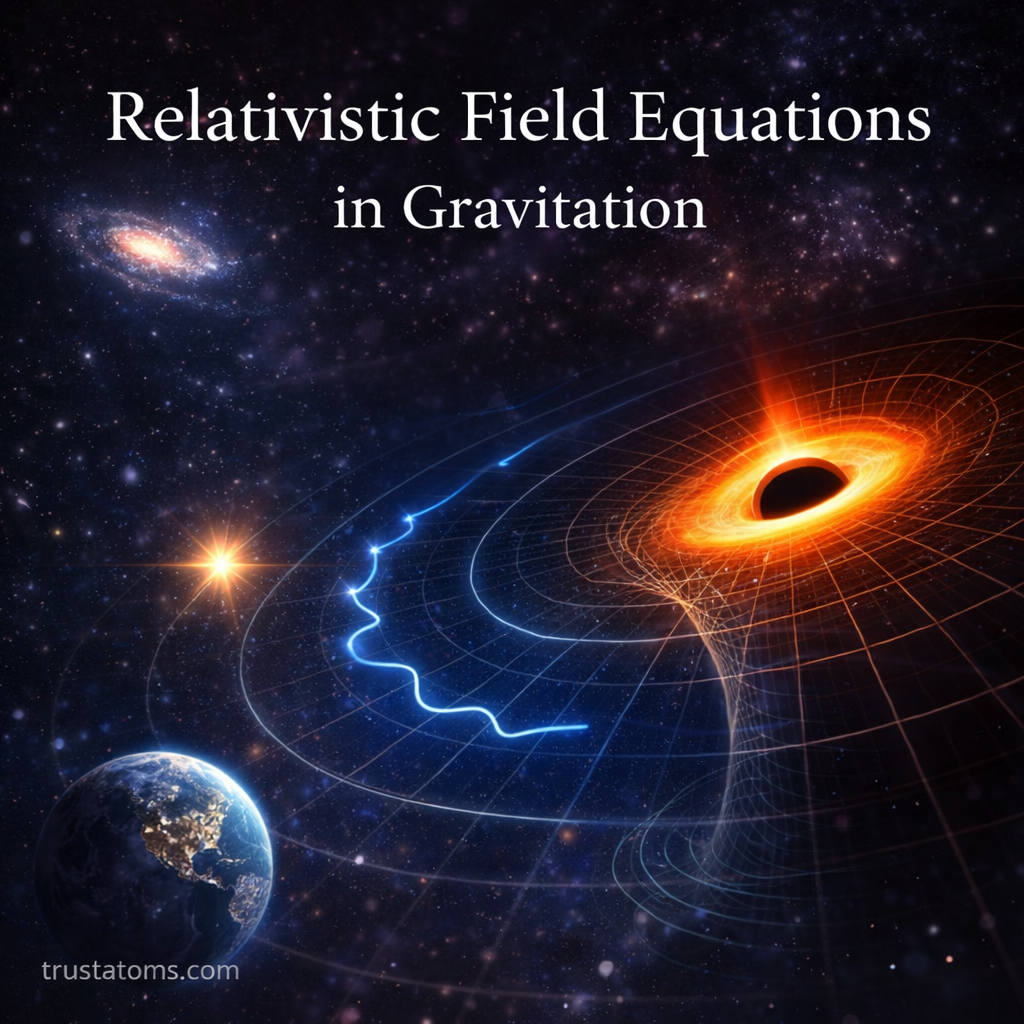
Gravity is not just a force pulling objects together.
According to modern physics, gravity is the curvature of spacetime itself. Massive objects bend the geometry around them, and that curvature tells matter how to move.
The mathematical description of this idea is contained in the relativistic field equations of gravitation, commonly known as Einstein’s field equations. These equations form the foundation of general relativity and modern gravitational physics.
In this article, we’ll explore what relativistic field equations are, what they describe, and why they revolutionized our understanding of gravity.
From Newton to Relativity
Before the 20th century, gravity was explained by Isaac Newton’s law of universal gravitation.
Newton described gravity as:
- A force acting instantly at a distance
- Proportional to mass
- Decreasing with distance squared
This worked extremely well for:
- Planetary motion
- Falling objects
- Orbital mechanics
However, Newton’s model had limitations:
- It assumed gravity acted instantaneously.
- It could not fully explain Mercury’s orbital precession.
- It did not incorporate the role of space and time.
Einstein’s theory of general relativity resolved these issues by redefining gravity entirely.
The Core Idea of General Relativity
General relativity proposes a radical shift:
Mass and energy curve spacetime, and curved spacetime guides motion.
Instead of viewing gravity as a force, it becomes a geometric effect.
Imagine spacetime as a flexible fabric:
- A massive object like a star creates a dip.
- Smaller objects move along the curved surface.
- Their motion appears as gravitational attraction.
This geometric interpretation is encoded mathematically in the relativistic field equations.
What Are Relativistic Field Equations?
Relativistic field equations describe how matter and energy determine the curvature of spacetime.
In simple conceptual terms, the equations connect:
- The geometry of spacetime
- The distribution of mass and energy
The structure of the equations can be summarized as:
Geometry = Energy and Momentum
On one side, the equations describe curvature.
On the other side, they describe matter and energy.
This balance ensures that spacetime geometry dynamically responds to physical content.
Key Components of the Equations
Although the full mathematical form is complex, the main conceptual ingredients include:
1. Spacetime Geometry
Spacetime is treated as a four-dimensional continuum:
- Three dimensions of space
- One dimension of time
Curvature is described using geometric objects that quantify how spacetime bends.
2. Energy–Momentum Content
All forms of energy contribute to gravity:
- Mass
- Radiation
- Pressure
- Momentum
This means gravity is influenced not only by mass but by energy in any form.
For example:
- Light bends around massive objects.
- Radiation in the early universe affected cosmic expansion.
3. The Cosmological Term
Einstein later introduced an additional term allowing spacetime itself to have intrinsic energy.
This term is now associated with:
- Dark energy
- Accelerating cosmic expansion
It plays a major role in modern cosmology.
Why These Equations Matter
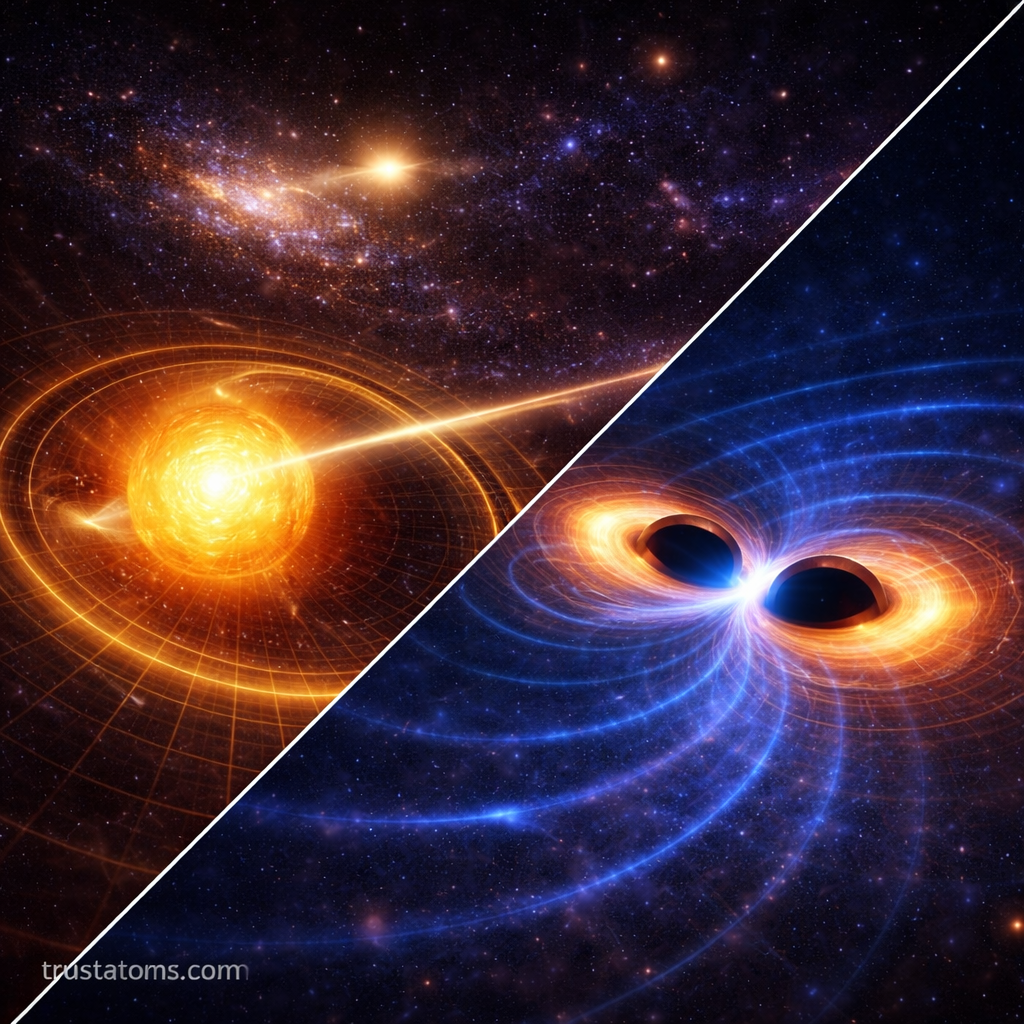
Relativistic field equations explain phenomena that Newtonian gravity cannot.
1. Gravitational Time Dilation
Time runs slower near massive objects.
This effect has been experimentally confirmed and must be accounted for in GPS satellite systems.
2. Light Bending
Light passing near a massive object follows curved spacetime.
This produces:
- Gravitational lensing
- Multiple images of distant galaxies
- Einstein rings
This was first confirmed during a solar eclipse in 1919.
3. Black Holes
The equations predict regions where spacetime curvature becomes extreme.
Black holes emerge naturally as solutions, featuring:
- Event horizons
- Singularities
- Intense gravitational effects
These objects are now routinely observed through gravitational wave detection and astrophysical imaging.
4. Gravitational Waves
Ripples in spacetime propagate outward when massive objects accelerate.
These waves were directly detected in 2015, confirming another major prediction of general relativity.
They allow scientists to observe:
- Merging black holes
- Neutron star collisions
- Cosmic events invisible in light
Mathematical Elegance and Complexity
Einstein’s field equations are compact in symbolic form but incredibly rich in meaning.
They are:
- Nonlinear
- Highly coupled
- Difficult to solve exactly
Only a few exact solutions are known, including:
- The Schwarzschild solution (non-rotating spherical mass)
- The Kerr solution (rotating black hole)
- Cosmological solutions describing expanding universes
Most real-world applications require numerical simulations.
Cosmology and the Expanding Universe
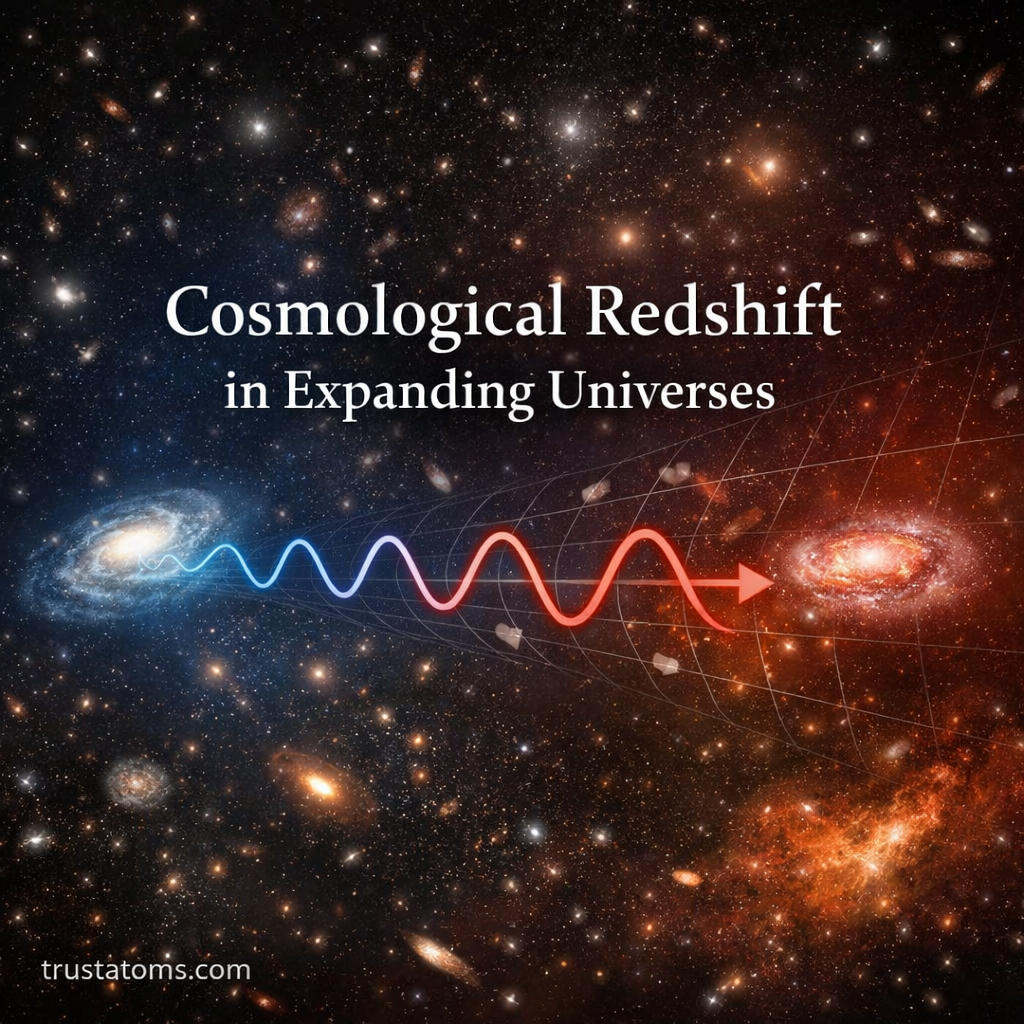
Relativistic field equations form the backbone of modern cosmology.
When applied to a large-scale, homogeneous universe, they predict:
- Expansion or contraction
- The Big Bang model
- Cosmic evolution over billions of years
The discovery that the universe is expanding emerged directly from solving these equations under cosmological assumptions.
How Relativistic Gravity Differs from Classical Gravity
Here’s a simplified comparison:
Newtonian Gravity:
- Force-based
- Instantaneous action
- Flat space
- Works at low speeds and weak gravity
Relativistic Gravity:
- Geometry-based
- Finite propagation speed (speed of light)
- Curved spacetime
- Necessary for strong gravity and high speeds
In everyday situations, Newton’s equations are accurate approximations.
In extreme environments, relativity is essential.
Challenges and Open Questions
Despite its success, general relativity is incomplete.
Major open problems include:
- Unifying gravity with quantum mechanics
- Understanding dark energy
- Resolving singularities inside black holes
- Explaining the earliest moments of the universe
Relativistic field equations remain central to these ongoing investigations.
Final Thoughts
Relativistic field equations in gravitation represent one of the greatest intellectual achievements in science.
They transformed gravity from a simple force into a dynamic geometric property of spacetime.
Through them, we understand:
- Why planets orbit
- How black holes form
- Why the universe expands
- How spacetime can ripple and bend
More than a century after their formulation, these equations continue to guide modern physics, astrophysics, and cosmology.
They reveal a universe not governed by invisible pulls, but by the deep geometry of space and time itself.