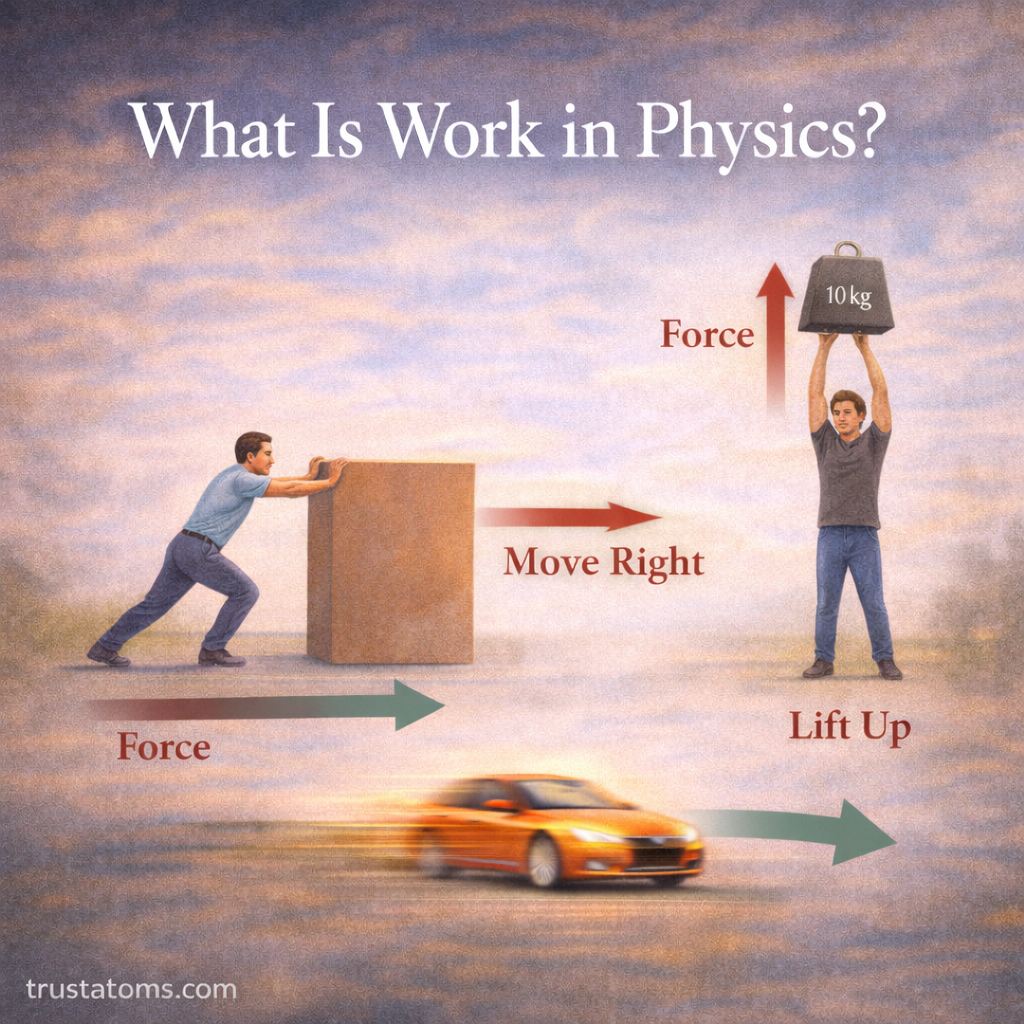
In everyday language, “work” means effort. In physics, work has a very specific meaning.
Work happens only when a force causes an object to move.
If there is no movement, no work is done — no matter how tired you feel.
In this guide, you’ll learn:
- The definition of work in physics
- The work formula
- How to calculate work step by step
- Real-world examples
- The connection between work and energy
Definition of Work in Physics
In physics, work is done when:
A force is applied to an object
AND
The object moves in the direction of the force.
If you push a wall and it does not move, you do zero work in physics terms.
The Formula for Work
The basic formula for work is:
W = F × d
Where:
- W = work (in joules, J)
- F = force (in newtons, N)
- d = distance moved in the direction of the force (in meters, m)
Units of Work
Work is measured in joules (J).
1 joule = 1 newton × 1 meter
When Force Is at an Angle
Sometimes force is applied at an angle.
The full formula becomes:
W = F × d × cos(θ)
Where:
- θ (theta) is the angle between the force and the direction of motion
If the force is perpendicular to motion (90°):
cos(90°) = 0
No work is done.
Example 1: Pushing a Box
You push a box with:
- Force = 50 N
- Distance = 4 m
W = 50 × 4
W = 200 J
You did 200 joules of work on the box.
Example 2: Lifting an Object
You lift a 10 kg object upward by 2 meters.
Step 1: Find the force needed (equal to weight).
Weight = mg
= 10 × 9.8
= 98 N
Step 2: Apply the work formula.
W = 98 × 2
W = 196 J
You did 196 joules of work lifting the object.
When Is No Work Done?
Work equals zero when:
- The object does not move
- The force is perpendicular to motion
- There is no force applied
Example:
Holding a heavy box still does no work in physics, even though your muscles feel strain.
Relationship Between Work and Energy
Work and energy are directly connected.
The Work-Energy Theorem states:
Work done on an object = Change in kinetic energy
If you apply work to an object, you change its energy.
For example:
- Push a car → it gains kinetic energy
- Lift an object → it gains gravitational potential energy
Work transfers energy.
Positive vs Negative Work
Positive Work
Occurs when force and motion are in the same direction.
Example:
Pushing a sled forward.
Negative Work
Occurs when force opposes motion.
Example:
Friction slowing a moving object.
Negative work removes energy from a system.
Real-Life Examples of Work in Physics
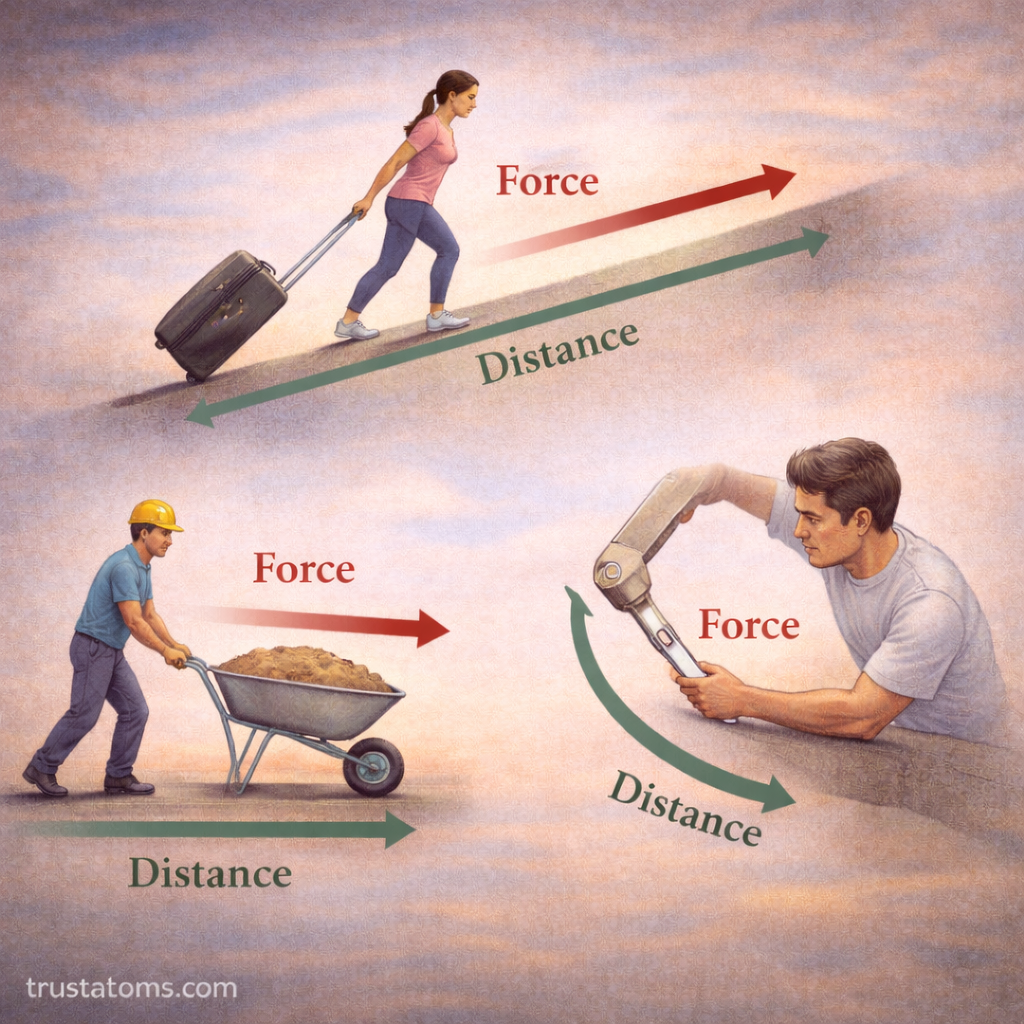
Work appears in:
- Lifting groceries
- Pulling a suitcase
- Braking a car
- Launching a rocket
- Compressing a spring
Anytime force causes motion, work is involved.
Common Misunderstandings About Work
Here are frequent misconceptions:
- Feeling tired means work was done (not necessarily true in physics).
- Holding something still counts as work (it does not).
- Larger force always means more work (distance matters too).
Both force and displacement are required.
Why Work Matters in Physics
The concept of work helps explain:
- Energy transfer
- Motion and acceleration
- Mechanical systems
- Engine performance
- Power generation
It is a foundation of classical mechanics.
Key Takeaways
- Work happens when force causes motion.
- The formula is W = F × d.
- Work is measured in joules.
- No movement = no work (in physics).
- Work changes an object’s energy.
Understanding work in physics helps you see how force and motion connect to energy. It’s not about effort — it’s about force causing displacement.
Once you grasp this idea, many other physics concepts become clearer.