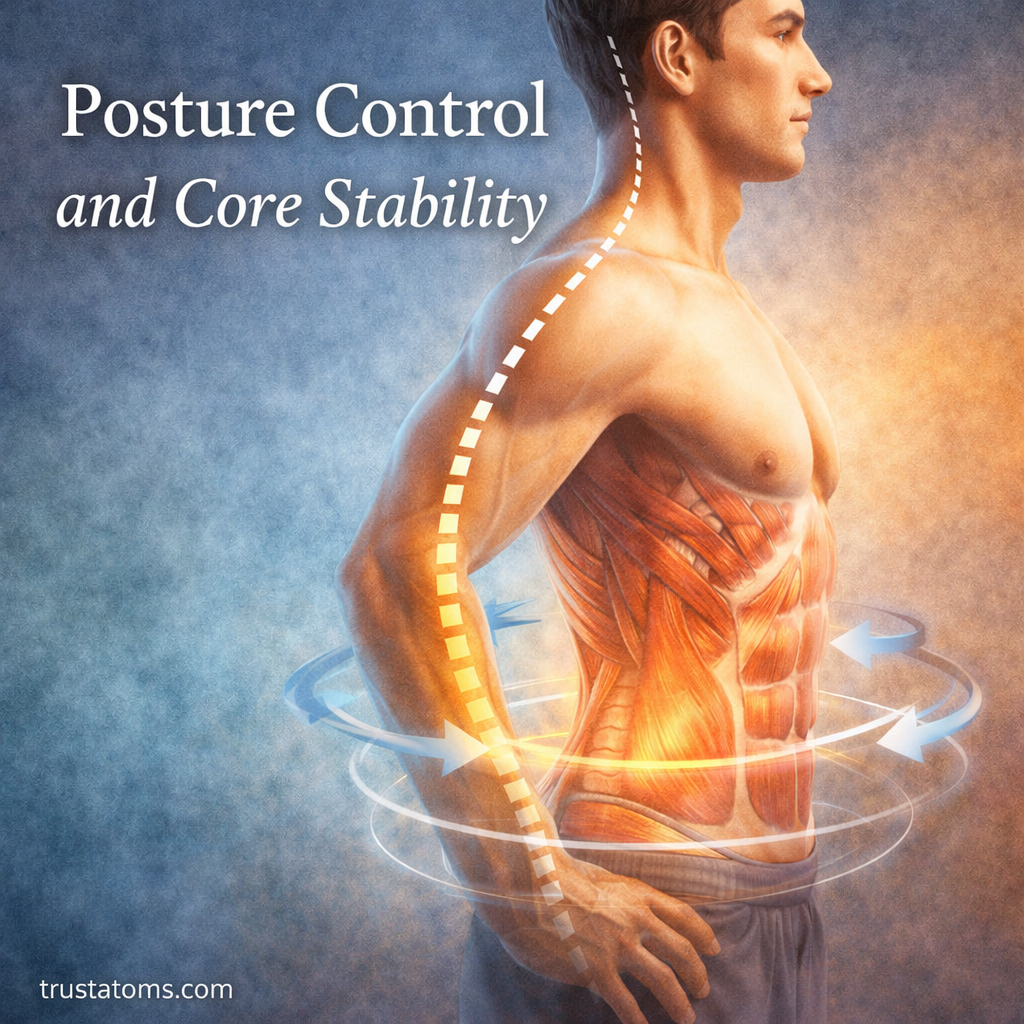
Posture control is the body’s ability to maintain balance and manage its position during sitting, standing, and movement. Core stability is the coordinated activity of muscles around the trunk and pelvis that supports the spine and helps control movement under different loads.
These functions work together whenever you reach for an object, walk across uneven ground, or lift something from the floor. Understanding their relationship connects human anatomy with the nervous system, muscle coordination, and the mechanical forces acting on the body.
What Is Posture Control?
Posture control, also called postural control, involves maintaining the body’s orientation and balance relative to gravity and the surrounding environment. Rather than holding every joint in one ideal position, the body makes continuous adjustments to meet the demands of an activity.
The spine’s natural cervical, thoracic, and lumbar curves help distribute mechanical forces. The relationship between spinal curvatures and load distribution explains why alignment influences how forces pass through vertebrae, discs, and supporting tissues.
Posture also affects load bearing in the spine, particularly when carrying objects or maintaining a position for an extended period. No single posture eliminates spinal loading, and comfortable movement usually involves changing positions rather than remaining rigidly upright.
Static and Dynamic Posture
- Static posture: Controlling body position while relatively still, such as standing in line or sitting at a desk.
- Dynamic posture: Maintaining balance and orientation during movement, such as walking, bending, or reaching overhead.
Even static posture requires small muscular adjustments. During quiet standing, the body naturally sways slightly as the nervous system continually regulates balance.
What Is Core Stability?
Core stability describes the ability to control the position and movement of the trunk and pelvis while responding to forces. It depends on muscle strength, endurance, timing, and coordination rather than abdominal strength alone.
The core works with the hips and surrounding joints to manage movement. Understanding hip joint mechanics and stability helps explain how the pelvis transfers forces between the legs and trunk. More broadly, joint stability depends on muscles, ligaments, joint surfaces, and nervous system control working together.
Muscles That Support the Core
- Transversus abdominis: A deep abdominal muscle that helps regulate trunk stiffness and abdominal pressure.
- Rectus abdominis: Helps bend the trunk forward and resist excessive spinal extension.
- Internal and external obliques: Assist with trunk rotation, side bending, and resisting unwanted movement.
- Multifidus and erector spinae: Support spinal extension and control movement between spinal segments.
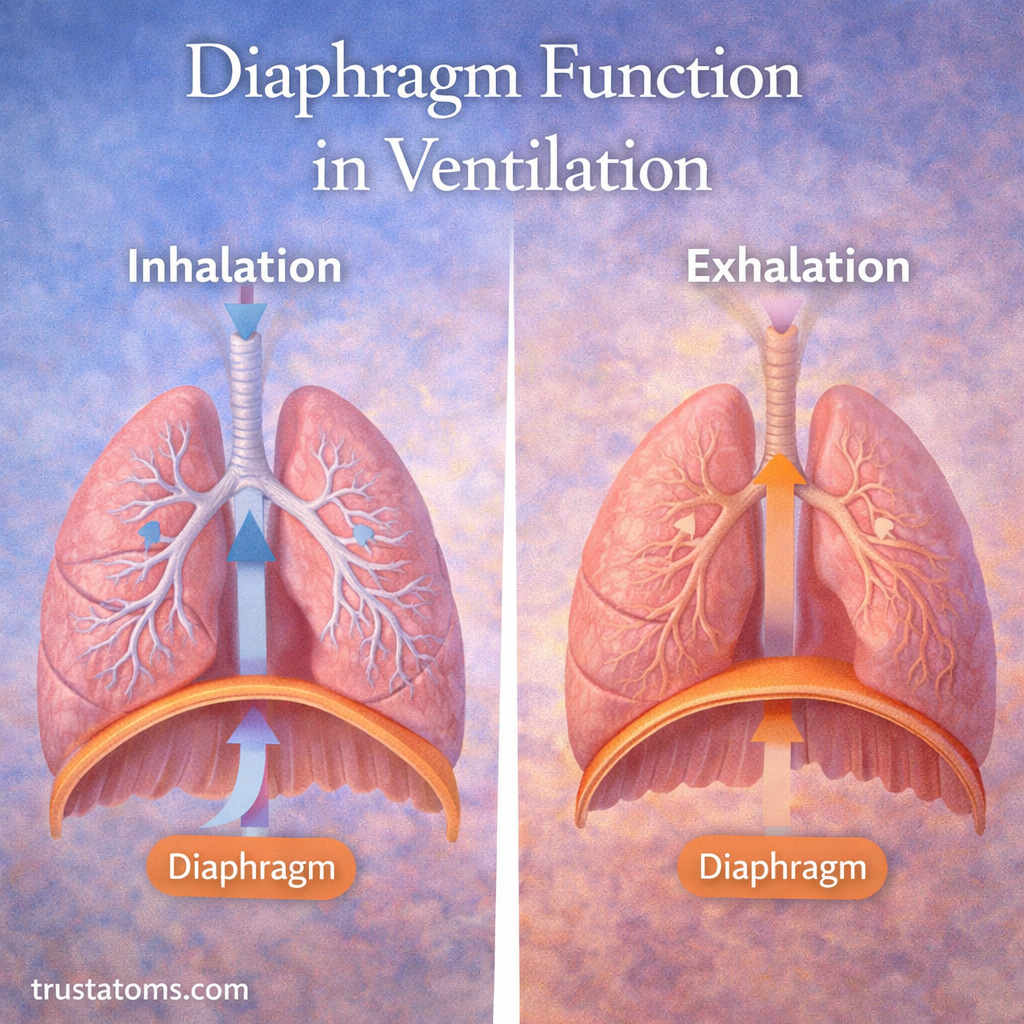
- Diaphragm and pelvic floor: Contribute to breathing, pressure regulation, and trunk support.
These muscles do not need to contract maximally during every activity. Efficient stability requires the nervous system to adjust muscle activity according to the task.
How Posture and Core Stability Work Together
Postural control determines how the body maintains its orientation and balance, while core muscles help manage forces acting on the trunk. During movement, these functions overlap continuously.
For example, reaching forward shifts the body’s center of mass. Muscles around the trunk, hips, and legs adjust their activity to control that shift and prevent loss of balance. Some adjustments begin before the arm moves, while others respond to the movement itself.
Core stability does not mean keeping the spine completely motionless. The spine needs controlled mobility for bending, rotating, and adapting to daily activities. Effective movement combines appropriate stiffness when resisting loads with flexibility when movement is required.
Everyday Example: Lifting a Grocery Bag
Imagine lifting a grocery bag weighing 10 pounds from the floor onto a kitchen counter. Although the bag’s weight stays the same, the mechanical demands change depending on its distance from your body and how you move.
- Approaching the bag: Positioning your feet near the object reduces the distance between the load and your body.
- Bending down: Your hips, knees, and spine move together as muscles control the descent.
- Gripping and lifting: Trunk muscles generate appropriate stiffness while the legs and hips help produce upward force.
- Placing the bag: The body adjusts its balance as the load moves toward the counter and leaves your hands.
Holding the bag farther away generally increases the turning force, or torque, that the back muscles must resist. Keeping the load reasonably close can reduce this demand. However, safe lifting also depends on the object’s weight, the person’s abilities, fatigue, and the frequency of lifting.
Common Posture Patterns and Their Effects
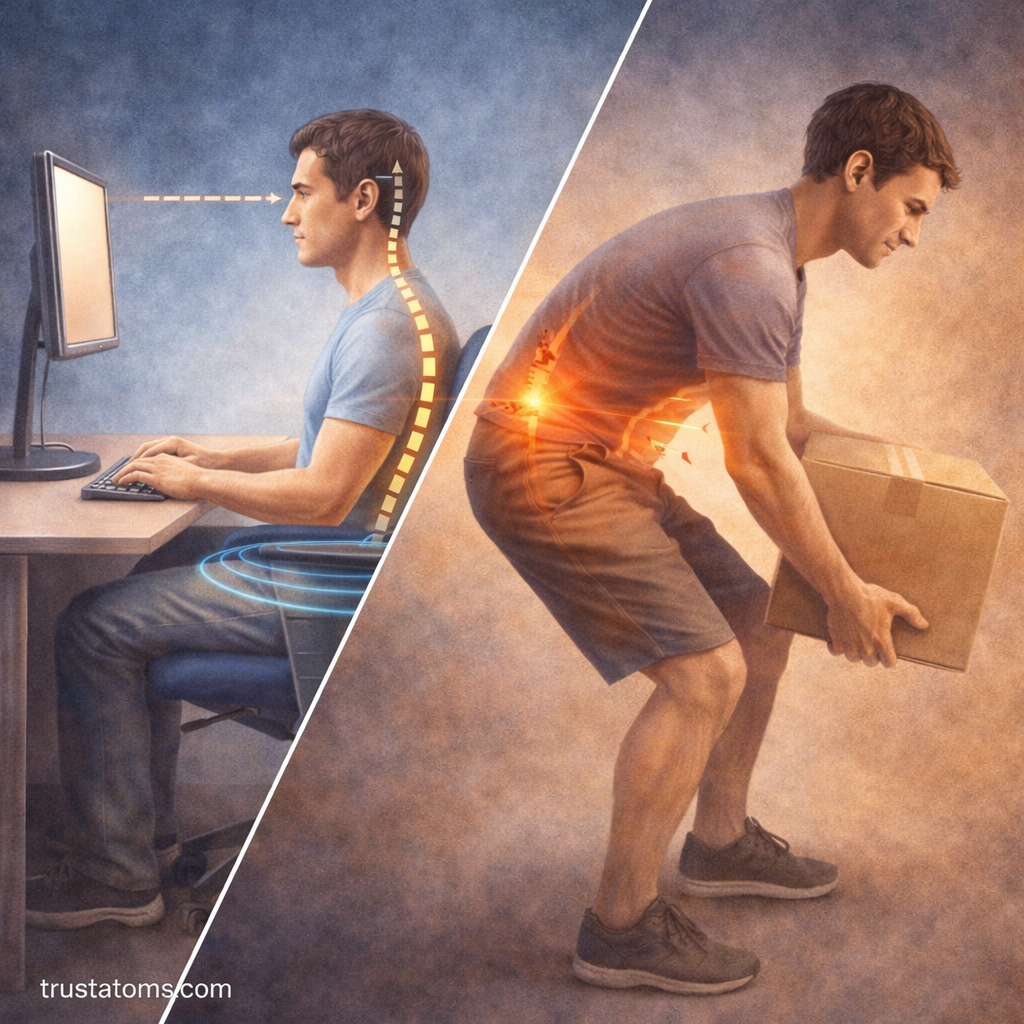
Common posture patterns include forward head positioning, rounded shoulders, increased lumbar arching, and slouched sitting. These positions are not automatically harmful, but maintaining any uncomfortable position for too long can contribute to fatigue or discomfort.
Several factors influence posture and movement tolerance:
- Prolonged inactivity: Remaining still can increase stiffness and reduce opportunities for muscular variation.
- Muscle endurance: Fatigue may make sustained positions more difficult.
- Workstation setup: Screen height, seating, and equipment placement influence comfort and movement options.
- Individual differences: Body proportions, mobility, strength, and existing conditions affect comfortable positions.
Research does not support treating every deviation from an idealized posture as a direct cause of pain or injury. Symptoms are influenced by multiple factors, and changing positions regularly is often more practical than trying to maintain perfect alignment.
How the Body Maintains Balance and Stability
Balance depends on the nervous system combining information from three major sensory sources:
- Vision: Provides information about the surrounding environment and body movement relative to it.
- Vestibular system: Structures in the inner ear detect head movement and orientation relative to gravity.
- Somatosensory system: Receptors in muscles, tendons, joints, and skin provide information about body position and contact with surfaces.
The brain and spinal cord process this information and adjust muscular activity. The coordination between muscles and joints allows the body to respond when a surface shifts, an object is lifted, or a person changes direction.
These adjustments include anticipatory responses that prepare the body for movement and reactive responses that correct unexpected disturbances. Both contribute to postural control.
Practical Ways to Improve Core Stability and Posture
Improvement generally comes from practicing varied movements, building strength and endurance, and gradually increasing activity demands.
Core Exercises for Beginners
- Bird dog: From hands and knees, extend one arm and the opposite leg while controlling trunk rotation.
- Glute bridge: Lie on your back with knees bent and lift your hips using the gluteal and trunk muscles.
- Dead bug: Lie on your back and slowly move opposite arms and legs while maintaining controlled trunk positioning.
- Modified plank: Support your body on forearms and knees while maintaining comfortable trunk alignment and breathing normally.
Start with a manageable number of controlled repetitions or short holds. Increase the difficulty gradually without forcing painful movements or holding your breath.
Daily Habits That Support Movement
- Change sitting and standing positions regularly.
- Adjust work surfaces and screens to reduce unnecessary strain.
- Practice lifting and carrying objects with controlled movements.
- Include walking, resistance exercise, and activities that challenge balance appropriately.
Frequently Asked Questions
Does good posture mean keeping the back straight?
No. The spine has natural curves, and healthy movement requires flexibility. Good postural control means adapting body position to an activity rather than keeping the back rigidly straight.
Are strong abdominal muscles enough for core stability?
No. Core stability depends on coordinated activity across abdominal, back, pelvic, and respiratory muscles, together with nervous system control. Strength is only one part of effective stabilization.
Can core exercises prevent lower back pain?
Core exercises can improve strength and movement control and may help some people manage back pain. However, they cannot guarantee prevention, because back pain has multiple contributing factors and no single exercise program works for everyone.
Posture control and core stability allow the body to adjust to gravity, changing loads, and everyday movement. Their effectiveness depends on coordinated muscles, sensory information, and appropriate movement rather than maintaining one perfect position. Building strength, practicing balance, and varying daily activity can improve how comfortably and confidently the body handles physical demands.
This article is for general education and is not medical advice. Talk to a qualified health professional about any medical concern.
Sources: OpenStax Anatomy and Physiology 2e; Neumann’s Kinesiology of the Musculoskeletal System; American College of Sports Medicine’s Guidelines for Exercise Testing and Prescription.