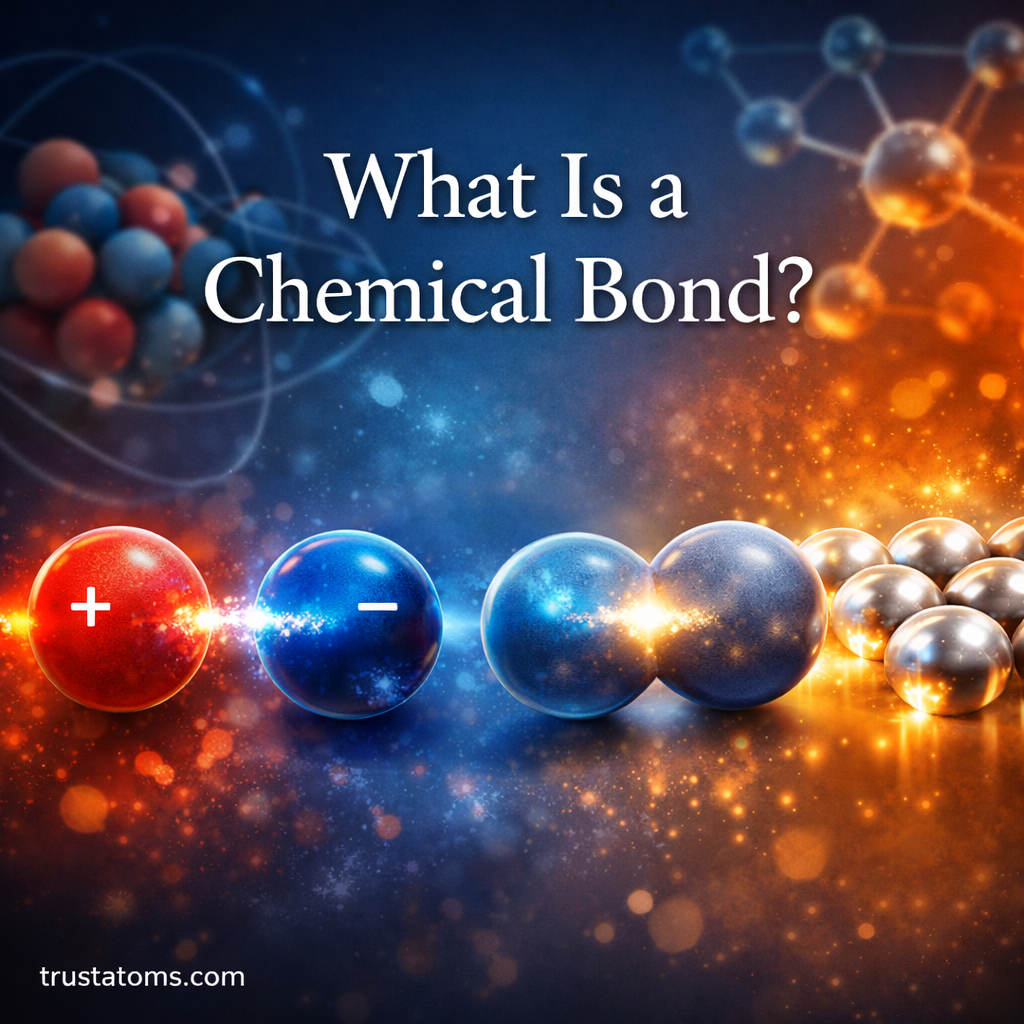
A chemical bond is the force that holds atoms together to form molecules and compounds. Without chemical bonds, matter as we know it would not exist — no water, no air, no cells, and no life.
At its core, a chemical bond forms because atoms seek a more stable, lower-energy arrangement of their electrons. By sharing, gaining, or losing electrons, atoms connect in predictable ways that create everything from simple gases to complex biological structures.
Why Do Atoms Form Chemical Bonds?
Atoms are made of a nucleus (protons and neutrons) surrounded by electrons. The outermost electrons — called valence electrons — determine how an atom interacts with others.
Most atoms are most stable when their outer shell is full. To reach this stable configuration, they may:
- Share electrons
- Transfer electrons
- Rearrange electrons through attraction
This drive toward stability is what creates chemical bonds.
The Three Main Types of Chemical Bonds
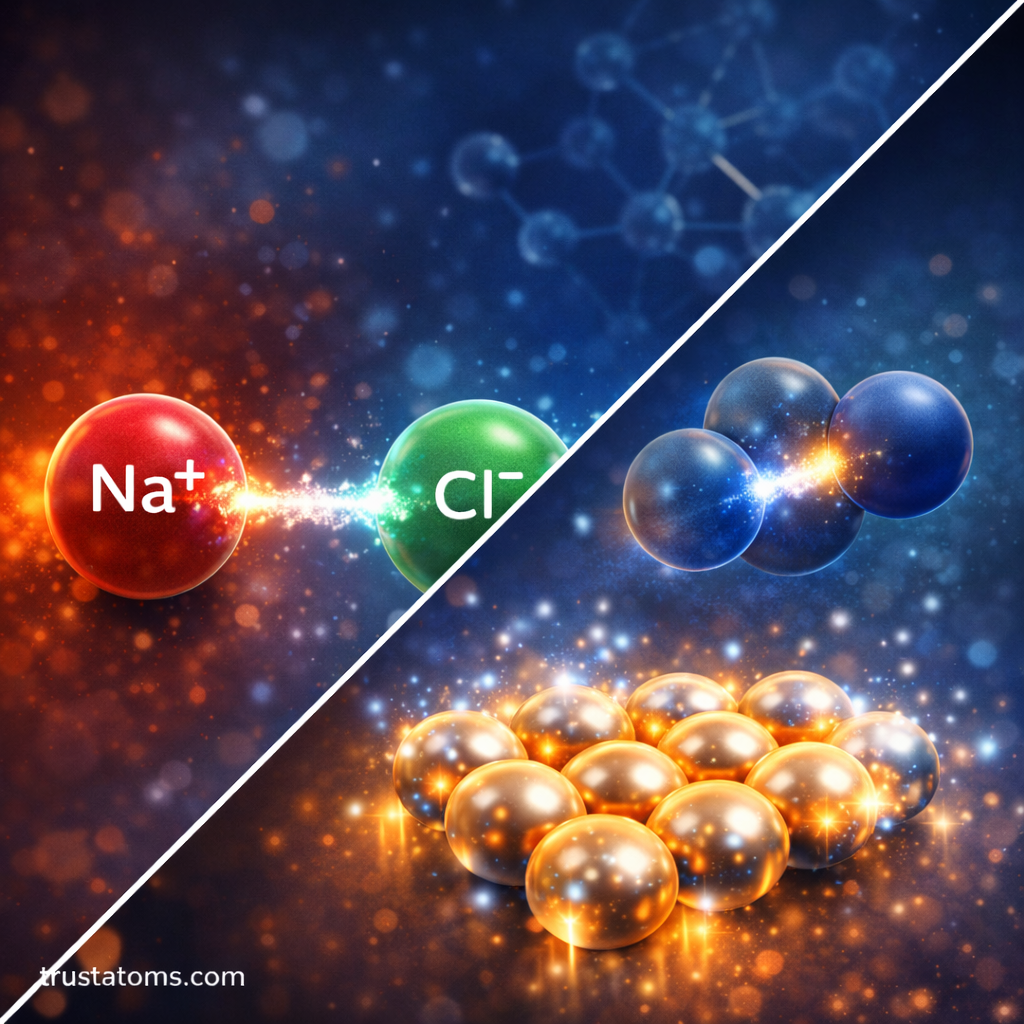
There are three primary types of chemical bonds in chemistry:
1. Ionic Bonds
An ionic bond forms when one atom transfers one or more electrons to another atom.
- One atom loses electrons and becomes positively charged (cation).
- The other atom gains electrons and becomes negatively charged (anion).
- Opposite charges attract, forming a strong electrostatic bond.
Example:
Sodium (Na) loses one electron, and chlorine (Cl) gains one electron, forming sodium chloride (table salt).
Common properties of ionic compounds:
- High melting and boiling points
- Often solid at room temperature
- Conduct electricity when dissolved in water
2. Covalent Bonds
A covalent bond forms when two atoms share electrons.
Instead of transferring electrons completely, the atoms share pairs of electrons to fill their outer shells.
Example:
Two hydrogen atoms share electrons with one oxygen atom to form water (H₂O).
Covalent bonds can be:
- Single (one shared pair)
- Double (two shared pairs)
- Triple (three shared pairs)
Common properties of covalent compounds:
- Lower melting and boiling points (compared to ionic compounds)
- Often gases or liquids
- Do not conduct electricity well
3. Metallic Bonds
Metallic bonds occur between metal atoms.
In this type of bonding:
- Valence electrons are not bound to one atom.
- Electrons move freely in a “sea” of shared electrons.
- Positive metal ions are held together by this electron cloud.
This explains why metals:
- Conduct electricity
- Conduct heat
- Are malleable and ductile
What Determines Bond Strength?
Not all chemical bonds are equal. Bond strength depends on several factors:
Electronegativity
Electronegativity is an atom’s ability to attract electrons.
- Large differences in electronegativity → ionic bond
- Small differences → covalent bond
Bond Length
Shorter bonds are generally stronger because atoms are closer together.
Number of Shared Electrons
- Triple bonds are stronger than double bonds.
- Double bonds are stronger than single bonds.
Polar vs. Nonpolar Covalent Bonds
Not all covalent bonds share electrons equally.
Nonpolar Covalent Bond
- Electrons are shared equally.
- No partial charges form.
Example: Oxygen gas (O₂)
Polar Covalent Bond
- Electrons are shared unequally.
- One atom becomes slightly negative (δ−).
- The other becomes slightly positive (δ+).
Example: Water (H₂O)
This unequal sharing is why water molecules stick to each other and dissolve many substances.
Chemical Bonds and Energy
Bond formation and breaking involve energy changes.
- When bonds form → energy is released.
- When bonds break → energy is absorbed.
This is the basis of chemical reactions.
For example:
- Burning fuel releases energy because strong new bonds form.
- Photosynthesis absorbs energy from sunlight to create chemical bonds.
How Chemical Bonds Shape the World
Chemical bonds determine:
- The structure of DNA
- The hardness of diamonds
- The flexibility of plastics
- The behavior of gases
- The reactions inside your body
Even small changes in bonding can completely change a substance’s properties. For example, graphite and diamond are both made of carbon — but their different bonding arrangements make one soft and the other extremely hard.
Summary: What Is a Chemical Bond?
A chemical bond is the attractive force that holds atoms together. It forms because atoms seek stability by adjusting their electrons.
The three main types are:
- Ionic bonds (electron transfer)
- Covalent bonds (electron sharing)
- Metallic bonds (shared electron sea)
Understanding chemical bonds helps explain how matter forms, how reactions happen, and how the physical world behaves at the atomic level.
Chemical bonds are not just a chemistry concept — they are the invisible connections that build everything around us.