Atomic number is one of the most important ideas in chemistry. It defines what an element is and determines how that element behaves in chemical reactions.
If you understand atomic number, you understand the foundation of the entire periodic table.
In this guide, we’ll break it down in simple terms — no complicated math required.
What Is Atomic Number?
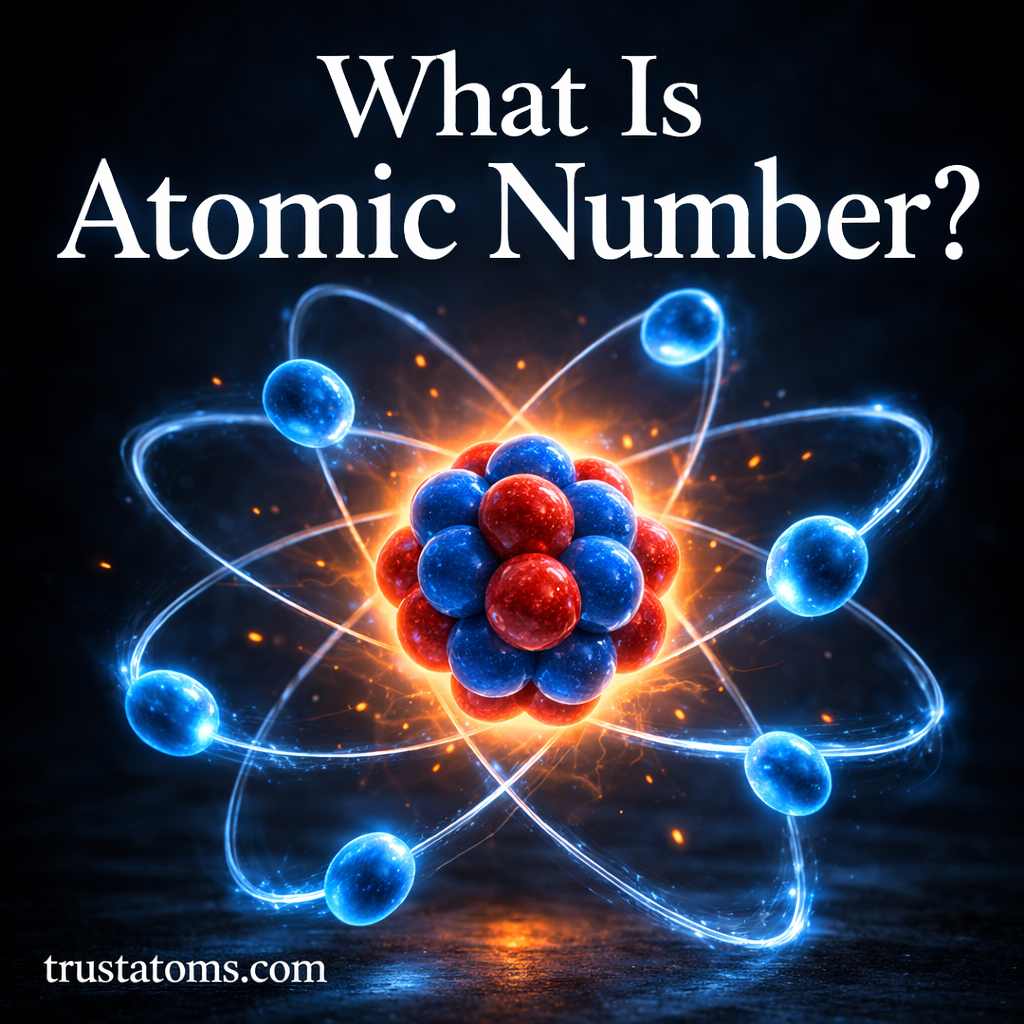
The atomic number of an element is the number of protons in the nucleus of an atom.
Every element has a unique atomic number. No two elements share the same number of protons.
For example:
- Hydrogen has 1 proton → Atomic number = 1
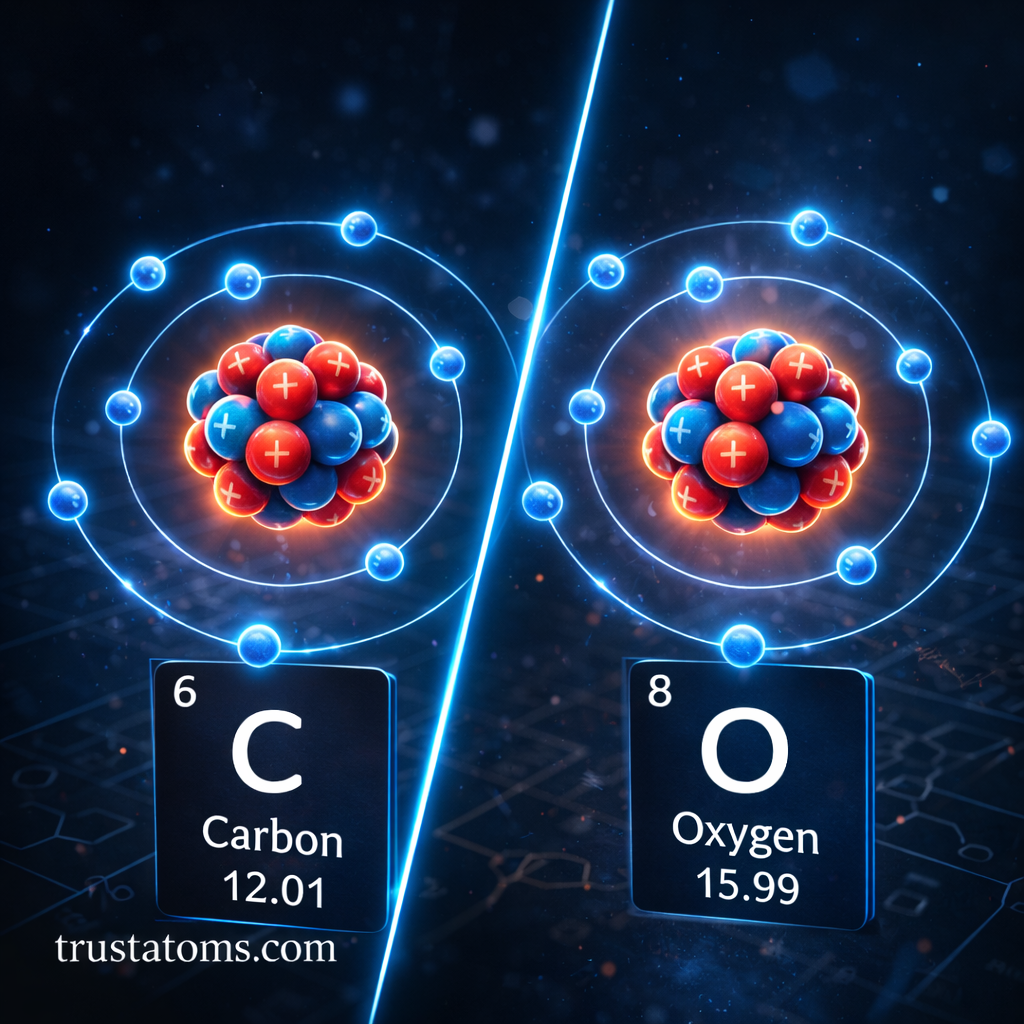
- Carbon has 6 protons → Atomic number = 6
- Oxygen has 8 protons → Atomic number = 8
If you change the number of protons, you change the element entirely.
That’s what makes atomic number so powerful — it defines identity.
Why Protons Matter
Protons carry a positive electric charge and are found in the center of the atom (the nucleus).
The number of protons:
- Determines the element’s name
- Determines its chemical symbol
- Controls how many electrons the atom has (in a neutral atom)
- Influences how the element reacts chemically
For example:
- An atom with 8 protons is always oxygen.
- An atom with 7 protons is always nitrogen.
Even if other parts of the atom change, the atomic number does not — unless the element itself changes.
How Atomic Number Relates to Electrons
In a neutral atom:
Number of protons = Number of electrons
So if oxygen has 8 protons, it also has 8 electrons.
Electrons determine how atoms bond and react. That means the atomic number indirectly controls chemical behavior.
For example:
- Hydrogen (1 proton, 1 electron) is highly reactive.
- Neon (10 protons, 10 electrons) is stable and rarely reacts.
The atomic number sets up the entire structure of the atom.
Atomic Number vs. Atomic Mass
These two terms are often confused.
Here’s the difference:
Atomic number:
- Counts protons only
- Defines the element
Atomic mass:
- Counts protons + neutrons
- Can vary between atoms of the same element
For example:
Carbon always has:
- 6 protons → Atomic number = 6
But it can have:
- 6 neutrons (Carbon-12)
- 8 neutrons (Carbon-14)
Different neutron counts create isotopes, but the atomic number stays the same.
How Atomic Number Organizes the Periodic Table
The periodic table is arranged in order of increasing atomic number.
As you move:
- Left to right → Atomic number increases by 1 each step
- Top to bottom → Atomic number continues increasing
This arrangement wasn’t always obvious.
In the early 1900s, scientist Henry Moseley discovered that elements should be organized by atomic number — not atomic mass. His work fixed inconsistencies in the earlier periodic table and created the structure we use today.
Without atomic number, the periodic table wouldn’t make sense.
What Happens If You Change the Atomic Number?
Changing the atomic number means changing the number of protons.
And if you change the number of protons, you create a completely different element.
For example:
- 6 protons → Carbon
- 7 protons → Nitrogen
- 8 protons → Oxygen
This process can happen in nuclear reactions, but not in ordinary chemical reactions.
Chemical reactions only rearrange electrons — they do not change atomic numbers.
Why Atomic Number Is So Important
Atomic number:
- Defines the identity of every element
- Determines electron structure
- Controls chemical properties
- Organizes the periodic table
- Connects atomic structure to real-world chemistry
Without atomic number, chemistry would be random and unpredictable.
It is the “ID number” of every element in the universe.
Quick Summary
- Atomic number = number of protons in an atom
- Each element has a unique atomic number
- It determines chemical identity
- It stays constant for a given element
- It organizes the periodic table
If you remember one thing, remember this:
Change the atomic number, and you change the element.
Final Thoughts
Atomic number may sound like a small detail, but it is the foundation of chemistry.
From the air you breathe to the water you drink, every substance is made of atoms defined by their atomic number.
Once you understand this concept, the entire periodic table becomes easier to understand — and chemistry starts to feel much more logical.