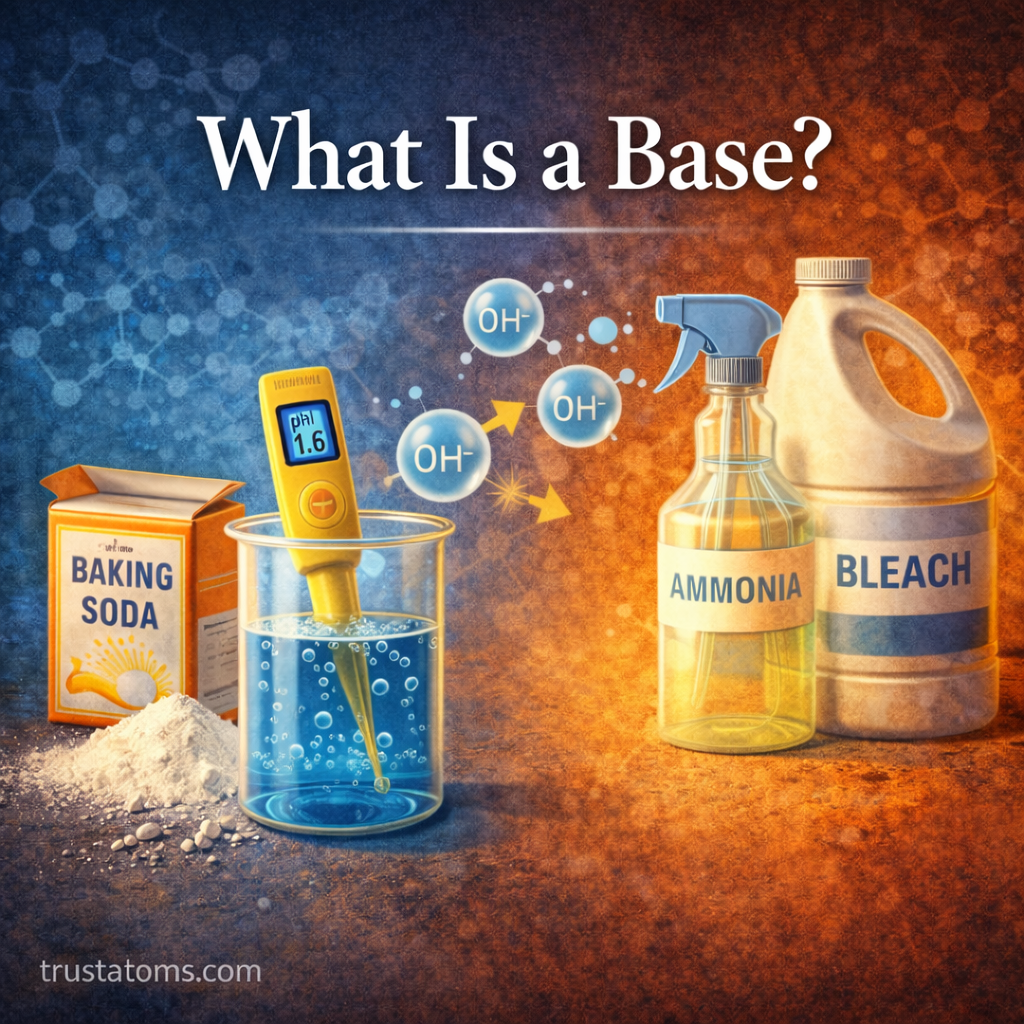
In chemistry, acids often get the spotlight. But bases are just as important. From baking soda in your kitchen to cleaning products under your sink, bases play a major role in daily life.
So what exactly is a base?
This guide explains what a base is, how bases behave, how they differ from acids, and why they matter in science and industry.
What Is a Base? (Simple Definition)
A base is a substance that either:
- Releases hydroxide ions (OH⁻) in water, or
- Accepts hydrogen ions (H⁺) in a chemical reaction
In simple terms, bases reduce the concentration of hydrogen ions in a solution, making it less acidic.
Key Properties of Bases
Bases share several common characteristics:
- Bitter taste
- Slippery or soapy feel
- Turn red litmus paper blue
- Have a pH greater than 7
- React with acids to form water and salts
These properties help chemists identify basic substances.
The pH Scale and Bases
The pH scale measures how acidic or basic a solution is.
- pH 7 = Neutral
- pH below 7 = Acidic
- pH above 7 = Basic (alkaline)
The higher the pH number, the stronger the base.
Examples:
- Baking soda solution: around pH 8–9
- Household ammonia: around pH 11
- Bleach: around pH 12–13
Like acids, the pH scale is logarithmic. Each whole number change represents a tenfold difference in basicity.
How Bases Work at the Molecular Level
When a base dissolves in water:
- It may release hydroxide ions (OH⁻), or
- It may react with hydrogen ions (H⁺), removing them from solution
This reduces acidity and shifts the solution toward alkaline conditions.
Because hydrogen ion concentration determines acidity, lowering that concentration makes a solution more basic.
Strong Bases vs. Weak Bases
Not all bases behave the same way. They are classified based on how completely they produce hydroxide ions or accept hydrogen ions.
Strong Bases
Strong bases:
- Fully dissociate in water
- Produce a high concentration of hydroxide ions
- Have very high pH values
Examples include sodium hydroxide and potassium hydroxide.
Strong bases are highly reactive and can be corrosive.
Weak Bases
Weak bases:
- Partially dissociate in water
- Produce fewer hydroxide ions
- Have moderately high pH values
Examples include ammonia and baking soda.
Weak bases are generally safer for everyday use.
Common Examples of Bases
Bases are found in many everyday products.
Household Bases
- Baking soda (used in cooking and cleaning)
- Ammonia (glass cleaners)
- Soap and detergents
Industrial Bases
- Sodium hydroxide (drain cleaners)
- Calcium hydroxide (cement and construction)
- Magnesium hydroxide (antacids)
These substances vary in strength but all share basic chemical behavior.
Base-Acid Neutralization
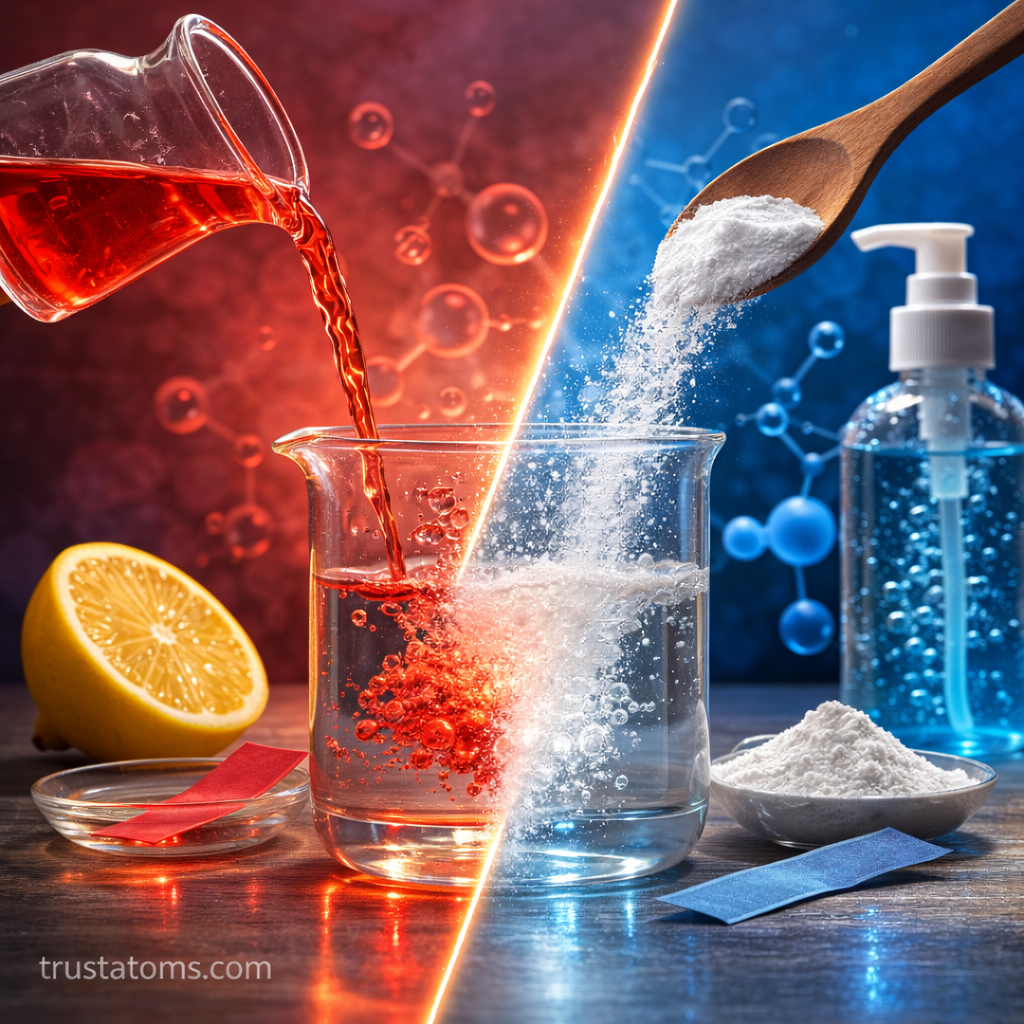
One of the most important reactions involving bases is neutralization.
When a base reacts with an acid:
- Hydrogen ions combine with hydroxide ions
- Water is formed
- A salt is produced
- The pH moves toward neutral
A familiar example is an antacid tablet neutralizing stomach acid to relieve discomfort.
Why Bases Matter in Science and Industry
Bases are essential in:
- Manufacturing soaps and detergents
- Food preparation and baking
- Water treatment processes
- Agriculture and soil management
- Medicine and digestion support
Without bases, many industrial and biological systems would not function properly.
Safety Considerations
Like strong acids, strong bases can be dangerous.
They may:
- Cause chemical burns
- Damage skin and eyes
- Corrode certain materials
Proper protective equipment and careful handling are important when working with concentrated bases.
Acids vs. Bases: Quick Comparison
Here’s a simplified comparison:
Acids:
- Release hydrogen ions
- pH below 7
- Sour taste
Bases:
- Release hydroxide ions or accept hydrogen ions
- pH above 7
- Bitter taste
Understanding both helps explain how chemical balance works in nature and in the lab.
Final Thoughts
A base is a substance that increases hydroxide ions or reduces hydrogen ions in a solution. This gives it distinct chemical properties, including a pH above 7.
From baking soda in the kitchen to large-scale industrial production, bases are everywhere. Understanding what a base is helps you better grasp:
- How neutralization works
- Why cleaning products are effective
- How pH affects biological systems
- How acids and bases balance each other
Chemistry is full of patterns, and bases are a key part of that structure.