In chemistry, a solution is a type of mixture where one substance dissolves evenly into another. The result is a uniform mixture in which the individual components cannot be easily distinguished.
Solutions are extremely common in everyday life. From saltwater and sugar in coffee to air and metal alloys, many substances around us exist as solutions.
Understanding solutions helps explain how substances mix, dissolve, and interact in chemical systems.
Understanding Solutions in Chemistry
A solution is defined as a homogeneous mixture composed of two or more substances that are evenly distributed at the molecular or atomic level.
Because the components are so thoroughly mixed, the mixture appears uniform throughout.
A solution has two main parts:
- Solute – the substance that dissolves
- Solvent – the substance that does the dissolving
For example:
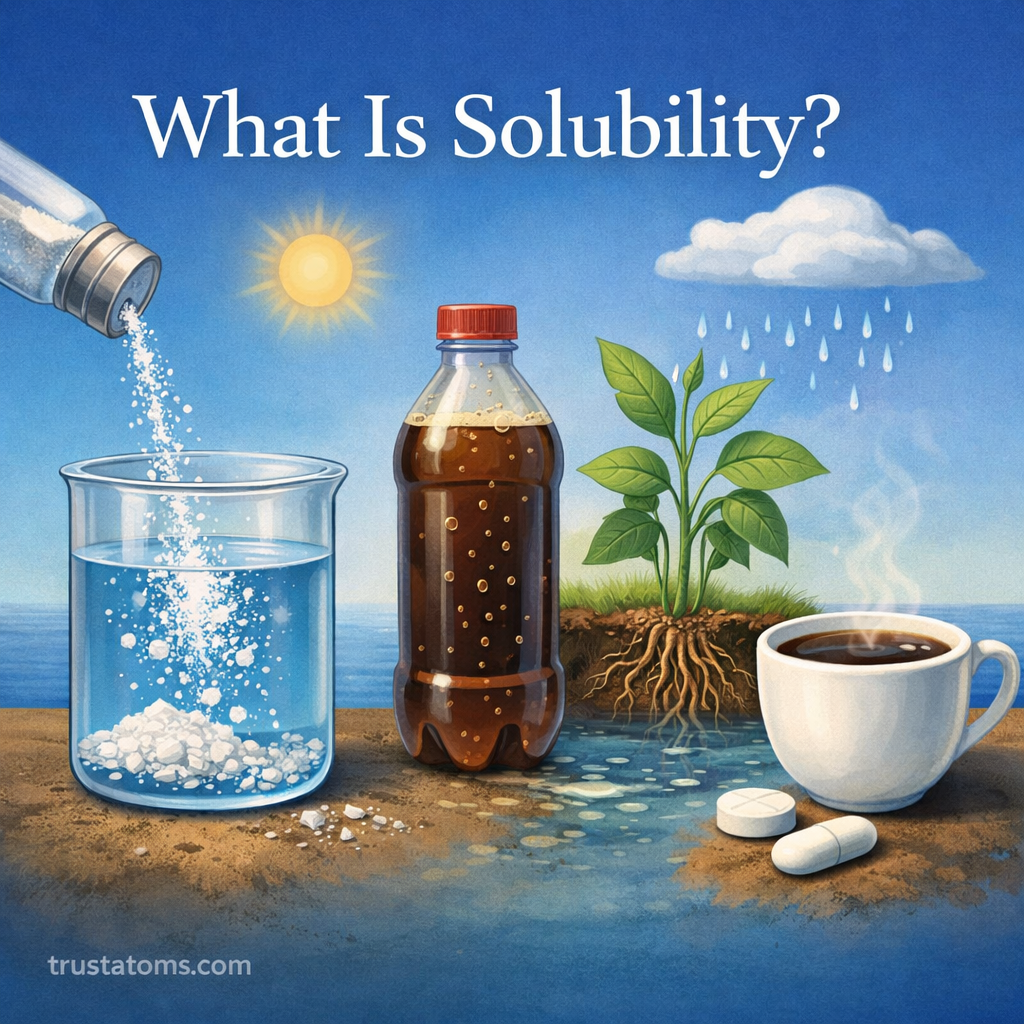
- In saltwater, salt is the solute and water is the solvent
- In soda, carbon dioxide gas is the solute and water is the solvent
The solvent is usually the component present in the larger amount.
Characteristics of a Solution
Solutions have several key properties that distinguish them from other types of mixtures.
These include:
- Uniform composition throughout
- Particles too small to be seen with the naked eye
- Components that cannot be separated by simple filtration
- Stable mixtures where substances do not settle out
Because the dissolved particles are so small, solutions remain evenly mixed over time.
Types of Solutions
Solutions can form in different states of matter depending on the substances involved.
Liquid Solutions
The most familiar solutions involve a liquid solvent.
Examples include:
- Salt dissolved in water
- Sugar dissolved in tea
- Vinegar mixed with water
Liquid solutions are commonly used in cooking, medicine, and laboratory chemistry.
Gas Solutions
Gases can also form solutions.
A common example is air, which is a mixture of gases including:
- Nitrogen
- Oxygen
- Carbon dioxide
- Argon
These gases mix evenly to form a stable gaseous solution.
Solid Solutions
Solutions can also exist in solid form.
Examples include metal alloys, where different metals mix evenly in the solid state.
Common solid solutions include:
- Brass (copper and zinc)
- Bronze (copper and tin)
- Steel (iron and carbon)
These materials often have properties different from the original metals.
How Substances Dissolve
Dissolving occurs when particles of a solute spread out among the particles of the solvent.
This process happens due to interactions between molecules.
Steps in dissolving typically include:
- Solvent molecules surround the solute particles.
- The solute particles separate from each other.
- The solvent stabilizes the dispersed particles.
Once these steps occur, the solute becomes evenly distributed in the solvent.
Factors That Affect Solubility
Solubility refers to the amount of solute that can dissolve in a solvent under certain conditions.
Several factors influence how well substances dissolve.
Temperature
Temperature often affects how much solute dissolves.
- Higher temperatures usually increase the solubility of solids in liquids.
- For gases, higher temperatures typically decrease solubility.
Pressure
Pressure mainly affects the solubility of gases in liquids.
For example:
- Carbonated beverages contain dissolved carbon dioxide under pressure.
- When the bottle is opened, pressure decreases and the gas escapes as bubbles.
Nature of the Substances
Some substances naturally dissolve better in certain solvents.
A common rule in chemistry is:
“Like dissolves like.”
This means substances with similar molecular properties tend to dissolve in one another.
For example:
- Polar substances dissolve well in polar solvents like water.
- Nonpolar substances dissolve better in nonpolar solvents like oils.
Concentration of Solutions
Concentration describes how much solute is present in a solution compared to the amount of solvent.
Solutions may be described as:
- Dilute – small amount of solute
- Concentrated – larger amount of solute
Chemists often measure concentration using specific units such as:
- Molarity
- Percent concentration
- Parts per million
These measurements help scientists prepare solutions accurately for experiments and industrial processes.
Solutions in Everyday Life
Solutions are essential in many everyday situations.
Common examples include:
- Saltwater in oceans
- Sugar dissolved in beverages
- Oxygen dissolved in blood
- Cleaning products
- Medicines and pharmaceuticals
These mixtures allow substances to interact in ways that would not occur if the components remained separate.
Why Solutions Are Important in Chemistry
Solutions play a major role in chemical reactions and biological processes.
Many reactions occur in solution because molecules can move freely and interact with one another.
Solutions are especially important in areas such as:
- Laboratory chemistry
- Environmental science
- Medicine and biology
- Industrial manufacturing
- Food science
By studying solutions, scientists gain a deeper understanding of how substances mix, react, and behave in different environments.
Final Thoughts
A solution is a homogeneous mixture where a solute dissolves evenly in a solvent. This type of mixture appears uniform throughout and cannot be separated by simple physical methods.
Solutions exist in liquids, gases, and solids and play a vital role in chemistry and everyday life.
Understanding how solutions form and behave helps scientists explain chemical reactions, develop new materials, and study the interactions between substances in natural and industrial systems.