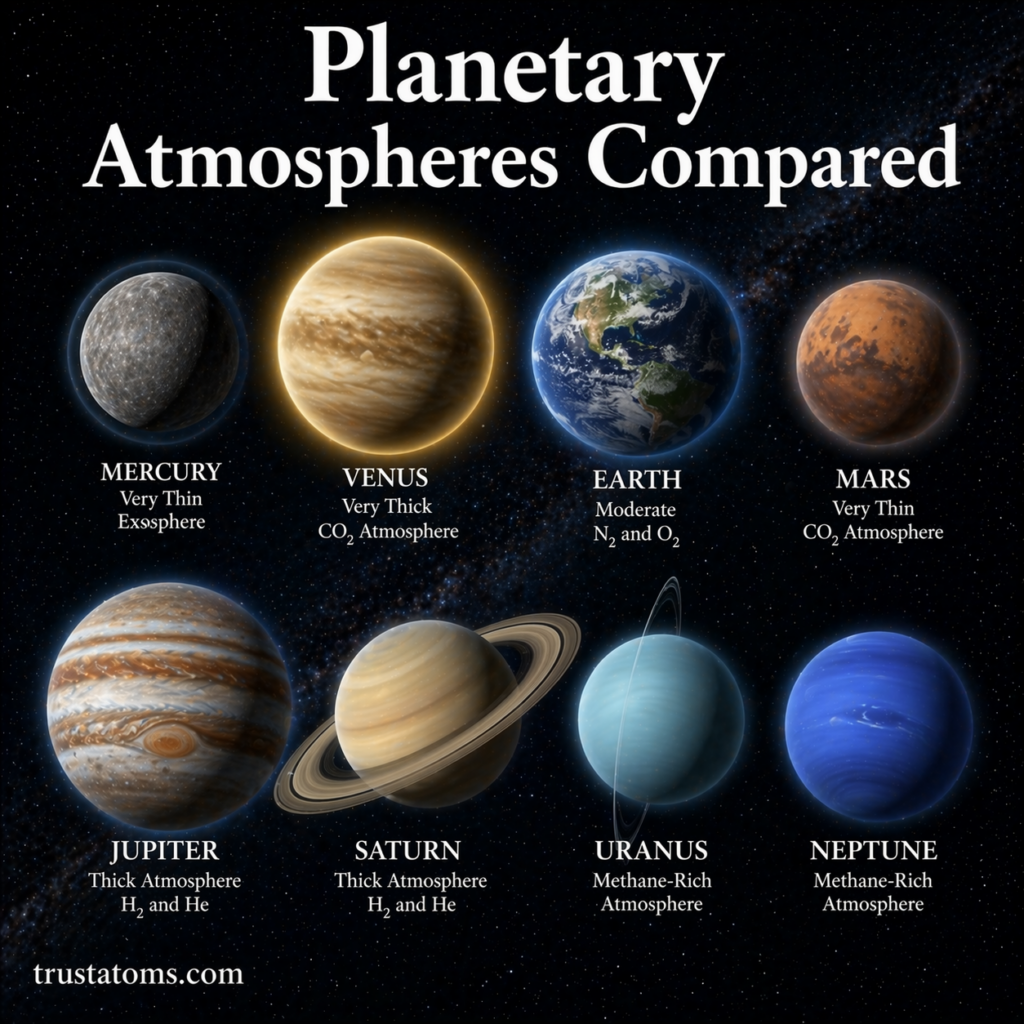
Planetary atmospheres vary dramatically across our solar system. From the thick, crushing clouds of Venus to the thin, nearly nonexistent air on Mercury, each world tells a unique story about temperature, chemistry, and evolution.
In this guide, we’ll compare planetary atmospheres, explore what they’re made of, and explain why they differ so much from one planet to another.
What Is a Planetary Atmosphere?
A planetary atmosphere is a layer of gases surrounding a planet, held in place by gravity. These gases can influence:
- Surface temperature
- Weather patterns
- Protection from radiation
- Potential for life
Not all planets have atmospheres, and those that do can be vastly different in composition and thickness.
Key Factors That Shape Atmospheres
Several factors determine whether a planet has an atmosphere—and what it looks like.
1. Gravity
- Stronger gravity helps retain gases
- Smaller planets lose gases more easily
For example, Earth can hold a stable atmosphere, while smaller bodies struggle to do so.
2. Distance from the Sun
- Closer planets are hotter, causing gases to escape
- Distant planets retain lighter gases due to lower temperatures
3. Magnetic Field
- Protects the atmosphere from solar wind
- Without it, gases can be stripped away over time
4. Geological Activity
- Volcanoes can release gases into the atmosphere
- Internal heat helps maintain atmospheric renewal
Inner Planets: Thin vs. Thick Atmospheres
The inner planets—Mercury, Venus, Earth, and Mars—show dramatic differences despite their proximity.
Mercury: Almost No Atmosphere
Mercury has an extremely thin exosphere rather than a true atmosphere.
- Cannot retain gases due to low gravity
- Extreme temperature swings
- No weather systems
Venus: A Runaway Greenhouse
Venus has the thickest atmosphere among terrestrial planets.
- Composed mostly of carbon dioxide
- Dense clouds of sulfuric acid
- Surface temperatures hot enough to melt lead
This is a classic example of a runaway greenhouse effect.
Earth: Balanced and Life-Supporting
Earth has a unique atmosphere that supports life.
- 78% nitrogen, 21% oxygen
- Moderate greenhouse effect
- Stable climate and weather systems
Mars: Thin and Cold
Mars has a very thin atmosphere.
- Mostly carbon dioxide
- Weak greenhouse effect
- Cold surface temperatures
Mars likely had a thicker atmosphere in the past, which has since been lost.
Gas Giants: Massive and Dynamic Atmospheres
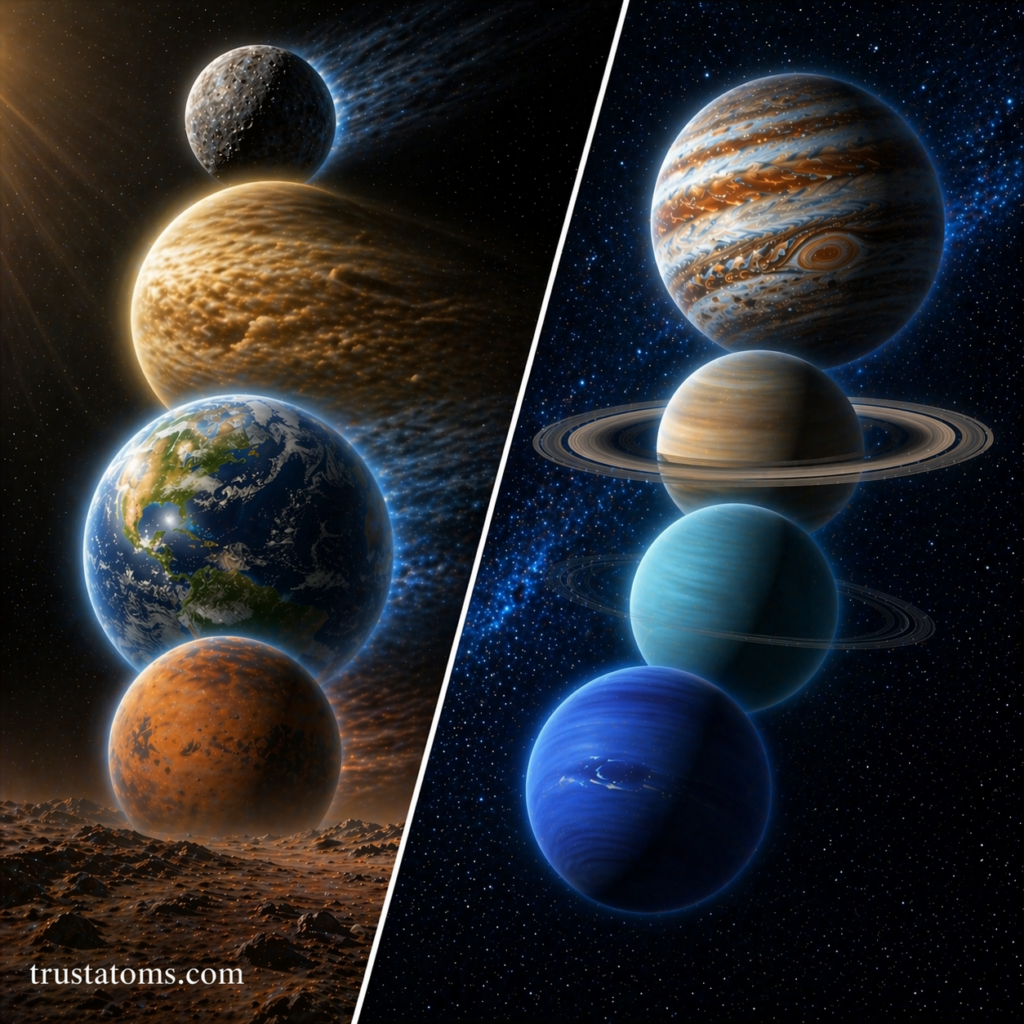
The outer planets are known for their thick, turbulent atmospheres.
Jupiter: The Giant Storm System
Jupiter has a massive atmosphere made primarily of hydrogen and helium.
- Features the Great Red Spot (a giant storm)
- Strong winds and banded cloud layers
- No solid surface
Saturn: Similar but Less Dense
Saturn has a composition similar to Jupiter.
- Hydrogen and helium dominant
- Less dense than Jupiter
- Known for its ring system and atmospheric bands
Ice Giants: Cold and Methane-Rich
The ice giants have different compositions compared to gas giants.
Uranus: Tilted and Unusual
Uranus has a unique axial tilt and cold atmosphere.
- Contains hydrogen, helium, and methane
- Methane gives it a blue-green color
- Less visible storm activity
Neptune: Windy and Active
Neptune is known for extreme weather.
- Strongest winds in the solar system
- Methane-rich atmosphere
- Dynamic storms despite its distance from the Sun
Comparing Atmospheric Composition
Here’s a simplified comparison of atmospheric makeup:
Terrestrial Planets
- Mercury: Almost none
- Venus: Carbon dioxide dominant
- Earth: Nitrogen and oxygen
- Mars: Thin carbon dioxide
Gas Giants
- Jupiter & Saturn: Hydrogen and helium
Ice Giants
- Uranus & Neptune: Hydrogen, helium, methane
Why Planetary Atmospheres Matter
Understanding atmospheres helps scientists answer fundamental questions.
Key Insights
- How planets form and evolve
- Potential for habitability
- Climate systems beyond Earth
- Effects of greenhouse gases
Atmospheric studies also help us compare Earth to other worlds and understand climate change.
Atmospheres Beyond Our Solar System
Astronomers are now studying atmospheres on exoplanets—planets orbiting other stars.
Using advanced telescopes, scientists can detect:
- Water vapor
- Carbon dioxide
- Methane
- Other chemical signatures
This research may one day help identify planets capable of supporting life.
Common Misconceptions About Planetary Atmospheres
“All planets have atmospheres”
Some, like Mercury, have almost none.
“Thicker atmospheres are always better”
Too thick can lead to extreme heat, as seen on Venus.
“Earth’s atmosphere is typical”
Earth’s atmosphere is actually quite rare and finely balanced.
Final Thoughts
Planetary atmospheres highlight the incredible diversity of our solar system. From scorching, dense clouds to thin, frozen layers of gas, each planet’s atmosphere reflects its history and environment.
By comparing these atmospheres, scientists gain a deeper understanding of how planets evolve—and what conditions might support life elsewhere in the universe.