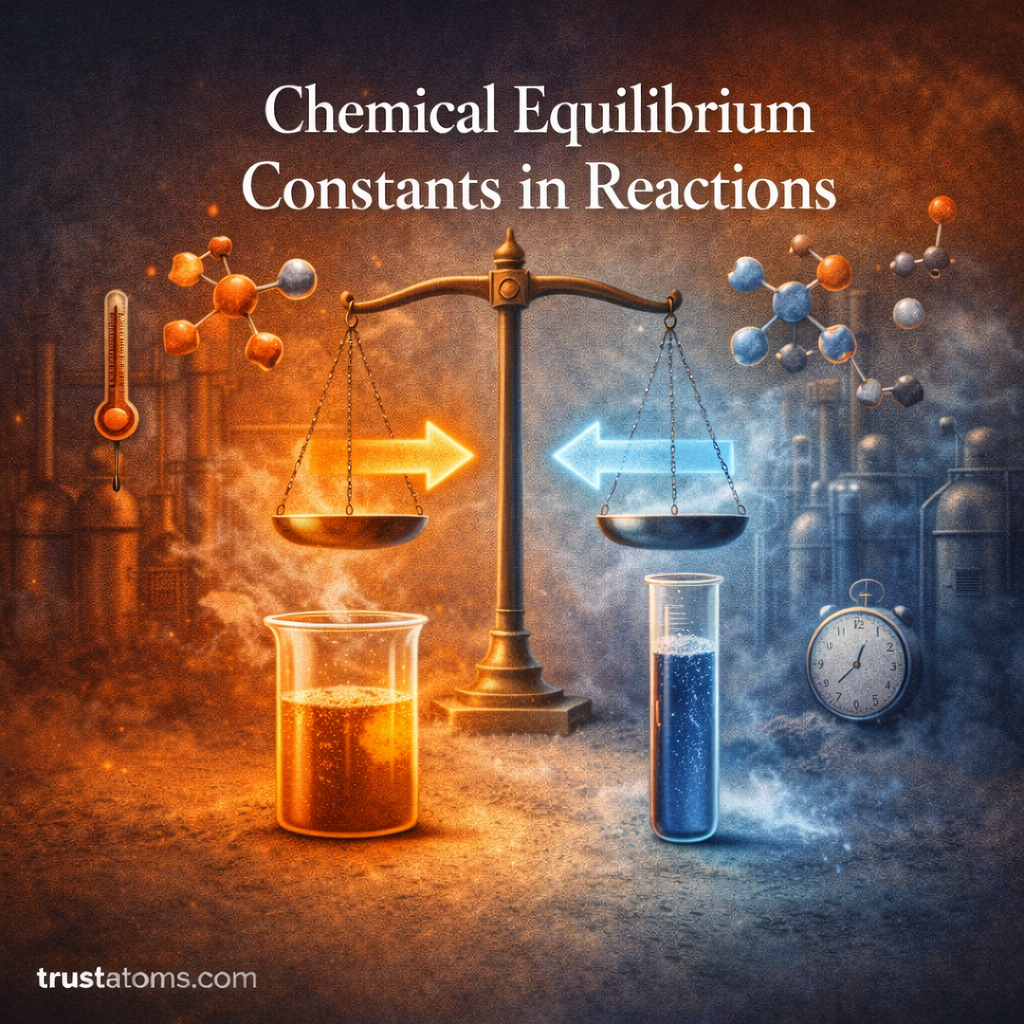
Many chemical reactions do not proceed in just one direction. Instead, they reach a balance where reactants and products are continuously forming at the same rate. This balanced state is known as chemical equilibrium.
To understand how far a reaction proceeds and how much product forms, chemists use a value called the equilibrium constant. The equilibrium constant provides a numerical measure of the relative amounts of reactants and products in a system at equilibrium.
By studying equilibrium constants, scientists can predict reaction behavior, optimize industrial processes, and understand complex chemical systems.
What Is Chemical Equilibrium?
Chemical equilibrium occurs when the forward and reverse reactions happen at the same rate.
At equilibrium:
- Reactants are still converting into products.
- Products are still converting back into reactants.
- The overall concentrations of reactants and products remain constant.
This does not mean the reaction has stopped. Instead, it means the reaction is in a dynamic balance.
Example:
In a reversible reaction, molecules constantly rearrange, but the overall ratio of substances remains stable once equilibrium is reached.
What Is the Equilibrium Constant?
The equilibrium constant, often written as K, describes the relationship between product and reactant concentrations when a reaction is at equilibrium.
It is a numerical value that indicates whether products or reactants are favored in a chemical reaction.
In general terms:
- Large K values indicate the reaction favors products
- Small K values indicate the reaction favors reactants
The equilibrium constant allows chemists to compare how strongly different reactions proceed toward completion.
Types of Equilibrium Constants
Different types of equilibrium constants are used depending on the reaction conditions.
Concentration-Based Equilibrium Constant (Kc)
Kc uses the molar concentrations of reactants and products.
It is commonly used in reactions occurring in solutions.
Pressure-Based Equilibrium Constant (Kp)
Kp applies to reactions involving gases and uses partial pressures rather than concentrations.
This form is especially useful in gas-phase reactions and atmospheric chemistry.
Both constants describe the same equilibrium system but are expressed using different measurements.
Interpreting the Value of K
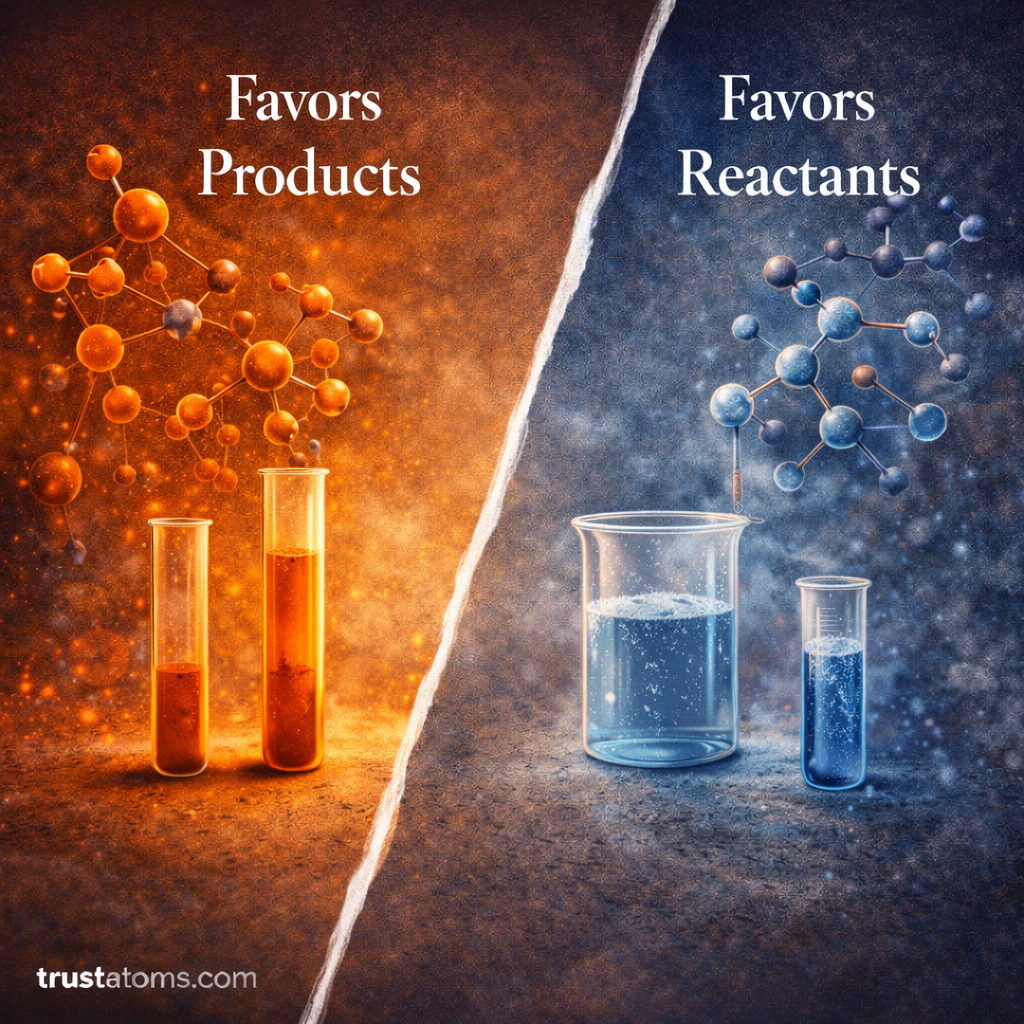
The magnitude of the equilibrium constant reveals how far a reaction proceeds toward forming products.
Large Equilibrium Constant (K > 1)
When K is greater than 1:
- Products are favored at equilibrium
- Most reactants convert into products
- The reaction proceeds significantly forward
Example situations include many combustion reactions or strongly favorable reactions.
Small Equilibrium Constant (K < 1)
When K is less than 1:
- Reactants are favored
- Only a small amount of product forms
- The reaction lies mostly on the reactant side
Equilibrium Constant Near 1
When K is close to 1:
- Both reactants and products exist in comparable amounts
- The reaction is balanced between forward and reverse processes
How Equilibrium Constants Are Determined
Equilibrium constants are determined through experimental measurement.
Scientists measure the concentrations or pressures of substances once equilibrium has been reached.
The process generally involves:
- Allowing a reaction to proceed in a controlled environment.
- Measuring the concentrations of reactants and products.
- Using those values to calculate the equilibrium constant.
Because equilibrium represents a stable condition, the constant value remains the same for a given reaction at a specific temperature.
Factors That Affect Equilibrium Constants
One important feature of equilibrium constants is that they depend only on temperature.
Changes in concentration, pressure, or volume may shift equilibrium temporarily, but they do not change the constant itself.
Temperature
Temperature is the only factor that directly changes the equilibrium constant.
Increasing temperature can:
- favor endothermic reactions
- reduce the equilibrium constant of exothermic reactions
Reaction Nature
The intrinsic properties of the reactants and products also determine the magnitude of the equilibrium constant.
Some reactions naturally favor products, while others strongly favor reactants.
Le Châtelier’s Principle and Equilibrium
Le Châtelier’s Principle explains how equilibrium systems respond to external changes.
If a system at equilibrium is disturbed, it shifts in a direction that helps reduce the disturbance.
Common disturbances include:
- changes in concentration
- changes in pressure
- changes in temperature
Examples:
- Adding more reactant often shifts equilibrium toward products.
- Increasing pressure in gas reactions may favor fewer gas molecules.
Although these changes shift equilibrium positions, the equilibrium constant remains unchanged unless temperature changes.
Industrial Applications of Equilibrium Constants
Equilibrium constants play an important role in chemical manufacturing and industrial chemistry.
Engineers use equilibrium data to maximize product yields and improve efficiency.
Examples include:
Ammonia Production
The Haber process uses equilibrium principles to produce ammonia from nitrogen and hydrogen. Temperature and pressure are carefully controlled to favor ammonia formation.
Acid and Base Chemistry
Equilibrium constants help chemists understand acid strength, buffering systems, and solution behavior.
Environmental Chemistry
Equilibrium reactions explain processes such as:
- mineral formation
- ocean chemistry
- atmospheric reactions
Understanding equilibrium helps scientists model and predict natural chemical systems.
Equilibrium Constants in Biological Systems
Equilibrium constants are also critical in biological chemistry.
Many reactions in living organisms operate close to equilibrium.
Examples include:
- enzyme-catalyzed reactions
- metabolic pathways
- oxygen binding in blood
- nutrient transport across membranes
Cells regulate these reactions carefully to maintain balance and support life processes.
Common Misconceptions About Equilibrium
Several misunderstandings often occur when learning about equilibrium.
Important clarifications include:
- Equilibrium does not mean the reaction stops.
- Reactants and products are still continuously interconverting.
- Equal concentrations are not required for equilibrium.
- Only temperature changes the equilibrium constant.
Understanding these ideas helps clarify how chemical systems behave in real conditions.
Why Equilibrium Constants Matter in Chemistry
Equilibrium constants provide valuable insight into chemical reactions.
They allow chemists to:
- predict reaction outcomes
- calculate concentrations of substances
- design industrial chemical processes
- understand biological and environmental systems
- analyze reversible chemical reactions
Because equilibrium constants summarize complex reaction behavior in a single value, they are a fundamental tool in chemical thermodynamics and kinetics.
Final Thoughts
Chemical equilibrium constants help scientists understand how reactions balance between reactants and products. By measuring the equilibrium constant, chemists can determine whether a reaction strongly favors products, remains balanced, or largely favors reactants.
Although many factors can shift equilibrium temporarily, the equilibrium constant itself depends only on temperature. This makes it a reliable way to describe the inherent tendency of a chemical reaction.
From industrial manufacturing to biological metabolism, equilibrium constants play a key role in explaining how chemical systems behave and how reactions reach balance.