Chemical reactions occur when atoms and molecules rearrange to form new substances. However, not every molecular collision results in a reaction. For a reaction to proceed, molecules must first overcome a specific energy barrier known as activation energy.
Activation energy plays a crucial role in determining how quickly a chemical reaction occurs and which pathway a reaction follows. By understanding activation energy, chemists can better predict reaction rates, control chemical processes, and design more efficient reactions.
What Is Activation Energy?
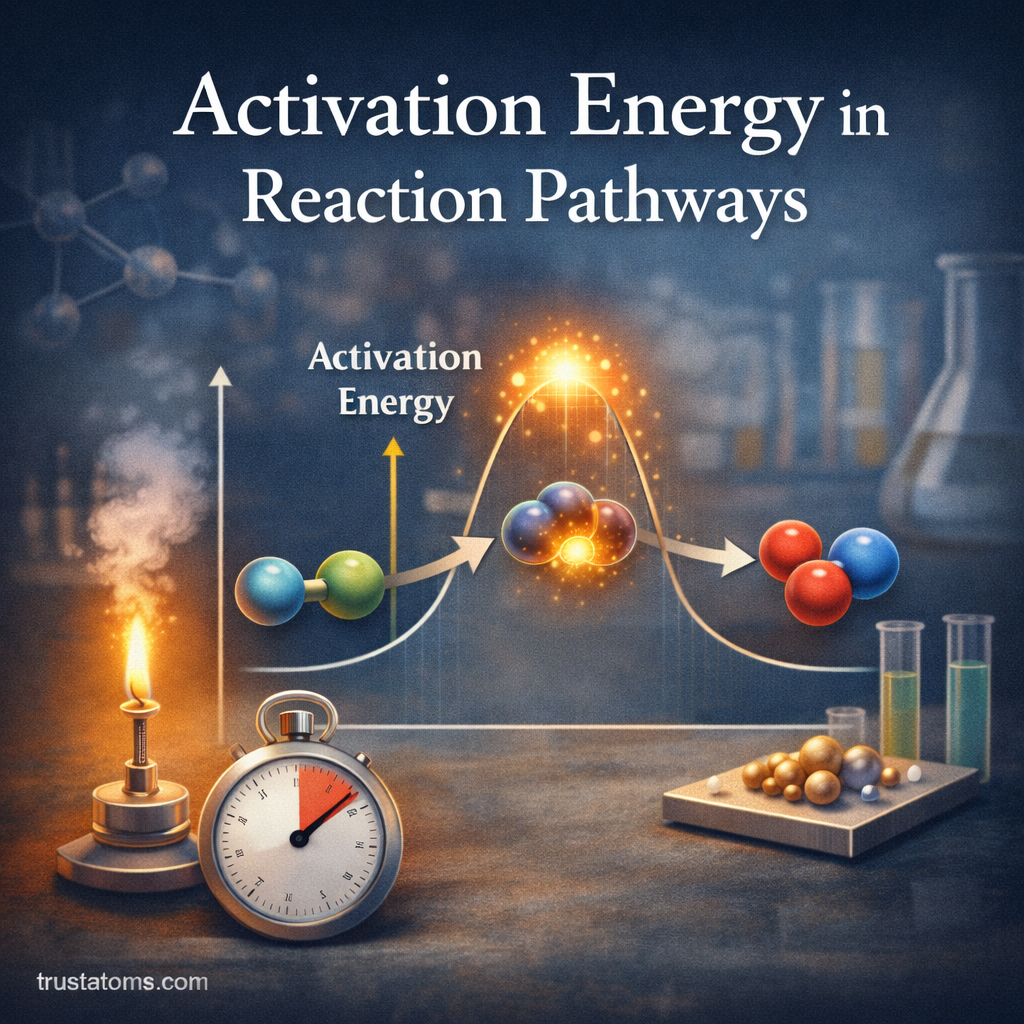
Activation energy is the minimum amount of energy required for a chemical reaction to begin.
Before reactants can transform into products, their molecules must reach a higher-energy state where bonds can break and new bonds can form. This temporary state is called the transition state.
In simple terms, activation energy is the energy barrier that must be overcome for a reaction to proceed.
Key characteristics of activation energy include:
- It must be supplied for a reaction to start
- It determines how easily a reaction occurs
- It varies depending on the reaction mechanism
- It influences the overall reaction rate
Even reactions that release energy overall still require activation energy to begin.
Reaction Pathways and Energy Barriers
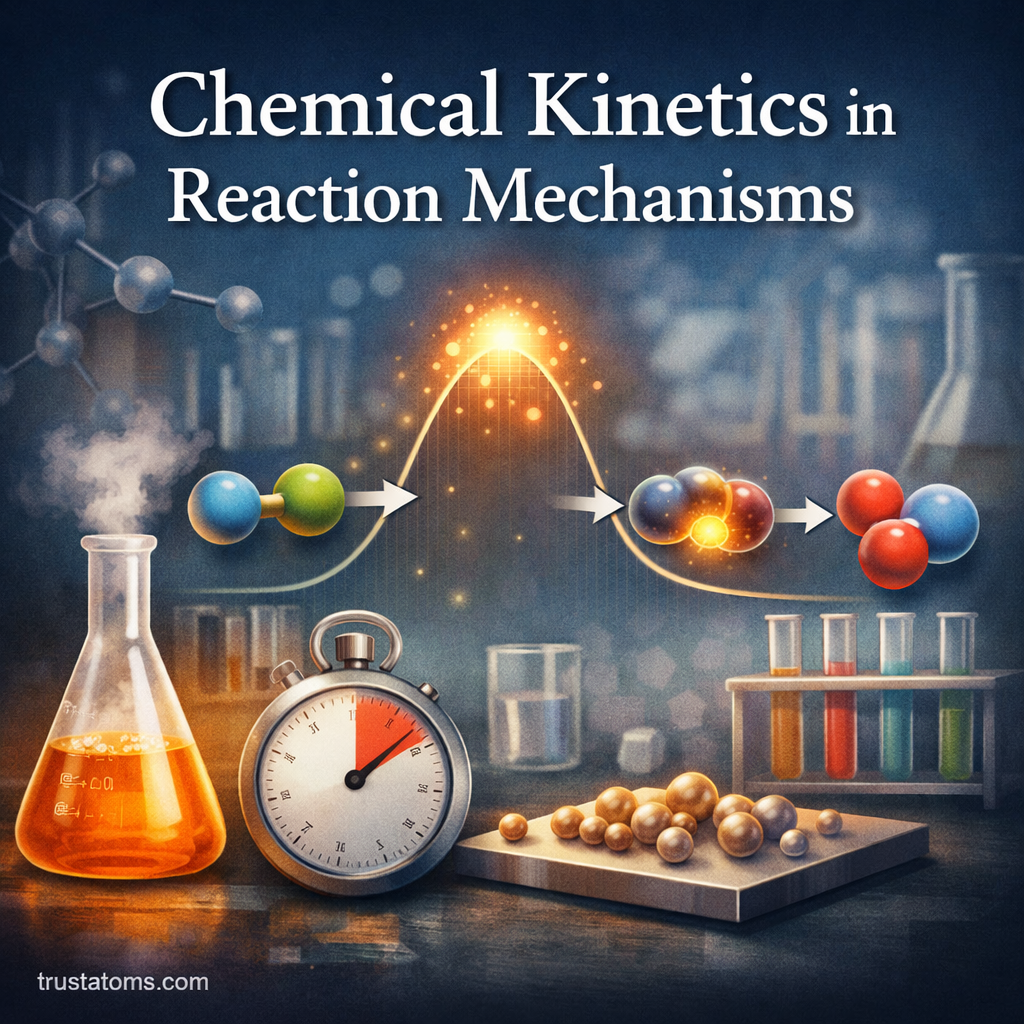
A reaction pathway describes the sequence of molecular changes that occur as reactants transform into products.
During this process, the system’s energy changes as bonds break and new ones form. The highest point along the pathway represents the activation energy barrier.
Reaction pathways can be visualized as:
- Reactants beginning at an initial energy level
- Energy increasing as molecules approach the transition state
- Products forming after the barrier is crossed
Some reactions involve multiple energy barriers when the reaction occurs through several intermediate steps.
The Transition State
The transition state is a high-energy arrangement of atoms that exists momentarily during a chemical reaction.
At this point:
- Old bonds are partially broken
- New bonds are partially formed
- The molecular structure is unstable
The transition state cannot be isolated or observed directly because it exists only briefly. However, it plays a central role in determining the energy required for the reaction to proceed.
Why Activation Energy Matters
Activation energy helps explain why some reactions happen quickly while others occur very slowly.
Low Activation Energy
Reactions with low activation energy:
- Occur more easily
- Require less energy input
- Often proceed rapidly at room temperature
High Activation Energy
Reactions with high activation energy:
- Require more energy to begin
- Occur slowly under normal conditions
- Often need heat or catalysts to proceed
This difference is why some reactions, such as combustion, require an initial spark before continuing.
Factors That Influence Activation Energy
Several factors affect the activation energy of a reaction and the pathway it follows.
Temperature
Increasing temperature raises the average kinetic energy of molecules.
As temperature increases:
- Molecules move faster
- Collisions occur more frequently
- More molecules possess enough energy to overcome the activation barrier
This typically leads to faster reaction rates.
Molecular Orientation
For a reaction to occur, molecules must collide with the correct orientation.
If molecules collide incorrectly, even with sufficient energy, the reaction may not proceed.
Chemical Environment
The surrounding environment can affect activation energy by influencing molecular interactions.
Examples include:
- Solvent effects
- Surface interactions
- Pressure conditions
These factors can alter how easily molecules reach the transition state.
Catalysts and Lowering Activation Energy
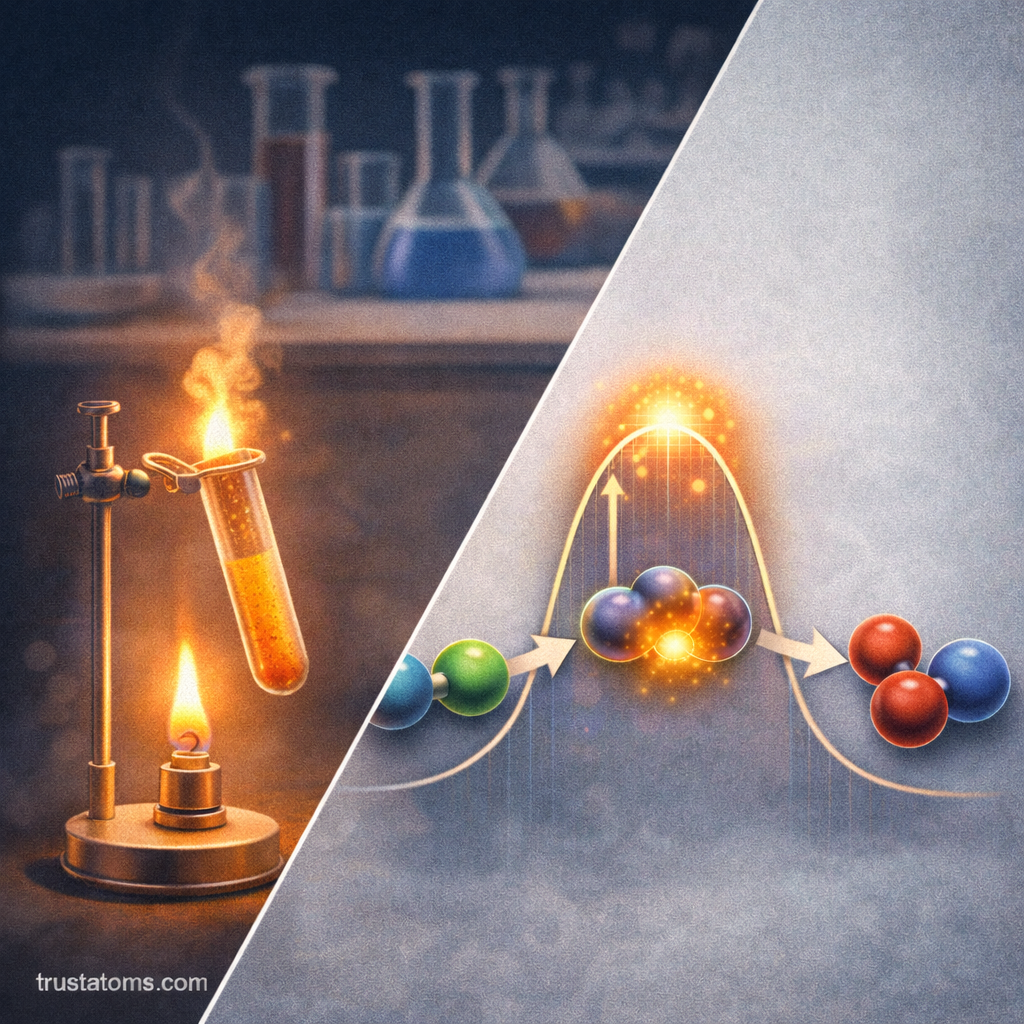
Catalysts are substances that increase reaction speed without being consumed in the process.
They work by providing an alternative reaction pathway with lower activation energy.
Catalysts may function by:
- Stabilizing intermediate structures
- Reducing energy barriers between steps
- Bringing reactant molecules into favorable positions
Because of these effects, catalysts allow reactions to occur faster and under milder conditions.
Examples of catalysts include:
- Enzymes in biological systems
- Metal surfaces in industrial reactions
- Acid or base catalysts in chemical synthesis
Multi-Step Reaction Pathways
Many reactions occur through multiple intermediate steps rather than a single direct transformation.
In multi-step reactions:
- Each step has its own activation energy
- Intermediate compounds form between steps
- One step is usually slower than the others
The slowest step is known as the rate-determining step, and it controls the overall reaction speed.
Understanding the activation energy of each step helps chemists identify which stage limits the reaction.
Energy Diagrams in Reaction Pathways
Chemists often represent reaction pathways using energy diagrams.
These diagrams show:
- Energy levels of reactants and products
- Peaks representing activation energy barriers
- Valleys representing intermediate species
In a simple reaction:
- One peak appears between reactants and products.
In complex reactions:
- Multiple peaks indicate several reaction steps.
Energy diagrams help visualize how energy changes during the course of a reaction.
Real-World Applications of Activation Energy
Activation energy plays a role in many natural and industrial processes.
Industrial Chemistry
Chemical manufacturers adjust conditions to control activation energy and optimize reaction efficiency.
Applications include:
- Fuel production
- Polymer manufacturing
- Chemical synthesis
Biological Reactions
Enzymes act as biological catalysts that lower activation energy in living organisms.
This allows essential reactions to occur rapidly at body temperature.
Environmental Chemistry
Understanding activation energy helps scientists study processes such as:
- Atmospheric reactions
- Decomposition of pollutants
- Climate-related chemical changes
Controlling Reaction Pathways
Chemists often manipulate reaction conditions to influence activation energy and select the desired pathway.
Methods include:
- Changing temperature
- Introducing catalysts
- Adjusting concentrations
- Altering reaction environments
By controlling these variables, scientists can guide reactions toward specific products and improve efficiency.
Final Thoughts
Activation energy is a fundamental concept that explains why chemical reactions occur and how fast they proceed. It represents the energy barrier that reactant molecules must overcome before transforming into products.
By studying activation energy in reaction pathways, chemists gain valuable insight into reaction mechanisms, energy changes, and molecular interactions. This knowledge allows scientists to design better catalysts, improve industrial processes, and understand the chemical behavior of systems across nature and technology.