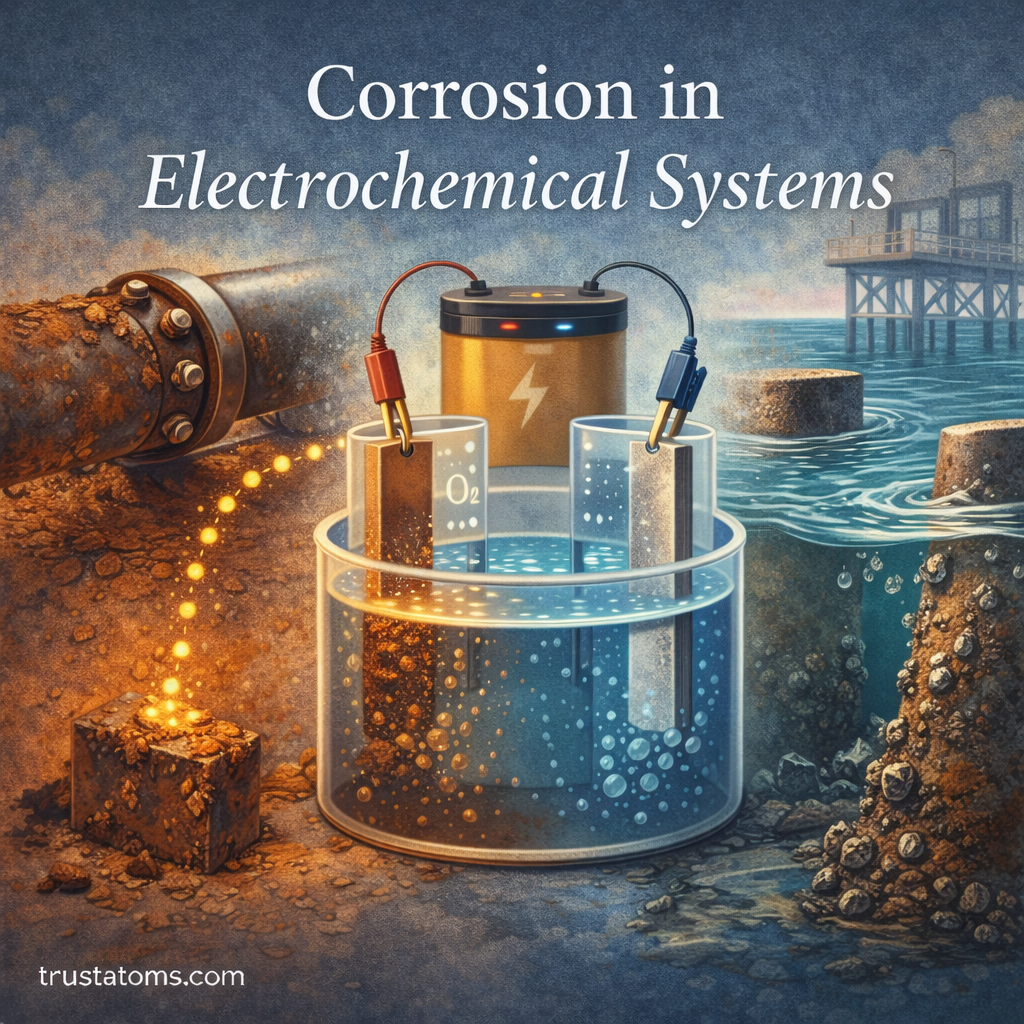
Corrosion is a natural electrochemical process that gradually degrades metals through chemical reactions with their environment. It affects everything from bridges and pipelines to vehicles and electronic components.
In electrochemical systems, corrosion occurs when metals lose electrons and form compounds such as oxides, hydroxides, or sulfides. Understanding corrosion from an electrochemical perspective helps scientists and engineers design better materials, improve infrastructure durability, and develop strategies to prevent damage.
Because corrosion can lead to structural failure, economic loss, and safety risks, it is a major focus of research in chemistry, materials science, and engineering.
What Is Corrosion?
Corrosion is the gradual destruction of a material, usually a metal, through electrochemical reactions with its environment.
Most corrosion involves a redox reaction where:
- The metal oxidizes and loses electrons.
- Another substance, such as oxygen or water, reduces and gains electrons.
This process converts the metal into more stable chemical compounds.
Common examples of corrosion include:
- Rust forming on iron
- Tarnish on silver
- Oxide layers on aluminum
- Degradation of metal structures in seawater
Although corrosion is often slow, its long-term effects can be significant.
How Corrosion Works as an Electrochemical Process
Corrosion behaves like a small electrochemical cell that forms on the metal surface.
For corrosion to occur, several components must be present:
- Anode – the region where metal atoms lose electrons.
- Cathode – the region where reduction reactions occur.
- Electrolyte – a medium such as water that allows ion movement.
- Electrical connection – electrons flow through the metal.
These components create a miniature electrochemical circuit.
At the anode, metal atoms lose electrons and dissolve into solution as ions.
At the cathode, reduction reactions consume the electrons produced at the anode.
Rust Formation on Iron
One of the most familiar examples of corrosion is the formation of rust on iron.
Rust forms when iron reacts with oxygen and moisture in the environment.
The general process involves several steps:
- Iron atoms lose electrons and become iron ions.
- Electrons travel through the metal to another region of the surface.
- Oxygen reacts with water and electrons to form hydroxide ions.
- Iron ions combine with hydroxide ions to form rust compounds.
Rust typically appears as a reddish-brown flaky material that weakens the metal structure over time.
Unlike some protective oxide layers, rust does not form a stable barrier and continues to expose fresh metal to corrosion.
Types of Corrosion in Electrochemical Systems
Corrosion can occur in several forms depending on environmental conditions and material properties.
Uniform Corrosion
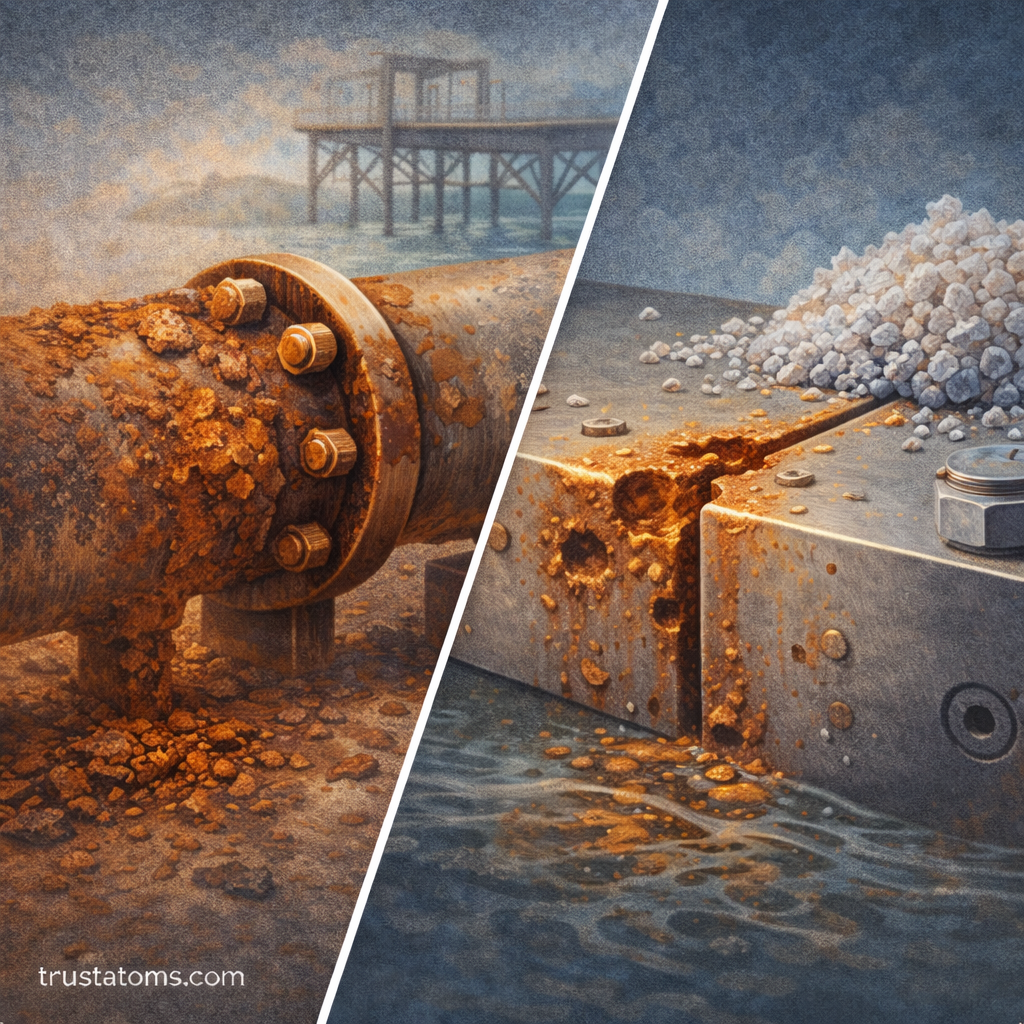
Uniform corrosion occurs evenly across the metal surface.
Characteristics include:
- Predictable material loss
- Even thinning of the metal
- Relatively easier monitoring
This type is common in exposed steel structures.
Galvanic Corrosion
Galvanic corrosion occurs when two different metals are electrically connected in the presence of an electrolyte.
In this situation:
- One metal becomes the anode and corrodes faster.
- The other metal acts as the cathode and is protected.
This effect is influenced by the difference in reduction potentials between the metals.
Pitting Corrosion
Pitting corrosion creates small localized holes or pits in the metal surface.
It can be particularly dangerous because:
- Damage may be difficult to detect
- Structural failure can occur unexpectedly
Pitting is often associated with chloride-containing environments, such as seawater.
Crevice Corrosion
Crevice corrosion occurs in confined spaces where stagnant fluid accumulates.
Examples include:
- Bolted joints
- Gasket interfaces
- Under deposits or coatings
These conditions create localized chemical environments that accelerate corrosion.
Factors That Influence Corrosion
Several environmental and material factors affect corrosion rates.
Key factors include:
Presence of Water or Electrolytes
Water containing dissolved salts increases electrical conductivity, making corrosion more likely.
Oxygen Availability
Oxygen often participates in the reduction reactions that drive corrosion.
Higher oxygen levels can accelerate corrosion processes.
Temperature
Higher temperatures typically increase reaction rates and can speed up corrosion.
Metal Composition
Different metals and alloys have varying resistance to corrosion depending on their chemical properties.
Surface Conditions
Scratches, cracks, and impurities can create localized areas where corrosion begins.
Preventing Corrosion
Because corrosion can cause serious structural and economic damage, many prevention strategies have been developed.
Common corrosion prevention methods include:
Protective Coatings
Paints, polymers, and plating layers can isolate the metal from moisture and oxygen.
Examples include:
- Automotive paint coatings
- Zinc plating
- Epoxy coatings
Cathodic Protection
Cathodic protection uses sacrificial metals to protect important structures.
In this system:
- A more reactive metal acts as the anode.
- The protected structure becomes the cathode.
This method is widely used for:
- Underground pipelines
- Ship hulls
- Offshore structures
Corrosion-Resistant Materials
Some metals naturally resist corrosion due to protective oxide layers.
Examples include:
- Stainless steel
- Aluminum
- Titanium
These materials form stable surface layers that prevent further oxidation.
Environmental Control
Reducing exposure to corrosive environments can slow corrosion.
Strategies include:
- Dehumidification
- Chemical inhibitors
- Improved drainage and ventilation
Corrosion in Energy and Industrial Systems
Corrosion is a critical concern in many electrochemical and industrial systems.
Industries affected include:
- Oil and gas pipelines
- Power plants
- Marine engineering
- Chemical manufacturing
- Transportation infrastructure
In energy systems, corrosion can reduce efficiency and shorten equipment lifespan.
Engineers often design systems with corrosion monitoring and protection mechanisms to ensure safety and reliability.
Why Understanding Corrosion Matters
Corrosion is responsible for billions of dollars in global maintenance and repair costs each year.
Understanding the electrochemical principles behind corrosion helps scientists and engineers:
- Predict metal degradation
- Design longer-lasting materials
- Develop protective technologies
- Improve infrastructure safety
- Extend the life of industrial equipment
Research in corrosion science continues to advance new coatings, alloys, and monitoring techniques.
Final Thoughts
Corrosion in electrochemical systems is a natural but complex process driven by redox reactions and environmental factors. By understanding how electrons move between metal surfaces and surrounding chemicals, scientists can better predict and control corrosion.
From rusting steel bridges to marine structures and energy systems, corrosion affects nearly every industry that relies on metal materials. Through protective coatings, improved materials, and electrochemical protection methods, engineers continue working to reduce corrosion damage and extend the lifespan of critical infrastructure.