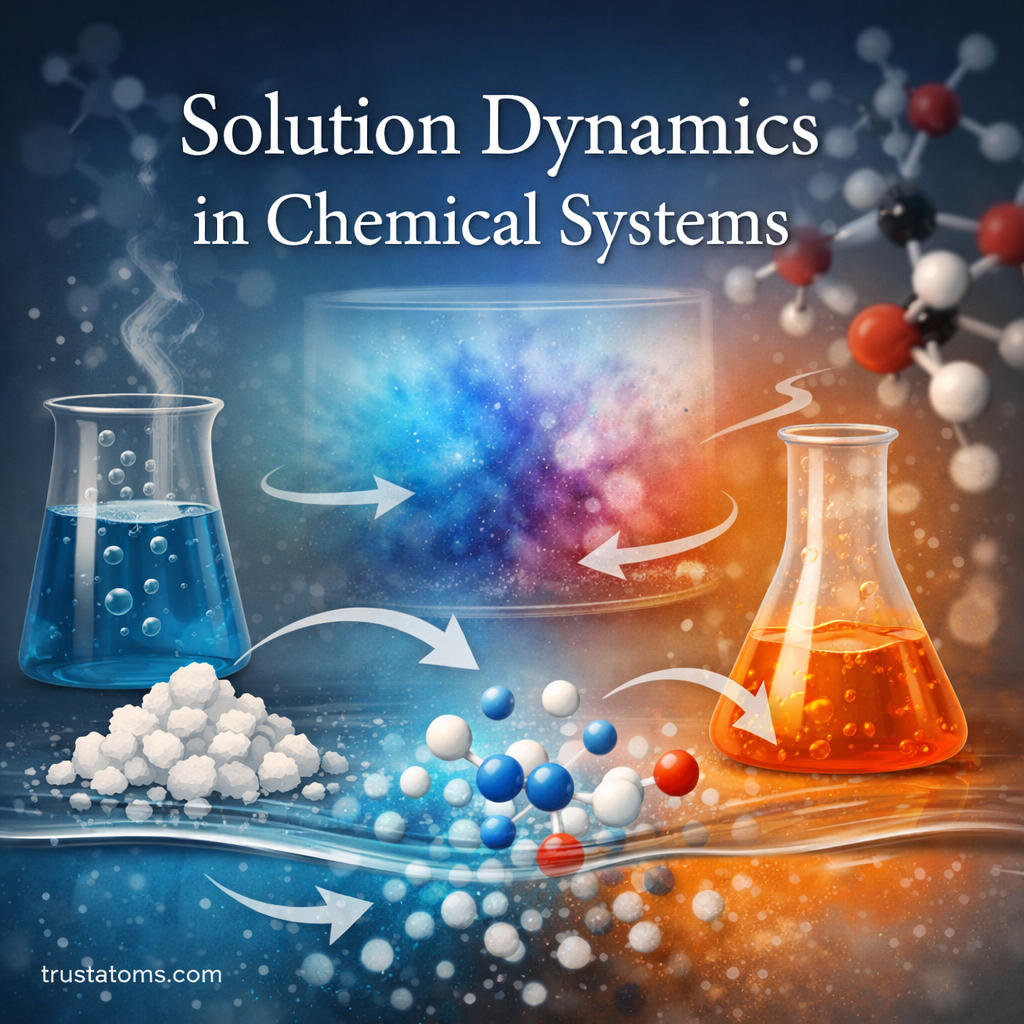
Solutions are everywhere in chemistry. From salt dissolving in water to complex industrial mixtures used in manufacturing, solutions play a crucial role in how substances interact. But solutions are not static mixtures. On a molecular level, they are constantly moving, interacting, separating, and reforming.
This ongoing molecular activity is known as solution dynamics. Understanding how molecules behave inside solutions helps chemists predict reaction rates, control chemical processes, and design better materials and medicines.
In this article, we’ll explore what solution dynamics are, how molecules move in solutions, and why these processes are essential in chemistry and real-world applications.
What Is a Chemical Solution?
A solution is a homogeneous mixture made of two main components:
- Solute – the substance being dissolved
- Solvent – the substance doing the dissolving
For example:
- Salt (solute) dissolving in water (solvent)
- Sugar dissolving in tea
- Oxygen dissolved in ocean water
In a solution, solute particles are evenly distributed throughout the solvent at the molecular or ionic level.
However, this distribution is not fixed. Molecules are constantly moving and interacting, which leads us to the concept of solution dynamics.
What Are Solution Dynamics?
Solution dynamics refers to the continuous motion and interaction of particles within a solution.
Key processes involved include:
- Molecular movement
- Diffusion
- Solvation and desolvation
- Chemical reactions
- Equilibrium shifts
These processes occur because molecules possess kinetic energy, causing them to move randomly and collide with each other.
This constant motion allows substances to dissolve, react, and redistribute throughout the solution.
Molecular Motion in Solutions
At the microscopic level, molecules in a solution are always moving. This motion results from thermal energy.
Types of molecular motion include:
- Translational motion – particles move through space
- Rotational motion – molecules rotate around bonds
- Vibrational motion – atoms vibrate within molecules
Because of these motions, particles constantly collide with surrounding molecules. These collisions drive the dynamic behavior of solutions.
For example, when sugar dissolves in water:
- Water molecules collide with sugar crystals.
- Sugar molecules separate from the crystal.
- They spread throughout the liquid due to continuous movement.
Diffusion: Spreading of Particles
One of the most important dynamic processes in solutions is diffusion.
Diffusion is the movement of particles from an area of higher concentration to an area of lower concentration.
This process continues until the solution becomes evenly distributed.
Everyday Example of Diffusion
If you place food coloring into a glass of water:
- The dye initially remains concentrated in one spot.
- Over time, it spreads throughout the water.
- Eventually, the color becomes uniform.
This spreading happens due to random molecular motion.
Factors Affecting Diffusion
Several factors influence diffusion rates:
- Temperature
- Molecular size
- Viscosity of the solvent
- Concentration gradients
Higher temperatures generally increase molecular motion, which speeds up diffusion.
Solvation and Intermolecular Interactions
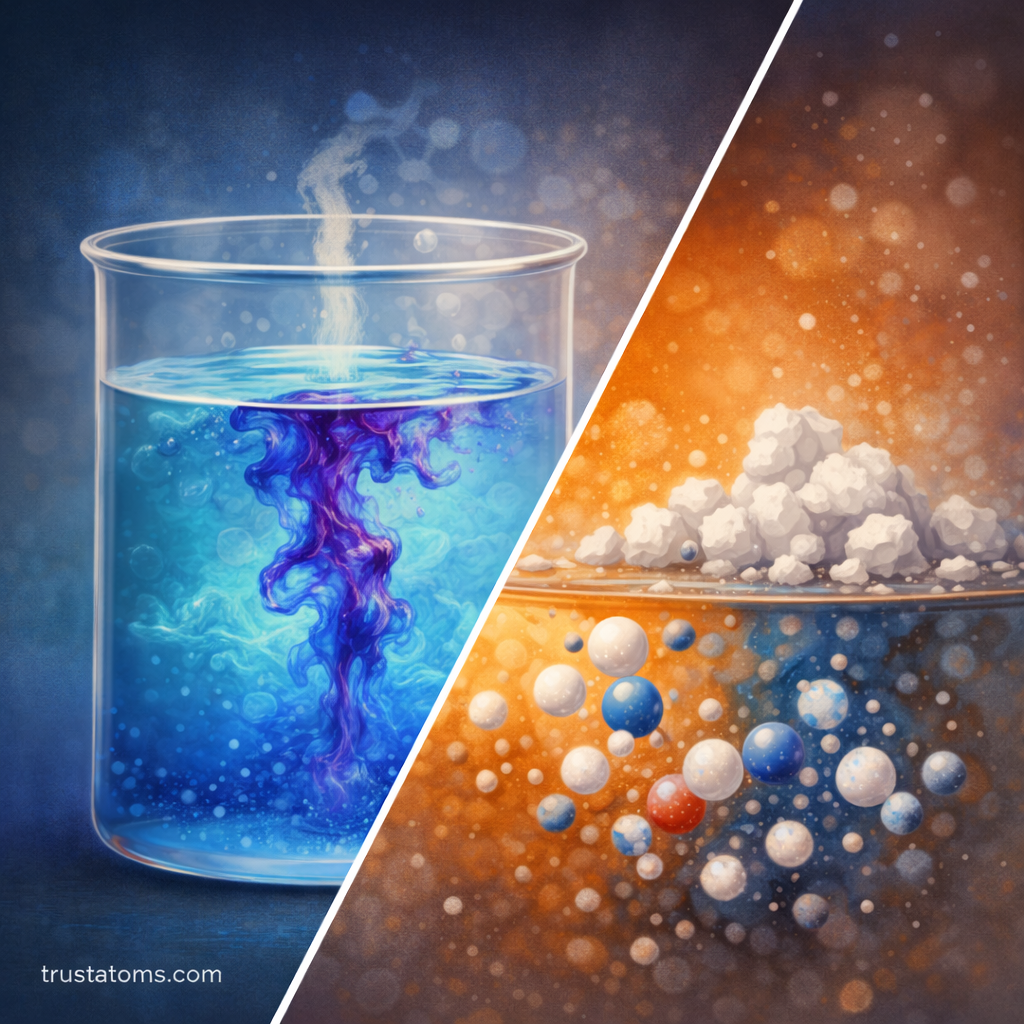
When a solute dissolves, solvent molecules surround and interact with solute particles. This process is called solvation.
If the solvent is water, the process is specifically called hydration.
Steps in the Solvation Process
- Solvent molecules separate slightly from each other.
- Solute particles separate from the solid or liquid.
- Solvent molecules surround and stabilize the solute particles.
These interactions are governed by intermolecular forces, such as:
- Hydrogen bonding
- Dipole–dipole interactions
- Ion–dipole interactions
- Dispersion forces
The strength and type of these forces determine how well substances dissolve.
Dynamic Equilibrium in Solutions
Many chemical systems reach a state known as dynamic equilibrium.
In this condition:
- Opposing processes occur simultaneously.
- The rates of these processes are equal.
- The overall concentration of substances remains constant.
However, the system is still active at the molecular level.
Example: Dissolving Salt
When salt dissolves in water:
- Salt ions leave the crystal and enter the solution.
- Some ions return to the solid surface.
Eventually, the rates of dissolving and re-forming the crystal become equal. At this point, the solution is saturated, and dynamic equilibrium exists.
Solution Dynamics and Chemical Reactions
Many chemical reactions occur in solutions. The dynamic behavior of molecules influences how quickly reactions happen.
For a reaction to occur:
- Reactant molecules must collide.
- The collision must have enough energy.
- The molecules must be oriented correctly.
Solution dynamics control how often these collisions happen.
Factors That Influence Reaction Rates in Solutions
- Concentration of reactants
- Temperature
- Presence of catalysts
- Solvent properties
For instance, increasing concentration increases the number of molecular collisions, which can speed up reactions.
The Role of Temperature in Solution Dynamics
Temperature has a major impact on solution behavior.
When temperature increases:
- Molecules move faster
- Diffusion speeds up
- Reaction rates often increase
- Solubility may change
This is why sugar dissolves faster in hot tea than in cold water.
Higher thermal energy increases molecular motion, enhancing the dynamic processes inside the solution.
Applications of Solution Dynamics
Understanding solution dynamics is essential in many scientific and industrial fields.
Medicine and Pharmaceuticals
Drug effectiveness often depends on how substances dissolve and move through bodily fluids.
Solution dynamics help researchers understand:
- Drug absorption
- Drug transport in blood
- Controlled release medications
Environmental Chemistry
Solution behavior influences how chemicals move through water systems.
This affects:
- Pollution dispersion
- Nutrient cycles
- Ocean chemistry
Industrial Chemistry
Many industrial processes rely on solution reactions.
Examples include:
- Chemical manufacturing
- Food processing
- Battery technology
- Electroplating
Controlling solution dynamics allows industries to improve efficiency and product quality.
Why Solution Dynamics Matter in Chemistry
Solution dynamics provide insight into how molecules behave in real chemical environments. Most chemical reactions in nature and industry occur in liquids, making this concept fundamental to chemistry.
By studying these dynamic processes, scientists can:
- Predict reaction outcomes
- Design better chemical systems
- Improve industrial processes
- Understand biological chemistry
Ultimately, solution dynamics reveal that chemical solutions are not static mixtures but active, constantly changing molecular systems.
Final Thoughts
Chemical solutions may appear calm and uniform, but at the molecular level they are incredibly active. Particles continuously move, collide, dissolve, and re-form in a complex dance driven by thermal energy and intermolecular forces.
Solution dynamics helps chemists understand how substances interact in liquids, why reactions occur at certain rates, and how equilibrium is maintained. From pharmaceuticals to environmental science, this concept plays a vital role in explaining how chemistry operates in the real world.
As scientists continue studying these microscopic processes, our ability to control and optimize chemical systems continues to grow.