Chemical systems constantly exchange energy with their surroundings. Understanding how energy moves and transforms is essential for predicting whether chemical reactions occur and how systems reach equilibrium. One of the most powerful tools chemists use for this purpose is the concept of thermodynamic potentials.
Thermodynamic potentials are energy-related quantities that describe how energy is stored, transferred, and converted within chemical systems. They help scientists determine whether processes will occur spontaneously and how systems respond to changes in temperature, pressure, or composition.
By analyzing these energy relationships, chemists can predict reaction behavior in fields ranging from industrial chemistry to biochemistry and materials science.
What Are Thermodynamic Potentials?
Thermodynamic potentials are state functions that measure different forms of energy in a system under specific conditions. Each potential provides information about how energy can perform work or drive chemical change.
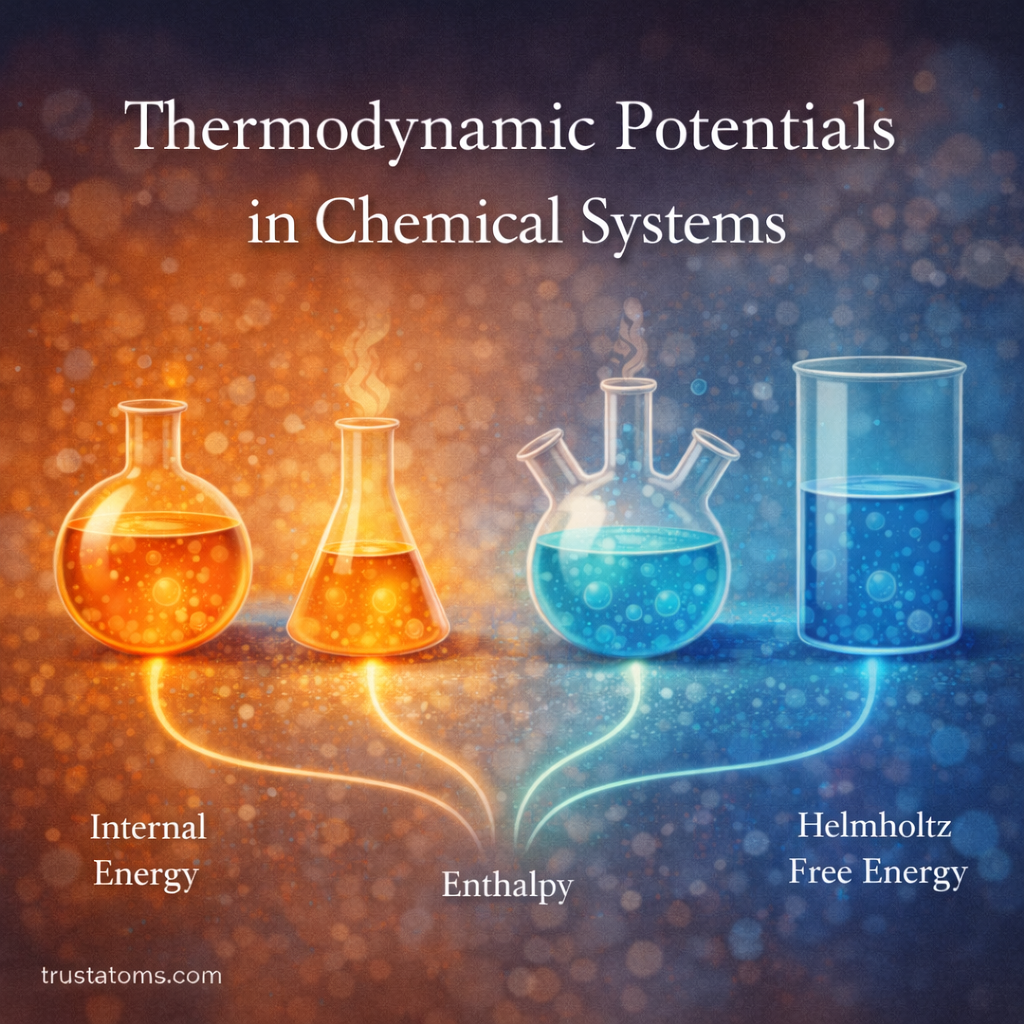
The most commonly used thermodynamic potentials in chemistry include:
- Internal energy
- Enthalpy
- Helmholtz free energy
- Gibbs free energy
Each of these quantities describes energy in a system but applies best under different physical conditions.
Understanding when and how to use each potential allows scientists to analyze complex chemical systems more effectively.
Internal Energy
Internal energy represents the total energy contained within a chemical system.
This includes:
- Kinetic energy of molecular motion
- Potential energy of molecular interactions
- Energy stored in chemical bonds
Internal energy changes when a system:
- Absorbs heat
- Releases heat
- Performs work
- Has work done on it
Why Internal Energy Matters
Internal energy provides the most fundamental description of energy in thermodynamics. It forms the foundation for other thermodynamic potentials.
For example, when a chemical reaction occurs, bond breaking and bond formation change the internal energy of the system.
Enthalpy
Enthalpy describes the heat energy of a system at constant pressure, which is the most common condition for chemical reactions in everyday environments.
In practical terms, enthalpy helps chemists measure the heat released or absorbed during chemical reactions.
Types of Enthalpy Changes
Several types of enthalpy changes are commonly studied:
- Enthalpy of reaction
- Enthalpy of formation
- Enthalpy of combustion
- Enthalpy of dissolution
For example, combustion reactions typically release large amounts of heat, resulting in a negative enthalpy change.
Enthalpy measurements are especially important in industrial chemistry, where energy efficiency and heat management are critical.
Free Energy and Chemical Spontaneity

While enthalpy measures heat flow, it does not fully determine whether a reaction will occur spontaneously. This is where free energy becomes essential.
Free energy accounts for both:
- Energy changes
- Changes in disorder within a system
Two main free energy potentials are used in thermodynamics:
- Helmholtz free energy
- Gibbs free energy
These quantities help determine whether chemical processes are energetically favorable.
Helmholtz Free Energy
Helmholtz free energy describes the usable energy available to perform work at constant temperature and volume.
This thermodynamic potential is commonly used in:
- Physical chemistry
- Statistical mechanics
- Systems studied under controlled laboratory conditions
Helmholtz free energy helps scientists analyze microscopic systems where volume remains constant.
Although important in theoretical work, it is less commonly used in everyday chemical reactions than Gibbs free energy.
Gibbs Free Energy
Gibbs free energy is the most widely used thermodynamic potential in chemistry because it applies to systems at constant temperature and pressure, which describes most real-world chemical environments.
Gibbs free energy determines whether a chemical reaction will occur spontaneously.
Interpreting Gibbs Free Energy
The sign of the Gibbs free energy change provides important information:
- Negative change → reaction occurs spontaneously
- Positive change → reaction requires energy input
- Zero change → system is at equilibrium
Because of this predictive ability, Gibbs free energy is central to chemical thermodynamics.
Thermodynamic Potentials and Chemical Equilibrium
Thermodynamic potentials help explain why chemical systems eventually reach equilibrium.
At equilibrium:
- Forward and reverse reaction rates are equal
- No net change occurs in the system
- Energy conditions are balanced
Gibbs free energy reaches its minimum value at equilibrium under constant temperature and pressure.
This principle allows chemists to determine the direction a reaction will move when conditions change.
Applications of Thermodynamic Potentials
Thermodynamic potentials play an essential role in many areas of science and engineering.
Industrial Chemistry
Energy calculations help engineers design efficient chemical processes such as:
- Fuel production
- Chemical manufacturing
- Catalytic reactions
- Energy storage systems
Thermodynamic analysis ensures reactions proceed under optimal conditions.
Biochemistry
Living organisms rely on chemical reactions that are governed by thermodynamic principles.
Examples include:
- Cellular metabolism
- ATP energy transfer
- Enzyme-driven reactions
- Biological energy cycles
Thermodynamic potentials help explain how biological systems manage energy efficiently.
Materials Science
Scientists use thermodynamic potentials to predict material behavior.
Applications include:
- Metal alloy formation
- Crystal growth
- Battery chemistry
- Semiconductor development
Understanding energy changes helps researchers design materials with specific properties.
Factors That Influence Thermodynamic Potentials
Several environmental variables influence thermodynamic potentials and chemical behavior.
Important factors include:
- Temperature
- Pressure
- Chemical composition
- Phase of matter
Changes in these variables can shift reaction conditions and alter the energy balance of a system.
For example, increasing temperature may make certain reactions more favorable by influencing energy distribution within molecules.
Why Thermodynamic Potentials Are Important
Thermodynamic potentials provide a framework for understanding how energy governs chemical behavior. By examining how energy changes during reactions, scientists can predict which processes will occur and under what conditions.
These tools allow chemists to:
- Determine reaction feasibility
- Predict equilibrium conditions
- Calculate energy changes
- Optimize chemical processes
Without thermodynamic analysis, predicting the behavior of chemical systems would be far more difficult.
Final Thoughts
Thermodynamic potentials are fundamental to understanding energy transformations in chemical systems. By analyzing quantities such as internal energy, enthalpy, Helmholtz free energy, and Gibbs free energy, scientists gain powerful insights into how reactions occur and why systems reach equilibrium.
These concepts form the backbone of chemical thermodynamics and influence everything from industrial manufacturing to biological processes. As chemistry continues to advance, thermodynamic potentials remain essential tools for exploring how energy drives the behavior of matter.