Chemical potential is one of the most important concepts in thermodynamics and physical chemistry. It helps scientists understand how substances move, react, and reach equilibrium in chemical systems.
At its core, chemical potential describes the energy change associated with adding or removing a small amount of a substance from a system. This idea plays a central role in explaining diffusion, chemical reactions, phase transitions, and equilibrium.
From biological cells to industrial chemical reactors, chemical potential helps determine how matter and energy behave in complex systems.
What Is Chemical Potential?
Chemical potential refers to the change in a system’s free energy when the number of particles of a particular substance changes.
In simpler terms, it measures how strongly a substance “wants” to move, react, or change phase.
Key characteristics of chemical potential include:
- It represents the energy per particle or per mole
- It determines the direction of chemical processes
- It depends on temperature, pressure, and composition
- Systems move toward lower chemical potential
If the chemical potential of a substance is higher in one region than another, particles tend to move toward the region with lower chemical potential.
Why Chemical Potential Matters in Thermodynamics
Chemical potential acts as a driving force for many natural processes.
Whenever molecules move, react, or redistribute themselves in a system, differences in chemical potential are usually responsible.
Examples of processes influenced by chemical potential include:
- Diffusion of gases and liquids
- Chemical reactions
- Phase transitions
- Osmosis in biological systems
- Material transport in engineering systems
In thermodynamic analysis, chemical potential helps determine whether a process will occur spontaneously.
Chemical Potential and Free Energy
Chemical potential is closely connected to Gibbs free energy, a central concept in thermodynamics.
In many systems, chemical potential is defined as the change in Gibbs free energy when the amount of a substance changes while temperature and pressure remain constant.
This relationship helps scientists analyze systems where multiple substances interact.
For example, in mixtures:
- Each component has its own chemical potential
- Interactions between molecules affect the potential
- Equilibrium occurs when potentials balance across the system
Understanding this connection allows chemists to predict how chemical systems evolve over time.
Chemical Potential in Chemical Equilibrium
One of the most important uses of chemical potential is explaining chemical equilibrium.
At equilibrium, the chemical potentials of reactants and products reach a balanced condition.
This means:
- No net chemical change occurs
- Forward and reverse reactions continue at equal rates
- Energy distribution across substances stabilizes
In practical terms, equilibrium occurs when the total Gibbs free energy of the system reaches a minimum.
Chemical potential provides a mathematical way to describe this balance.
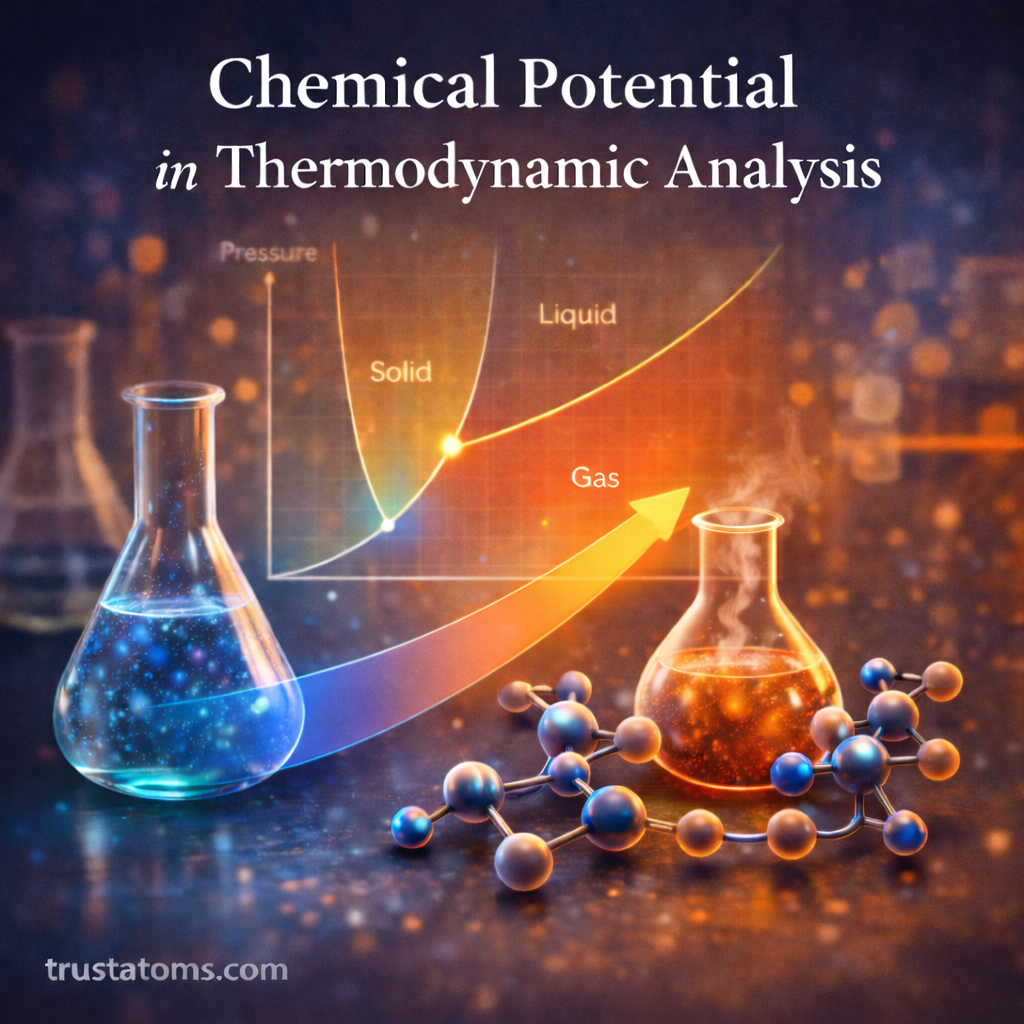
Chemical Potential in Phase Transitions
Chemical potential also determines when substances change phases, such as melting, boiling, or condensing.
At the boundary between phases:
- The chemical potential of a substance must be the same in each phase.
For example:
- During boiling, the chemical potential of a liquid equals that of the vapor.
- During melting, the chemical potential of the solid equals that of the liquid.
This equality ensures that both phases can coexist in equilibrium.
Phase diagrams used in chemistry and materials science rely heavily on this principle.
Chemical Potential in Diffusion and Transport
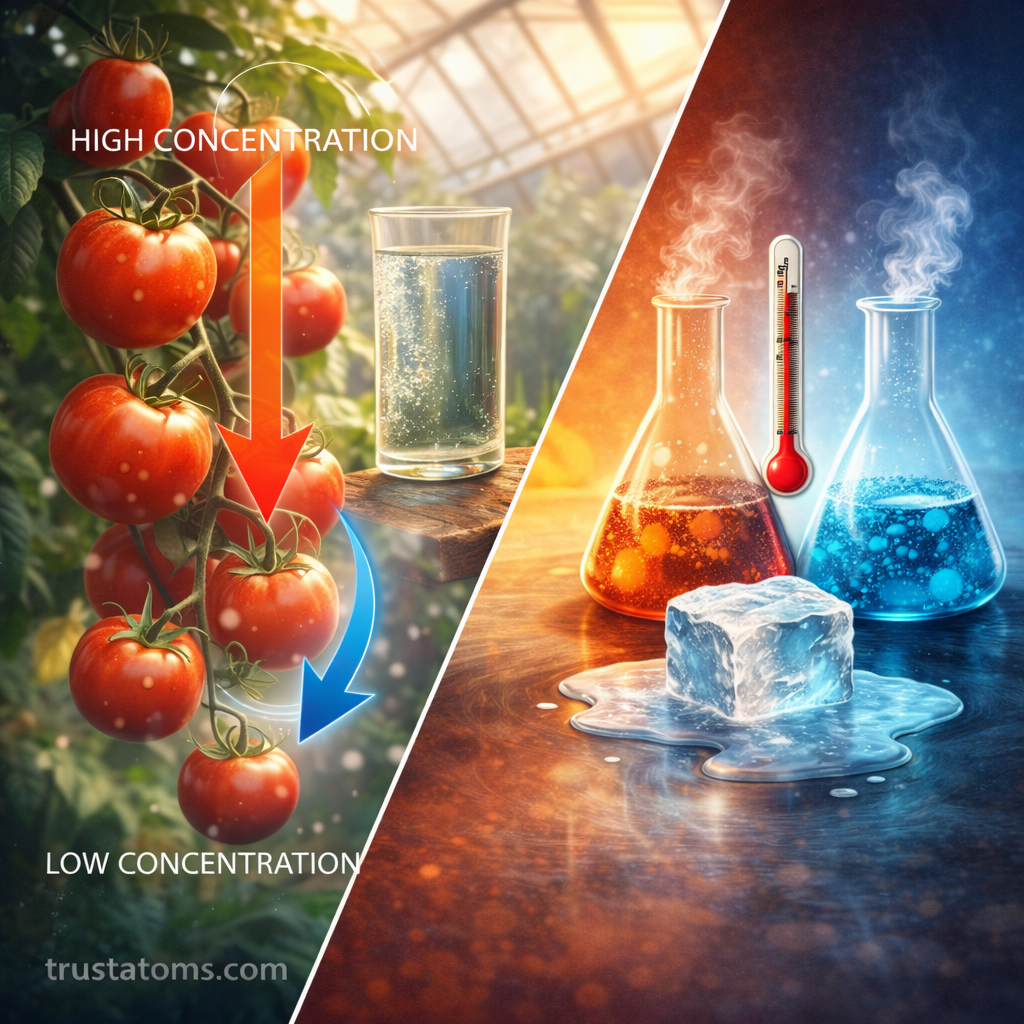
Chemical potential differences are responsible for the movement of particles through space.
When molecules move from one region to another, they typically move from higher chemical potential to lower chemical potential.
This process drives several important phenomena:
Diffusion
Particles spread out to equalize concentration differences.
Osmosis
Water moves across semipermeable membranes due to chemical potential differences.
Material Transport
Atoms and molecules move through solids, liquids, or gases in response to potential gradients.
These processes are essential in biology, chemistry, and engineering.
Chemical Potential in Multicomponent Systems
Real-world systems often contain multiple chemical components interacting with each other.
In such systems:
- Each component has its own chemical potential
- Interactions between components influence system behavior
- Thermodynamic stability depends on the balance of potentials
For example, in solutions:
- Solutes affect the chemical potential of the solvent
- Concentration changes alter thermodynamic properties
- Equilibrium shifts depending on composition
Understanding these relationships allows scientists to analyze mixtures, solutions, and reaction systems more accurately.
Applications of Chemical Potential
Chemical potential plays a major role in many scientific and technological fields.
Chemistry and Chemical Engineering
- Predicting reaction directions
- Designing chemical reactors
- Studying reaction kinetics and equilibrium
Materials Science
- Understanding phase diagrams
- Designing alloys and polymers
- Controlling material stability
Biology and Biochemistry
- Explaining nutrient transport in cells
- Modeling metabolic reactions
- Understanding membrane transport processes
Environmental Science
- Modeling atmospheric chemical processes
- Understanding pollutant movement in ecosystems
These applications demonstrate how chemical potential connects microscopic particle behavior to large-scale system changes.
Key Takeaways
Chemical potential provides a powerful framework for understanding how matter behaves in thermodynamic systems.
Important points to remember include:
- Chemical potential measures how the free energy of a system changes when particles are added or removed.
- Differences in chemical potential drive diffusion, reactions, and phase changes.
- Chemical equilibrium occurs when chemical potentials balance across a system.
- The concept plays a central role in chemistry, biology, materials science, and engineering.
By analyzing chemical potential, scientists gain deeper insight into the energy and stability of complex systems.