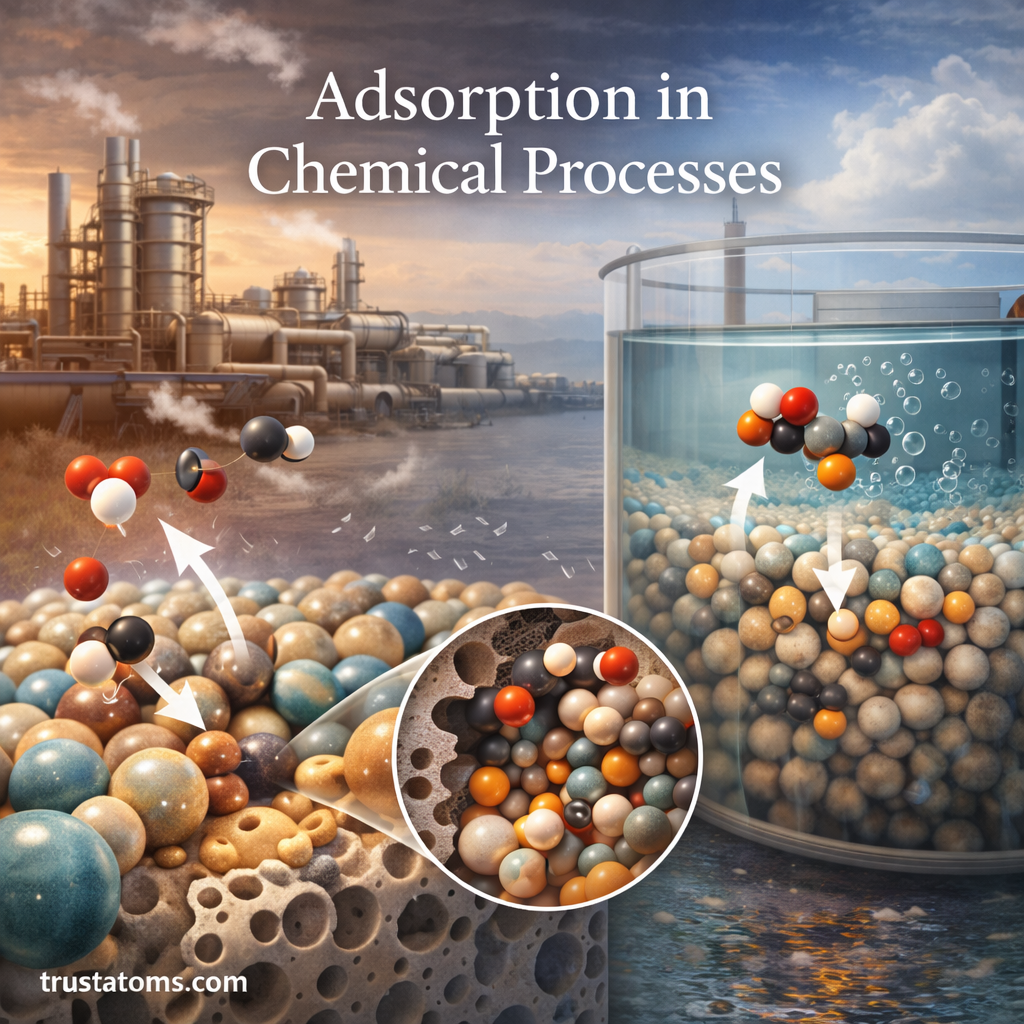
Adsorption is a fundamental surface phenomenon in chemistry where molecules from a gas or liquid accumulate on the surface of a solid or liquid. Unlike absorption—where substances dissolve into the bulk of a material—adsorption occurs strictly at the surface interface.
This process plays a critical role in many chemical and industrial systems, including catalysis, environmental purification, gas storage, and separation technologies. By controlling how molecules attach to surfaces, scientists and engineers can improve reaction efficiency, remove pollutants, and develop advanced materials for energy and industrial applications.
What Is Adsorption?
Adsorption occurs when molecules, atoms, or ions from a surrounding phase adhere to the surface of a material called the adsorbent. The particles that accumulate on the surface are known as adsorbates.
The process happens because surface atoms have unbalanced forces compared to atoms within the bulk material. These surface atoms attract nearby molecules, causing them to stick to the surface.
Adsorption typically involves three components:
- Adsorbent – the material providing the surface (e.g., activated carbon, silica, metals)
- Adsorbate – the substance being adsorbed
- Interface – the surface where adsorption occurs
This interaction creates a thin molecular layer on the adsorbent surface.
Why Adsorption Is Important in Chemistry
Adsorption plays an essential role in many natural and industrial processes. Because reactions often occur at surfaces, adsorption can determine how molecules behave and interact.
Key benefits of adsorption include:
- Concentrating molecules on surfaces
- Enabling surface chemical reactions
- Removing impurities from fluids
- Separating chemical mixtures
- Storing gases efficiently
In chemical industries, adsorption is widely used to control reaction pathways, improve selectivity, and capture unwanted substances.
Types of Adsorption
Adsorption can occur through different types of interactions depending on the forces between the surface and the adsorbate.
Physisorption (Physical Adsorption)
Physisorption involves weak intermolecular forces, typically van der Waals interactions.
Characteristics include:
- Weak attraction between molecules and surface
- Reversible process
- Low energy requirement
- Often occurs at lower temperatures
- Can involve multiple molecular layers
Physisorption is common in gas storage systems and surface-based separation processes.
Chemisorption (Chemical Adsorption)
Chemisorption involves strong chemical bonding between the adsorbate and the surface.
Important features include:
- Formation of chemical bonds
- Usually limited to a single molecular layer
- Higher energy interaction
- Often irreversible under reaction conditions
- Highly specific to particular surfaces
Chemisorption is particularly important in catalytic reactions, where molecules must bind strongly enough to react.
Factors Affecting Adsorption
Several physical and chemical factors influence how effectively adsorption occurs.
Surface Area
A larger surface area provides more locations for molecules to attach.
Materials used for adsorption are often highly porous, such as:
- Activated carbon
- Zeolites
- Silica gel
- Metal-organic frameworks
These materials can contain enormous internal surface areas within microscopic pores.
Temperature
Temperature affects adsorption differently depending on the type:
- Physisorption decreases as temperature increases
- Chemisorption may require moderate temperatures to occur
Higher temperatures often cause adsorbed molecules to detach from surfaces.
Pressure and Concentration
Increasing gas pressure or solution concentration generally increases adsorption because more molecules are available to interact with the surface.
This effect is especially important in gas adsorption systems.
Nature of the Surface
Surface properties such as:
- Chemical composition
- Surface defects
- Atomic arrangement
- Surface charge
can strongly influence adsorption strength and selectivity.
Adsorption Isotherms
Scientists study adsorption behavior using adsorption isotherms, which describe how the amount of adsorbate on a surface changes with pressure or concentration at constant temperature.
Common adsorption models include:
Langmuir Isotherm
The Langmuir model assumes:
- Adsorption occurs on specific surface sites
- Only one molecular layer forms
- All adsorption sites are equivalent
- No interactions occur between adsorbed molecules
This model is often used to describe chemisorption.
Freundlich Isotherm
The Freundlich model assumes:
- Surface sites have different adsorption energies
- Adsorption can form multiple layers
- The surface is heterogeneous
This model is commonly applied to real-world adsorption systems such as activated carbon.
Adsorption in Industrial Chemical Processes
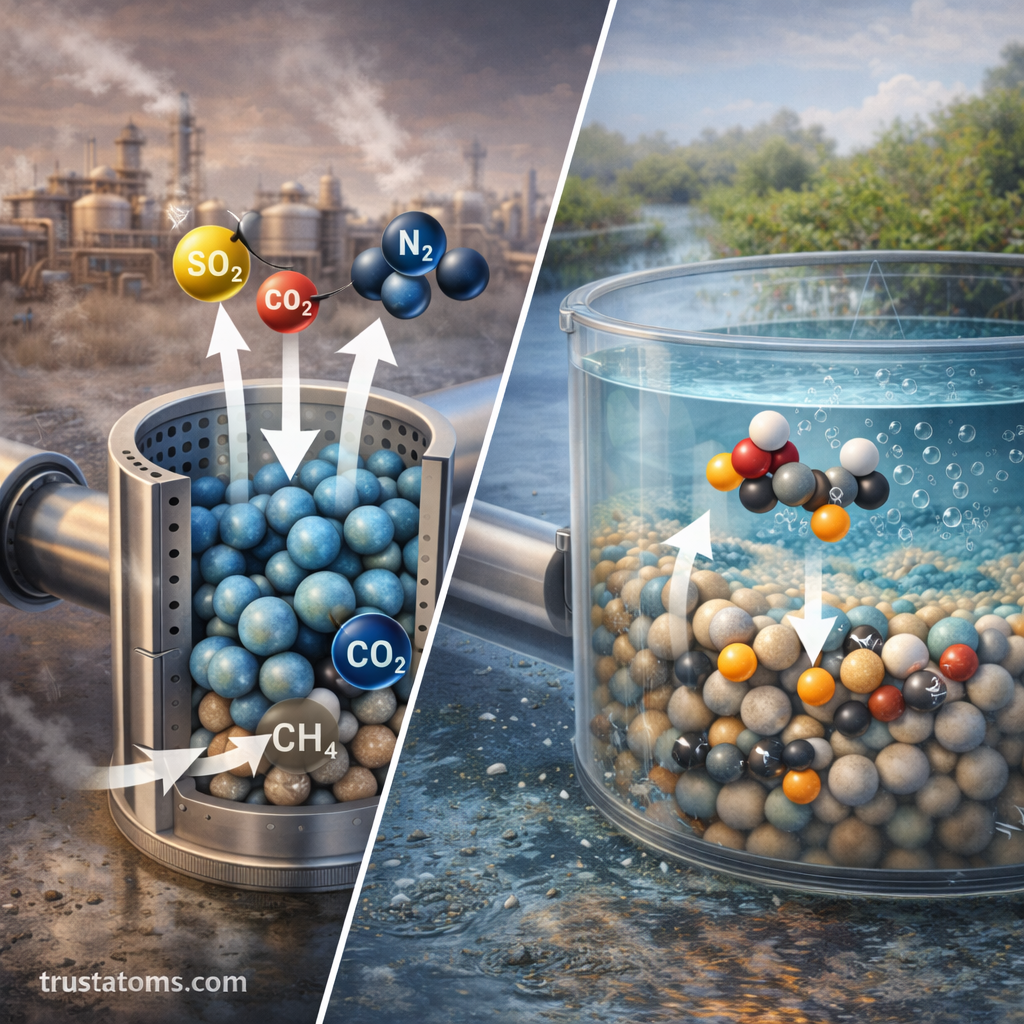
Adsorption is widely used across many industries to control chemical processes and separate substances.
Gas Purification
Adsorption helps remove unwanted gases and contaminants.
Examples include:
- Removing sulfur compounds from natural gas
- Capturing carbon dioxide from industrial emissions
- Filtering toxic gases from air streams
Water Treatment
Adsorption materials can remove pollutants from water.
Common targets include:
- Organic chemicals
- Heavy metals
- Chlorine compounds
- Industrial contaminants
Activated carbon filters are widely used for this purpose.
Catalytic Processes
In catalytic reactions, adsorption is often the first step in the reaction mechanism.
Reactant molecules adsorb onto catalyst surfaces, react, and then release products.
This sequence allows catalysts to:
- Lower activation energy
- Increase reaction speed
- Improve reaction selectivity
Gas Storage and Separation
Certain porous materials can adsorb gases efficiently, enabling applications such as:
- Hydrogen storage
- Methane storage
- Gas separation technologies
These systems are important for clean energy and industrial gas management.
Environmental Applications of Adsorption
Adsorption technologies are widely used to address environmental challenges.
Some important applications include:
- Air purification systems
- Industrial emission control
- Oil spill cleanup
- Wastewater treatment
- Removal of pharmaceutical residues
Because adsorption systems can capture pollutants efficiently, they are often used in sustainable environmental engineering.
Advantages and Limitations of Adsorption
Adsorption is a versatile and effective process, but it also has certain limitations.
Advantages
- High efficiency for removing contaminants
- Selective adsorption of specific molecules
- Reusable adsorbent materials
- Energy-efficient compared to many alternatives
- Applicable to gases and liquids
Limitations
- Adsorbent materials eventually become saturated
- Regeneration may require heat or chemical treatment
- Some adsorbents degrade over time
- Performance may vary depending on temperature and pressure
Understanding these limitations helps engineers design more efficient adsorption systems.
Final Thoughts
Adsorption is a key concept in surface chemistry and chemical engineering. By enabling molecules to attach to solid surfaces, adsorption allows chemists to control reactions, separate substances, and remove contaminants from air and water.
From catalytic reactions to environmental purification systems, adsorption supports many of the technologies that modern industries depend on. Continued research into advanced adsorbent materials and surface chemistry is expanding the potential of adsorption processes in fields such as energy storage, environmental protection, and industrial manufacturing.